The Magician and Learning to Hide Your Magic

Magic might exist best in silence.

The internet has made the world’s spiritual traditions available to anyone with a curious mind. In the space of an afternoon you can watch videos on Tarot, meditation, astrology, Wicca, Hermetic philosophy, or ancient shamanic practices.

That kind of openness creates an illusion that every spiritual subject is now safe to discuss openly.

Unfortunately, that isn’t always true.

The Price of Being Different

The word eccentric simply means “off center.”

Imagine society as a great circle. Most people live comfortably near the middle, sharing many of the same assumptions about life, religion, and reality. They may disagree about politics, music, or sports, but the foundation of their worldview is remarkably similar.

A spiritual journey often carries us away from that center.

We begin asking unusual questions. We become interested in synchronicity, Tarot, meditation, dreams, symbols, or ancient traditions. We may even come to believe in things that many people dismiss without a second thought.

Naturally, we’re excited.

Whenever we discover something meaningful, our first instinct is to share it with the people we love.

And that can be a grave mistake.

The people listening may smile politely while privately wondering whether we’ve lost our grip on reality. Sometimes the judgment remains unspoken. 

Occasionally it comes back with surprising force from people we trusted completely and that can feel especially devastating.
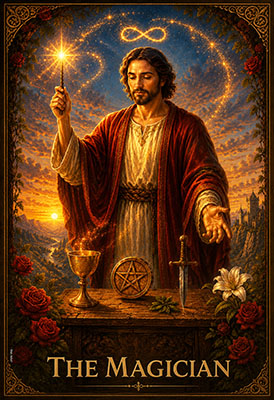
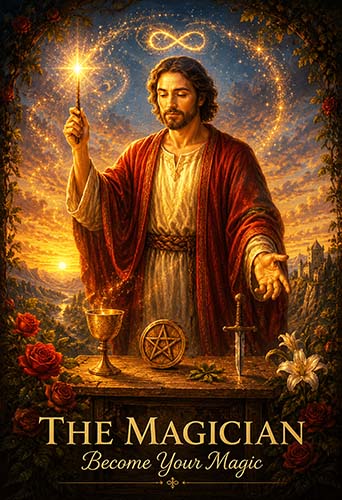
The Magician – 13 X 19 inch poster by Dan Adair – Available on Etsy

Protecting Young Beliefs

This is especially important when you’re just beginning your spiritual exploration.

New beliefs are like tender seedlings pushing through the soil. They aren’t yet strong enough to withstand harsh weather.

They need time.

They need experience.

Most of all, they need protection.

Sharing those fragile discoveries with someone who has already decided they’re nonsense is like inviting someone to stomp through your garden wearing heavy boots.

The damage isn’t necessarily that they change your mind.

The damage is that they plant seeds of doubt before your own understanding has had time to mature.

History Is Shorter Than You Think

It’s easy to assume that hostility toward unconventional spiritual practices belongs to the distant past.

We remember the witch trials and the Inquisition, when innocent people were imprisoned, tortured, or killed because they were suspected of practicing forbidden arts.

Yet fear of the occult has appeared much more recently.

During the Satanic Panic of the 1980s, innocent people were accused of bizarre crimes involving imagined occult rituals. The most famous example was the McMartin Preschool case in California, where extraordinary accusations dominated headlines despite the complete lack of supporting evidence. 

Witnesses testified that Virginia McMartin, who ran a day care center for preschoolers in Manhattan Beach was, “leading children into secret underground tunnels where they dressed up as witches and flew around in the air.  Other parents made similarly shocking allegations about McMartin Preschool, accusing the employees of cannibalism, blood-drinking and infant sacrifice.”

Only 40 years ago, right here in the United States, a county attorney indicted a woman for dressing up like a witch and flying around the air.

Let that sink in.

Why the Magician Keeps Silent

There is an interesting clue in the very word,  “occult.”

It simply means, “hidden.”

We usually think of hidden knowledge—teachings that are not widely known—but perhaps there is another lesson as well.

Some things are best kept private, even from people we thought we could trust.

There is quiet wisdom in that.

Not every insight needs to become a public discussion.

Not every ritual needs an audience.

Not every spiritual experience needs to be explained.

Sometimes the greatest magic grows best in silence.

The greatest secrets of Western Occultism were passed down from adept to student, always hidden from the prying eyes of the crowds, the priests, and the judges.  That’s how they survived through the many years of the Dark Ages.  Perhaps that’s how they’ll survive again.

That is one of The Magician’s deepest lessons—not simply learning how to work with unseen forces, but learning when to keep them unseen.
Available on Etsy as a downloadable PDF book.

Four Paths to Becoming the Hermit

An exploration of being alone in the world.

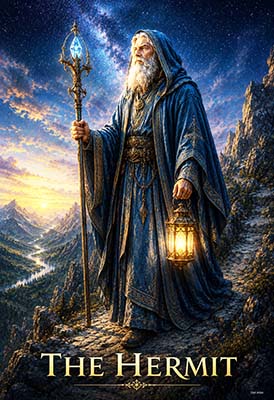
The Hermit – 13 X 19 inch poster by Dan Adair – Available on Etsy

Of all the figures in the Tarot, none stands more completely alone than The Hermit.

Unlike the Fool, the Magician, or the Emperor, the Hermit has intentionally stepped away from the crowd. He has withdrawn from unnecessary human contact, choosing solitude over society.

That seems almost contrary to human nature.

Aristotle observed that anyone who has no need of society must be either a god or a beast. Yet the Hermit is neither. He is simply a human being who has walked a very unusual road.

So how does someone become the Hermit?

1. The Wounded Hermit

For many people, the journey begins with pain.

They reached out sincerely. They loved, trusted, and tried to belong. Again and again they were hurt, rejected, or misunderstood.

Eventually they withdraw—not because they hate people, but because they need to protect what remains of their heart.

For some, this is the first step toward becoming the Hermit.

2. The Disappointed Hermit

Others are not driven away by wounds but by disillusionment.

They have done everything society promised would bring fulfillment. They built careers, earned money, fell in love, married, raised families, or achieved success.

Yet something still feels empty.

Status, romance, wealth, and recognition eventually turn to dust, leaving them quietly asking:

“Is this really all there is?”

3. The Called Hermit

Sometimes the first two experiences awaken something deeper.

After enough disappointment, a person begins to long for truth rather than comfort. They become convinced that life must contain something more profound than endless striving.

This is where the spiritual search begins.

The Hermit is no longer running away from the world.

He is walking toward wisdom.

4. The Natural Hermit

Some people simply possess the temperament for solitude.

Introverts often discover that being alone restores rather than depletes them. What began as an escape from pain gradually becomes a place of peace.

They don’t merely tolerate solitude.

They flourish there.

For these people, being alone feels less like isolation and more like coming home.

The Hermit’s True Gift

For some, the Hermit is only a season of life—a place of healing before they return to the world.

For others, it becomes a lifelong calling.

They gradually realize they never truly fit the expectations of the culture around them. Solitude begins as medicine but eventually becomes as necessary as breathing.

The Hermit archetype doesn’t create that feeling of being different.

It simply shines a lantern on a truth that has always been there.

Sometimes the greatest journey isn’t learning how to belong to the crowd.

Sometimes it’s discovering who you become when the crowd is no longer needed.

Available on Etsy as a downloadable PDF book.

Saturn, The Tower, and Why I Meditate on The Fool

Saturn Transits and The Tower Card – How to NOT get run over.

As an Aries, I was recently dismayed to discover that Saturn has entered…

Gulp… Aries.

If you know anything about astrology, you probably understand why that made me nervous.

Saturn doesn’t exactly have the reputation of being the life of the party.

Saturn’s Bad Reputation

Saturn is often associated with:

* limitations

* delays

* responsibility

* endings

* hard lessons

* tearing down what no longer works

In other words…

Saturn has a way of rearranging your life whether you asked for it or not.

Sound Familiar?

If you’re a Tarot reader, that description probably reminds you of another archetype.

The Tower.

The Tower burns down the building.

It strips away certainty.

It leaves you standing in the ashes wondering,

“What just happened?”

A difficult Saturn transit can feel remarkably similar.

Sometimes it seems as though a cosmic steamroller has flattened your best-laid plans.

But They’re Not Exactly the Same

This is where I think people sometimes misunderstand Saturn.

The Tower is total collapse.

When the Tower appears, something fundamental is breaking apart.

It’s dramatic.

It’s shocking.

It’s often terrifying.

Saturn, however, is usually much more selective.

Saturn doesn’t destroy everything.

It destroys what isn’t solid.

That distinction makes all the difference.

Think of Saturn as a Strict Parent

I’ve always thought of Saturn as having a fatherly quality.

Not cruel.

Just uncompromising.

Imagine a parent walking into your room and saying,

“You haven’t used half this stuff in years. It’s time to clean it out.”

That’s Saturn.

Old habits.

Old beliefs.

Old ambitions.

Old identities.

If they’ve stopped serving your life, Saturn starts carrying them to the curb.

It may not feel pleasant.

But it isn’t random destruction.

Every Ending Makes Space for a Beginning

One thing that’s easy to overlook is that Saturn often marks the beginning of an entirely new chapter.

Yes, something is ending.

But something else is quietly making room to begin.

That’s why so many people look back on difficult Saturn periods years later and say,

“I wouldn’t want to go through it again…

…but I wouldn’t trade what came afterward.”

Why I Meditate on The Fool

When I’m going through Saturn energy, I don’t usually meditate on The Tower.

I meditate on The Fool.

That may sound strange at first.

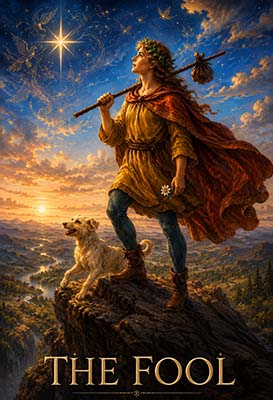
The Fool is the card of beginnings.

Fresh energy.

New possibilities.

A journey that hasn’t been written yet.

The Fool steps into a completely unknown future with little more than hope, trust, and curiosity.

In many ways, that’s exactly what Saturn is asking us to do.

The Real Lesson

Here’s the conclusion I’ve gradually come to.

Saturn isn’t really asking us to suffer.

It’s asking us to let go.

Those are not the same thing.

The suffering often comes from trying to hold on to something that’s already finished.

When we resist Saturn…

the process feels brutal.

When we cooperate with Saturn…

the same energy becomes a tool for rebuilding.

You Can’t Stop Saturn…

…but you can work with it.

You can’t negotiate with it.

You can’t outrun it.

But you can decide whether you’ll spend your energy clinging to yesterday…

…or building tomorrow.

That’s why, during difficult Saturn transits, I keep coming back to The Fool.

Not because the journey is easy.

But because every meaningful journey begins the same way.

With one uncertain step into a brand-new world.

Tarot and the Art of Alignment – Available on Amazon

Fairies, Devas and Angels, Oh My . . .

Why our belief in nature spirits has diminished at the time that we need it the most.

Do you believe in fairies?

Gnomes?

Water sprites?

Undines, sylphs, elves, salamanders?

In a nutshell, nature spirits?

If you don’t believe in them, you’re right there with the great majority.  The few studies that have been done suggest that only about 10% of Americans believe that nature spirits exist.  Most of that 10% is composed of children, women, and people who research paranormal phenomena.

IT’S NOT NORMAL

If you tell other people that you believe in fairies, you’re going to get some serious side-eye, at the very least.  If you INSIST that you believe in fairies, you’ll be tagged as weird, eccentric, or seriously delusional.

After all, it’s just not NORMAL, is it?

Ironically, as Tim Wyatt points out in this video from the Theosophical Society, it absolutely IS “normal” to believe in nature spirits.  Every culture in human history has had frequent contacts with them.  Until now.

Our lack of belief in them is actually an aberration.  We’re the ones who aren’t normal.

So what happened?  Why did we lose contact with them?  Wyatt has some interesting suggestions.

URBANIZATION

The onset of the Industrial Revolution witnessed a huge migration of humans out of the country and into cities.  For the first time in human history, more people now live in cities than in towns and villages.

And the thing is, nature spirits love . . . guess what? . . . nature.  They reside in streams, rivers, lakes, forests, and beaches.  They are not present where there is a decided lack of nature, such as we find in the concrete monstrosities of our modern cities.

To put it another way, we’ve lost contact with nature spirits because we’ve lost contact with nature.  In our lust for constant construction, high-rises, and endless suburbs, we’ve driven the nature spirits out and they no longer speak with many of us.

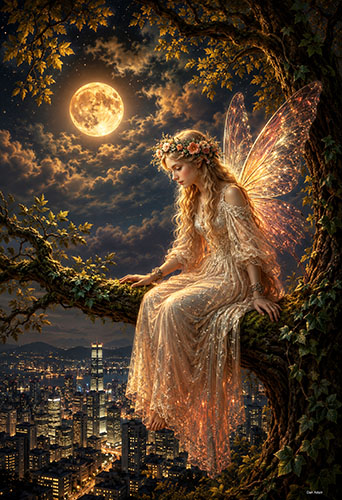
That’s what I was trying to portray with the image of the fairy looking down at the cityscape.  How sad it must be for them to witness us raping the lands where they once lived freely.

ORGANIZED RELIGION

The rise of Christian theology had a devastating effect on our relationship with nature and the spirits that inhabit it.  

It has traditionally taken a very binary approach to life and metaphysics.  On one side there’s good and on the other side there’s evil.  On one side there’s God and on the other side there’s Satan.

As Wyatt points out, angels were allowed into the Christian worldview, but only because they were messengers of God.  Nature spirits, on the other hand, were clearly pronounced to be servants of evil.  

Those who believed in nature spirits and communed with them were, in the Christian view, witches and sorcerers and were tortured and condemned to death.

Perhaps the clearest example of that approach was when the Catholic Church arrived in Ireland and cut down thousands of oak trees because the Druids worshiped in the sacred groves.  The church literally destroyed the very places where the nature spirits lived.

CYNICISM

What struck me most forcefully in Wyatt’s analysis was the effect that cynicism has had on our belief in nature spirits.

Cynicism is . . . fashionable.  We’ve only to scroll through the internet in order to find millions of people who don’t seem to believe in anything.  They mercilessly mock the belief systems of others and wear their pessimism like a badge of honor.

The news is fake.  Politicians are fake.  Liberals are fake.  Conservatives are fake.  Even viruses are fake.

What’s worse, we find many people who loudly proclaim their faith and simply ignore it in their day-to-day lives.  People who claim to believe in a Higher Power, yet spew hatred, vitriol, and distrust.

Which, of course, makes us . . . ahem . . . somewhat cynical about their faith.

In an age when people routinely dismiss what they see with their own eyes, why would we expect them to believe in something that they haven’t seen?  It’s far easier to dismiss nature spirits as superstitions of simple-minded people than to take them seriously, even if every other culture in human history has believed in them.

WHAT HAPPENS TO NATURE?

The Theosophists have a very interesting take on nature spirits, angels, and devas.  They don’t simply see them as amusing little creatures that frolic around the woods wearing pinecone crowns.

Rather, they view them as organizers of nature.  They are the underlying forces that make nature work.

For instance, we might think of a water sprite as living in a river.  From the Theosophist’s viewpoint, she’s actually making the river into what it is, overseeing the purity of the water and maintaining the lives of the various animals that live in it.

Orcas Island, off the coast of Washington, is said to have a magnificent deva or angel, who oversees all of the life of the island.  Lakes, rivers, streams, forests, mountains, all have nature spirits who nurture and sustain them.

Without the spirits, the earth begins to die and without the earth, we die.

MAKE LOVE, NOT WAR

As near as I can tell, the nature spirits don’t really give a flying fig whether we believe in them or not.  They’re not some Tinker Bell spirits who’ll curl up and die if we don’t clap for them.

In fact, they seem to avoid our company as much as possible, thank you very much.

What they DO want is for us to quit making war on them.

Stop cutting down those sacred groves of trees.  

Stop dumping tons of garbage into the oceans.

Stop paving over paradise and putting up parking lots.

Stop slaughtering millions of animals every year because it’s, “convenient,” for us.

I’m not asking anyone to share my beliefs.  But . . . you might go sit by a stream and think about it.  

Maybe ask the stream what it thinks.

The Happiness Compass: What If Joy Is Trying to Tell You Something?

Exploring the idea that happiness is a compass that points us in the right direction.

We’ve all heard the old saying from the 1960s:

“If it feels good, do it.”

Unfortunately, our culture often teaches the exact opposite.

Work a job you hate because it’s practical.

Stay in a relationship that’s gone stale because it’s your duty.

Ignore your dreams because they’re unrealistic.

Somewhere along the way, many of us begin wearing our unhappiness like a badge of honor, as though misery proves we’re responsible adults.

But what if we’ve misunderstood happiness?

What if it isn’t a luxury?

What if it’s a compass?

Happiness Isn’t Random

One of the central ideas in my book, Tarot and the Art of Alignment, is that happiness isn’t merely an emotion that comes and goes.

It’s directional.

It points.

When we’re moving toward the life we’re meant to live, something inside us quietly says:

“Yes…this is the way.”

Likewise, when we drift away from our authentic nature, life begins to feel heavy, flat, and strangely empty.

Our emotions aren’t simply fluctuations. They’re messages that point us in the right direction.

The Simplest Question

Perhaps the most radical question we can ask ourselves isn’t:

“How much money am I making?”

Or…

“What will other people think?”

It’s simply this:

Am I happy here?

If the honest answer is no, don’t treat it as a failure. Treat it as information.

Your inner compass is trying to get your attention.

Isn’t That Just Hedonism?

Whenever people talk about following happiness, someone inevitably objects:

“That sounds selfish.”

Or…

“Life isn’t supposed to be fun all the time.”

I agree. This isn’t about chasing pleasure.

There’s a profound difference between pleasure and fulfillment.

Pleasure asks:

“What feels good right now?”

Fulfillment asks:

“What kind of joy helps me become more fully myself?”

Real happiness isn’t the endless pursuit of dopamine. It’s the quiet satisfaction that comes from living in harmony with your deepest nature.

Happiness Is a Side Effect of Truth

One of the biggest misconceptions in our culture is that happiness comes from accumulating enough “stuff.”

More money.

A bigger house.

A nicer car.

More followers.

Those things may be enjoyable. But they’re not necessarily meaningful.

Real happiness comes from something much deeper.

It appears when we’re living with integrity.

When our actions reflect who we really are.

When we’re doing the work we came here to do—even if that work is difficult.

Happiness isn’t the goal.

It’s the glow that appears when we’re moving in the right direction.

Entering the Flow

Psychologists call it flow.

The Taoists simply speak of being in harmony with the Tao.

Athletes call it being in the zone.

Whatever name we give it, most of us have experienced those rare moments when intention and action become one.  When life seems to go perfectly.

Time disappears.

Energy rises.

Life feels strangely enchanted.

Synchronicities seem to increase.

Everything flows naturally.

To me, this is the Happiness Compass operating at full strength. The needle of the compass isn’t spinning in circles anymore – it’s pointing solidly in one direction.

Why We Lose Our Way

The tragedy is that most of us weren’t taught to trust this inner guidance.

We were taught to obey.

To fit in. To be practical. To put duty ahead of authenticity.

Eventually the compass is still there…

But it’s buried beneath expectations, obligations, financial worries, and the opinions of other people.

Eventually, we may not even remember what genuine happiness feels like, because we’ve forgotten who we truly are.

How the Tarot Can Help

This is one of the reasons I love working with the Tarot.

The cards don’t tell us who we’re supposed to become. They remind us who we already are. They gently reveal where we’ve ignored our intuition, overridden our happiness, or wandered away from our authentic path.

The cards are about helping us realign with ourselves and answer that basic question:  Am I happy? If the answer is no, they tell us why.

Perhaps happiness isn’t something we have to chase.  Perhaps it’s simply something that we need to remember.

⸻

Adapted from Chapter Six of my new book, Tarot and the Art of Alignment: Using the Cards to Remember Who You Are, which explores how the Tarot can become a practical compass for discovering your authentic path and living with greater joy, purpose, and synchronicity.


Now available – Tarot Meditation Kits

What If Your Destiny Isn’t to Become Rich?

Exploring the idea that we’re not just here to get rich.

Spend a few minutes browsing YouTube or social media and you’ll quickly discover that almost everyone seems to know your destiny.

Apparently, you’re supposed to become wealthy.

Manifest abundance.

Drive the right car.

Live in the right house.

Travel the world.

And, of course, achieve financial freedom.

There’s nothing inherently wrong with any of those goals. The question is whether they’re everyone’s destiny.

I’m not convinced they are.

The Feeling That Something Is Missing

Most of us have experienced a quiet feeling that we’re here for some larger purpose.

Even when life is going reasonably well, there can be a sense that something remains unfinished.

It’s as though we’re being gently called toward a life that is more authentic, more meaningful, and somehow more fully our own.

But what exactly is that calling? Some people say it’s destiny.

Two Ways of Looking at Destiny

Over the years, I’ve noticed that most spiritual teachings seem to fall into one of two broad models.

The first is what I call the Earth School Model.

According to this view, we reincarnate again and again in order to learn lessons, overcome limitations, and gradually evolve spiritually.

Life is a classroom.

Every challenge is part of the curriculum.

The second is what I call the Actualization Model.

Instead of asking, “What lessons am I here to learn?” it asks:

“Who am I here to become?”

This idea reminds me of psychologist Abraham Maslow’s famous hierarchy of needs.

At the very top of his pyramid wasn’t wealth.

It wasn’t fame.

It wasn’t status.

It was self-actualization—becoming the fullest expression of your authentic self.

I find that idea deeply compelling.

The Prosperity Trap

Somewhere during the twentieth century, something interesting happened.

The New Thought movement, with its emphasis on affirmations, visualization, and the creative power of the mind, gradually merged with American ideas about success and capitalism.

Before long, spiritual growth and financial success became almost interchangeable.

Manifestation came to mean one thing:

More money.

Now, don’t misunderstand me.

There’s absolutely nothing wrong with financial security.

Most of us would welcome a little more of it.

But if we believe that every soul reincarnated primarily to become rich, we end up with a rather curious picture of human existence. Can we really imagine that we’ve come back again and again because we should all be more like Elon Musk?

Imagine a shepherd whose deepest fulfillment comes from tending goats in the mountains.

Or a teacher whose greatest joy is helping children learn to read.

Or an artist who creates beauty that quietly changes people’s lives.

Would we really say that these people have somehow missed their destiny because they didn’t become millionaires?

I don’t think so.

Their success may have very little to do with the size of their bank account.

Listening for Your Own Call

One of the central ideas in my book, Tarot and the Art of Alignment, is that destiny isn’t something someone else can define for you.

It isn’t found in a bestselling seminar or a motivational slogan.

It arises from discovering your own authentic nature.

For one person, that path may indeed involve building a successful business.

For another, it may involve raising a family, creating art, caring for others, teaching, healing, or living a quiet life close to nature.

The Tarot doesn’t ask us to pursue someone else’s dream.

It asks us to discover our own.

Perhaps the real purpose of life isn’t to become rich.

Perhaps it’s to become ourselves.

And in the end, that may be the greatest success of all.

Now available – Tarot Meditation Kits

Tarot and the Two Kinds of Desire:  Filling the Hole and Expressing the Soul

Exploring the sources of true happiness.

One of the major themes in my new book, Tarot and the Art of Alignment, is how to use the Tarot to create greater happiness and satisfaction in our lives.

But that raises an important question:

What do we really mean by happiness?

Most of us assume that all desires are the same.

We want more money.

We want a better relationship.

We want a bigger house.

We want status, recognition, and success.

But what if there are actually two very different kinds of desire?

And what if one of them leads to lasting fulfillment while the other keeps us trapped in an endless cycle of wanting?

Are We Really Happy?

Studies about happiness are fascinating because they sometimes seem to completely contradict one another.

On the one hand, surveys consistently show that most Americans report being satisfied with their lives. According to a 2024 study conducted by the Centers for Disease Control, the overwhelming majority of Americans describe themselves as satisfied or very satisfied.

That’s kind of astounding, isn’t it?

If that were the whole story, we might expect to step outside and find people skipping down the street singing, “Zip-a-Dee-Doo-Dah” and celebrating the sheer joy of being alive.

Yet another study found that 61% of Americans experience loneliness on a regular basis, with a substantial number reporting that they feel isolated much of the time.

So which is it?

Are we happy?

Or are we lonely?

Are our desires being fulfilled?

The answer, I believe, lies in understanding that there are two very different kinds of desire operating within us.

Desire #1: Filling the Hole

Wharton School senior fellow Matthew Killingsworth conducted research suggesting that money does, in fact, increase happiness.

At first glance, that seems to confirm the modern assumption that more money equals a better life.

And to a certain extent, that’s true. But . . . buried in that study is the fact that it takes a LOT of money to be happy all of the time. Billionaires are very happy campers – the rest of us, not so much. The statistics show that you have to be making at least $175,500 per year to crack into that money = happiness paradigm.

Over half of the people in the United States make less than $75,000 a year. So, quite literally, money is NOT going to buy them happiness.

The problem is that most of us unconsciously continue to believe that it will.

We begin to believe that happiness is always just one purchase away.

Maybe a new car will make us happy.

Maybe a larger house will make us happy.

Maybe the latest phone, computer, or gadget will finally make us feel successful and secure.

Sometimes these things do make us happy—for a little while. Then the novelty wears off. The new car becomes the old car. The new computer crashes. The bigger house develops problems.

And before long we’re looking for the next thing that will finally make us feel complete.

At its core, this desire is driven by a feeling of lack.

It whispers:

“You don’t have enough.”

And because you don’t have enough:

“You aren’t enough.”

This kind of desire attempts to fill an inner emptiness with outer possessions.

The problem is that the hole never stays filled for very long.

Desire #2: Expressing the Soul

There is a second kind of desire that stands in stark contrast to the first.

Rather than trying to fill an inner void, it seeks to express something that already exists within us.

Carl Jung called it individuation.

Abraham Maslow called it self-actualization.

The Buddhists speak of dharma.

Most people simply call it purpose or destiny.

This desire isn’t asking: “What can I get?” It’s asking: “Who am I meant to become?”

At some level, most of us sense that we are here for a reason. We feel drawn toward certain experiences, certain talents, certain ways of contributing to the world.

For one person, that calling may involve art. For another, healing. For another, teaching, parenting, writing, building, serving, or leading.

The details differ, but the underlying experience is the same. Something inside us wants to become fully expressed.

The tragedy is that many of us lose touch with that calling.

From childhood onward, we’re taught to fit in, conform, and follow the established path. Schools, institutions, social expectations, and sometimes even our own families encourage us to become what is expected rather than what is authentic.

Over time, we begin to forget the dreams that we felt so vividly as children. We lose sight of the deeper reason we came here. And then we wonder why life feels empty.

We don’t have meaning in our lives and so life feels meaning-less.

Alignment = Happiness

This second desire contains the secret of lasting happiness.

The more closely we align with our authentic purpose, the more alive we feel. The farther we drift from it, the more restless, dissatisfied, and disconnected we become.

This doesn’t mean life suddenly becomes easy (although it frequently does.) It means life becomes meaningful.

And meaning has a remarkable ability to sustain us even through difficulty.

This is where Tarot enters the picture.

Rather than using the cards exclusively to predict future events, we can use them as a mirror that reflects our deeper purpose.

We can ask:

* What am I here to learn?

* What gifts am I meant to develop?

* Where am I out of alignment?

* What is trying to emerge through me?

In Tarot and the Art of Alignment, I introduce a process called the Soul Reading, designed to help uncover those answers.

Once we begin to understand who we are and why we’re here, the Tarot becomes more than a tool for prediction.

It becomes a tool for alignment.

And alignment, more than money, possessions, status, or recognition, is where lasting happiness is found.

Tarot and the Art of Alignment: A New Way to Read the Cards

For years I’ve been fascinated by a simple question: What if Tarot isn’t primarily about predicting the future? That question eventually grew into my new book, Tarot and the Art of Alignment.

For years, I’ve been fascinated by a simple question:

What if Tarot isn’t primarily about predicting the future?

What if the cards are actually showing us where we’re aligned—or misaligned—with our deeper path?

That question eventually grew into my new book, Tarot and the Art of Alignment.

Of course, behind that question lies another one that human beings have been asking for thousands of years:

Why am I here?

We phrase it in many different ways:

* What is my purpose in life?

* Do I have some sort of destiny?

* Why did I incarnate in this place and time?

* Or, on particularly difficult days: What in the HELL is all of this about?

Philosophers, psychologists, and spiritual teachers have all recognized that human beings have a deep need for meaning in their lives. It isn’t enough to simply wake up, go to work, buy things, pursue pleasure, and repeat the process until our inevitable deaths.

We long for something more.

We need a sense of purpose. We need to feel that our lives matter, that our struggles and triumphs are part of a larger story. Without that sense of meaning, life can begin to feel exactly what the word suggests: meaningless.

Over time, it began to dawn on me that the answer to those questions might be found in the Tarot.

Most of us use the cards to ask questions about the future:

* What is my week going to be like?

* Should I take this job?

* Is this relationship headed somewhere meaningful?

* Am I making the right decision?

When we stop and think about it, that’s actually a remarkable process.

Whenever we lay out the cards, we operate from the assumption that we’re tapping into a source of wisdom greater than our ordinary awareness. Whether we call that source Spirit, the Universe, God/dess, Higher Self, Angels, Guides, or simply the deeper unconscious mind, we trust that the cards can reveal information we don’t consciously possess.

And if that greater source can offer guidance about a career decision, a relationship, or whether we’re headed in the right direction, then surely it can help us answer the most important question of all:

Why am I here?

That realization led me to begin experimenting with a different way of reading the cards.

Instead of asking the Tarot to predict what might happen next, I began asking it to reveal who I am, why I’m here, and whether my life is aligned with my deeper purpose.

I also began using the cards as an ongoing check-in system—a way of determining whether I was moving toward greater alignment or drifting away from it.

This book is the result.

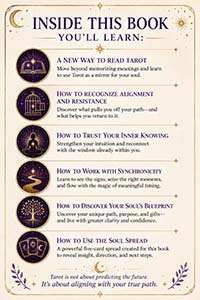
Rather than teaching hundreds of card meanings to memorize, the book explores a different approach. It shows how Tarot can become a mirror that helps us recognize alignment, resistance, intuition, synchronicity, and purpose.

At its heart, Tarot and the Art of Alignment is about learning to see the cards as a conversation with the deeper self.

The Tarot has always been rich with symbols, archetypes, and spiritual lessons. Yet many readers become trapped in the endless task of memorizing meanings and predicting outcomes. This book shifts the focus from fortune-telling to self-discovery. The question is no longer, “What will happen to me?” but rather, “Who am I becoming?”

Through the practices and spreads presented in the book, you’ll learn how to identify the beliefs that keep you stuck, reconnect with your intuition, recognize meaningful patterns and synchronicities, and uncover the deeper purpose that has been quietly calling to you all along.

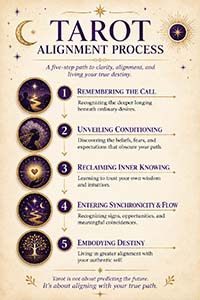
At the heart of the book is a model I call The Tarot Alignment Process.

The first step is Remembering the Call. This is the moment when we become conscious of our deep hunger for meaning and purpose. We stop drifting through life and begin to recognize that something within us is calling for a more authentic way of living.

The second step is Unveiling Conditioning. Here we examine the beliefs, fears, expectations, and assumptions that have caused us to forget who we really are. We explore the ways that family, culture, education, and society have shaped our identity—and often obscured our deeper truth.

The third step is Reclaiming Inner Knowing. Through Tarot and self-reflection, we begin to trust our own wisdom again. We learn to listen to the quiet voice within that knows why we came into this life and what we are here to contribute.

The fourth step is Entering Synchronicity and Flow. We discover how our emotions, life circumstances, and meaningful coincidences can serve as guides, helping us recognize when we are moving in harmony with our deeper purpose.

And finally, the fifth step is Embodying Destiny. Rather than seeking occasional moments of inspiration, we learn how to stay aligned over time, using the Tarot as an ongoing tool for guidance, self-correction, and growth.

Looking back, I realize that I’ve spent years exploring these themes through Tarot readings, blog posts, synchronicity, personal experience, and spiritual study. This book is my attempt to gather all of those threads together into a single framework.

Over the next several weeks, I’ll be exploring many of these ideas here on the blog, including alignment and resistance, synchronicity, the Soul Spread, and why difficult Tarot readings may not be bad news at all.

If those topics interest you, I hope you’ll join me for the journey.

Tarot and the Art of Alignment

The book is now available as an Amazon Kindle edition:

Tarot and the Art of Alignment – Kindle Edition

Or as a downloadable PDF edition:

Tarot and the Art of Alignment – Downloadable PDF Edition

Remember:

Tarot is not about predicting the future.

It’s about aligning with your true path.

The Tower Is About the Basement, Not the Top Floor

The freedom hidden in The Tower card – starting all over.

When we glance at The Tower card, our eyes naturally go to the most dramatic part of the image.

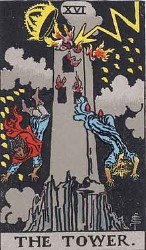
A mighty tower has been struck by lightning. Flames erupt from the windows. The occupants, hurled into the air by the force of the blast, are plunging toward a very unpleasant landing.

Yikes.

It’s one of the most feared cards in the Tarot. Whether it appears upright or reversed, The Tower usually signals upheaval, disruption, loss, or sudden change.

But here’s the thing:

The Tower isn’t really about the top of the tower.

It’s about the basement.

The Importance of Foundations

Like a Saturn return in astrology, The Tower destroys whatever is built on a weak foundation.

Notice that the lightning strike isn’t the whole story. Lightning hits buildings all the time. What turns a lightning strike into a catastrophe is the condition of the structure itself.

The real lesson of The Tower is that most of us build our lives on foundations we rarely examine.

Our assumptions.

Our beliefs.

Our fears.

Our relationships.

Our careers.

Our identities.

We construct elaborate towers on top of these foundations and then spend years assuming they’ll stand forever.

Until they don’t.

Eliphas Levi and the Wrong Turn

Part of the reason The Tower has such a grim reputation comes from an interpretation popularized by the nineteenth-century occultist Eliphas Levi.

Levi identified the card with the Tower of Babel from the Bible.

The problem is that the story doesn’t really fit.

The Tower of Babel wasn’t destroyed by lightning. According to the story, God punished its builders by confusing their languages so they could no longer communicate.

The deeper message of Babel is that humanity was punished for its pride. The builders reached too high, became too ambitious, and were struck down for their arrogance.

Once this idea attached itself to The Tower card, the interpretation began drifting toward a very Christian notion of guilt and punishment.

Something bad happened.

Therefore you must have done something wrong.

God, Karma, Fate, or the Universe is simply giving you what you deserve.

It’s a comforting theory because it suggests that bad things only happen for a reason.

Unfortunately, life doesn’t always work that way.

Just The Tarot, by Dan Adair – Available on Amazon

The “Shit Happens” Principle

One of the hardest truths to accept is that sometimes terrible things happen for no obvious reason.

A good person gets sick.

A devoted spouse is abandoned.

A careful driver gets hit by a drunk driver.

Someone loses their job, their savings, and their sense of security all within a few months.

When these things happen, we immediately begin searching for explanations.

What did they do wrong?

What lesson are they supposed to learn?

What hidden flaw attracted the disaster?

Sometimes there may be a lesson.

Sometimes there isn’t.

Sometimes shit just happens.

That’s not a very comforting answer, but it’s often a truthful one.

The Pendulum

The Kybalion offers a useful way of looking at this.

According to the Principle of Rhythm, life moves like a pendulum.

Good times are followed by difficult times.

Difficult times are followed by good times.

The pendulum swings one way and then the other.

There is nothing personal about it.

The tides come in and go out.

The moon waxes and wanes.

Seasons change.

Life moves in cycles.

The Tower often appears when we’ve forgotten that truth and begun acting as though our present circumstances are permanent.

The Gift Hidden Inside The Tower

As painful as The Tower can be, it contains an unexpected gift.

It reveals what isn’t working.

A loveless marriage ends.

A dead-end career collapses.

An identity built on appearances falls apart.

A belief system that no longer serves us is shattered.

At the time, these experiences can feel catastrophic.

Years later, many people look back and realize that The Tower didn’t destroy their lives.

It destroyed the illusion that their lives were built on solid ground.

And once the illusion is gone, something remarkable becomes possible.

Rebuilding.

That is the hidden blessing of The Tower.

Very few people willingly tear down their lives and start over.

The Tower does it for us.

Not because we are being punished.

Not because God is angry.

Not because the Universe is keeping score.

But because whatever was false can no longer support the weight placed upon it.

The Tower clears the ground.

What we build next is up to us.

As Kris Kristofferson famously wrote:

“Freedom’s just another word for nothing left to lose.”

Strange as it may sound, that’s the freedom The Tower offers.

Not the freedom to avoid change.

The freedom to begin again.

THE DEVIL CARD AND FREEDOM

Exploring the element of choice with The Devil card.

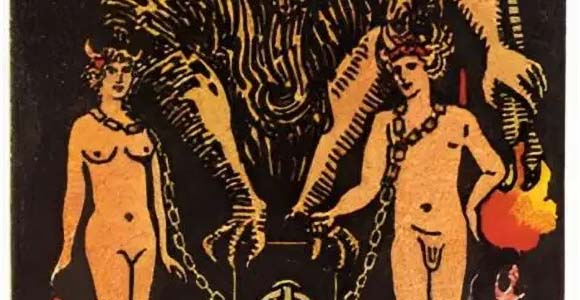
It’s always a little scary to get The Devil card in a Tarot reading.  Based on the famous illustration of Eliphas Levi’s Baphomet, we see a large, horny critter with bat wings looming over a hapless couple in chains.  Not only do they look miserable, but their tails are actually on fire.  

Which has always seemed like a bit of an overreaction to me.  It’s bad enough to take away their clothes and chain them to a black altar.  Lighting their tails on fire is just plain mean.

When we get this card in a reading, we can assume that (a) we are personally in a really bad, low-vibration place or (b) we’re involved with someone else who’s in that sort of a space.  

There’s also a school of thought that The Devil card can indicate black magic.  Perhaps we pissed off someone and they whomped a hoodoo on us.  Maybe that person we broke it off with romantically is spending their Saturday nights burning black candles and sticking pins into a picture of us.

And that can be true.  I don’t want to downplay that possibility, but it tends to miss one of the most important messages of this card, which is CHOICE.  

When we get involved in or stay in a really dark place, it’s the matter of whether we choose to be there that determines whether it’s evil.

THE CHAINS AROUND OUR NECKS

There are so many things that we think of as being, “evil,” that can feel like chains around our necks.  

Drug addiction.

Alcoholism.

Abusive relationships.

Codependency.

All of those can feel as if we’re literally enslaved.  We may know in our hearts that we’re in a really bad space and feel constant misery over it.  But, without help, we may be powerless to escape from the bottle, the needle in the arm, the slap across the face.

Sadly, there are many people who casually assume that people in those situations just don’t want to be free of them.  We saw that in the so-called, “war on drugs,” where the advice was, “just say no to drugs.”  

The reality of being an addict, of course, is that you CAN’T say no to drugs.  That’s why we call them addicts, right?

We also see it in the judgment that people ladle out to women who are enmeshed in abusive relationships.  “Why don’t you just leave him” we ask.  “What’s wrong with you?”

What’s wrong with them is that they don’t know HOW to leave an abusive relationship.

And codependents may lose their entire lives “saving,” other people because they haven’t got a clue about how to set up healthy boundaries.

So, in all of these situations, there’s one element in common:  a lack of choice.  And you can’t make a choice to be evil if you can’t make a choice at all.

HOW LOOSE ARE THE CHAINS?

When we zoom in a little closer on The Devil card, we make an astonishing discovery:

Their hands are free and the chains around the couple’s necks are so loose that they could easily be lifted right over their heads.  

In other words, their apparent slavery is entirely a matter of choice.  They could, at any moment, remove the chains and walk away, but they CHOOSE not to do it.

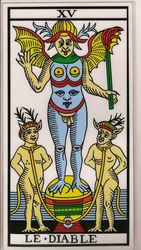
This was actually a major change in the way that this card was designed.  In the older, Marseille deck we see the same couple, but their hands are bound tightly behind them and the ropes around their necks can’t be moved.  

A.E. Waite and Pamela Coleman Smith deliberately decided to incorporate the element of choice in portraying evil when they designed this card.  

Why did they take this radical step?

MENTAL ILLNESS AND EVIL

The Waite-Smith Tarot deck was released in 1909, which was the tail end of the Victorian Era in England.  This period saw massive changes in the way humans lived, mainly brought on by the Industrial Revolution and mass manufacturing.  

One of the areas that saw the greatest changes was the legal system and the ways in which we think about crime.  In particular, what emerged was the concept that a person couldn’t commit a crime if they were insane.  

In a nutshell, if a person was so deranged that they didn’t know what they were doing was wrong, or if they had an irresistible impulse that made it impossible for them to NOT act in a particular way, then they weren’t making a CHOICE to commit a crime and couldn’t be found guilty of it.

For us, that notion is completely commonplace.  Not guilty by reason of insanity is a phrase that we hear all the time.  But that idea of choice determining evil wasn’t in play until about 150 years ago and I’m guessing that’s why we saw the change in The Devil card.  

WHY IT’S IMPORTANT

Now, you may be wondering what all of this has to do with doing an actual Tarot reading and that’s a fair question.

There’s a subtle nuance here that’s important to recognize and that has to do with freedom.  The people portrayed in The Devil card are free to walk away from what they’re doing.

Which really feels counter-intuitive.  When we look at the card, we see that they’re chained and completely dominated by the Devil critter.  At first glance, it seems that they’re not free at all.

But they are.  They’re not insane.  They’re not compelled to be there.  They choose to be there.

And so, when we pull this card in a reading, we can emphasize that.  We can actually look at this card and tell a client, “Yeah, you’re in a bad space, but you can change all of that.  You don’t have to go on being miserable.  You can walk away from it and be free.”

And that’s HUGE.  That gives the client agency in a situation where they may feel totally trapped.  It tells them that their freedom is in their own hands, if they decide to take it.

ALTERNATIVES

Now, again, I want to emphasize that this isn’t the only interpretation of The Devil card.  If, for instance, we saw the Devil paired with The Moon, then we might actually be looking at issues like insanity or serious delusions.

If we saw The Devil paired with The Magician reversed, we might infer that there really IS some black magic going on.  Always look at the surrounding cards.

By far and away, though, The Devil is a card of choice, of choosing to live in negativity and low vibrations.  That’s not good news, of course – no one wants to exist like that.  But freedom grows out of choices and that IS good news.

“Just the Tarot,” by Dan Adair.  Available on Amazon.