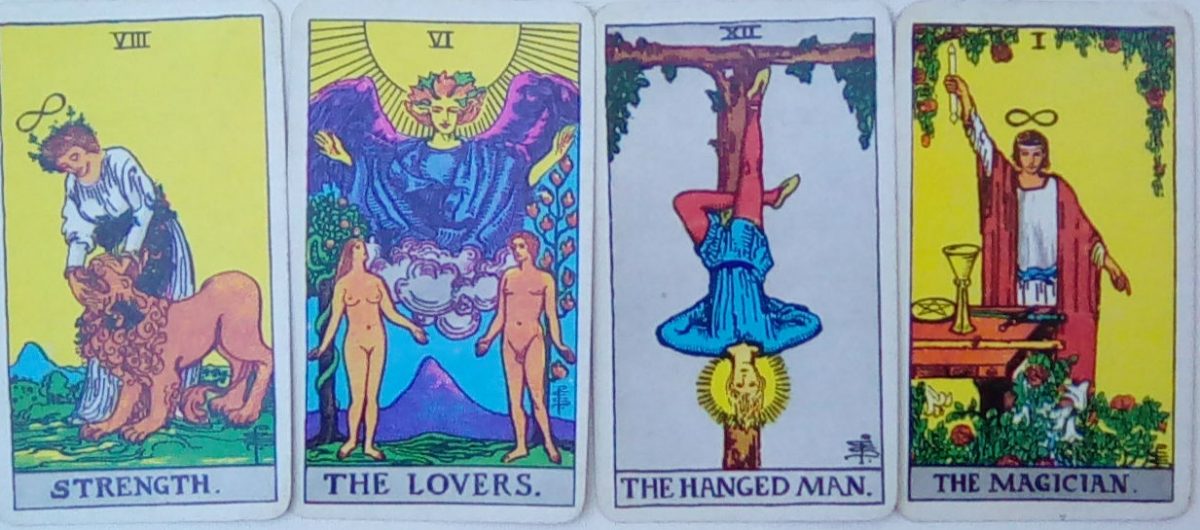
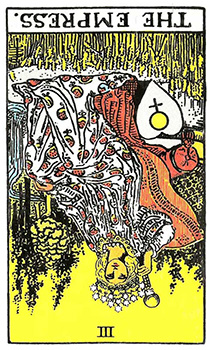
You turn over a Tarot card and there it is:
The Empress—upside down.
Now what?
If you’re new to Tarot, reversed cards can make an already complicated subject seem twice as difficult. You finally begin learning the meanings of 78 cards, only to discover that some books provide an entirely separate meaning for every card when it appears reversed.
Suddenly it seems as though you’re expected to memorize 156 Tarot cards. Fortunately, you aren’t.
The real question isn’t whether you should read a reversed card. Obviously, the card is still part of the reading. The question is whether you should interpret that card differently because it appeared upside down.
Some Tarot readers do. Others simply turn the card upright and interpret it normally, allowing the question, its position in the spread and the surrounding cards to determine which aspects of the card apply. Neither approach is inherently right or wrong.
So let’s look at what reversals can add to a reading—and whether you actually need them.
WHAT IS A REVERSED TAROT CARD?
A reversed card is simply a Tarot card that appears upside down in a reading.
Some readers deliberately shuffle their decks so that cards can appear in either direction and consider the reversed orientation part of the message. Other readers don’t assign any special significance to orientation. If a card appears upside down, they simply turn it upright and read the card normally.
This doesn’t mean they’re ignoring the reversed card or rejecting its more difficult meanings. Quite the opposite. They consider those meanings to be already contained within the card.
For example, The Emperor can represent healthy structure, leadership and stability. But Emperor energy can also become rigid, authoritarian and controlling. A reader who uses reversals might associate some of those more difficult qualities with The Emperor reversed.
A reader who doesn’t use reversals may see exactly the same qualities in an upright Emperor, depending upon the question and the card’s position in the spread. The difference isn’t necessarily in what the card can mean. It’s in how the reader determines which meaning applies.
WHAT DOES A REVERSED CARD MEAN?
Here’s where things become interesting.
There is no single rule.
A reversed card might suggest that the upright energy is:
* Blocked or frustrated
* Weakened
* Excessive or out of balance
* Turned inward
* Delayed or incomplete
* Being resisted
* Expressing its more difficult or shadow qualities
Occasionally, the reversed card may even suggest something close to the opposite of its usual meaning.
That’s much more sophisticated than simply saying: Upright = good. Reversed = bad. In fact, some reversed cards can be quite encouraging.
The Devil reversed might suggest breaking free from an unhealthy attachment. The Eight of Swords reversed might indicate recognizing that you aren’t nearly as trapped as you believed.
Meanwhile, an apparently wonderful card such as The Sun reversed could suggest that happiness is available but something is preventing you from fully experiencing it.
Reversals aren’t necessarily negative. They can simply show us that something unusual is happening to the card’s energy.
REVERSALS AS BLOCKED ENERGY
One of the easiest ways to begin working with reversals is to think of them as blocked energy.
Every Tarot card represents a particular kind of energy or experience.
The Magician wants to create.
The Empress wants to nurture.
The Chariot wants to move forward.
The Star wants to shine.
When one of those cards appears reversed, we can ask: What is preventing this energy from expressing itself naturally?
The reversed Magician might suggest unused ability or uncertainty about your own power.
The reversed Empress might indicate difficulty nurturing yourself—or nurturing everyone else until you’ve exhausted yourself.
The reversed Chariot might represent plenty of effort but no clear direction.
The reversed Star might indicate that your light is still there, but you’ve temporarily lost confidence in it.
The original meaning of the card hasn’t disappeared. Something has happened to it.
SOMETIMES THERE’S TOO MUCH OF A GOOD THING
A reversal can also suggest excess. Sometimes the problem isn’t too little of the card’s energy. It’s too much.
The Emperor’s structure can become rigid control.
The Hermit’s solitude can become isolation.
The Four of Pentacles’ stability can become possessiveness.
The Knight of Swords’ determination can become reckless action.
In this approach, the reversed card acts almost like a warning light: This energy has moved out of balance. That’s particularly useful in psychological or self-development readings because a reversal can reveal where an otherwise healthy quality has become exaggerated.
REVERSALS CAN TURN THE ENERGY INWARD
There’s another way of interpreting reversals that I particularly like.
Sometimes an upright card can represent energy being expressed in the external world, while the reversed card suggests that the same process is taking place internally.
The Queen of Cups upright might describe compassion and emotional sensitivity directed toward other people. Reversed, she might ask you to direct some of that compassion toward yourself.
The Magician upright might indicate using your abilities to create something in the world. Reversed, he might suggest discovering abilities within yourself that haven’t yet found outward expression.
This interpretation won’t work for every card or every reading. But that’s the point. Reversals aren’t formulas. They’re additional information.
DO REVERSED CARDS MEAN THE OPPOSITE?
Sometimes—but I wouldn’t make that the automatic assumption.
Consider The Hermit. Upright, The Hermit can represent solitude, contemplation and turning inward in search of wisdom.
If we simply reverse that meaning, does The Hermit reversed mean being sociable and going to a party? Probably not. It might indicate too much isolation.
Or perhaps the person desperately needs solitude but isn’t getting it.
Maybe they’ve found something during their period of introspection that now needs to be brought back into the world.
Instead of asking:
What’s the opposite of The Hermit?
Try asking: What has happened to the energy of The Hermit?
That opens considerably more interesting possibilities.
WHY SOME READERS DON’T USE REVERSALS
There’s a very good argument for not assigning reversed cards separate meanings: The Tarot already contains an enormous range of human experience.
We certainly don’t have a shortage of difficult cards.
The Tower, Devil, Three of Swords, Five of Pentacles and Ten of Swords are perfectly capable of telling us when something has gone wrong.
More importantly, every Tarot card already contains both light and shadow.
The Emperor can represent healthy structure or oppressive control.
The Hermit can represent valuable solitude or unhealthy isolation.
The Moon can represent intuition or confusion.
The Four of Pentacles can represent financial stability or fearfully clinging to what you possess.
You don’t necessarily need to turn a card upside down to access those meanings. The question being asked, the position of the card within the spread and the cards surrounding it can provide the context.
That’s why a reader who doesn’t use reversals isn’t reading only the “positive half” of Tarot. They’re reading the entire spectrum of meaning contained within each upright card.
BUT REVERSALS HAVE ONE BIG ADVANTAGE
They get your attention.
Suppose The Emperor appears in a position labeled: What’s preventing me from moving forward?
Even upright, that position tells us that some aspect of Emperor energy may be causing difficulty. Perhaps there’s too much structure, too much control or an unwillingness to deviate from the plan.
But if The Emperor appears reversed, we receive an additional visual signal: Something about this energy isn’t functioning normally.
A reversed card interrupts the visual flow of a spread. It makes us stop and look again. It’s almost as though Tarot has underlined the card.
And that can be extremely useful.
WHAT IF HALF THE READING IS REVERSED?
This is where reversals can become more interesting than individual card meanings.
If one card is reversed, look closely at that card. If most of the spread is reversed, look at the pattern.
Perhaps the situation is stalled. Perhaps there’s tremendous internal activity but very little outward movement. Perhaps someone is resisting change. Perhaps energy is being blocked in several different areas.
Or perhaps you accidentally turned half the deck upside down while shuffling.
Never underestimate the mystical power of bad shuffling.
SHOULD BEGINNERS USE REVERSALS?
I’d suggest learning the basic meanings of the cards first.
Not because reversals are especially difficult, but because understanding the fundamental energy of a card makes its reversal much easier to interpret.
If you understand The Chariot as directed movement, determination and willpower, you don’t need to memorize an entirely separate paragraph for The Chariot reversed.
You can simply ask: What happens when Chariot energy isn’t working properly?
Maybe there’s no direction.
Maybe determination has become obsession.
Maybe you’re trying to control something that can’t be controlled.
Maybe you’re pushing ahead when you should stop.
Now you aren’t memorizing another Tarot definition. You’re thinking about the card. And that’s ultimately a much better way to learn Tarot.
SO—SHOULD YOU INTERPRET REVERSED CARDS DIFFERENTLY?
You don’t have to.
If a reversed card appears, you can turn it upright and interpret the full range of meanings contained within that card. The question, spread position and surrounding cards can tell you whether its constructive or difficult qualities are being expressed.
Or you can leave it reversed and treat its orientation as one more piece of information in the reading.
Neither method gives you a more “authentic” Tarot reading. They’re simply different systems.
If you do choose to use reversals, however, I think there’s a much more useful question than: “What does this card mean upside down?”
Ask instead: “What has happened to the energy of this card?”
Is it blocked? Weakened? Exaggerated? Turned inward? Delayed? Being resisted?
Once you begin thinking about reversals that way, you don’t have another 78 definitions to memorize.
You simply have another way of looking at the 78 cards you already know.


