Do you believe in fairies?
Gnomes?
Water sprites?
Undines, sylphs, elves, salamanders?
In a nutshell, nature spirits?
If you don’t believe in them, you’re right there with the great majority. The few studies that have been done suggest that only about 10% of Americans believe that nature spirits exist. Most of that 10% is composed of children, women, and people who research paranormal phenomena.
IT’S NOT NORMAL
If you tell other people that you believe in fairies, you’re going to get some serious side-eye, at the very least. If you INSIST that you believe in fairies, you’ll be tagged as weird, eccentric, or seriously delusional.
After all, it’s just not NORMAL, is it?
Ironically, as Tim Wyatt points out in this video from the Theosophical Society, it absolutely IS “normal” to believe in nature spirits. Every culture in human history has had frequent contacts with them. Until now.
Our lack of belief in them is actually an aberration. We’re the ones who aren’t normal.
So what happened? Why did we lose contact with them? Wyatt has some interesting suggestions.
URBANIZATION
The onset of the Industrial Revolution witnessed a huge migration of humans out of the country and into cities. For the first time in human history, more people now live in cities than in towns and villages.
And the thing is, nature spirits love . . . guess what? . . . nature. They reside in streams, rivers, lakes, forests, and beaches. They are not present where there is a decided lack of nature, such as we find in the concrete monstrosities of our modern cities.
To put it another way, we’ve lost contact with nature spirits because we’ve lost contact with nature. In our lust for constant construction, high-rises, and endless suburbs, we’ve driven the nature spirits out and they no longer speak with many of us.
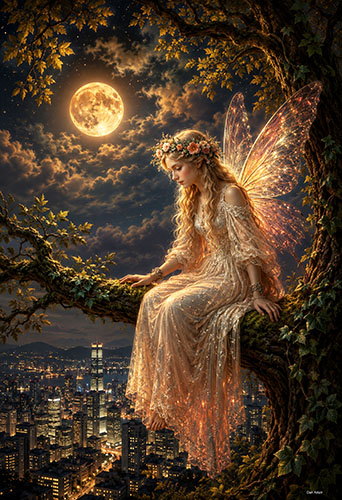
That’s what I was trying to portray with the image of the fairy looking down at the cityscape. How sad it must be for them to witness us raping the lands where they once lived freely.
ORGANIZED RELIGION
The rise of Christian theology had a devastating effect on our relationship with nature and the spirits that inhabit it.
It has traditionally taken a very binary approach to life and metaphysics. On one side there’s good and on the other side there’s evil. On one side there’s God and on the other side there’s Satan.
As Wyatt points out, angels were allowed into the Christian worldview, but only because they were messengers of God. Nature spirits, on the other hand, were clearly pronounced to be servants of evil.
Those who believed in nature spirits and communed with them were, in the Christian view, witches and sorcerers and were tortured and condemned to death.
Perhaps the clearest example of that approach was when the Catholic Church arrived in Ireland and cut down thousands of oak trees because the Druids worshiped in the sacred groves. The church literally destroyed the very places where the nature spirits lived.
CYNICISM
What struck me most forcefully in Wyatt’s analysis was the effect that cynicism has had on our belief in nature spirits.
Cynicism is . . . fashionable. We’ve only to scroll through the internet in order to find millions of people who don’t seem to believe in anything. They mercilessly mock the belief systems of others and wear their pessimism like a badge of honor.
The news is fake. Politicians are fake. Liberals are fake. Conservatives are fake. Even viruses are fake.
What’s worse, we find many people who loudly proclaim their faith and simply ignore it in their day-to-day lives. People who claim to believe in a Higher Power, yet spew hatred, vitriol, and distrust.
Which, of course, makes us . . . ahem . . . somewhat cynical about their faith.
In an age when people routinely dismiss what they see with their own eyes, why would we expect them to believe in something that they haven’t seen? It’s far easier to dismiss nature spirits as superstitions of simple-minded people than to take them seriously, even if every other culture in human history has believed in them.
WHAT HAPPENS TO NATURE?
The Theosophists have a very interesting take on nature spirits, angels, and devas. They don’t simply see them as amusing little creatures that frolic around the woods wearing pinecone crowns.
Rather, they view them as organizers of nature. They are the underlying forces that make nature work.
For instance, we might think of a water sprite as living in a river. From the Theosophist’s viewpoint, she’s actually making the river into what it is, overseeing the purity of the water and maintaining the lives of the various animals that live in it.
Orcas Island, off the coast of Washington, is said to have a magnificent deva or angel, who oversees all of the life of the island. Lakes, rivers, streams, forests, mountains, all have nature spirits who nurture and sustain them.
Without the spirits, the earth begins to die and without the earth, we die.
MAKE LOVE, NOT WAR
As near as I can tell, the nature spirits don’t really give a flying fig whether we believe in them or not. They’re not some Tinker Bell spirits who’ll curl up and die if we don’t clap for them.
In fact, they seem to avoid our company as much as possible, thank you very much.
What they DO want is for us to quit making war on them.
Stop cutting down those sacred groves of trees.
Stop dumping tons of garbage into the oceans.
Stop paving over paradise and putting up parking lots.
Stop slaughtering millions of animals every year because it’s, “convenient,” for us.
I’m not asking anyone to share my beliefs. But . . . you might go sit by a stream and think about it.
Maybe ask the stream what it thinks.

