
It’s always a little scary to get The Devil card in a Tarot reading. Based on the famous illustration of Eliphas Levi’s Baphomet, we see a large, horny critter with bat wings looming over a hapless couple in chains. Not only do they look miserable, but their tails are actually on fire.
Which has always seemed like a bit of an overreaction to me. It’s bad enough to take away their clothes and chain them to a black altar. Lighting their tails on fire is just plain mean.
When we get this card in a reading, we can assume that (a) we are personally in a really bad, low-vibration place or (b) we’re involved with someone else who’s in that sort of a space.
There’s also a school of thought that The Devil card can indicate black magic. Perhaps we pissed off someone and they whomped a hoodoo on us. Maybe that person we broke it off with romantically is spending their Saturday nights burning black candles and sticking pins into a picture of us.
And that can be true. I don’t want to downplay that possibility, but it tends to miss one of the most important messages of this card, which is CHOICE.
When we get involved in or stay in a really dark place, it’s the matter of whether we choose to be there that determines whether it’s evil.
THE CHAINS AROUND OUR NECKS
There are so many things that we think of as being, “evil,” that can feel like chains around our necks.
Drug addiction.
Alcoholism.
Abusive relationships.
Codependency.
All of those can feel as if we’re literally enslaved. We may know in our hearts that we’re in a really bad space and feel constant misery over it. But, without help, we may be powerless to escape from the bottle, the needle in the arm, the slap across the face.
Sadly, there are many people who casually assume that people in those situations just don’t want to be free of them. We saw that in the so-called, “war on drugs,” where the advice was, “just say no to drugs.”
The reality of being an addict, of course, is that you CAN’T say no to drugs. That’s why we call them addicts, right?
We also see it in the judgment that people ladle out to women who are enmeshed in abusive relationships. “Why don’t you just leave him” we ask. “What’s wrong with you?”
What’s wrong with them is that they don’t know HOW to leave an abusive relationship.
And codependents may lose their entire lives “saving,” other people because they haven’t got a clue about how to set up healthy boundaries.
So, in all of these situations, there’s one element in common: a lack of choice. And you can’t make a choice to be evil if you can’t make a choice at all.
HOW LOOSE ARE THE CHAINS?
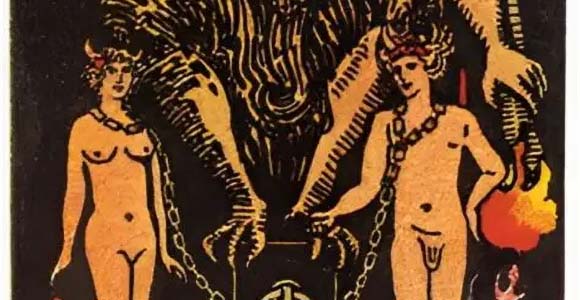
When we zoom in a little closer on The Devil card, we make an astonishing discovery:
Their hands are free and the chains around the couple’s necks are so loose that they could easily be lifted right over their heads.
In other words, their apparent slavery is entirely a matter of choice. They could, at any moment, remove the chains and walk away, but they CHOOSE not to do it.
This was actually a major change in the way that this card was designed. In the older, Marseille deck we see the same couple, but their hands are bound tightly behind them and the ropes around their necks can’t be moved.
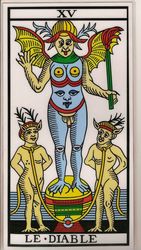
A.E. Waite and Pamela Coleman Smith deliberately decided to incorporate the element of choice in portraying evil when they designed this card.
Why did they take this radical step?
MENTAL ILLNESS AND EVIL
The Waite-Smith Tarot deck was released in 1909, which was the tail end of the Victorian Era in England. This period saw massive changes in the way humans lived, mainly brought on by the Industrial Revolution and mass manufacturing.
One of the areas that saw the greatest changes was the legal system and the ways in which we think about crime. In particular, what emerged was the concept that a person couldn’t commit a crime if they were insane.
In a nutshell, if a person was so deranged that they didn’t know what they were doing was wrong, or if they had an irresistible impulse that made it impossible for them to NOT act in a particular way, then they weren’t making a CHOICE to commit a crime and couldn’t be found guilty of it.
For us, that notion is completely commonplace. Not guilty by reason of insanity is a phrase that we hear all the time. But that idea of choice determining evil wasn’t in play until about 150 years ago and I’m guessing that’s why we saw the change in The Devil card.
WHY IT’S IMPORTANT
Now, you may be wondering what all of this has to do with doing an actual Tarot reading and that’s a fair question.
There’s a subtle nuance here that’s important to recognize and that has to do with freedom. The people portrayed in The Devil card are free to walk away from what they’re doing.
Which really feels counter-intuitive. When we look at the card, we see that they’re chained and completely dominated by the Devil critter. At first glance, it seems that they’re not free at all.
But they are. They’re not insane. They’re not compelled to be there. They choose to be there.
And so, when we pull this card in a reading, we can emphasize that. We can actually look at this card and tell a client, “Yeah, you’re in a bad space, but you can change all of that. You don’t have to go on being miserable. You can walk away from it and be free.”
And that’s HUGE. That gives the client agency in a situation where they may feel totally trapped. It tells them that their freedom is in their own hands, if they decide to take it.
ALTERNATIVES
Now, again, I want to emphasize that this isn’t the only interpretation of The Devil card. If, for instance, we saw the Devil paired with The Moon, then we might actually be looking at issues like insanity or serious delusions.
If we saw The Devil paired with The Magician reversed, we might infer that there really IS some black magic going on. Always look at the surrounding cards.
By far and away, though, The Devil is a card of choice, of choosing to live in negativity and low vibrations. That’s not good news, of course – no one wants to exist like that. But freedom grows out of choices and that IS good news.


