THE DEVIL CARD AND FREEDOM

Exploring the element of choice with The Devil card.

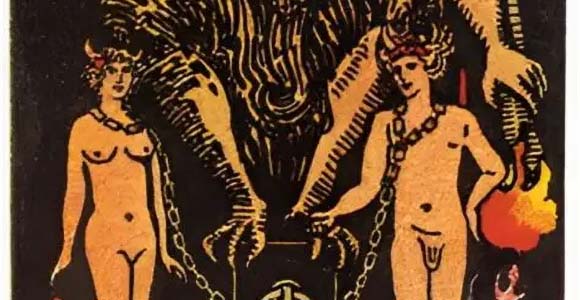
It’s always a little scary to get The Devil card in a Tarot reading.  Based on the famous illustration of Eliphas Levi’s Baphomet, we see a large, horny critter with bat wings looming over a hapless couple in chains.  Not only do they look miserable, but their tails are actually on fire.  

Which has always seemed like a bit of an overreaction to me.  It’s bad enough to take away their clothes and chain them to a black altar.  Lighting their tails on fire is just plain mean.

When we get this card in a reading, we can assume that (a) we are personally in a really bad, low-vibration place or (b) we’re involved with someone else who’s in that sort of a space.  

There’s also a school of thought that The Devil card can indicate black magic.  Perhaps we pissed off someone and they whomped a hoodoo on us.  Maybe that person we broke it off with romantically is spending their Saturday nights burning black candles and sticking pins into a picture of us.

And that can be true.  I don’t want to downplay that possibility, but it tends to miss one of the most important messages of this card, which is CHOICE.  

When we get involved in or stay in a really dark place, it’s the matter of whether we choose to be there that determines whether it’s evil.

THE CHAINS AROUND OUR NECKS

There are so many things that we think of as being, “evil,” that can feel like chains around our necks.  

Drug addiction.

Alcoholism.

Abusive relationships.

Codependency.

All of those can feel as if we’re literally enslaved.  We may know in our hearts that we’re in a really bad space and feel constant misery over it.  But, without help, we may be powerless to escape from the bottle, the needle in the arm, the slap across the face.

Sadly, there are many people who casually assume that people in those situations just don’t want to be free of them.  We saw that in the so-called, “war on drugs,” where the advice was, “just say no to drugs.”  

The reality of being an addict, of course, is that you CAN’T say no to drugs.  That’s why we call them addicts, right?

We also see it in the judgment that people ladle out to women who are enmeshed in abusive relationships.  “Why don’t you just leave him” we ask.  “What’s wrong with you?”

What’s wrong with them is that they don’t know HOW to leave an abusive relationship.

And codependents may lose their entire lives “saving,” other people because they haven’t got a clue about how to set up healthy boundaries.

So, in all of these situations, there’s one element in common:  a lack of choice.  And you can’t make a choice to be evil if you can’t make a choice at all.

HOW LOOSE ARE THE CHAINS?

When we zoom in a little closer on The Devil card, we make an astonishing discovery:

Their hands are free and the chains around the couple’s necks are so loose that they could easily be lifted right over their heads.  

In other words, their apparent slavery is entirely a matter of choice.  They could, at any moment, remove the chains and walk away, but they CHOOSE not to do it.

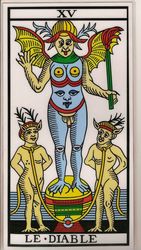
This was actually a major change in the way that this card was designed.  In the older, Marseille deck we see the same couple, but their hands are bound tightly behind them and the ropes around their necks can’t be moved.  

A.E. Waite and Pamela Coleman Smith deliberately decided to incorporate the element of choice in portraying evil when they designed this card.  

Why did they take this radical step?

MENTAL ILLNESS AND EVIL

The Waite-Smith Tarot deck was released in 1909, which was the tail end of the Victorian Era in England.  This period saw massive changes in the way humans lived, mainly brought on by the Industrial Revolution and mass manufacturing.  

One of the areas that saw the greatest changes was the legal system and the ways in which we think about crime.  In particular, what emerged was the concept that a person couldn’t commit a crime if they were insane.  

In a nutshell, if a person was so deranged that they didn’t know what they were doing was wrong, or if they had an irresistible impulse that made it impossible for them to NOT act in a particular way, then they weren’t making a CHOICE to commit a crime and couldn’t be found guilty of it.

For us, that notion is completely commonplace.  Not guilty by reason of insanity is a phrase that we hear all the time.  But that idea of choice determining evil wasn’t in play until about 150 years ago and I’m guessing that’s why we saw the change in The Devil card.  

WHY IT’S IMPORTANT

Now, you may be wondering what all of this has to do with doing an actual Tarot reading and that’s a fair question.

There’s a subtle nuance here that’s important to recognize and that has to do with freedom.  The people portrayed in The Devil card are free to walk away from what they’re doing.

Which really feels counter-intuitive.  When we look at the card, we see that they’re chained and completely dominated by the Devil critter.  At first glance, it seems that they’re not free at all.

But they are.  They’re not insane.  They’re not compelled to be there.  They choose to be there.

And so, when we pull this card in a reading, we can emphasize that.  We can actually look at this card and tell a client, “Yeah, you’re in a bad space, but you can change all of that.  You don’t have to go on being miserable.  You can walk away from it and be free.”

And that’s HUGE.  That gives the client agency in a situation where they may feel totally trapped.  It tells them that their freedom is in their own hands, if they decide to take it.

ALTERNATIVES

Now, again, I want to emphasize that this isn’t the only interpretation of The Devil card.  If, for instance, we saw the Devil paired with The Moon, then we might actually be looking at issues like insanity or serious delusions.

If we saw The Devil paired with The Magician reversed, we might infer that there really IS some black magic going on.  Always look at the surrounding cards.

By far and away, though, The Devil is a card of choice, of choosing to live in negativity and low vibrations.  That’s not good news, of course – no one wants to exist like that.  But freedom grows out of choices and that IS good news.

“Just the Tarot,” by Dan Adair.  Available on Amazon.

REVERSE ENGINEERING A BAD READING

Changing a negative reading to a positive reading by using the lesson that needs to be learned.

Available on Amazon

If we read Tarot cards for long enough, we will eventually pull a bad reading. Sometimes it’s a really, really bad reading.  You know:  Death, The Tower, 10 of Swords, and maybe a few other horrible seeming cards thrown in.  

After all, everyone has ups and downs.  Everyone goes in and out of the light.  Bad things happen to good people and vice versa.

The completely natural reaction to that is to freak out and think, “Oh, I’m so screwed.”  And then we may batten down our psychological hatches, load our pockets full of protective crystals and charms, and go forth into the world, fully expecting to be hit by a bolt of lightning.

IT’S NOT CARVED IN STONE

A better approach is to remember that Tarot readings are never carved in stone.  They’re a snapshot of the present moment, a prediction of how things are going to turn out if they continue along the present course.

Yes, they are eerily reliable.  If the Tarot predicts that something is going to happen – good, bad, or neutral – it usually does.

But that’s primarily because we forget that we have free will and we can make choices.  By acknowledging what’s happening right now and getting to work on it, we can alter the outcome of those readings.  In a phrase, we can look at the problems that the Tarot is predicting and reverse engineer them so that they don’t happen.

HERE’S AN EXAMPLE

Let’s look at a simple three card reading.  The question of the reading is, “Where am I aligning with my life’s purpose?”

1 – Where does the energy flow most freely? – The Tower reversed.

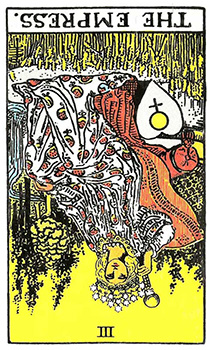
2 – Where does the greatest resistance occur? – The Empress reversed.

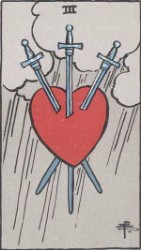
3 – What lesson needs to be learned at this point? – The Three of Swords

Now, if we were to just look at that sequence of cards as they lay on the table, it’s not a very positive reading.  The Tower reversed warns of serious destruction.  The Empress reversed is a loss of abundance.  The Three of Swords is heartbreak.

If we were just reading this predictively, we’d say, “Okay, this person is going to get hit by something heavy, he’ll lose his abundance, and it will break his heart.”  

When we look at it symbolically, in the context of the actual reading, though, we see a far different message.

The energy is flowing most freely where the person is consciously dismantling false foundations and lies in his own life (The Tower, reversed.)  He’s unable to receive abundance because he can’t open to it (Empress reversed.). AND the reason that he can’t open to it is because his heart, his trust, has been seriously wounded in the past (Three of Swords.)

REVERSING IT

Now, as I said, none of this is carved in stone and all of this can be changed.  So, what does this person need to do to flip the reading to something more positive?

We look directly at the last card – what lesson needs to be learned – for guidance.  This person needs to heal his heart.  When he heals his heart, that will enable him to trust the world and receive the abundance that he deserves.  When he heals his heart and learns to trust the world, then the false foundation of The Tower reversed becomes a real foundation that’s based on love.

If we were to put in purely energetic terms, this person has been deeply wounded emotionally, resulting in his heart chakra being blocked.  His heart chakra being blocked has kept him from being able to receive abundance.  His inability to receive abundance has caused him to question the basis for his existence, which is the falling Tower.

CAUSE AND EFFECT

When we use this approach, we cease to look at a Tarot reading as if it’s just a prediction and we start to look at it as a puzzle that can be solved.  We don’t just see that bad things may be about to happen – we see WHY they’re about to happen.

And if we can change the WHY, we can change the HOW.

There are about a kajillion different Tarot spreads out there, but most of them will have a, “lesson card.”  That card may be called:

– what needs to be learned;

– hidden forces;

– causal factors;

– opposing forces, etc.

That’s the card that we want to focus in on when we’re trying to reverse engineer a bad reading.  We don’t want to take an attitude of, “Well, shit happens.”  We want to figure out why it’s happening and then reverse those forces with an opposite energy.

In the example above, the client had a broken heart (AKA, a blocked heart chakra) and so the solution was to bring love into his heart.  A simple Metta meditation, done every day, began to cultivate more compassion, understanding, and love.

The, “lesson,” will probably be different with each client, of course.  It may be that their issue is addiction (The Devil) or a need for more solitude (The Hermit) or a lack of direction (Seven of Cups.)

Whatever the lesson card may be, that’s the keystone that holds the whole reading together.  Figure out what the client needs to learn, and you figure out what’s happening to her and why.  

Don’t just look at the effect – look at the cause.  And that will change the effect.

The Fool’s Journey and the Dance of Synchronicity

When The Fool appears in a tarot reading, it may be more than a call to begin—it might be a sign that synchronicity is already at play in your life. In this post, we explore how The Fool’s symbols—from the cliff to the rose—mirror the way meaningful coincidences guide us toward growth, transformation, and spiritual alignment. Learn how to recognize The Fool’s invitation to trust the unknown and follow life’s hidden rhythms.

There are moments in life when something just clicks. A random conversation, a song on the radio, a recurring symbol—these aren’t just coincidences. They feel charged, alive, timely. These are the moments that Carl Jung called synchronicities—meaningful coincidences that seem to guide us, gently but unmistakably, toward the next step in our journey.

And there’s no better symbol for that mysterious push into the unknown than The Fool in the Tarot.

Jung and Synchronicity

Swiss psychologist Carl Jung coined the term synchronicity to describe those uncanny moments when something in the outer world perfectly mirrors something happening inside you—without any logical cause. Like when you think of an old friend you haven’t heard from in years, and just then, the phone rings and it’s her. There’s no rational explanation, but it feels too precise to be chance. Jung believed these moments point to a deeper, hidden order—a mysterious connection between our inner lives and the unfolding world around us.

The Fool as the Signpost of Synchronicity

In the Tarot, The Fool is often misunderstood as naïve or aimless, but in truth, The Fool is the sacred wanderer—the soul on the brink of transformation. When this card appears in a reading, it may be more than a call to take a leap of faith; it may be a signal that synchronicity is actively at work in your life. Like a cosmic green light, The Fool shows up when invisible forces are aligning to open new doors, push you out of old patterns, or introduce the exact people, signs, and nudges you need to move forward. It is the Tarot’s way of saying: “Pay attention. Something meaningful is unfolding, even if you don’t yet understand it.”

The Sacred Zero: Becoming an Empty Vessel

The Fool is the only card in the Major Arcana marked with the number zero—a symbol of pure potential, of being open, unformed, unburdened. In many ways, zero represents the exact state in which synchronicity becomes most alive. When we release the ego’s need to plan, predict, and make sense of everything, we create space for the unexpected to enter. The logical, linear mind wants control; it wants cause and effect. But synchronicity belongs to the language of the soul, not the intellect. It speaks in symbols, dreams, chance encounters—and The Fool, with heart wide open and eyes on the horizon, is its perfect interpreter.

The Dog as the Spirit of Play

One often-overlooked symbol in The Fool card is the small white dog trotting at his side. While some say the dog warns The Fool of the cliff’s edge, it may also represent the playful, instinctive energy that keeps us open to life’s hidden magic. Synchronicity rarely happens when we’re tense, overthinking, or trying to force outcomes. It arises when we’re relaxed, present, and in tune with the moment—much like a happy dog on a walk, open to whatever comes. The dog reminds us that joy, spontaneity, and a sense of wonder are not distractions from the spiritual path—they are the path.

The Cliff: The Edge of the Known

The Fool stands at the edge of a cliff, one foot about to step into the great unknown. It looks dangerous—foolish, even. But from the perspective of synchronicity, the cliff represents the threshold between what we can predict and what we can’t. It’s the edge of logic, the border of the familiar. To experience synchronicity is to step beyond the rational mind and into a world that operates by deeper laws—hidden patterns, Soul timing, and symbolic meaning. When we reach the edge of what we know, we’re invited to trust what we feel. The Fool doesn’t fall; he flies—because synchronicity has a way of catching those who take a leap with an open heart.

The Satchel: What the Soul Already Knows

Slung over The Fool’s shoulder is a small satchel—light, almost weightless, but significant. It contains the inner tools The Fool brings into the unknown: intuition, past experiences, hidden wisdom. In moments of synchronicity, we often feel a sense of recognition—as though some part of us already knows what’s happening, even if we can’t explain it. That’s the satchel at work. It’s the symbolic storage of our soul’s memory, the part of us that is quietly guiding the journey even when our conscious mind is unsure. The synchronicities we encounter may feel random, but they often resonate with something we’ve carried with us all along.

The White Rose: Presence, Purity, and Attunement

In the Rider-Waite depiction of The Fool, he holds a single white rose. In a world obsessed with control and destination, this simple act—pausing to experience beauty fully—is radical. The white rose symbolizes innocence, spiritual purity, and being fully present. And that’s exactly the state in which synchronicity most often occurs. When we are truly attuned to the now—our senses open, our heart soft, our mind quiet—we become receptive to life’s subtle signals. The Fool’s rose is not a distraction; it’s a compass. It reminds us that paying attention to beauty, wonder, and fleeting moments may be how the universe whispers its guidance to us.

Following the Fool’s Footsteps

The Fool is not just the beginning of the tarot’s journey—it’s an invitation to live with openness, curiosity, and trust in life’s mysterious choreography. When The Fool appears in a reading, it may be a signal that synchronicity is stirring, that the universe is aligning unseen threads on your behalf. It asks you to stay present, to pay attention, to sniff the rose, listen to the nudge, follow the sign. It reminds you that the unknown is not empty—it is alive. So next time you draw The Fool, don’t just think of risk or adventure. Think of magic. Think of timing. Think of how the world may be conspiring, right now, to lead you exactly where you need to go.

King of Pentacles

The meaning of the King of Pentacles in a Tarot reading with definitions for both upright and reversed positions.

A man wearing a crown sits on a heavily carved throne adorned with carvings of bulls heads.  He wears a flowing robe embroidered with grape vines and holds a globed scepter in his right hand.  His left hand holds a pentacle which rests upon his leg.

Upright: A very successful and probably fairly wealthy man with an abundance of good business sense.  This isn’t someone who’s striving for success – he’s already there. And, in keeping with the old cliche about how the rich get richer, he just keeps on making more money.

The bulls on the throne show that he has a strong sensual nature but probably also feels a need to dominate those around them.  The grapes indicate that, like his queen, he enjoys the finer things in life and expects nothing but the best.On a mundane level, look for a dark complected, heavy set or muscular man who is conservative and close to his family.  Solid but fairly boring.

Reversed:  A businessman who is capable of being vicious and very hard hearted who may be after the questioner in some sense.  Alternatively, a businessman who looks rock solid but may be totally undependable or secretly down on his luck.

EXAMPLES:  The CEO of a major company with a heavy stock portfolio.

The patriarch of a very successful family business.

“Just the Tarot,” by Dan Adair – a kindle ebook available on Amazon

Queen of Pentacles

The meaning of the Queen of Pentacles in a Tarot reading, with definitions for both the upright and reversed positions.

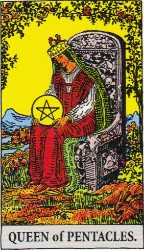
A crowned woman sits on a heavily carved throne adorned with goats and cherubs.  She is surrounded by a lush garden and gazes down at a pentacle which she holds in her lap.  A rabbit is hopping by in the lower corner of the card.

Upright: This is a very sensuous, materialistic woman.  Since this is the Queen of Pentacles, the suit of money and possessions, we know that both of those are very important to this woman.  Beyond that, though, there is an awareness of the fact that money really represents the good things in life that money can buy. This is a woman who enjoys – and expects – the finer things in life.  A nice car, a lovely home, a good income, and, yes, probably a very nice garden.

And with the goats on the throne and the rabbit at her feet we can interpret that there is a very strong element of sexuality to this woman.  Among the other fine things she expects and enjoys are good lovers and slow, delicious love making.

On a mundane level, look for a woman who possesses and excellent business sense and knows how to turn money into more money.

Reversed:  A tough, resilient business woman who is willing to get down in the ditches and fight it out hand to hand.  Very good with money but there is a hard, materialistic edge to her soul.

EXAMPLES:  A middle aged business woman who lives happily alone in a beautiful home and enjoys sharing her bed with the occasional lover.

A sensual, beautiful wife who EXPECTS to be supported in a luxurious manner because she’s damned well worth it.

“Just the Tarot,” by Dan Adair – Available on Amazon

Knight of Pentacles

The meaning of the Knight of Pentacles in a Tarot reading with definitions for both the upright and reversed positions.

A heavily armored man sits astride an immobile horse.  He holds a pentacle aloft in his gloved hand. Sprigs of greenery are attached to his helmet and to the mane of the horse.  A plowed field stretches out behind him.

Upright: A good money card, though hardly exciting or glamorous.  Unlike the Knight of Swords, this Knight isn’t going anywhere.  He sits still, solidly planted on his very solid looking horse. The plowed field represents the routine, day to day, hard work that’s necessary to bring projects to fruition.  This card shows a dependable, hard working individual who takes care of details and keeps money coming in.

On a mundane level, this may show the presence of a young, conservative individual in the questioners life.

Reversed:  Problems with money due to the disruption of the daily routine.  A young, conservative person who is causing problems in the questioners life.

EXAMPLES:  The single mother or father who reliably shows up for work every day, does the job with no drama or complaints, and put food on the table and shoes on the baby.

A college student who grinds his or her way through to a PhD by taking a few courses every year while working a full time job.

“Just the Tarot,” by Dan Adair – a kindle ebook available on Amazon

Ten of Pentacles

The meaning of the Ten of Pentacles in a Tarot reading, with definitions for both the upright and reversed positions.

An elderly, bearded man draped in a shawl sits and pets some dogs.  A man, a woman and a child stand just beyond him and the child reaches out to touch one of the dogs.  A tower and part of a castle complex are visible through an archway and ten pentacles are arranged in the pattern of the tree of life.

Upright: This is the end of the pentacle or money cycle and indicates good fortune and financial success.  There is a strong, multi-generational presence of family in the card so it may indicate a family owned business which has done very well.  The elderly man may point toward a happy, secure retirement.

Reversed:  Money is on the way.  It may be of the unexpected sort such as winning a lottery.  May point toward securing a good pension and medical benefits.

EXAMPLES:  A family owned store that is thriving and expanding.

Turning your business over to your children or grandchildren and entering a happy, well deserved retirement.

“Just the Tarot,” by Dan Adair – a kindle ebook available on Amazon

Nine of Pentacles

The meaning of the Nine of Pentacles in a Tarot reading, with definitions for both the upright and reversed positions.

A woman in a long, flowing robe stands in a garden surrounded by pentacles.  Her left hand is covered with a heavy leather glove and a bind folded hawk perches there.

Upright: A card of financial success with an emphasis on the home.  Perhaps redecorating or redesigning the questioners residence.  There is also an odd element of a lack of freedom here. Possibly someone who has compromised his or her desires for freedom in order to have security.  In any case the card is very positive in terms of money.

Reversed:  Bad news financially.  If the questioner is involved in some sort of money making project she should cut her losses and walk away.  Continued efforts along these lines can lead to financial ruin.

EXAMPLES:  The trophy wife who has oodles of cash and a brand new luxury car but is very much under the thumb of her husband.

A writer or artist who has given up his creative ambitions but is still doing very well financially.

Seven of Pentacles

The meaning of the Seven of Pentacles in a Tarot reading, including definitions for both the upright and reversed positions.

A man leans against a hoe, resting and contemplating a plant that is covered in seven pentacles.

Upright: Anyone who is a gardener will understand this card immediately.  Achievement and success as a result of sustained work and careful planning.  This card emphasizes the need to keep working on things on a daily basis and the questioners efforts will ultimately bear fruit.

Reversed:  A long period of hard work that isn’t ready to pay off yet.  Wait for more developments.

EXAMPLES:  A small business owner who has worked meticulously over the years and is seeing her business profit and grow.

An artist or writer who has slowly but surely acquired new techniques over a period of years and is now a master at his craft.

“Just the Tarot,” by Dan Adair – a kindle ebook available on Amazon

Six of Pentacles

The meaning of the Six of Pentacles in a Tarot reading, including definitions for the upright and reversed positions.

A richly dressed man drops coins into the hands of a beggar who kneels at his feet and holds a perfectly balanced scale with the other hand.  Another beggar kneels on the other side of him, hands outstretched. Six pentacles are displayed above the scene.

Upright: A loss of money.  The questioner has to pay out a fair amount of his resources to cover bills or debts.  There is a sense of stinginess here, of giving but not with a willing heart. Of carefully measuring out what the person is willing share and not giving one dime more.  Probably bad times coming financially.

Reversed:  There has been a bad stretch financially but it will be ending soon.  Possibly new resources and helpful people on the way.

EXAMPLES:  A bad divorce where a person ends up paying large amounts of spousal and child support and has very little left over to live on.

Losing your ass in the stock market and having to radically adjust your lifestyle downward.