
Why do we let our lights shine?
There’s an old country and western song that proclaims, “You can’t be a beacon if your light don’t shine.”
But suppose you don’t want to be a beacon? Should your light still shine?
The Hermit is one of the most interesting paradoxes of the Tarot.
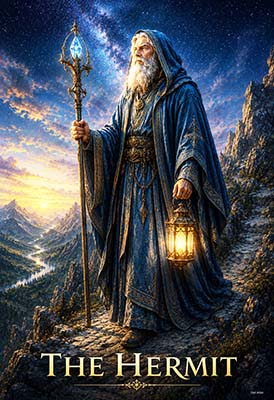
We see an old man standing alone on a mountain peak, holding a lantern high above his head so that its light shines into the darkness.
Only…
There’s nobody there.
The number of people who are actually seeing his light appears to be exactly zero.
That tiny detail invites us to question one of the most common interpretations of the card.
Most Tarot books tell us that The Hermit has withdrawn from society, gained wisdom through solitude, and is now returning to share that wisdom with humanity.
It’s a beautiful story.
The problem is that the card itself never tells us that story.
There is no path leading back to civilization. There is no village waiting below. There are no followers gathering around him. The image simply shows a solitary man standing quietly on a mountain, holding up a lamp.
Perhaps another wanderer on a distant peak catches sight of it. Maybe a passing Yeti looked over and wondered, “I wonder what that old dude is up to?”
Perhaps no one sees it.
The picture doesn’t seem very concerned with the audience.

The Hero’s Journey
The traditional interpretation may come from one of humanity’s oldest myths.
The hero enters the wilderness, gains wisdom, and returns transformed.
Jesus withdraws into the desert.
The Buddha leaves the palace before awakening beneath the Bodhi tree.
The knights search for the Holy Grail.
Frodo returns to the Shire.
We’re so accustomed to this pattern that we naturally assume The Hermit must be following it as well.
Surely no one would choose to live alone forever.
Surely solitude is only a temporary stage before returning to the world.
But is that really what we’re looking at?
The Nature of the Hermit
In an earlier post, I suggested that there are many expressions of the Hermit archetype.
Some people withdraw because life has wounded them. They need silence to heal. Eventually, they return.
Others retreat for a season to study, write, pray, or rediscover themselves.
But the true Hermit is something different.
Solitude isn’t a strategy.
It isn’t therapy.
It isn’t preparation for the next chapter.
It is simply his nature.
He isn’t hiding from humanity.
He isn’t waiting for humanity.
He’s exactly where he belongs.
If he retreats only so that he can eventually come back and teach everyone else, then he isn’t really a Hermit at all. He’s simply taking a very long vacation.
The Hermit in the Tarot doesn’t appear to be preparing for a return.
He simply stands on his mountain with his lamp.
The Lamp
So why hold the lantern aloft?
If it isn’t meant to illuminate the world, what is it illuminating?
Perhaps the answer is beautifully simple.
The Hermit is illuminating himself.
That is the real purpose of his solitude.
Away from the endless noise of civilization, he can finally hear his own thoughts.
He can meditate.
He can write.
He can ask the deepest questions without someone else’s voice rushing in to answer them.
He is discovering who he really is.
John Muir captured that spirit perfectly when he wrote:
“I’d rather be in the mountains thinking about God than in church thinking about the mountains.”
The Hermit’s mountain is not an escape from life.
It is the place where life finally becomes quiet enough to hear.
The Gift of the Hermit
Ironically, people who truly become themselves often end up helping others without ever intending to.
Someone may see the light from that distant mountain and find hope.
Someone may read the Hermit’s journal centuries later.
Someone may simply be inspired by knowing that another human being lived authentically.
But that isn’t why the Hermit holds the lamp.
Helping others is a beautiful consequence.
It is not the purpose.
The purpose is to live honestly.
To know yourself.
To become the person you were created to be, even if no one is watching.
Perhaps that’s the greatest lesson of The Hermit.
Not every light is meant to attract a crowd.
Some lights exist simply because they are true.