Navigating the Ocean of Self-Help

Using the Tarot to become your own guru.

Why We Don’t Need Another Guru

The Buddha once taught that certain conditions are necessary for enlightenment:

  • Being born human
  • The appearance of a Buddha or enlightened teacher
  • A way for those teachings to reach human beings
  • People capable of understanding and applying the teachings

Today, I’d like to focus on that third point: How do the teachings reach us?

And perhaps more importantly:

How do we know which teachings are right for us?

From Ancient Villages to Information Overload

In the Buddha’s day, getting a spiritual message out into the world was no small task.

There were no emails, podcasts, YouTube channels, online courses, or social media platforms.

The Buddha spent roughly forty-five years walking from village to village, teaching anyone who was willing to listen. Basically, walking up to strangers and saying, “Hey, I’ve got an idea . . .”

Imagine that.

No marketing department. No sales funnel. No premium membership package.

Just a teacher sharing what he had discovered.

Fast forward twenty-five centuries and we’ve arrived at the opposite problem.

When I wake up in the morning, my inbox is usually full of messages promising to transform my life, align my energy, unlock hidden potential, activate forgotten abilities, and teach me the secret to happiness, wealth, abundance, success, enlightenment, or all of the above.

The challenge is no longer finding information.

The challenge is sorting through it.

Never before in human history have so many spiritual teachings, philosophies, techniques, and self-help systems been available to so many people.

And yet many of us remain confused about what actually works.

The Billion-Dollar Search for Happiness

The self-help industry generates tens of billions of dollars each year.

That’s a big chunk of enlightenment.

Most programs follow a familiar pattern:

  • I have achieved success.
  • You have not.
  • I have a special technique, secret, or system.
  • Pay me, and I’ll teach it to you.

To be fair, some of these teachers are sincere and genuinely helpful.

Many people have benefited from books, courses, seminars, and retreats.

But there is also a tendency to assume that one technique should work for everyone.

What if that assumption is wrong? What if there is no universal formula? What if different people require different paths?

Satisfaction Not Guaranteed

One thing I’ve noticed over the years is that self-help programs rarely come with guarantees.

Suppose someone is struggling financially and spends thousands of dollars attending an exclusive retreat in Costa Rica. They spend a week sipping organic hot chocolate, munching down tofu rice cakes, and opening their heart chakra.

At the end of the experience, they may feel inspired, motivated, and hopeful. But what if nothing really changed, other than they have a better tan and a lighter wallet?

What if their life remains exactly the same six months later?

The explanation is often that they didn’t practice enough, believe enough, surrender enough, visualize enough, or raise their vibration enough.

In other words, if MY method doesn’t work, it’s YOUR fault.

Let’s face it: if one teacher could make everyone happy, rich and successful, we’d all be going to that teacher and we’d all be rich.

Instead, the emails continue to pile up in our in-boxes.

Where the Tarot Is Different

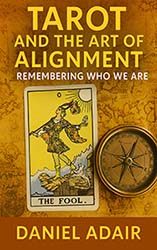
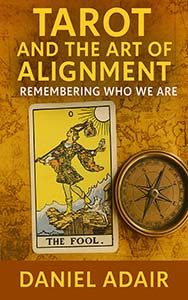
This is where my book, Tarot and the Art of Alignment, takes a different arapproach.

The central idea is surprisingly simple:

The wisdom we seek is not somewhere outside of us.

It is already within us.

The challenge is learning how to access it.

The Tarot provides a remarkably effective way to do exactly that.

Rather than telling us what to think, the cards help us listen.

Rather than asking us to surrender our authority to a teacher, they encourage us to develop trust in our own inner knowing.

Rather than offering one answer for everyone, they reveal the unique lessons, challenges, and opportunities present in each individual’s life.

In this model, the Tarot is not a fortune-telling device.

It is a mirror.

A guide.

A conversation with the deeper parts of ourselves.

Your Own Inner Teacher

One of the things I appreciate most about the Tarot is its simplicity.

A Tarot deck costs roughly twenty-five to thirty bucks.

Once you have it, the conversation can begin.

There are no monthly subscription fees. No expensive retreats. No advanced certification programs. No endless upselling.

Just you, the cards, and the wisdom waiting beneath the noise of everyday life.

The goal is not to find another guru.

The goal is to discover the teacher that has been quietly waiting within you all along.

And in my experience, the Tarot is one of the most powerful keys to that door.

Why Your Visualizations Aren’t Working (And How the Tarot Can Help)

Using the Tarot to boost your visualizations and manifestations.

One of the strangest things about visualization and manifestation is that almost everyone who practices it has seen it work at least once.

A check arrives unexpectedly in the mail.

A new opportunity appears out of nowhere.

A problem that seemed impossible to solve suddenly resolves itself.

Most of us who have explored manifestation have had moments like that. The experience is so striking that we walk away convinced that there really is something to it.

The problem is that it often seems wildly inconsistent.

It’s as if we were handed a magic wand that only works on Tuesdays.

Sometimes it works beautifully.

Sometimes nothing happens at all.

So what’s going on?

Now available – Tarot Meditation Kits

THE PROBLEM MAY NOT BE THE UNIVERSE

Most manifestation teachings assume that if something isn’t showing up in our lives, we simply aren’t visualizing hard enough, affirming often enough, or maintaining a high enough vibration.

Sometimes that’s true.

But sometimes the problem lies somewhere else entirely.

Sometimes we’re trying to manifest something that we don’t actually want.

That sounds strange, but think about it for a moment.

We’re constantly being told what we should want.

More money.

A bigger house.

A more prestigious career.

A newer car.

A better relationship.

Society hands us a ready-made list of desires and then encourages us to spend our lives pursuing them.

But what if those desires aren’t really ours?

Suppose your deepest dream is to live a quiet, peaceful life creating art, writing books, tending a garden, or herding goats in the mountains.

Trying to manifest a million-dollar corporate empire might actually move you farther away from what you truly want.

One part of you is saying:

“I want more money.”

Another part is saying:

“I want simplicity, freedom, and peace.”

The messages conflict.

And when they conflict, the energy behind them weakens.

THE HIDDEN VOICE OF THE SUBCONSCIOUS

There’s another reason manifestation sometimes fails.

Many of our deepest beliefs operate below conscious awareness.

We may consciously desire wealth while secretly believing that wealthy people are selfish or corrupt. So why would we want to be one?

We may desire a loving relationship while carrying a deep conviction that we are unworthy of love.

We may want success while simultaneously fearing attention, criticism, or failure.

In those situations, our conscious intentions and our subconscious beliefs are pulling in opposite directions.

No amount of affirmations can completely overcome a belief that remains hidden and unexamined.

THE TEN PERCENT PRINCIPLE

One idea that has always fascinated me is what I call the Ten Percent Principle.

Rather than focusing on the times manifestation didn’t work, focus on the times it did.

If your visualization works only ten percent of the time, that’s still astonishing.

That’s magic.

That’s making something appear out of nothing, simply using the power of your mind and heart.

So how do we increase that success rate from 10% to 50%?  How do we start to live the magic that we know is there?

HOW THE TAROT CAN HELP

This is where the Tarot becomes so valuable.

Most manifestation techniques begin with a conscious desire.

“I want more money.”

“I want a new relationship.”

“I want a better job.”

The Tarot approaches the problem from the opposite direction.

Because Tarot communicates through symbols, images, and archetypes, it speaks directly to the subconscious mind. It bypasses many of the stories, assumptions, and social programming that shape our everyday thinking.

The cards often reveal things we weren’t expecting to hear.

Sometimes they show us hidden fears.

Sometimes they reveal limiting beliefs.

And sometimes they show us that the thing we’re trying to manifest isn’t what we really want at all.

The Tarot doesn’t simply ask:

“What do you want?”

It asks:

“What does your soul want?”

THE SOUL SPREAD

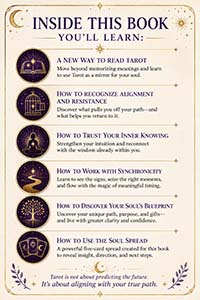
One of the central ideas in my new book, Tarot and the Art of Alignment, is a reading method I call the Soul Spread.

Rather than focusing on future events, the Soul Spread is designed to uncover your deeper purpose, natural gifts, hidden challenges, and the path that brings the greatest sense of meaning and fulfillment.

In other words, it helps answer a question that most manifestation systems never ask:

“Am I trying to create a life that is actually mine?”

When our conscious goals and our deeper purpose come into alignment, something remarkable often happens.

The struggle begins to ease.

Synchronicities increase.

Opportunities appear.

The path feels more natural.

It’s as though life itself begins cooperating with us.

Perhaps the secret isn’t learning how to force the universe to give us what we want.

Perhaps the secret is discovering what we truly want in the first place.

And that’s a journey the Tarot is uniquely qualified to help us make.

Tarot and the Art of Alignment is now available as both a Kindle edition and a downloadable PDF. If you’ve ever wondered why your visualizations seem inconsistent—or how to uncover the deeper desires beneath your conscious goals—the book offers a practical framework for using the Tarot as a tool for alignment, purpose, and personal transformation.

Why Are We Here? Bridey Murphy, Reincarnation, and the Search for Purpose

Exploring past life memories and looking for meaning with the Tarot.

In 1956, a hugely controversial book called The Search for Bridey Murphy became a national sensation.

The book documented a series of hypnotic regressions conducted by a Colorado businessman named Morey Bernstein. His subject, Virginia Tighe, was initially regressed to childhood memories. Instead, she began describing what appeared to be a previous life in nineteenth-century Ireland.

According to the story, Virginia remembered being a young woman named Bridey Murphy who had lived in County Cork. She described places, customs, people, and events in remarkable detail.

The reaction was immediate.

Some people were fascinated.

Some were deeply moved.

Some were furious.

Others thought the whole thing was ridiculous.

The book became a bestseller. It was turned into a movie. Comedians did Bridey Murphy jokes. People threw Bridey Murphy-themed parties. Children even dressed up as Bridey Murphy for Halloween.

Imagine that for a moment.

Millions of Americans were suddenly debating whether reincarnation might actually be real.

That would be surprising today.

In the buttoned-down 1950s, it was astonishing.

After all, more than ninety percent of Americans then identified as church-going Christians. Traditional Christian theology leaves very little room for reincarnation. From the perspective of many ministers and priests, the idea was outright heresy.

Naturally, there were efforts to debunk the claims, expose errors, and prove that the entire thing was a misunderstanding or a fraud. Eventually the public moved on.

But I’ve always been fascinated by one aspect of the story.

Why did so many people take it seriously in the first place?

Why didn’t they simply dismiss it out of hand?

The Strange Familiarity of Past-Life Memories

Today, surveys suggest that roughly a third of Americans believe in reincarnation. Among many New Age and metaphysical communities, the idea is simply taken for granted.

Most of us, however, don’t have detailed memories like Virginia Tighe supposedly did.

We don’t remember specific addresses.

We don’t remember the names of shopkeepers.

We don’t remember exact dates.

What many people do experience are odd fragments.

Half-memories.

Dreams.

Emotions that seem to belong to someone else and yet somehow feel intimately familiar.

Over the years I’ve spoken with dozens of people who have reported experiences like this.

One person remembered being a stone carver in ancient Egypt. What struck him most wasn’t some grand spiritual revelation. It was the memory of being exhausted, sweaty, and desperately in need of a bath.

Another remembered being a poet during the American Revolution. His strongest impression wasn’t literary genius. It was embarrassment over being a terrible poet.

Yet another remembered escaping from a Mississippi jail during the 1930s, stealing a car, and taking a brief joyride before being captured.

None of these people could provide names, dates, or evidence that would satisfy a historian.

Yet they all said the same thing.

The memories felt absolutely real.

In some ways, I find these stories more convincing than tales of being Cleopatra or Joan of Arc. Most people don’t remember being kings and queens.

If reincarnation is real, the overwhelming majority of us probably spent most of our lives being ordinary people.

Which leads to a much more interesting question.

Why Would We Keep Coming Back?

Let’s suppose, for the sake of argument, that reincarnation is real.

Why are we doing this?

Why would a soul return over and over again?

The idea that we’re reincarnating merely to carve stones, write bad poetry, or heist a car seems a little absurd.

Most of us instinctively feel that there must be more to it than that. We sense that there must be a purpose behind the process.

Perhaps we’re here to learn.

Perhaps we’re here to grow.

Perhaps we’re here to develop qualities that cannot be learned anywhere else.

Perhaps we’re here to become something.

What’s fascinating is that we often ask these questions about our past lives while completely ignoring them in our current one.

We look at a supposed lifetime in ancient Egypt and ask:

“What lesson was I learning?”

“What was the purpose of that incarnation?”

“What was I supposed to become?”

Yet many of us live our present lives without ever asking the same questions.

We get up. Go to work. Pay bills. Consume several million calories. Accumulate possessions. Grow older.

And eventually die.

Then we wonder why life sometimes feels strangely empty.

Perhaps the real mystery isn’t whether we’ve lived before.

Perhaps the real mystery is why we’re here now.

Understanding the “Why”

This is one of the questions that led me to develop the ideas explored in Tarot and the Art of Alignment.

What if the purpose of Tarot isn’t merely to predict future events?

What if the cards can help us discover why we came here in the first place?

Most Tarot readings focus on questions such as:

“Will I get the job?”

“Will this relationship work out?”

“What should I expect next week?”

Those are perfectly valid questions.

But there may be a deeper question hiding beneath all of them.

“What am I here to become?”

In my own work, I’ve found that Tarot can be an extraordinary tool for exploring that question.

The cards often reveal recurring themes, gifts, challenges, and lessons that seem to run through an entire lifetime.

They can help us recognize where we’re in alignment with our deeper purpose—and where we’ve drifted away from it.

In the coming weeks, I’ll be writing more about the Soul Reading described in Tarot and the Art of Alignment, a Tarot spread specifically designed to explore these larger questions of purpose, destiny, and meaning.

Because whether reincarnation is real or not, one question remains:

Why are you here?

And that may be the most important question any of us will ever ask.

Tarot and the Art of Alignment: A New Way to Read the Cards

For years I’ve been fascinated by a simple question: What if Tarot isn’t primarily about predicting the future? That question eventually grew into my new book, Tarot and the Art of Alignment.

For years, I’ve been fascinated by a simple question:

What if Tarot isn’t primarily about predicting the future?

What if the cards are actually showing us where we’re aligned—or misaligned—with our deeper path?

That question eventually grew into my new book, Tarot and the Art of Alignment.

Of course, behind that question lies another one that human beings have been asking for thousands of years:

Why am I here?

We phrase it in many different ways:

* What is my purpose in life?

* Do I have some sort of destiny?

* Why did I incarnate in this place and time?

* Or, on particularly difficult days: What in the HELL is all of this about?

Philosophers, psychologists, and spiritual teachers have all recognized that human beings have a deep need for meaning in their lives. It isn’t enough to simply wake up, go to work, buy things, pursue pleasure, and repeat the process until our inevitable deaths.

We long for something more.

We need a sense of purpose. We need to feel that our lives matter, that our struggles and triumphs are part of a larger story. Without that sense of meaning, life can begin to feel exactly what the word suggests: meaningless.

Over time, it began to dawn on me that the answer to those questions might be found in the Tarot.

Most of us use the cards to ask questions about the future:

* What is my week going to be like?

* Should I take this job?

* Is this relationship headed somewhere meaningful?

* Am I making the right decision?

When we stop and think about it, that’s actually a remarkable process.

Whenever we lay out the cards, we operate from the assumption that we’re tapping into a source of wisdom greater than our ordinary awareness. Whether we call that source Spirit, the Universe, God/dess, Higher Self, Angels, Guides, or simply the deeper unconscious mind, we trust that the cards can reveal information we don’t consciously possess.

And if that greater source can offer guidance about a career decision, a relationship, or whether we’re headed in the right direction, then surely it can help us answer the most important question of all:

Why am I here?

That realization led me to begin experimenting with a different way of reading the cards.

Instead of asking the Tarot to predict what might happen next, I began asking it to reveal who I am, why I’m here, and whether my life is aligned with my deeper purpose.

I also began using the cards as an ongoing check-in system—a way of determining whether I was moving toward greater alignment or drifting away from it.

This book is the result.

Rather than teaching hundreds of card meanings to memorize, the book explores a different approach. It shows how Tarot can become a mirror that helps us recognize alignment, resistance, intuition, synchronicity, and purpose.

At its heart, Tarot and the Art of Alignment is about learning to see the cards as a conversation with the deeper self.

The Tarot has always been rich with symbols, archetypes, and spiritual lessons. Yet many readers become trapped in the endless task of memorizing meanings and predicting outcomes. This book shifts the focus from fortune-telling to self-discovery. The question is no longer, “What will happen to me?” but rather, “Who am I becoming?”

Through the practices and spreads presented in the book, you’ll learn how to identify the beliefs that keep you stuck, reconnect with your intuition, recognize meaningful patterns and synchronicities, and uncover the deeper purpose that has been quietly calling to you all along.

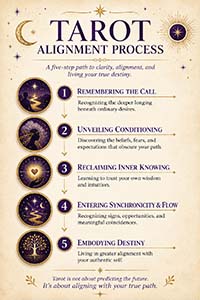
At the heart of the book is a model I call The Tarot Alignment Process.

The first step is Remembering the Call. This is the moment when we become conscious of our deep hunger for meaning and purpose. We stop drifting through life and begin to recognize that something within us is calling for a more authentic way of living.

The second step is Unveiling Conditioning. Here we examine the beliefs, fears, expectations, and assumptions that have caused us to forget who we really are. We explore the ways that family, culture, education, and society have shaped our identity—and often obscured our deeper truth.

The third step is Reclaiming Inner Knowing. Through Tarot and self-reflection, we begin to trust our own wisdom again. We learn to listen to the quiet voice within that knows why we came into this life and what we are here to contribute.

The fourth step is Entering Synchronicity and Flow. We discover how our emotions, life circumstances, and meaningful coincidences can serve as guides, helping us recognize when we are moving in harmony with our deeper purpose.

And finally, the fifth step is Embodying Destiny. Rather than seeking occasional moments of inspiration, we learn how to stay aligned over time, using the Tarot as an ongoing tool for guidance, self-correction, and growth.

Looking back, I realize that I’ve spent years exploring these themes through Tarot readings, blog posts, synchronicity, personal experience, and spiritual study. This book is my attempt to gather all of those threads together into a single framework.

Over the next several weeks, I’ll be exploring many of these ideas here on the blog, including alignment and resistance, synchronicity, the Soul Spread, and why difficult Tarot readings may not be bad news at all.

If those topics interest you, I hope you’ll join me for the journey.

Tarot and the Art of Alignment

The book is now available as an Amazon Kindle edition:

Tarot and the Art of Alignment – Kindle Edition

Or as a downloadable PDF edition:

Tarot and the Art of Alignment – Downloadable PDF Edition

Remember:

Tarot is not about predicting the future.

It’s about aligning with your true path.

THE DEVIL CARD AND FREEDOM

Exploring the element of choice with The Devil card.

It’s always a little scary to get The Devil card in a Tarot reading.  Based on the famous illustration of Eliphas Levi’s Baphomet, we see a large, horny critter with bat wings looming over a hapless couple in chains.  Not only do they look miserable, but their tails are actually on fire.  

Which has always seemed like a bit of an overreaction to me.  It’s bad enough to take away their clothes and chain them to a black altar.  Lighting their tails on fire is just plain mean.

When we get this card in a reading, we can assume that (a) we are personally in a really bad, low-vibration place or (b) we’re involved with someone else who’s in that sort of a space.  

There’s also a school of thought that The Devil card can indicate black magic.  Perhaps we pissed off someone and they whomped a hoodoo on us.  Maybe that person we broke it off with romantically is spending their Saturday nights burning black candles and sticking pins into a picture of us.

And that can be true.  I don’t want to downplay that possibility, but it tends to miss one of the most important messages of this card, which is CHOICE.  

When we get involved in or stay in a really dark place, it’s the matter of whether we choose to be there that determines whether it’s evil.

THE CHAINS AROUND OUR NECKS

There are so many things that we think of as being, “evil,” that can feel like chains around our necks.  

Drug addiction.

Alcoholism.

Abusive relationships.

Codependency.

All of those can feel as if we’re literally enslaved.  We may know in our hearts that we’re in a really bad space and feel constant misery over it.  But, without help, we may be powerless to escape from the bottle, the needle in the arm, the slap across the face.

Sadly, there are many people who casually assume that people in those situations just don’t want to be free of them.  We saw that in the so-called, “war on drugs,” where the advice was, “just say no to drugs.”  

The reality of being an addict, of course, is that you CAN’T say no to drugs.  That’s why we call them addicts, right?

We also see it in the judgment that people ladle out to women who are enmeshed in abusive relationships.  “Why don’t you just leave him” we ask.  “What’s wrong with you?”

What’s wrong with them is that they don’t know HOW to leave an abusive relationship.

And codependents may lose their entire lives “saving,” other people because they haven’t got a clue about how to set up healthy boundaries.

So, in all of these situations, there’s one element in common:  a lack of choice.  And you can’t make a choice to be evil if you can’t make a choice at all.

HOW LOOSE ARE THE CHAINS?

When we zoom in a little closer on The Devil card, we make an astonishing discovery:

Their hands are free and the chains around the couple’s necks are so loose that they could easily be lifted right over their heads.  

In other words, their apparent slavery is entirely a matter of choice.  They could, at any moment, remove the chains and walk away, but they CHOOSE not to do it.

This was actually a major change in the way that this card was designed.  In the older, Marseille deck we see the same couple, but their hands are bound tightly behind them and the ropes around their necks can’t be moved.  

A.E. Waite and Pamela Coleman Smith deliberately decided to incorporate the element of choice in portraying evil when they designed this card.  

Why did they take this radical step?

MENTAL ILLNESS AND EVIL

The Waite-Smith Tarot deck was released in 1909, which was the tail end of the Victorian Era in England.  This period saw massive changes in the way humans lived, mainly brought on by the Industrial Revolution and mass manufacturing.  

One of the areas that saw the greatest changes was the legal system and the ways in which we think about crime.  In particular, what emerged was the concept that a person couldn’t commit a crime if they were insane.  

In a nutshell, if a person was so deranged that they didn’t know what they were doing was wrong, or if they had an irresistible impulse that made it impossible for them to NOT act in a particular way, then they weren’t making a CHOICE to commit a crime and couldn’t be found guilty of it.

For us, that notion is completely commonplace.  Not guilty by reason of insanity is a phrase that we hear all the time.  But that idea of choice determining evil wasn’t in play until about 150 years ago and I’m guessing that’s why we saw the change in The Devil card.  

WHY IT’S IMPORTANT

Now, you may be wondering what all of this has to do with doing an actual Tarot reading and that’s a fair question.

There’s a subtle nuance here that’s important to recognize and that has to do with freedom.  The people portrayed in The Devil card are free to walk away from what they’re doing.

Which really feels counter-intuitive.  When we look at the card, we see that they’re chained and completely dominated by the Devil critter.  At first glance, it seems that they’re not free at all.

But they are.  They’re not insane.  They’re not compelled to be there.  They choose to be there.

And so, when we pull this card in a reading, we can emphasize that.  We can actually look at this card and tell a client, “Yeah, you’re in a bad space, but you can change all of that.  You don’t have to go on being miserable.  You can walk away from it and be free.”

And that’s HUGE.  That gives the client agency in a situation where they may feel totally trapped.  It tells them that their freedom is in their own hands, if they decide to take it.

ALTERNATIVES

Now, again, I want to emphasize that this isn’t the only interpretation of The Devil card.  If, for instance, we saw the Devil paired with The Moon, then we might actually be looking at issues like insanity or serious delusions.

If we saw The Devil paired with The Magician reversed, we might infer that there really IS some black magic going on.  Always look at the surrounding cards.

By far and away, though, The Devil is a card of choice, of choosing to live in negativity and low vibrations.  That’s not good news, of course – no one wants to exist like that.  But freedom grows out of choices and that IS good news.

“Just the Tarot,” by Dan Adair.  Available on Amazon.

REVERSE ENGINEERING A BAD READING

Changing a negative reading to a positive reading by using the lesson that needs to be learned.

Available on Amazon

If we read Tarot cards for long enough, we will eventually pull a bad reading. Sometimes it’s a really, really bad reading.  You know:  Death, The Tower, 10 of Swords, and maybe a few other horrible seeming cards thrown in.  

After all, everyone has ups and downs.  Everyone goes in and out of the light.  Bad things happen to good people and vice versa.

The completely natural reaction to that is to freak out and think, “Oh, I’m so screwed.”  And then we may batten down our psychological hatches, load our pockets full of protective crystals and charms, and go forth into the world, fully expecting to be hit by a bolt of lightning.

IT’S NOT CARVED IN STONE

A better approach is to remember that Tarot readings are never carved in stone.  They’re a snapshot of the present moment, a prediction of how things are going to turn out if they continue along the present course.

Yes, they are eerily reliable.  If the Tarot predicts that something is going to happen – good, bad, or neutral – it usually does.

But that’s primarily because we forget that we have free will and we can make choices.  By acknowledging what’s happening right now and getting to work on it, we can alter the outcome of those readings.  In a phrase, we can look at the problems that the Tarot is predicting and reverse engineer them so that they don’t happen.

HERE’S AN EXAMPLE

Let’s look at a simple three card reading.  The question of the reading is, “Where am I aligning with my life’s purpose?”

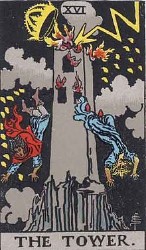
1 – Where does the energy flow most freely? – The Tower reversed.

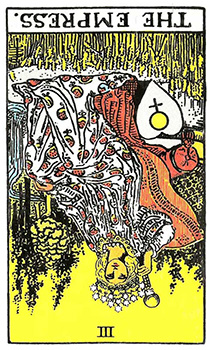
2 – Where does the greatest resistance occur? – The Empress reversed.

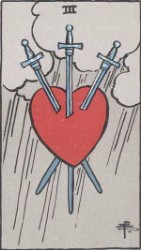
3 – What lesson needs to be learned at this point? – The Three of Swords

Now, if we were to just look at that sequence of cards as they lay on the table, it’s not a very positive reading.  The Tower reversed warns of serious destruction.  The Empress reversed is a loss of abundance.  The Three of Swords is heartbreak.

If we were just reading this predictively, we’d say, “Okay, this person is going to get hit by something heavy, he’ll lose his abundance, and it will break his heart.”  

When we look at it symbolically, in the context of the actual reading, though, we see a far different message.

The energy is flowing most freely where the person is consciously dismantling false foundations and lies in his own life (The Tower, reversed.)  He’s unable to receive abundance because he can’t open to it (Empress reversed.). AND the reason that he can’t open to it is because his heart, his trust, has been seriously wounded in the past (Three of Swords.)

REVERSING IT

Now, as I said, none of this is carved in stone and all of this can be changed.  So, what does this person need to do to flip the reading to something more positive?

We look directly at the last card – what lesson needs to be learned – for guidance.  This person needs to heal his heart.  When he heals his heart, that will enable him to trust the world and receive the abundance that he deserves.  When he heals his heart and learns to trust the world, then the false foundation of The Tower reversed becomes a real foundation that’s based on love.

If we were to put in purely energetic terms, this person has been deeply wounded emotionally, resulting in his heart chakra being blocked.  His heart chakra being blocked has kept him from being able to receive abundance.  His inability to receive abundance has caused him to question the basis for his existence, which is the falling Tower.

CAUSE AND EFFECT

When we use this approach, we cease to look at a Tarot reading as if it’s just a prediction and we start to look at it as a puzzle that can be solved.  We don’t just see that bad things may be about to happen – we see WHY they’re about to happen.

And if we can change the WHY, we can change the HOW.

There are about a kajillion different Tarot spreads out there, but most of them will have a, “lesson card.”  That card may be called:

– what needs to be learned;

– hidden forces;

– causal factors;

– opposing forces, etc.

That’s the card that we want to focus in on when we’re trying to reverse engineer a bad reading.  We don’t want to take an attitude of, “Well, shit happens.”  We want to figure out why it’s happening and then reverse those forces with an opposite energy.

In the example above, the client had a broken heart (AKA, a blocked heart chakra) and so the solution was to bring love into his heart.  A simple Metta meditation, done every day, began to cultivate more compassion, understanding, and love.

The, “lesson,” will probably be different with each client, of course.  It may be that their issue is addiction (The Devil) or a need for more solitude (The Hermit) or a lack of direction (Seven of Cups.)

Whatever the lesson card may be, that’s the keystone that holds the whole reading together.  Figure out what the client needs to learn, and you figure out what’s happening to her and why.  

Don’t just look at the effect – look at the cause.  And that will change the effect.

What Are Tarot Archetypes (And Why They Matter)?

The influence of Tarot archetypes in our lives.

The Empress Abundance Poster – available on Etsy

In any serious discussion of the Tarot, you’ll hear people referring to the Major Arcana as “archetypes.”

Which sounds very impressive… but also raises a perfectly reasonable question:

What, exactly, is an archetype?

The idea goes all the way back to Plato, but in modern usage it’s most often associated with the Swiss psychologist Carl Jung.

Jung defined archetypes as:

Universal, inherited patterns of thought or imagery that exist in the collective unconscious of all human beings.

Which is a fine scholarly definition… but for most of us, it lands somewhere around:

“Huh?”

So instead of trying to define archetypes academically, let’s talk about how they actually show up in real life—especially through the Tarot.

The Major Arcana

If you’re reading a Tarot blog, you probably already know the basics.  The Tarot is divided into two parts, the Minor Arcana and the Major Arcana.

• The Minor Arcana (Wands, Cups, Pentacles, Swords) deal with everyday life.

• The Major Arcana (22 cards) deal with something deeper.

The images of the Major Arcana are the ancient core of the Tarot, dating back to the 15th century (and possibly earlier). The Minor Arcana didn’t even get illustrated scenes until the Waite-Smith deck in 1909.

So when we talk about archetypes in Tarot, we’re really talking about the Major Arcana.

They’re Not Personal

Here’s the first—and most important—thing to understand:

Archetypes are not personal.

Now, I know that sounds strange, because they feel very personal.

If you pull Death or The Tower in a reading, it doesn’t feel abstract. It feels like the universe just singled you out and dropped a piano on your head.

But here’s the shift:

• Minor Arcana = things you’re generating and can influence

• Major Arcana = larger forces moving through your life

For example:

• Two of Cups → You’re falling in love.  Those are personal dynamics, like the type of person you find attractive, are you feeling lonely, do you want a partner?

• The Lovers → Love as an energy is active in your life (archetypal force.). The energy isn’t something you’re creating and it’s not attached to any one person.  It’s just moving through your life.

In other words:

You don’t create archetypes—you experience them.

Sometimes They’re Collective

Archetypes don’t just affect individuals—they can sweep through entire cultures.

Jung noticed this before World War II when many of his German patients reported eerily similar dreams of White men riding black horses through the night—images that seemed to foreshadow the rise of Nazism. He interpreted this as a collective archetype emerging.

And honestly, you don’t have to look far to see this kind of thing in today’s politics.

We’ve all watched people we’ve known for years suddenly shift—sometimes dramatically—in beliefs, behavior, or identity. It can feel almost like they’ve been “taken over.”

From an archetypal perspective, that’s not entirely wrong.

These are psychic weather systems—and sometimes whole populations get caught in them.

The important takeaway?

Just because an energy is present doesn’t mean you have to identify with it.

Shelter in Place

Obviously, not all archetypes are pleasant.

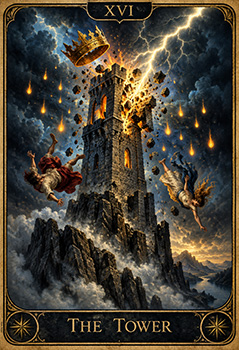
• The Tower → destruction

• The Moon → confusion, illusion, emotional instability

• The Devil → addiction, entrapment, shadow patterns

So what do you do when one of these shows up?

You’ve got two main options.

1. Shelter in Place

Sometimes the best strategy is simple:

Ride it out.

Think of a tornado. You don’t go out and negotiate with it. You don’t try to “manifest” it away.

You get into the storm shelter and wait.

Life sometimes does this:

• Relationship ends

• Job disappears

• Everything falls apart at once

That’s Tower energy.

And sometimes the wisest response is:

“Okay… this is happening. Let’s survive it.”  Hunker down and wait for it to go away.

2. Rise Above It

The Kybalion talks about this strategy quite a bit.

Even if you can’t control the event, you can control your response.

You can:

• shift your perspective

• regulate your emotions

• choose your interpretation

For instance, with The Tower, you can respond to it in one of two ways.

• “This is a disaster. I lost my job, my partner divorced me, I’m out of money. My life is ruined.”

OR

• “This is a reset. I get to rebuild from scratch. My old life is gone, so I get to build my new life exactly as I want it.”

The external event is the same.

The internal vibration is not.

And that makes all the difference.  We haven’t, “cured,” what happened to us, but we’ve vastly diminished it effects on us.

Invoking the Positive Archetypes

Here’s where things get interesting.

Even though archetypes aren’t created by us…

We can align with them.

Think of it less as control and more as tuning in.

Examples:

• Feeling stuck financially? → work with The Empress (abundance, growth)

• Struggling with confidence? → invoke The Emperor (authority, structure)

• Feeling lonely? → connect with The Lovers (connection, union)

• Burned out? → step into The Hermit (withdrawal, restoration)

This can be done through:

• meditation

• visualization

• journaling

• even just keeping the image nearby

You’re not creating the energy.

You’re opening yourself to it and inviting it’s power into your life.

 Conclusion

So what is an archetype, really?

It’s not just a symbol.

It’s not just a psychological idea.

It’s more like a living pattern of energy that moves through human experience.

Sometimes it lifts us.

Sometimes it breaks us open.

Sometimes it sweeps through entire cultures like a storm.

But here’s the key:

You are not powerless in the face of archetypes.

You may not control when they appear,

but you do have a say in how you meet them.

You can:

• recognize them

• name them

• step back from them

• align with the ones that serve you

And over time, something interesting happens:

Instead of being tossed around by these forces…

You start to navigate them.

And that’s really what Tarot is for.

“Just the Tarot,” by Dan Adair – Available on Amazon

Politics and the Tarot

Exploring spirituality and politics.

I admit it:  I’m a political junkie.  I have a lifelong obsession with watching how politics play out in our country and around the world and it hasn’t diminished much as I’ve aged.

In part, that may be a generational thing.  I grew up during a time when people had, “the daily paper,” delivered to their front porch every morning. When every family had subscriptions to magazines like Time and Newsweek, and we all gathered around the television to watch the nightly news.  Even movies at theaters frequently started with a recap of the week’s news events.  In many ways, we were FAR more plugged into political events than we are now, even with the advent of the internet.

And so I love it when I see an intersection of this passion – the Tarot – and that passion – politics.  Put very simply, I love watching Tarot readers trying to figure out what in the HELL is going on with our crazy politics at any given time.

By far and away, my current favorite is Touched by Tarot and Beyond, which is a YouTube channel run by a woman named Afefe, who is a psychic reader and retired journalist.  She posts online readings a couple of times a week and she’s amazingly accurate.  Just for grins I kept track of her predictions over a period of a month and she was right on about 85 to 90% of the time.

And, yes, she is unapologetically political and progressively liberal and her readings are all over our insane political happenings.

SPIRITUALITY AND POLITICS

Now, I have several friends who are deeply into spirituality and turn up their noses at politics.    There are a couple of reasons for that, as near as I can tell.

The first is that many folks who are on the spiritual path are empaths.  As empaths, we tend to absorb whatever energies are coming our way and the energy of our current politics is SO toxic.  For an empath, reading the morning news can be like drinking a cup of poison for breakfast.  Sooner or later, it’s going to make them sick, so they try to avoid it.

The second reason that many New Agers avoid politics is that they have a sort of a more-spiritual-than-thou attitude.  Politics are common and mundane and not at all like the high minded path that spiritual people are supposed to tread.  

In that model, we’re supposed to rise above the mere physical – politics – and keep our noses pointed toward the Higher Powers.  We meditate, do yoga, take sound baths, and chant.  We do NOT indulge in the hatred and division that can come along with political discourse.  

Of course, when an increasing number of our fellow humans are being arrested, tortured, and cut off from food and shelter, the question arises:  where is your compassion?  Where is your love?  If you see someone suffering and do nothing to alleviate it, how spiritual ARE you, really?

And so, spirituality can become a good excuse for doing nothing and feeling comfortable about it.  I completely understand people who simply can’t follow politics because it burns them out energetically.  People who just feel that they’re somehow above it all, though?  Not so much.

TRACKING THE CRAZINESS

One of the most fascinating things I see happening with political Tarot readings is the vastly increased difficulty in predicting what’s going to happen.

As I’ve said many times before, a Tarot reading is just a snapshot in time.  It’s not written in stone.  A Tarot reading gathers in all of the relevant factors from the past and the present and – based on those factors – makes a prediction about what the probable outcome will be.  

Now, built in to that process is the idea that people are . . . well . . . predictable.  By the time that we become adults, most of us have a pretty predictable set of behaviors.  We have fairly firm political and religious beliefs. We tend to dress a certain way and behave a certain way. We react emotionally a certain way.  We’re introverts or extroverts, Republicans or Democrats, liberals or conservatives.

Unless we undergo a mental breakdown or a personal disaster, we’re very unlikely to deviate from those behaviors and so the outcome of a Tarot reading is easy to ascertain.

Normally, politics follow along those same lines.  Cultures and societies actually change at a much slower pace than individuals do, and it’s fairly easy to predict what directions they’re heading in.

Until now.

Our culture and society are changing at such an incredibly rapid rate that it really is hard to predict which direction we’re going in next, even with a deck of Tarot cards.

THE CHAOS FACTOR

The reason for that is that we’re seeing deliberately induced chaos.  Normal patterns of behavior are being disrupted to a point where our society is shaking apart.

One of the favorite expressions of the Silicon Valley techies is, “Move fast and break things.”  In other words, don’t plan what you’re going to replace something with before you break it – just break it and let chaos fill in the void.

Another conservative aphorism is, “flood the zone.”  That means introducing so many crazy changes so fast that a normal human attention span simply can’t keep up with them.  Eventually, we give up and shut down.

Which is exactly what we see in the news every week.  It jumps from the Epstein files to killing people in fishing boats to invading Iran to shooting demonstrators.  It’s literally one crisis after another with no respite.  Just when you think it can’t get any crazier, it does.  

Chaos has always been a factor in human existence.  Cultures have enshrined that principle in the idea of, “tricksters,” like Loki or Coyote’ or Satan, who basically just like to fuck things up and see what happens.  

Scientists call it, “entropy.”  The tendency of organized systems to fall apart.

We seldom, however, see political leaders deliberately inducing chaos as we do today. It makes rational prediction way more complicated.

RECLAIMING OUR GROUND

Of course, all of this is quite intentional.  When we’re constantly frightened or angry – AKA fight or flight response – the parts of our brains that are logical and creative shut down.  Brain scans show that we literally lose our ability to think rationally and judge what’s going on.  

Margaret Lynch Raniere refers to this as being, “hijacked.”  Our normal personalities are taken over by the fight-or-flight response, we’re flooded with cortisol and adrenaline, and we become . . . someone else.  Someone who lives in fear and anger.  Someone who has no compassion.  Someone who is incapable of empathy.

This is where political Tarot readings can re-introduce a level of sanity by giving us perspective.  

The Moon card may tell us that – no, it’s not just us – things really ARE crazy right now.

The Emperor reversed may tell us that the King is crazy as a loon and meaner than a constipated crocodile.

The Hierophant reversed may tell us that religion is being twisted and the land is full of false prophets.

The readings can’t change reality.  They don’t magically make things better.  But they do tell us what’s actually going on behind the smoke and mirrors.  They give us the ground to stand on while it all unfurls, rather than simply being swept away by the tides of fear and anger.

Hunter Thompson once said, “Things never got crazy enough for me.”  Perhaps if he’d lived a few years longer . . .

“Just the Tarot,” by Dan Adair – available on Amazon.

The Empress and the Courage to Be “Unproductive”

The Empress Archetype and Relaxation as a Way to Nurture Creativity.

In my Empress affirmation poster, I paired her image with the words:

Nurture Creativity

This may be one of the most misunderstood instructions in the entire Tarot.

  Empress Affirmation Poster – Available on Etsy

Because most of us have been trained to believe that creativity comes from effort. From discipline. From pushing harder. From sitting at the desk and refusing to get up until something happens.

That approach belongs to The Emperor.

The Empress operates differently.

She does not force growth.

She allows it.

She creates the conditions in which growth becomes inevitable.

Creativity Cannot Be Forced

Every creative person eventually encounters this paradox.

The harder you try to force creativity, the more it retreats.

You sit at your desk, determined to produce something brilliant. Hours pass. Nothing happens. Your mind feels like dry soil.

And then, days later—while taking a walk, washing dishes, or doing something completely unrelated—an idea appears effortlessly.

It arrives whole.

Not constructed, but received.

Albert Einstein understood this phenomenon. When asked how he discovered the theory of relativity, he didn’t describe grinding intellectual labor. He said simply:

“It just dropped in while I was playing the piano.”

He wasn’t forcing the insight.

He was allowing it.

This is Empress energy.

The Forgotten Value of Leisure

The philosopher Josef Pieper wrote a remarkable book titled Leisure as the Basis of Culture. In it, he argues that leisure is not the absence of productivity, but its foundation.

Leisure, in its true sense, is not laziness in the modern, pejorative sense. It is a state of receptive openness.

It is the willingness to stop forcing.

Pieper observed that culture itself—art, philosophy, music, science—arises not from frantic effort, but from spaces of inward stillness.

When we allow ourselves to be idle, something deeper begins to move.

The soil replenishes itself.

Modern society often treats leisure as wasteful. We are taught that our worth is tied to constant activity. But creativity obeys older, quieter laws.

Seeds do not grow faster because you stare at them.

They grow because the conditions are right.

“Just the Tarot,” by Dan Adair – available on Amazon

Julia Cameron and the Act of Creative Nurturing

Julia Cameron’s The Artist’s Way remains one of the most practical and psychologically accurate guides to creativity ever written.

Her central insight is simple: creativity must be nurtured.

Not commanded.

She encourages practices like morning pages and artist dates—not to produce finished work, but to create space for the creative self to emerge naturally.

These practices are Empress practices.

They say to the creative mind:

You are safe here.

You are allowed to emerge in your own time.

And when that safety is present, creativity begins to flow again.

The Courage to Be “Lazy”

This is perhaps the most radical lesson of The Empress.

You must allow yourself to be, at times, unproductive.

Not because you are weak.

But because you are cultivating fertility.

What appears to be inactivity is often incubation.

Beneath the surface, ideas are forming. Connections are being made. Your subconscious is doing its work.

If you constantly demand output, you exhaust the system that produces it.

The Empress reminds us that rest is not the opposite of creation.

It is part of creation.

Nurture Creativity

The Empress does not shout. She does not command. She invites.

She reminds us that creativity is not a machine, but a living process.

It responds to kindness.

It responds to patience.

It responds to nourishment.

When you stop trying to force creativity and begin nurturing it instead, something remarkable happens.

Ideas begin to arrive again.

Quietly.

Effortlessly.

Like seeds finding their way toward the light.

So when The Empress appears in your readings—or quietly makes herself known in your life—it is not a signal to push harder. It is an invitation to soften. She asks you to step out of the mentality of force and into the rhythm of cultivation. To rest without guilt. To follow your curiosity. To trust that creativity, like all living things, emerges when it is nourished rather than commanded.

 She reminds you that you are not a machine designed for constant output, but a garden capable of extraordinary growth. Your task is not to force the flowers to bloom, but to tend the soil and allow them to emerge in their own time.

The Four of Swords: ReCreation

Recreating ourselves through rest. An exploration of the Four of Swords.

If you’re feeling stuck, exhausted, or strangely unmotivated right now, the Four of Swords may have a valuable message for you.

In the traditional Tarot, the Four of Swords depicts an armored knight lying in deep slumber. Three swords hang above him; one rests beneath him. It’s a card associated not just with rest, but with recovery. We often see it when someone has gone through a physically or emotionally traumatic experience and simply needs to become as quiet as possible in order to heal.

But there’s a subtler message here — one that goes beyond simple rest.

It’s about re-creation.

When we’re physically ill, we’re encouraged to sleep as much as possible. Why? Because the body heals in stillness. Damaged cells are repaired. Infections are fought. New, healthy tissue is created. We intuitively understand that the human body is self-healing — if we can just turn off the busy mind and get out of the way.

The same principle applies emotionally and spiritually.

When we’ve been wounded — by stress, burnout, loss, disappointment, or simply too much striving — our instinct is often to withdraw. To reduce contact. To go quiet. That instinct isn’t weakness. It’s wisdom.

That’s what I was emphasizing in my Tarot affirmation poster for the Four of Swords: sometimes the periods when we feel least productive are actually the periods of our greatest growth.

Tarot Affirmation Print available on Etsy.

The Cultural Problem

Part of the struggle comes from the culture we swim in.

From the time we’re children, we’re trained to work harder, move faster, achieve more. Rest is framed as a brief pit stop before we re-enter the race. Productivity is virtue. Exhaustion is normal.

So when we find ourselves demotivated or depleted, our first reaction is usually self-criticism.

“I don’t know what’s wrong with me.”

“I just can’t get it together.”

“I feel stuck.”

But what if nothing is wrong with you?

What if you’re not broken — you’re rebuilding?

What if your body, mind, and spirit are quietly saying, “You need time. You need stillness. You need space.”

The tragedy is that the more we fight that message, the longer the recovery takes. We override the natural healing cycle because we’re afraid of falling behind.

Nature Doesn’t Apologize for Rest

Look at Nature.

The Earth explodes into life in the Spring.

She flourishes in Summer.

She releases in Autumn.

She rests in Winter.

Do you imagine the Earth berating herself all Winter long? Does she panic and whisper, “I should be more productive”?

Of course not.

Rest is part of the cycle.

Contraction makes expansion possible.

Stillness prepares the ground for growth.

And yet, though we are children of the Earth, we rarely grant ourselves the same permission.

Reframing “Stuck”

When we hit a slack period — when progress stalls and energy feels low — we can frame it in one of two ways.

We can tell ourselves we’re lazy, depressed, failing, falling behind.

Or we can recognize that we’re in a season of restoration before the next expansion.

Because that is precisely what often happens.

When we release our grip — when we stop forcing clarity, stop chasing momentum, stop judging ourselves — something begins to recalibrate beneath the surface. Just as the body eliminates toxins during sleep, the psyche releases old narratives during rest.

We may not consciously see it happening. Our subconscious may be reorganizing itself in silence. Old wounds may be dissolving. A new identity may be forming.

The Four of Swords is not stagnation.

It is sacred pause.

It is integration.

It is ReCreation — not recreation as distraction, but re-creation as transformation.

And if we can trust that process, if we can stop fighting it, those quiet, stuck-feeling days may turn out to be the very foundation of our next, beautiful phase of growth.

Sometimes the most powerful thing we can do is lay down the sword — and let ourselves become new.


“Just the Tarot,” by Dan Adair – available on Amazon