The Devil and the Problem of Unconscious Choice

The Devil Card and the need for choice before morality.

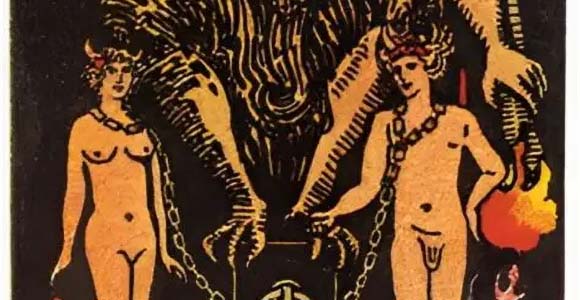
One of the most frequently discussed details in the Rider-Waite-Smith Devil card is the chains.

The naked man and woman stand chained to the black pedestal beneath the Devil, but a closer look reveals something peculiar. Their hands are completely free, and the chains around their necks are so loose that either figure could simply lift the loop over his or her head and walk away.

That gives us one of the standard interpretations of The Devil: we are often imprisoned by things that we can walk away from if we choose to do it.

It’s a powerful interpretation, and one I’ve discussed before. (See my previous post The Devil Card and Freedom.) But it raises another question that may take us deeper into the card.

What if the people don’t know that they can take the chains off?

Why Don’t They Take Off the Chains?

When we look at the picture, knowing that the chains are loose, their behavior seems completely puzzling.

Why don’t they simply leave?
One answer might be that they just don’t want to.  They might actually be enjoying whatever’s keeping them in chains.  Maybe they like getting drunk.  Maybe they’re having a really hot secret affair with their next door neighbor and it feels mighty fine.  Maybe they like being an addict.

But when we look carefully at the card, it doesn’t look like they’re making any kind of conscious decision at all.

Look at them.

They aren’t struggling against their chains.

They aren’t examining them.

They aren’t looking toward one another for help.

Most strikingly, neither of them is looking at the Devil.

There is an enormous, gigantic, scary, horny creature looming immediately behind them, and they seem almost completely unaware of his presence.

The man is even more remarkable. The Devil holds a flaming torch downward toward him, and the man’s tail has caught fire.

He doesn’t seem to notice.  Really?  Wouldn’t you notice it if your tail caught fire?  I know I would.

But maybe we’ve been asking the wrong question.

Instead of asking “Why don’t they choose to remove the chains?” perhaps we should be asking:

“Do they realize they’re wearing chains at all?”

Do they even realize that they’re slaves?

The Devil We Don’t See

This gives us a very different way of understanding the card.

The Devil represents something we haven’t yet seen.

We could make a serious case for the idea that most of us don’t make conscious choices about our lives.  Oh, we think we do and we like to brag about how well informed we are, but do we really?

There are, of course, marvelous exceptions but most of us are born in a particular rut and stay in that rut for most of our lives.  If we were born into a Christian family, we’ll probably stay Christians.  If our parents always voted Republican, we’ll probably vote Republican.  If we were born middle class, we’ll probably die middle class.  

We can say the same thing about our habitual ways of thinking.  If our parents were cynics and viewed the world skeptically, we will, too.  If our parents were depressive or angry, we’ll probably be depressed or angry, too.  If we were raised in a racist family, we’ll most likely be racist adults.

By the time we reach adolescence, we are thoroughly programmed little robots.  We may get a nose ring or a tattoo and call it rebellion, but soon enough we return to the rut we were born in.

And all the while, WE HAVE NO IDEA that we’re not making our own choices.  In fact, a part of the programming we receive is that we have freedom of choice when we really don’t.

It might be a belief inherited from our parents. It might be an assumption about money, sexuality, success, relationships, gender, class, religion or respectability. It might be a fear acquired in childhood. It might simply be a habit repeated for so many years that we’ve forgotten there was ever another way of behaving.

We don’t say, “I have chosen this.”

We say, “That’s just the way things are.”

And that may be one of the most powerful chains of all.

Morality Requires Choice

This brings us to perhaps the most provocative aspect of The Devil.

We traditionally associate the Devil with immorality. But what if the deeper problem depicted by the card is not immoral choice at all?

What if it is the absence of conscious choice?

In Jung and Tarot: An Archetypal Journey, Sallie Nichols writes:

“Without freedom to choose, there can be no true morality. The fact is that most of us today have more free choice than we realize; but many, still unconsciously imprisoned within cultural mores, refuse to accept the responsibility for moral choice.”

That distinction is crucial.

Morality isn’t simply obedience to a collection of rules. Genuine morality requires the ability to recognize alternatives, understand consequences, and then choose among them.

If I behave in a particular way merely because “that’s what people do,” I haven’t necessarily made a moral decision.

If I follow a religious commandment without ever examining it, I may be obedient—but obedience and morality aren’t the same thing.

If I repeat the prejudices of my culture because I’ve never recognized them as prejudices, I haven’t consciously decided that they are right.

And if I hurt another person while blindly acting out an unconscious fear or compulsion, the consequences remain real even though I may never have consciously intended them.

Consciousness creates the possibility of moral choice.

That’s where The Devil becomes considerably more complicated than a card about temptation or sin.

The people beneath him may not be wicked.

They may simply be asleep.

The First Act of Freedom Is Seeing the Chain

That brings us back to the apparent paradox at the center of the picture.

The couple are free. And they aren’t free.

Objectively, nothing prevents them from lifting those chains from their necks. Subjectively, however, they may have no idea that such a possibility exists.

Freedom therefore requires something before choice. It requires awareness.

We have to see the chain. We have to recognize the Devil standing behind us.

We may even have to notice that our tail is on fire.

Only then can we decide what we’re going to do about it.

Perhaps that is why The Devil occupies such an important place in the Major Arcana. He confronts us not simply with our appetites or our bad behavior, but with the uncomfortable possibility that forces we haven’t recognized may be making some of our choices for us.

The moment we see those forces clearly, something changes. We may still choose to remain exactly where we are.  But now it really is a choice.

What The Devil Means in a Reading

When The Devil appears in a reading, then, the question may not simply be “What has you trapped?”

A more useful question might be:

“What are you taking for granted that you have never consciously chosen?”

Look for the invisible assumption behind the situation. A relationship pattern, an inherited belief, a fear, a social expectation, a desire, an old family rule, or simply the conviction that “I don’t have any other choice.”

The card doesn’t necessarily tell you to break the chain.

It asks you first to see it.

Because once the chain becomes visible, you can finally decide whether to keep wearing it.
THE DEVIL CARD AND FREEDOM

Exploring the element of choice with The Devil card.

It’s always a little scary to get The Devil card in a Tarot reading.  Based on the famous illustration of Eliphas Levi’s Baphomet, we see a large, horny critter with bat wings looming over a hapless couple in chains.  Not only do they look miserable, but their tails are actually on fire.  

Which has always seemed like a bit of an overreaction to me.  It’s bad enough to take away their clothes and chain them to a black altar.  Lighting their tails on fire is just plain mean.

When we get this card in a reading, we can assume that (a) we are personally in a really bad, low-vibration place or (b) we’re involved with someone else who’s in that sort of a space.  

There’s also a school of thought that The Devil card can indicate black magic.  Perhaps we pissed off someone and they whomped a hoodoo on us.  Maybe that person we broke it off with romantically is spending their Saturday nights burning black candles and sticking pins into a picture of us.

And that can be true.  I don’t want to downplay that possibility, but it tends to miss one of the most important messages of this card, which is CHOICE.  

When we get involved in or stay in a really dark place, it’s the matter of whether we choose to be there that determines whether it’s evil.

THE CHAINS AROUND OUR NECKS

There are so many things that we think of as being, “evil,” that can feel like chains around our necks.  

Drug addiction.

Alcoholism.

Abusive relationships.

Codependency.

All of those can feel as if we’re literally enslaved.  We may know in our hearts that we’re in a really bad space and feel constant misery over it.  But, without help, we may be powerless to escape from the bottle, the needle in the arm, the slap across the face.

Sadly, there are many people who casually assume that people in those situations just don’t want to be free of them.  We saw that in the so-called, “war on drugs,” where the advice was, “just say no to drugs.”  

The reality of being an addict, of course, is that you CAN’T say no to drugs.  That’s why we call them addicts, right?

We also see it in the judgment that people ladle out to women who are enmeshed in abusive relationships.  “Why don’t you just leave him” we ask.  “What’s wrong with you?”

What’s wrong with them is that they don’t know HOW to leave an abusive relationship.

And codependents may lose their entire lives “saving,” other people because they haven’t got a clue about how to set up healthy boundaries.

So, in all of these situations, there’s one element in common:  a lack of choice.  And you can’t make a choice to be evil if you can’t make a choice at all.

HOW LOOSE ARE THE CHAINS?

When we zoom in a little closer on The Devil card, we make an astonishing discovery:

Their hands are free and the chains around the couple’s necks are so loose that they could easily be lifted right over their heads.  

In other words, their apparent slavery is entirely a matter of choice.  They could, at any moment, remove the chains and walk away, but they CHOOSE not to do it.

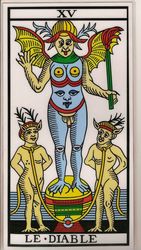
This was actually a major change in the way that this card was designed.  In the older, Marseille deck we see the same couple, but their hands are bound tightly behind them and the ropes around their necks can’t be moved.  

A.E. Waite and Pamela Coleman Smith deliberately decided to incorporate the element of choice in portraying evil when they designed this card.  

Why did they take this radical step?

MENTAL ILLNESS AND EVIL

The Waite-Smith Tarot deck was released in 1909, which was the tail end of the Victorian Era in England.  This period saw massive changes in the way humans lived, mainly brought on by the Industrial Revolution and mass manufacturing.  

One of the areas that saw the greatest changes was the legal system and the ways in which we think about crime.  In particular, what emerged was the concept that a person couldn’t commit a crime if they were insane.  

In a nutshell, if a person was so deranged that they didn’t know what they were doing was wrong, or if they had an irresistible impulse that made it impossible for them to NOT act in a particular way, then they weren’t making a CHOICE to commit a crime and couldn’t be found guilty of it.

For us, that notion is completely commonplace.  Not guilty by reason of insanity is a phrase that we hear all the time.  But that idea of choice determining evil wasn’t in play until about 150 years ago and I’m guessing that’s why we saw the change in The Devil card.  

WHY IT’S IMPORTANT

Now, you may be wondering what all of this has to do with doing an actual Tarot reading and that’s a fair question.

There’s a subtle nuance here that’s important to recognize and that has to do with freedom.  The people portrayed in The Devil card are free to walk away from what they’re doing.

Which really feels counter-intuitive.  When we look at the card, we see that they’re chained and completely dominated by the Devil critter.  At first glance, it seems that they’re not free at all.

But they are.  They’re not insane.  They’re not compelled to be there.  They choose to be there.

And so, when we pull this card in a reading, we can emphasize that.  We can actually look at this card and tell a client, “Yeah, you’re in a bad space, but you can change all of that.  You don’t have to go on being miserable.  You can walk away from it and be free.”

And that’s HUGE.  That gives the client agency in a situation where they may feel totally trapped.  It tells them that their freedom is in their own hands, if they decide to take it.

ALTERNATIVES

Now, again, I want to emphasize that this isn’t the only interpretation of The Devil card.  If, for instance, we saw the Devil paired with The Moon, then we might actually be looking at issues like insanity or serious delusions.

If we saw The Devil paired with The Magician reversed, we might infer that there really IS some black magic going on.  Always look at the surrounding cards.

By far and away, though, The Devil is a card of choice, of choosing to live in negativity and low vibrations.  That’s not good news, of course – no one wants to exist like that.  But freedom grows out of choices and that IS good news.

“Just the Tarot,” by Dan Adair.  Available on Amazon.

Donald Trump and the Dark Archetypes of the Tarot

A closer look at the dark archetypes the Donald Trump embodies and has brought into our national consciousness.

Most of us embody certain archetypes as we move through life.

Some of us are “The Wounded Healer” and endeavor to share our personal healing with others. Some of us are “The Magical Child,” who lead others back to their own creativity and wonder. Yet others are “The Wizards,” who have a deep understanding of life’s mysteries.

Donald Trump seems to embody several archetypes symbolized in the Tarot—none of them good—and it might be interesting to take a look at them.

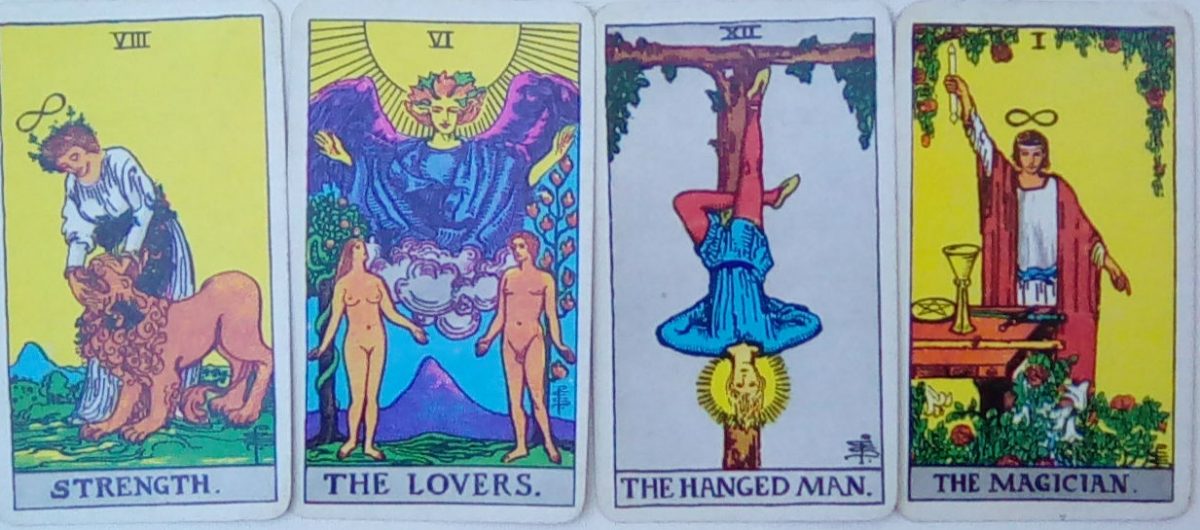
THE MAGICIAN REVERSED

In order to really understand this one, we need to look at the older version of The Magician from the original Tarot decks. Contrary to the shining image portrayed in the modern decks, The Magician was much more of a street performer than an occultist. The closest we have to that in modern life is the stage magician who makes flowers appear out of his sleeve or pulls rabbits from his hat. In a word, he was an illusionist.

Another version of that is what is referred to as a “flim-flam man” in the South. He’s the guy who sets up three shells on a table and you have to guess which one the pea is hidden under while he shifts the shells faster than the eye can see. He’s also known as a con artist.

Trump is very much in that tradition. From his fake university to his fake charities to his golden tennis shoes and engraved guitars, he’s been conning people his entire life. He is such an excellent illusionist that he’s actually managed to con his way into the White House—not once but twice.

THE HIEROPHANT REVERSED

The Hierophant is basically a religious leader—more specifically, a leader of a formal religion rather than a spiritual path. When he’s reversed, he’s a false teacher, a pastor who’s leading his sheep-like followers down a path to the slaughterhouse.

This “religious” aspect of Trump may be the most surprising of all. As many people have noted, his most devoted followers have all of the characteristics of cult members. Despite the facts that he’s a serial adulterer, a pathological liar, a convicted felon, and an adjudicated rapist, they’re convinced that he’s been sent by God to watch over the United States. He’s violated every single teaching of Jesus Christ, yet he’s become the de facto leader of Christian nationalism.

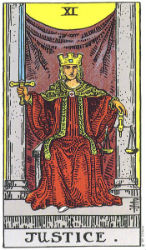
JUSTICE REVERSED

The Justice card is strongly associated with the legal system. Quite simply, when it’s upright it indicates a fair and balanced outcome in the law. Reversed, it indicates injustice and a lack of fairness.

Using his immense wealth and a stable of crooked lawyers, Trump has managed to evade 90% of the legal consequences that he should have faced. Yes, he fomented an insurrection; yes, he stole top secret documents and lied about it; yes, he’s committed one impeachable offense after another. But he continues to skate on the consequences. When his pet attorney general says, “No one is above the law,” she means no one but Trump.

THE DEVIL

If The Lovers card exemplifies love, then The Devil exemplifies hate. Trump is very fond of saying that he hates his opponents, he hates Democrats, he hates liberals, and he hates immigrants. In many ways, he’s hatred and vindictiveness personified.

Moreover, The Devil is a card of people being chained to their basest instincts. Trump has an amazing power to bring out the very worst in people. In just a few short years, he’s managed to turn half of the country into xenophobic, homophobic, misogynist racists who are happily ripping up our Constitution in order to celebrate their prejudices.

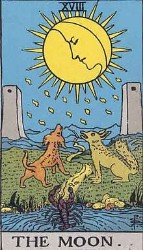
THE MOON

At its root, The Moon is the card of insanity. It’s the card of both delusions and illusions. You only have to listen to one of Trump’s speeches to know that he’s out of his mind. From rambling about sharks eating electric boats to windmills driving whales insane to his obsession with toilets that won’t flush, he’s a never-ending fountain of gibberish and word salads.

And beyond that, he drives the rest of us to the verge of insanity. He’s like this brain virus that’s slowly eating away at our serenity and sense of well-being. His view of the world is so skewed, so bizarre, so out of touch with reality that it’s astounding—and yet, here he is in our daily lives, ranting and raving and frothing at the mouth.

CONCLUSION – NAMING THE ARCHETYPES TO WEAKEN THEM

Archetypes are powerful forces shaping our destinies, our worldviews, and even our collective behavior. When they surface on a national scale, they can feel like hurricanes we can only endure.

But awareness is its own kind of power. By recognizing these archetypes and calling them by name, we loosen their grip. We stop being unwitting participants in someone else’s drama and begin to reclaim our agency. In a time when dark archetypes seem to walk among us, simple recognition is a first act of resistance.

“Just the Tarot,” by  Dan Adair – a kindle ebook available on Amazon