For years, I’ve been fascinated by a simple question:
What if Tarot isn’t primarily about predicting the future?
What if the cards are actually showing us where we’re aligned—or misaligned—with our deeper path?
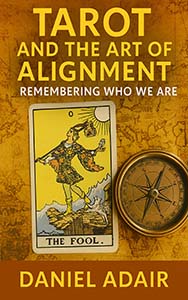
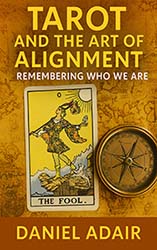
That question eventually grew into my new book, Tarot and the Art of Alignment.
Of course, behind that question lies another one that human beings have been asking for thousands of years:
Why am I here?
We phrase it in many different ways:
* What is my purpose in life?
* Do I have some sort of destiny?
* Why did I incarnate in this place and time?
* Or, on particularly difficult days: What in the HELL is all of this about?
Philosophers, psychologists, and spiritual teachers have all recognized that human beings have a deep need for meaning in their lives. It isn’t enough to simply wake up, go to work, buy things, pursue pleasure, and repeat the process until our inevitable deaths.
We long for something more.
We need a sense of purpose. We need to feel that our lives matter, that our struggles and triumphs are part of a larger story. Without that sense of meaning, life can begin to feel exactly what the word suggests: meaningless.
Over time, it began to dawn on me that the answer to those questions might be found in the Tarot.
Most of us use the cards to ask questions about the future:
* What is my week going to be like?
* Should I take this job?
* Is this relationship headed somewhere meaningful?
* Am I making the right decision?
When we stop and think about it, that’s actually a remarkable process.
Whenever we lay out the cards, we operate from the assumption that we’re tapping into a source of wisdom greater than our ordinary awareness. Whether we call that source Spirit, the Universe, God/dess, Higher Self, Angels, Guides, or simply the deeper unconscious mind, we trust that the cards can reveal information we don’t consciously possess.
And if that greater source can offer guidance about a career decision, a relationship, or whether we’re headed in the right direction, then surely it can help us answer the most important question of all:
Why am I here?
That realization led me to begin experimenting with a different way of reading the cards.
Instead of asking the Tarot to predict what might happen next, I began asking it to reveal who I am, why I’m here, and whether my life is aligned with my deeper purpose.
I also began using the cards as an ongoing check-in system—a way of determining whether I was moving toward greater alignment or drifting away from it.
This book is the result.
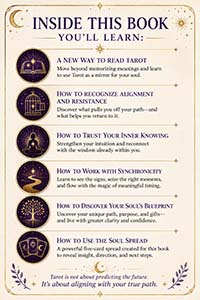
Rather than teaching hundreds of card meanings to memorize, the book explores a different approach. It shows how Tarot can become a mirror that helps us recognize alignment, resistance, intuition, synchronicity, and purpose.
At its heart, Tarot and the Art of Alignment is about learning to see the cards as a conversation with the deeper self.
The Tarot has always been rich with symbols, archetypes, and spiritual lessons. Yet many readers become trapped in the endless task of memorizing meanings and predicting outcomes. This book shifts the focus from fortune-telling to self-discovery. The question is no longer, “What will happen to me?” but rather, “Who am I becoming?”
Through the practices and spreads presented in the book, you’ll learn how to identify the beliefs that keep you stuck, reconnect with your intuition, recognize meaningful patterns and synchronicities, and uncover the deeper purpose that has been quietly calling to you all along.
At the heart of the book is a model I call The Tarot Alignment Process.
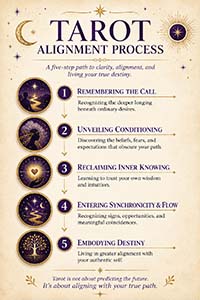
The first step is Remembering the Call. This is the moment when we become conscious of our deep hunger for meaning and purpose. We stop drifting through life and begin to recognize that something within us is calling for a more authentic way of living.
The second step is Unveiling Conditioning. Here we examine the beliefs, fears, expectations, and assumptions that have caused us to forget who we really are. We explore the ways that family, culture, education, and society have shaped our identity—and often obscured our deeper truth.
The third step is Reclaiming Inner Knowing. Through Tarot and self-reflection, we begin to trust our own wisdom again. We learn to listen to the quiet voice within that knows why we came into this life and what we are here to contribute.
The fourth step is Entering Synchronicity and Flow. We discover how our emotions, life circumstances, and meaningful coincidences can serve as guides, helping us recognize when we are moving in harmony with our deeper purpose.
And finally, the fifth step is Embodying Destiny. Rather than seeking occasional moments of inspiration, we learn how to stay aligned over time, using the Tarot as an ongoing tool for guidance, self-correction, and growth.
Looking back, I realize that I’ve spent years exploring these themes through Tarot readings, blog posts, synchronicity, personal experience, and spiritual study. This book is my attempt to gather all of those threads together into a single framework.
Over the next several weeks, I’ll be exploring many of these ideas here on the blog, including alignment and resistance, synchronicity, the Soul Spread, and why difficult Tarot readings may not be bad news at all.
If those topics interest you, I hope you’ll join me for the journey.
Tarot and the Art of Alignment
The book is now available as an Amazon Kindle edition:
Or as a downloadable PDF edition:
Remember:
Tarot is not about predicting the future.
It’s about aligning with your true path.


