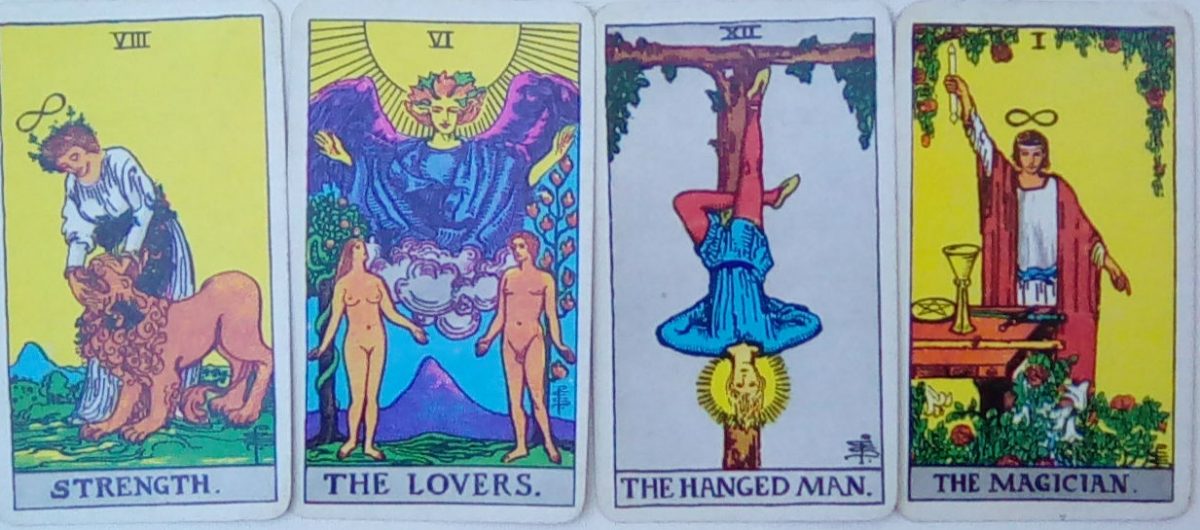

In my previous post, “10 Tarot Cards That May Indicate a Blocked Root Chakra,” we explored how Tarot can reveal energetic patterns related to fear, insecurity, survival struggles, and grounding issues. Those are all first chakra issues.
So now, let’s look at the Root Chakra in a little more depth.
The Root Chakra, or Muladhara, is located at the base of the spine and is traditionally associated with the color red. It serves as the energetic foundation of the chakra system, governing our sense of safety, survival, stability, and belonging.
Its symbol is a four-petaled lotus, often interpreted as representing the four directions—north, south, east, and west—symbolizing our connection to the physical world and our grounded presence within it.
Its seed syllable, or bija mantra, is LAM, a sound traditionally used in meditation to strengthen and activate Root Chakra energy.
When balanced, this chakra allows us to feel safe in our bodies and secure in the world. When blocked, however, it can create profound ripple effects throughout every other area of life.
CHAKRAS AND DEVELOPMENTAL PSYCHOLOGY
One of the most interesting things about chakra work is that it’s really a method of developmental psychology.
What do we mean by that?
Developmental psychology posits that there are certain, “goals,” that we have to achieve as we develop into complete human beings and achieving one goal helps us to achieve the next goal.
To use a really simple example that’s become a cliche’, we have to learn how to walk before we run. When we look at an infant, we can see that that’s literally true: the child’s body has to develop the muscular strength to walk before she can run.
In the same sense, the child has to learn to make sounds before he can make words and has to learn what words mean before he can make sentences. Each developmental step leads into the next.
The important point here is that if we don’t fully achieve the first step, it makes it more difficult to achieve the next step.
While all of that is going on with our physical bodies, there’s a similar development happening with our energetic bodies, i.e. the chakra system.
Each chakra actually develops at a particular phase of our lives and – if it doesn’t develop right – that causes problems in the next chakra, which causes problems in the next chakra, and so on.
LOWER CHAKRA DEVELOPMENTAL STAGES
Chakra One (Root Chakra)
Womb to 12 months
Develops our sense of safety, security, and trust in life.
Chakra Two (Sacral Chakra)
6 months to 2 years
Develops personal identity, emotional experience, and selfhood.
Chakra Three (Solar Plexus Chakra)
18 months to 3.5 years
Develops ego strength, confidence, and our ability to project ourselves into the world.
Chakra Four (Heart Chakra)
3.5 years to 7 years
Develops our ability to form loving, healthy relationships.
Here’s how that looks in the lower chakras:
So, if the first chakra doesn’t develop correctly, then we don’t feel safe in the world.
If we don’t feel safe in the world, then we’ll try to hide who we really are, so the second chakra won’t develop well.
If we try to hide who we really are, then we’ll never have the confidence to project ourselves into the world in a healthy way, so the third chakra won’t develop.
And if we don’t have a strong ego structure, then we can’t develop healthy relationships, so the fourth chakra becomes stunted.
Each step leads to the next, right?
FIRST CHAKRA ISSUES
In her powerful book: “Unblocked: A Revolutionary Approach to Tapping into Your Chakra Empowerment Energy to Reclaim Your Passion, Joy, and Confidence”, Margaret Lynch Raniere suggests that the Inner Child essentially lives within the Root Chakra.
This is a profound concept because it means the first chakra contains the earliest energetic blueprint for:
* Safety
* Security
* Trust
* Survival
* Worthiness of care
According to this model, Root Chakra healing often comes down to two essential early-life questions:
1. Did we feel safe?
2. Were our needs met?
The answers to these questions become deeply wired into both our nervous systems and our energetic systems.

DID WE FEEL SAFE?
That’s actually a fairly complex question. If we were born into extremely abusive or dysfunctional families, it’s fairly easy to surmise that we didn’t feel safe. If we were being slapped around or screamed at as a helpless infant, obviously we wouldn’t feel safe.
Remember, though, that the first chakra forms – not just in our first year – but also in the womb. During that period when we were gestating inside of our mother’s bodies, we were basically immersed in whatever chemicals and hormones SHE was feeling.
And so the second part of this question is, “Did our mothers feel safe?”
Because, for that period that we were in the womb, her nervous system was our nervous system.
For instance, if our family was going through a period of extreme stress during the time that we were gestating, we can reasonably conclude that our mothers were producing really high levels of cortisol and adrenaline in their bodies. If they were depressed, they may have had chronically low levels of serotonin. And so did we.
Put another way, if our mothers didn’t feel safe, then we didn’t feel safe.
Whatever they were feeling is the emotional set point that we had when we entered the world. If they were extremely anxious, then we were extremely anxious. If they were depressed, then we were depressed.
And we carry that forward into the rest of our lives. If we felt unsafe as infants, we’ll be in chronic low level fight or flight reactions as adults. We’ll be hyper-vigilant, always looking for the next threat.
We may be ungrounded and unfocused because it’s literally painful to be in our own bodies.
We may even be attracted to people who MAKE us feel unsafe as a way to validate our feelings.
WERE OUR NEEDS BEING MET?
As Raniere pointed out, we might think of the needs of an infant as a continuing series of irritations followed by being soothed.
In a healthy family, that runs like this:
Irritation: I’m hungry. Soothing: someone fed me.
Irritation: I’m cold. Soothing: someone covers me.
Irritation: I’m scared. Soothing: someone holds me.
That sets up a pattern in the nervous system whereby we feel that our needs will always be met. And if our needs are met, then we feel safe and secure in the world.
Now, again, we may think of an infant’s needs not being met in terms of the extremes of child neglect. If a child isn’t held and loved they can actually die from failure to thrive. But not having your needs met can exist over a broad spectrum.
We may, for instance, have good, loving parents who simply have too many kids. Raniere touches on this with the fact that she had 8 siblings who also needed to be taken care of by her parents.
As we were talking about in the preceding section, we may have had a mother who was suffering from deep depression or a physical illness and simply couldn’t provide the care that we needed.
And as Gabor Mate’ has pointed out, it’s possible that our parents adopted a child-rearing philosophy where they thought it was actually good for the infant to ignore her needs. If you just let the baby sit its crib and cry, they’ll learn patience, right?
Whatever the reasons, if our needs weren’t being met as infants, that sets up in our first chakra as the expectation that our needs won’t be met as adults.
We can drift into codependent relationships where we’re constantly over-giving in the hopes that our partners will at least meet some of our needs.
We can intentionally seek out partners who aren’t capable of meeting our needs in order to validate our expectations.
Even worse, we may learn to ignore our needs and fail to take care of ourselves as adults. The pattern we learned was, “Something is irritating me and I’m not going to be soothed, so I have to just live with it.” Our levels of self-care, self-love, and self-compassion may be almost non-existent.
MOVING ON TO SOME SOLUTIONS
So in the first post in this series, we looked at some Tarot cards that may indicate that we have a blocked first chakra. In this post, we looked at how that happens. In the next post, I’ll gather together a list of really good resources to help us heal the root chakra and regain a sense of safety in our lives.
Because when we reclaim our foundation, we reclaim the possibility of building a life rooted not in fear—but in genuine security.


One thought on “Understanding the Root Chakra More Deeply: Safety, Survival, and the Foundations of Self”