Temperance is usually defined as moderation, balance, and avoiding extremes. But the imagery of the Tarot suggests something more precise. Temperance is not simply about having less of something—it is about discovering the right proportion between different forces in our lives.
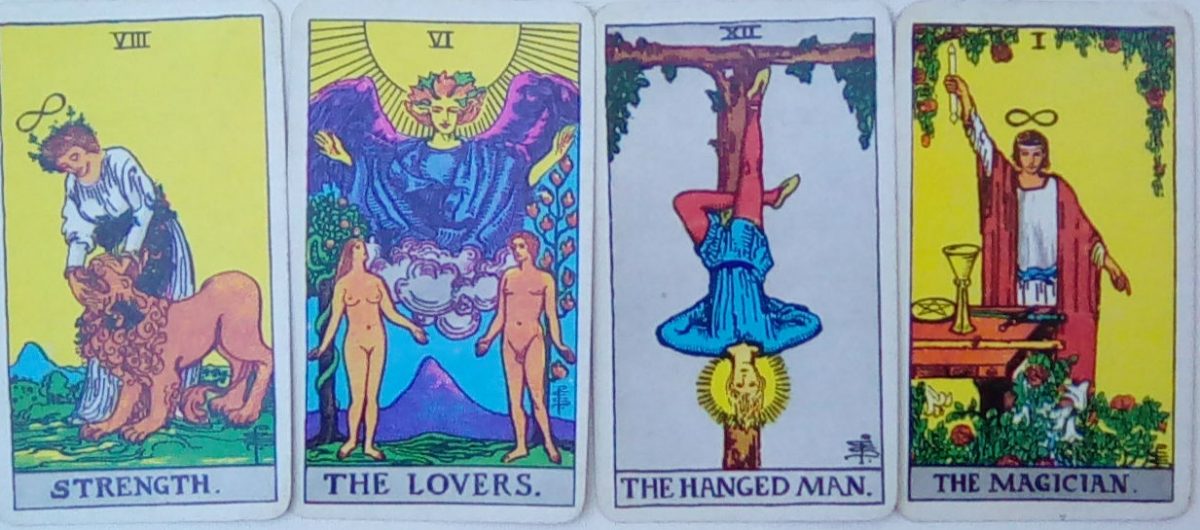
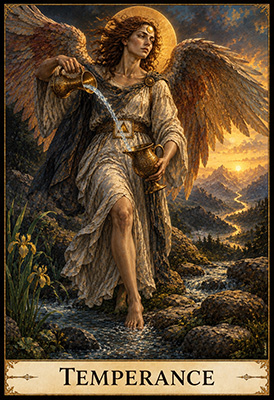
At first glance, Temperance can seem like one of the simpler cards in the Major Arcana. An angel stands quietly, pouring liquid from one cup into another. One foot rests on the earth while the other stands in water. Behind the angel, a path winds toward distant mountains and a brilliant golden light.
Nothing particularly dramatic is happening.
But perhaps that’s the point.
Temperance is about the delicate process of bringing different parts of ourselves—and different parts of our lives—into the proper relationship with one another.
Temperance as a Cardinal Virtue
Temperance is one of the traditional cardinal virtues, along with Justice, Fortitude and Prudence. Three of these virtues survive quite recognizably in the standard Tarot: Justice, Strength (Fortitude), and Temperance. Prudence is conspicuously absent. (For more on the missing Prudence card, see my previous post Dear Prudence – The Mysterious Case of the Missing Tarot Card.)
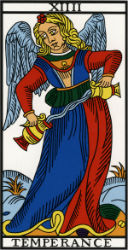
In older Tarot decks such as the Tarot de Marseille, the imagery of Temperance is considerably simpler than that of the Waite-Smith card. We generally see an angelic figure pouring liquid between two vessels.
To modern eyes, pouring something from one cup to another may not immediately suggest moderation. Historically, however, the connection was much more obvious.
The older meaning of temperance was not merely abstaining from excess. The Latin root temperare carries the sense of regulating, combining or mixing things in the correct proportions. Water and wine, for example, could be mixed so that the strength of the wine was tempered.
This gives us the fundamental symbolism of the two cups.
Temperance is creating the right mixture.
And importantly, the right mixture does not necessarily mean equal amounts.
Balance Doesn’t Always Mean 50/50
We often visualize balance as equality. Put the same amount on both sides of a scale and equilibrium is achieved.
Temperance offers a different model.
Suppose you’re making soup. Equal quantities of salt and water would certainly represent equality, but they wouldn’t produce anything you’d want to eat.
The ingredients have to be present in the proper proportions.
The same principle applies to life.
We need work and rest, but that doesn’t mean twelve hours of each every day. We need independence and connection, reason and emotion, discipline and spontaneity. What constitutes the right balance changes according to circumstances.
Temperance therefore represents something more sophisticated than simply avoiding extremes. It asks:
What does this particular mixture require?
That is a dynamic form of balance. The liquid in the card is moving because maintaining equilibrium often requires continual adjustment.
One Foot in the Water, One on the Land
A. E. Waite and Pamela Colman Smith greatly expanded the symbolism of the older Tarot image.
One of their most famous additions is the angel’s peculiar stance: one foot rests on dry land while the other is immersed in water.
Water traditionally represents emotion, intuition, imagination and the unconscious. Solid ground suggests physical reality, stability, practicality and the tangible world.
The angel doesn’t choose between them.
It participates in both.
We could read this very simply as advice to feel deeply without losing our grounding.
Someone who lives entirely through emotion may be swept along by every changing feeling. Someone who insists upon remaining completely rational and controlled may become disconnected from intuition and emotional reality.
Temperance asks for neither extreme.
It asks us to discover the useful proportion between them.
Head and Heart
Something similar appears in the symbols placed upon the angel’s forehead and chest.
It’s entirely possible that these were meant to represent the influences of the heart and brow chakras. And their placement naturally suggests another important polarity.
Head and heart.
Thought and feeling.
Reason and intuition.
Again, the card does not tell us which should win.
Imagine someone deciding whether to remain in a difficult relationship. Their emotions may say one thing while the observable facts say another.
Temperance doesn’t necessarily say, “Ignore your feelings and be rational.”
Nor does it say, “Follow your heart regardless of the evidence.”
Instead it asks the person to bring both sources of information into the same vessel.
What do I feel?
What do I know?
And what conclusion emerges when both are given their proper weight?
That’s Temperance at work.
Justice Weighs; Temperance Blends
This also gives us an interesting distinction between two of the cardinal virtue cards.
Both Justice and Temperance concern balance, but they achieve it differently.
Justice balances by weighing.
Temperance balances by blending.
Justice holds a scale. Separate things are compared against one another until equilibrium is established.
Temperance pours one thing into another. The elements aren’t merely compared—they become part of a new mixture.
That makes Temperance particularly useful when apparently contradictory needs are both legitimate.
Perhaps someone is pursuing an important creative project but becoming exhausted.
The answer isn’t necessarily to abandon the project. Nor is it necessarily to push harder.
Temperance asks a different question:
What proportion of work and restoration will allow the work to continue?
Perhaps the problem isn’t the goal at all.
The mixture is wrong.
The Path Toward the Light
Behind the angel is another important feature: a winding path disappearing into the distance.
It eventually reaches mountains beneath a brilliant golden light, within which appears something resembling a crown.
This introduces movement into an otherwise remarkably still card.
The angel isn’t walking along the road. The angel stands quietly performing the work of integration.
The road comes afterward.
That suggests a beautiful practical interpretation of Temperance. Sometimes we cannot see how to move forward because something within our present situation is badly out of proportion.
We may be working too much and recovering too little.
Thinking endlessly and feeling too little.
Giving constantly and receiving nothing.
Dreaming without acting—or acting without considering where we’re going.
When those elements are brought back into a workable relationship, the next step may become much easier to see.
The balance isn’t the destination.
The balance makes the journey possible.
Temperance in a Tarot Reading
When Temperance appears in a reading, the familiar advice to practice moderation is perfectly valid—but we can make it considerably more useful.
Temperance may be saying:
Something here needs to be brought into better proportion.
That might mean less of something, but it could equally mean more of something that has been neglected.
Too much work may require rest. Too much caution may require a little risk. Excessive emotional involvement may need perspective. Excessive intellectualization may need feeling. Constant giving may need to be balanced by receiving.
The card can also suggest that two things we’ve been treating as opposites don’t actually require an either/or decision. Perhaps they can be combined.
And that brings us back to those two cups.
The angel continually pours between them, adjusting the mixture.
Temperance isn’t asking us to eliminate one part of ourselves in favor of another. It asks us to discover how the different parts belong together.
Find the right proportion. Integrate the opposites. And when the mixture is right, continue along the path.


