THE DEVIL CARD AND FREEDOM

Exploring the element of choice with The Devil card.

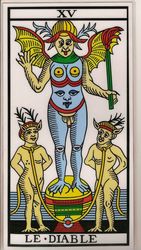
It’s always a little scary to get The Devil card in a Tarot reading.  Based on the famous illustration of Eliphas Levi’s Baphomet, we see a large, horny critter with bat wings looming over a hapless couple in chains.  Not only do they look miserable, but their tails are actually on fire.  

Which has always seemed like a bit of an overreaction to me.  It’s bad enough to take away their clothes and chain them to a black altar.  Lighting their tails on fire is just plain mean.

When we get this card in a reading, we can assume that (a) we are personally in a really bad, low-vibration place or (b) we’re involved with someone else who’s in that sort of a space.  

There’s also a school of thought that The Devil card can indicate black magic.  Perhaps we pissed off someone and they whomped a hoodoo on us.  Maybe that person we broke it off with romantically is spending their Saturday nights burning black candles and sticking pins into a picture of us.

And that can be true.  I don’t want to downplay that possibility, but it tends to miss one of the most important messages of this card, which is CHOICE.  

When we get involved in or stay in a really dark place, it’s the matter of whether we choose to be there that determines whether it’s evil.

THE CHAINS AROUND OUR NECKS

There are so many things that we think of as being, “evil,” that can feel like chains around our necks.  

Drug addiction.

Alcoholism.

Abusive relationships.

Codependency.

All of those can feel as if we’re literally enslaved.  We may know in our hearts that we’re in a really bad space and feel constant misery over it.  But, without help, we may be powerless to escape from the bottle, the needle in the arm, the slap across the face.

Sadly, there are many people who casually assume that people in those situations just don’t want to be free of them.  We saw that in the so-called, “war on drugs,” where the advice was, “just say no to drugs.”  

The reality of being an addict, of course, is that you CAN’T say no to drugs.  That’s why we call them addicts, right?

We also see it in the judgment that people ladle out to women who are enmeshed in abusive relationships.  “Why don’t you just leave him” we ask.  “What’s wrong with you?”

What’s wrong with them is that they don’t know HOW to leave an abusive relationship.

And codependents may lose their entire lives “saving,” other people because they haven’t got a clue about how to set up healthy boundaries.

So, in all of these situations, there’s one element in common:  a lack of choice.  And you can’t make a choice to be evil if you can’t make a choice at all.

HOW LOOSE ARE THE CHAINS?

When we zoom in a little closer on The Devil card, we make an astonishing discovery:

Their hands are free and the chains around the couple’s necks are so loose that they could easily be lifted right over their heads.  

In other words, their apparent slavery is entirely a matter of choice.  They could, at any moment, remove the chains and walk away, but they CHOOSE not to do it.

This was actually a major change in the way that this card was designed.  In the older, Marseille deck we see the same couple, but their hands are bound tightly behind them and the ropes around their necks can’t be moved.  

A.E. Waite and Pamela Coleman Smith deliberately decided to incorporate the element of choice in portraying evil when they designed this card.  

Why did they take this radical step?

MENTAL ILLNESS AND EVIL

The Waite-Smith Tarot deck was released in 1909, which was the tail end of the Victorian Era in England.  This period saw massive changes in the way humans lived, mainly brought on by the Industrial Revolution and mass manufacturing.  

One of the areas that saw the greatest changes was the legal system and the ways in which we think about crime.  In particular, what emerged was the concept that a person couldn’t commit a crime if they were insane.  

In a nutshell, if a person was so deranged that they didn’t know what they were doing was wrong, or if they had an irresistible impulse that made it impossible for them to NOT act in a particular way, then they weren’t making a CHOICE to commit a crime and couldn’t be found guilty of it.

For us, that notion is completely commonplace.  Not guilty by reason of insanity is a phrase that we hear all the time.  But that idea of choice determining evil wasn’t in play until about 150 years ago and I’m guessing that’s why we saw the change in The Devil card.  

WHY IT’S IMPORTANT

Now, you may be wondering what all of this has to do with doing an actual Tarot reading and that’s a fair question.

There’s a subtle nuance here that’s important to recognize and that has to do with freedom.  The people portrayed in The Devil card are free to walk away from what they’re doing.

Which really feels counter-intuitive.  When we look at the card, we see that they’re chained and completely dominated by the Devil critter.  At first glance, it seems that they’re not free at all.

But they are.  They’re not insane.  They’re not compelled to be there.  They choose to be there.

And so, when we pull this card in a reading, we can emphasize that.  We can actually look at this card and tell a client, “Yeah, you’re in a bad space, but you can change all of that.  You don’t have to go on being miserable.  You can walk away from it and be free.”

And that’s HUGE.  That gives the client agency in a situation where they may feel totally trapped.  It tells them that their freedom is in their own hands, if they decide to take it.

ALTERNATIVES

Now, again, I want to emphasize that this isn’t the only interpretation of The Devil card.  If, for instance, we saw the Devil paired with The Moon, then we might actually be looking at issues like insanity or serious delusions.

If we saw The Devil paired with The Magician reversed, we might infer that there really IS some black magic going on.  Always look at the surrounding cards.

By far and away, though, The Devil is a card of choice, of choosing to live in negativity and low vibrations.  That’s not good news, of course – no one wants to exist like that.  But freedom grows out of choices and that IS good news.

“Just the Tarot,” by Dan Adair.  Available on Amazon.

Tarot and the Root Chakra – Part Three – Finding Healing

Resources for Healing the Root Chakra – Part Three in a series on Tarot and the Root Chakra.

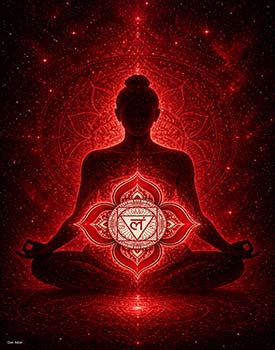
Root Chakra Meditation Poster – Available on Etsy.

This is the last of a three part series on Tarot and the root chakra.  In the first part, “10 Tarot Cards That May Indicate a Blocked Root Chakra (1st Chakra)” we looked at some of the cards that are signposts for root chakra issues.  In the second part, “Understanding the Root Chakra More Deeply: Safety, Survival, and the Foundations of Self,” we explored some of the devastating effects that problems with our root chakra can cause in our adult lives.  

Of course, for any problem, we should also lay out some solutions, so in this post I’ve compiled some of the resources that I’ve personally used and found to be dependable.  If you’re aware of other resources that you’d like to see listed here, please don’t hesitate to write and let me know.

BOOKS:

Energy Rules: Deflect Negative Vibrations and Own Your Energy by Alla Svirinskaya.  This was originally published under the name of, “Own Your Energy,” and is a wonderful explanation of the chakras and meridian system by a world renowned energy healer.  She also has some interesting thoughts about energy vampires and how to preserve your unique energy identity.

Chakras Made Easy: Seven Keys to Awakening and Healing the Energy Body (Made Easy series) by Anodea Judith. A complete guide to understanding, working with and developing your connection to your chakra system for healing and transformation.  I’ve had this one in my library for several years and it’s one of the best and most complete explanations of the chakra system.

Root Chakra: The Ultimate Guide to Opening, Balancing, and Healing Muladhara (The Seven Chakras) by Mari Silva – Understand the role of your root chakra and learn how to keep it healthy and happy.  Silva has written extensively about the chakra system and this is short, easy read on the root chakra.

Unblocked: A Revolutionary Approach to Tapping into Your Chakra Empowerment Energy to Reclaim Your Passion, Joy, and Confidence by Margaret Lynch Raniere and David Raniere – This is centered around using EFT tapping to unblock your chakras, but does a very deep dive into the lower four chakras.  She especially covers how a blocked root chakra can lead to a weak sense of personal identity and severely affect our ability to attract abundance.

VIDEOS

Unblock Your SuperPowers – Chakra One – by Margaret Lynch Raniere – This is a really nice series covering that lower four chakras, which is an explanation of her book.  About an hour long and packed with good ideas.

10 Minute Root Chakra Guided Meditation – by Great Meditations – Great Meditations has several chakra meditations up and they’re all good.  If you have trouble meditating (or even if you don’t) this is a wonderful resource for quick, powerful visualizations.

Grounding with the First Chakra – Part One – by Sonia Choquette – Sonia, of course, is one of the best spiritual teachers out there and this is a wonderful three part series with many tips for immediate grounding.

10 min Chakra Meditation Series~Note C~1st~Root Chakra with Tibetan Bowls~No Vocals – by Temple Sounds – A quick sound meditation designed to stimulate the root chakra through vibrations.

Balance Your Chakras Using Tapping – Chakra #1 – by Helen McConnell Tapping Into Higher Consciousness – EFT tapping to heal root chakra blocks.

Yoga Nidra for the Root Chakra – 30 Minute Yoga Nidra for the Root Chakra with Costa Rican Jungle Soundscape – by Ally Boothroyd, Sarovara Yoga – All of her yoga Nidra videos are incredibly healing and this one is specifically for root chakra.

“Just the Tarot,” by Dan Adair – available on Amazon

The High Priestess: What It Really Means to Trust Your Intuition

The High Priestess Archetype and learning to trust our intuition.

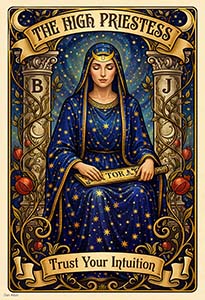
In my High Priestess affirmation poster, I chose the phrase:

“Trust Your Intuition.”

It sounds simple. Almost obvious.

And yet it’s one of the most misunderstood instructions in the entire Tarot.

We say things like:

“I have a feeling . .

“I just have a hunch . . .”

“I’m getting bad vibes about this . . .”

All human beings have intuition — some more than others. Some people sneer at it as a primitive, pseudo-mystical leftover from a less scientific age. Others practically swim in it, using it as their primary guide through life.

Most of us fall somewhere in the middle.

We occasionally get flashes of clarity about which path to take and which to avoid. But most of the time we default to logic. We try to predict outcomes. We use our brains rather than our hearts.

And then sometimes — usually in hindsight — we think:

“Damn, I knew better . . .”

So it’s worth asking:

What is intuition… and what is it not?

“Just the Tarot,” by Dan Adair – available on Amazon

It’s Not Fear

One of the biggest confusions we have is mixing intuition up with the limbic system — the ancient part of the brain responsible for fight-or-flight.

That system exists to keep us alive. It detects threat. It reacts instantly.

It was what warned our ancestors that something dangerous was hiding in the trees. We experience it today as:

  • The hairs rising on the back of our neck
  • A sudden jolt of anxiety
  • The feeling that someone is watching us

That reaction can feel mysterious. But it isn’t mystical. It’s biological.

True intuition does not trigger fight-or-flight.

It doesn’t flood the body with adrenaline. It doesn’t tighten the chest.

Real intuition is calm.

It arrives quietly, with a sense of understanding. It clarifies rather than agitates. Instead of panic, it brings steadiness — a subtle reassurance that says:

“This is right – you’ll be okay.”


It’s Not Rapid-Fire Prediction

The brain is constantly predicting the future based on the past.

When we encounter a new situation, the mind instantly searches its archives for similar experiences. It matches patterns, runs comparisons, and projects possible outcomes — all in a fraction of a second.

We’re mostly unaware this is happening.

So when we say we “have a feeling” about someone, what we often have is a memory.

If we once had a terrible experience with a brunette woman wearing purple socks, we may feel wary of a new brunette wearing purple socks. We call that a vibe.

It isn’t.

Some people process these patterns so quickly that it seems magical. Certain personality types — INFJs and INFPs, for example — are especially skilled at rapid, intuitive-seeming synthesis.

But that process is still rooted in past data.

True intuition is different.

It is not logical.

It is not based on memory.

It may have absolutely nothing to do with what has happened before.

It is a clear message about the present moment — even when there’s no obvious reason you should understand what you understand.


It’s Not Fragmented

You may have met highly sensitive or empathic people whose lives are chaotic.

On the surface, that seems contradictory. If they absorb more information than most, shouldn’t they navigate life more easily?

Not necessarily.

When someone takes in too much external input without discernment, they can lose track of what belongs to them and what belongs to others.

If they’re near someone who is anxious, they become anxious. If they’re around anger, they internalize anger.

Soon they feel as if they’re having five contradictory “intuitions” at once.

But intuition does not contradict itself.

It does not conduct committee meetings in your head.

It does not present twelve equally compelling paths and demand that you choose one immediately.

True intuition is singular.

It points.

It does not debate.


Clear, Calm, and Quietly Joyful

Perhaps the greatest hallmark of genuine intuition is that it brings relief.

It removes doubt.

It dissolves mental noise.

It doesn’t shout. It doesn’t demand. It doesn’t come with fireworks.

It simply settles into you and says:

“Yes, this is it.”

And when it does, there is often a subtle happiness attached to it — not excitement, not mania — but a deep rightness.

That is the High Priestess.

She does not force reality.

She does not argue.

She does not panic.

She knows.

And when that knowing arrives within you, the work is not to question it endlessly — it is to honor it.

That is what “Trust Your Intuition” really means.


Solstice Thoughts: For Empaths Standing at the Edge of a New Year

Reflections on the past year and strategies for empathic coping with the year to come.

Sunday is the Solstice — the darkest day of the year — before our beautiful Earth begins its long, slow climb back into the light. In many ancient traditions, this moment marked the true New Year: not a calendar flip, but a turning point.

Light returns.

And this year, that matters.

A Difficult Year for Sensitive Souls

2025 has been a particularly rough year for many of us. It’s not surprising if you’re ending it feeling exhausted, raw, or strangely unsteady.

We’ve been inundated with horrific images. Norms we once relied on for stability have been violated again and again. The overall effect has been a pervasive sense of unsafety — not just politically or socially, but emotionally.

And while it feels endless, it helps to remember this:

in the span of a lifetime, five years is a very short time.

It’s only been five years since a global pandemic placed our very existence in question. Many of us were still recovering from a prolonged fight-or-flight response when the world was thrown into further chaos. What once felt “crazy” somehow got even crazier.

That constant state of activation takes a toll.

Why This Has Been Especially Hard on Empaths

If you’re an empath, this year may have felt truly overwhelming.

Empaths naturally absorb the emotional atmosphere around them. Other people’s suffering draws us in. Compassion isn’t optional — it’s automatic.

And that means one of our greatest challenges is keeping the outside, outside.

This year has been a near-constant boundary violation.

There has been a deliberate strategy — politically and culturally — to keep people off balance, upset, and reactive. A lack of empathy and compassion at a societal level doesn’t just distress empaths; it can destabilize us.

When the collective feels unhinged, empaths feel it in their nervous systems.

A Choice at the Turning Point

At this Solstice, we face a choice.

We can tell ourselves:

“The world has gone mad, and I need to hide.”

Or we can reframe this moment as:

“This is a difficult — but perfect — environment for learning new skills.”

Skills that help us survive and stay open.

The Core Skill Empaths Need Right Now

To navigate what’s coming, empaths must learn to distinguish:

What energy is mine — and what does not belong to me.

Right now, there is a lot of chaotic energy in the air. That means we need to perform regular internal “fact checks.”

Ask yourself:

• Am I actually in danger right now?

• Am I personally unstable — or do I just feel unstable?

And yes — it’s okay if you are occasionally a little crazy. We all are.

But if you’re not objectively falling apart and yet you feel like you are, that’s a strong sign the energy is coming from outside you.

Once you recognize that, the next question becomes:

How do I respond — without absorbing it?

Practical Strategies for the Year Ahead

Here are a few grounded ways empaths can protect their nervous systems:

Unplug intentionally.

Turn off the news. Step back from social media. Don’t answer every text like Pavlov’s dog. Your attention is precious.

Curate what you consume.

If you spend five minutes wading through the sewage of daily news, balance it with ten minutes of something hopeful — music, art, a book, a walk, a moment of beauty.

Name the manipulation.

Much of what we’re experiencing is designed to keep people in fight-or-flight. This isn’t accidental. Recognizing that helps break its spell.

When fear and outrage are being deliberately amplified, our most radical response is calm, mindfulness, and conscious detachment.

That doesn’t mean indifference.

It means sovereignty.

Walking Toward the Light

The Solstice reminds us that even at the darkest point, the turn has already begun. The light doesn’t return all at once — it comes back slowly, almost imperceptibly, day by day.

As we move into the new year, especially those of us who feel deeply, the work isn’t to harden or shut down. It’s to strengthen boundaries, choose what we engage with, and care for our nervous systems with intention.

That, too, is a form of courage.

May the coming year bring more steadiness, more discernment, and moments of real peace — both within us and, slowly, in the world we share.

Blessed Be.

Surviving the Season: A Light-Hearted Guide to Beating SAD Without Losing Your Mind

This post explores the realities of Seasonal Affective Disorder (SAD) with a humorous twist — why the winter blues hit so hard, how light deprivation messes with our brains, and what actually helps. From sunrise-mimicking light boxes to Vitamin D3 and CBT-SAD reframing techniques, this guide offers practical, affordable ways to lift your mood when the days get dark. Includes a free downloadable PDF of 15 winter affirmations to help rewire your thoughts and make the season feel gentler, brighter, and a whole lot more manageable.

Are you still suffering from the cosmic hangover known as the time change?

Maybe you can’t sleep at night but can barely keep your eyes open during the day. Maybe you’re stumbling through the month like a melancholy robot — mostly upright, mildly conscious, but deeply unimpressed with existence.

And isn’t it cruelly ironic that exactly when we’re all miserable from light deprivation, the government decides to turn the lights off an hour early?

Thanks, folks. Really helpful.

 Light and Happiness (a Love Story as Old as Humans)

Humans have a deep evolutionary connection with light — not metaphorical light, not spiritual light, not “good vibes” light — we’re talking about actual photons hitting your eyeballs. For centuries, nearly every culture has tried to cheer up the dark months by adding more light: bonfires, candles, lantern festivals, torches, flaming wheels, glowing turnips… you name it, someone set it on fire.

Even our pop songs know what’s up:

• You are the sunshine of my life.

• You light up my life.

• I’ve got sunshine on a cloudy day.

• Sunshine on my shoulders makes me happy.

But when there isn’t enough light?

We become depressed, anxious, sluggish, and mildly feral. We want to curl up under a quilt with a 40-pound bag of potato chips and hibernate until April.

In short:

Light = joy.

Dark = sadness.

This is not complicated.

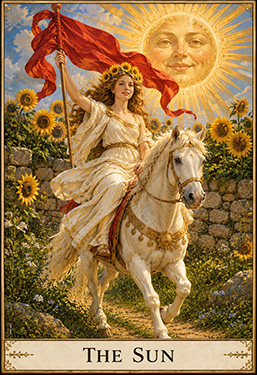
The Sun Tarot Affirmation Poster available on Etsy

 Seasonal Affective Disorder (SAD): The Winter Blues With a Capital B

The official psychological name for the winter blues is Seasonal Affective Disorder, or SAD — which is honestly too accurate. It ranges from “a little down” to “I may never be cheerful again and also don’t touch me.”

Depending on which study you read, SAD affects anywhere from 5% of Americans to 10 million people, with symptoms like:

• chronic sadness

• sleep pattern chaos

• irritability

• carb cravings

• emotional flatness

• hiding from society like a depressed woodland creature

If you’ve ever had it, you know what a total beast it can be. While everyone else is decking halls and singing carols, you’re sitting at home thinking:

“Crap… three more months of this.”

I’ve had SAD kick my ass more than once, so I was very happy to discover that it’s now the subject of its own therapeutic specialty:

CBT-SAD — Cognitive Behavioral Therapy for Seasonal Affective Disorder.

And it’s not as complicated as it sounds.

The Three Pillars of Beating SAD (According to CBT-SAD)

1. Increase Your Light

This one feels obvious:

If darkness is the problem, light is the solution.

But not just any light.

You need a blast of sunrise-level brightness first thing in the morning — something that tells your brain:

“Hello, it’s daytime, stop making melatonin.”

Enter: the mood-enhancing light box.

These used to be huge contraptions you practically had to strap to your head. Now they’re about the size of a tablet, reasonably priced, and honestly kind of pleasant.

Light boxes work because they:

• mimic sunrise

• raise serotonin

• lower melatonin

• reset your circadian rhythm

• tell your brain to get out of bed and stop being a raccoon

This is the one I use because it’s inexpensive and has great reviews:

2. Vitamin D3 (Your Winter Sunshine Backup Plan)

We naturally get Vitamin D from sunshine — so of course, in winter, our levels tank. Add the fact that we’re bundled head-to-toe like sentient laundry bags, and you’ve got the perfect recipe for deficiency.

Low Vitamin D contributes to:

• low serotonin

• flat dopamine

• brain fog

• irritability

• low energy

• general “I’m over this” mood

Supplementing D3 helps stabilize:

• serotonin

• dopamine

• inflammation

• sleep-wake cycles

• mood regulation

And best of all: it’s cheap.

You can grab it on Amazon or at the pharmacy.

3. Reframing the Way You Think About Winter

This is where the cognitive part comes in.

My sister once pointed out that constantly referring to winter as “the dark times” might not be the healthiest mindset. Fair enough.

If we’ve had rough winters in the past, we tend to brace for them like emotional storm preppers:

• “I hate winter.”

• “I dread those long dark months.”

• “Wake me up when it’s spring.”

These thoughts become self-fulfilling prophecies.

CBT-SAD teaches us to rewire those expectations and rewrite our inner scripts — not with toxic positivity, but with seasonal intelligence.

For example:

• Winter is not the enemy — winter is the exhale.

• Early nights are invitations to gentler evenings.

• Light is scarce now, so I become intentional with it.

• Winter is not a shutdown — it’s a recalibration.

These reframes help your brain reinterpret winter as:

• restorative

• quiet

• intentional

• gentle

• rhythmic

Instead of something to dread, it becomes something to work with.

I’ve included 15 winter reframes as a free downloadable PDF that you can get by clicking here:


Final Thoughts (and a Pep Talk)

If SAD is hitting you hard, it’s worth finding a good therapist who understands seasonal depression. But even without professional help, these three pillars can make a huge difference.

Hopefully, this little article gives you a few ideas about how to get the Bah Humbug out of your brain and bring some light back into your winter.

And remember:

Light returns. It always returns.

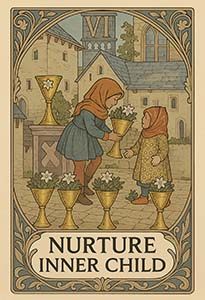
The Six of Cups — Protecting the Inner Child of Your Art

The Six of Cups reminds us that our creativity flows from the innocence of the inner child. Protecting that child means honoring your art, choosing who sees it, and never letting careless criticism silence your joy.

When Beauty Meets Criticism

Have you ever created something you thought was beautiful — a painting, an essay, even a garden — and when you finally shared it, the first thing someone did was point out the flaws? Instead of seeing what you were trying to express, they zeroed in on what they thought was wrong.

There’s always a tension between creating and sharing. When we make something real — assuming we’re not just hacking away — we’re revealing a piece of our heart, our soul, our lived experience. A careless critique can feel like a personal attack. It can leave us feeling exposed, vulnerable, even ashamed.

The Inner Child at Play

Picasso once said, “All children are born artists; the problem is to remain an artist as we grow up.” Creativity flows from the same source as play — from the child who once molded mud into castles or splashed finger paints across paper just for the joy of it.

That inner child still lives inside us, but it’s easily wounded. A thoughtless comment can silence it. A dismissive tone can make it retreat. And when that happens, the creative flow — the very essence of who we are — begins to dry up.

The Birth of the Critic

Mel Brooks joked that with the birth of art came the inevitable afterbirth — the critic. And he wasn’t wrong. If you take your creativity seriously, you’ll eventually encounter people who feel compelled to “fix” your work.

Julia Cameron wrote that before we can become good artists, we must first give ourselves permission to be bad ones. Every artist, writer, gardener, or musician produces clumsy beginnings — and even seasoned creators sometimes turn out a piece that just doesn’t land.

The creative process is messy and human. Yet while you’re admiring what went right, someone else may focus only on what went wrong.

The Wound of the Inner Artist

Cameron also warned that exposing your inner artist to harsh criticism is the emotional equivalent of child abuse. It’s like taking the eager, innocent child who offers you their finger painting and saying, “That’s terrible. You don’t really have any talent, do you?”

If you choose a creative life, criticism is inevitable. Some people simply won’t resonate with your vision, and occasionally you’ll make something that misses the mark. That’s part of the territory. But you can — and must — protect your inner artist with the same fierce loyalty you’d show a child under attack.

Learning by Heart

I became an artist late in life and am entirely self-taught. I picked up a mallet and chisel and learned to carve wood through trial, error, and stubborn joy. I learned to paint the same way.

Looking back, I can see how rough those early pieces were — primitive, awkward, untrained — and yet they were full of life. I still remember the pride I felt each time I saw progress take shape beneath my hands.

Claiming the title artist took courage. The first time I walked into a gallery and asked, “Would you show my work?” was absolutely terrifying.

A Pact of Protection

One simple, unbreakable pact guides me still: when someone criticizes my art, that’s the last time they see my art.

Showing your work is an act of intimacy — an unveiling of something deeply personal. The art flows from the child within you, and that child deserves protection.

How to Shine Your Star and NOT Be a Good Codependent

Do you ever feel invisible, like you’ve disappeared into someone else’s needs? The Star reversed shows how codependency drains us — and how to take back your light.

Of all of the forms of codependency, perhaps the most insidious is the, “good,” kind.  The kind where we’re actually making ourselves less, because it’s the right thing to do.  

Or so we think.  

Our personal light, our Spirit becomes dimmed because we’re trying to make someone else’s shine a little brighter.  If it goes on for too long, we can even forget who we really are.

WHAT CODEPENDENCY REALLY MEANS

When we hear the word, “codependency,” most of us think of the classic scenario involving an alcoholic/addict and the person taking care of him.  In that sort of a relationship, the alcoholic may have the money, but he’s too screwed up to really take care of himself.  The codependent takes care of him – sees that the bills are paid on time, buys the groceries, cleans the house, defends him from criticism, but doesn’t have any personal funds.  

The result, of course, is that neither party is able to survive on their own.  They are mutually dependent on the other for survival and they may hate each other but they also need each other.

At its root, though, codependency is any relationship where we chronically subordinate our own needs and desires to someone else’s.  

That can actually take the form of a noble pursuit.  In a very real sense, good parents subordinate their own needs and desires to rearing their children until the children can fly on their own.  We can also see it in home healthcare situations, where one partner in the relationship is literally too ill to care for herself and the other partner becomes a full-time caretaker.

These are the, “good,” forms of codependency where we’re basically just doing what’s right and what’s loving.  But they can still destroy us over the long haul.

MAKING OURSELVES SMALLER

One of the hallmarks of codependency is shrinking ourselves while inflating someone else.

In the home healthcare situation that I just mentioned, the partner who is healthy may be devoting her entire life to taking care of the partner who is ill, yet insisting that, “it’s no big deal.”  She may sacrifice her social life, her hobbies, her time for herself to an endless round of cooking, cleaning, medications, and taking her partner to medical appointments.  She may have completely given up her own life in order to preserve his.

Because the other person’s light is so dimmed, we do everything we can to make it shine a little brighter.  We praise them, we prop them up, we take care of their every need and we never, ever, let them feel that they are, “less than,” because of their illness.

Over time, this creates an energy imbalance that leaves us feeling like invisible ghosts, like we never had the chance to live as our fullest, most authentic selves because we’ve disappeared into someone else’s needs.

The real tragedy of codependency isn’t just exhaustion – it’s the slow erosion of Self.

THE STAR REVERSED

In the Tarot, the exemplar of codependency is The Star reversed.  When it’s upright, The Star is a beacon of hope, inspiration, and healing.  It’s someone who is fully shining his light into the world.

When it’s reversed, it can point directly to codependent patterns such as:

• Outsourcing your self-worth to another person.

• Over-giving and self-sacrifice until your own cup is bone dry.

• Healing others while neglecting your own healing.

• Depending on someone’s approval to feel hopeful.

• Pretending everything’s fine just to keep the relationship intact.

The Star reversed doesn’t mean you’ve lost your light, though. It means you’ve been dimming it.

THE ANTIDOTE IS RECLAIMING YOUR OWN LIGHT

The medicine for The Star reversed is to consciously reclaim your own radiance:

• Affirm your intrinsic value through affirmations, creative expression, and celebrating small achievements.  That can be as easy as taking a few moments to journal every morning and write about what YOUR dreams are.

• Set boundaries and practice saying “no” without guilt. That can be as simple as saying, “No, I don’t watch that television show,” or, “I’d rather listen to MY music.”

• Shift your focus from “I’ll fix them” to “I’ll care for myself first.” You DO have a right to savor your morning coffee before you make their breakfast.

• Anchor hope internally by nurturing personal goals, spiritual practices, or creative outlets.  Do you love to paint or write or garden?  Insist on taking some time for that every week.  No excuses and no interruptions.  Even if it’s only an hour, that’s your sacred space.

• Practice radical honesty — with yourself and others.  If you hate what you’re doing, you’ve got a right to express that.  If you think you deserve some extra praise and kindness instead of being taken for granted, you’ve got a right to that, too.

• Cultivate interdependence, where two whole people choose connection rather than two halves clinging to each other.  Especially if there’s an imbalance in money, remind your partner frequently of all of the things that you do and how much he’d have to pay to have someone other than you do them.  

Each of these steps helps you pour back into your own cup — and when you shine, you inspire others to shine too.

THE PARADOX OF HEALING

The paradox of this type of codependency is that we usually take it on precisely because we ARE good, loving, kind people. If we see someone who needs help, we help them.  If our child is troubled, we’re there for them 200%.  If our partners are ill, of COURSE we’re going to move heaven and earth to take care of them.

But as it goes on . . . and on . . . and on . . . that good, loving person who is our core being begins to erode.  It isn’t that we become bad people or quit caring – it’s that we simply begin to disappear.  We become nothing but appendages to the needs of the people that we’re caring for.

The lesson of The Star is to let our light shine again.  That core of ourselves that we’re losing through the codependency is what was healing the other person to begin with.  When we lose it, we lose our ability to heal, not just them, but ourselves.

We have to let our lights shine.

“The Star,” a personal affirmation poster available on my etsy site

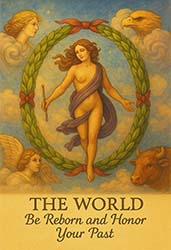
Recovery, Shame, and The World Card

In therapy or recovery but still haunted by your past? This post explores how The World card can help transform shame and regret into growth. By embracing even painful histories, we can find “closure without a bow” — turning painful memories into guides instead of burdens.

Are you in recovery from alcoholism or addiction but still feel really deep shame about your past?

Are you in therapy but just can’t seem to shake off the depression and anxiety that springs from old beliefs and the ghosts of trauma?

Believe me – you’re not alone.  Many of us can stay sober or work our asses off in counseling, but still feel like we’re going through it with a cinder block chained around our necks.  Guilt, shame, and memories of what we were can weigh us down to a point where we’re almost paralyzed.

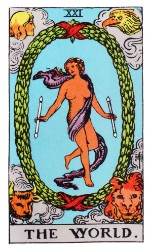
The World card from the Tarot can offer a powerful lens for looking at this struggle and finding a way forward.

A SYMBOL OF COMPLETION

In its traditional meaning, The World card celebrates the completion of one cycle and moving onto the next one.  It’s the, “and they lived happily ever after,” card for, “normal,” people

For instance, a person might leave their job after many successful years and move on to another one that presents new challenges.

Or perhaps a parent has spent 18 years raising a child and when the kid goes off to college, the parent finally has time for her own dreams.

Or maybe a writer has spent 2 years putting a book together, it’s finally been published, and now they’re moving on to a new project.

The common theme there is that all of these people can look back and honestly say, “Well done.”

But what happens when we look back at our past and all we can say is, “Oh, christ, what a freaking mess.”

WHEN SATISFACTION ISN’T POSSIBLE

For many of us, the past doesn’t exactly sparkle with bright and cheery accomplishments.  Instead, it can feel like an extended disaster zone.

Maybe we worked at the same job for years and got fired because of poor performance.

Perhaps we wasted many years in a toxic, codependent relationship.

Or we might have been so drunk or drugged up that we destroyed everything and everyone we touched.

Trying to get into a sustained recovery can seem almost impossible under the weight of regret.  The question is:  How do we process all of this and move on to a new life?

WHAT DOES AA SAY ABOUT IT?

When I was trying to help a relative get into recovery, I sat through literally hundreds of Alcoholics Anonymous meetings with her.

Let me hasten to say, I’m not trying to push an AA agenda or wave a Big Book in your face.  It works for some people, it doesn’t work for others, and it’s not everyone’s cup of tea.

What really struck me in those meetings, though, was that some of their members had figured out a way to do this.  They’d sit there and calmly tell the most horrific stories imaginable about their drinking careers and then talk about how happy they were now.

The phrase that was always repeated was, “We will not regret the past nor wish to shut the door on it.”  There are two powerful statements in that:

1 – Even if we totally screwed up, we can CHOOSE not to regret it.

2 – We don’t slam the door on it or pretend that it never happened.

It’s not about denying the past.  It’s about reclaiming it.

FACING THE PAST WITH COURAGE

Facing what we’d rather forget requires a lot of courage, and we need to give ourselves credit for that struggle.  It can also mean that we can mine a few diamonds out of the sewage and become better human beings.

The heartbreak of being totally broken can teach us greater compassion for those who are still struggling.

The mistakes that we made can teach us humility.  It’s mighty hard to look down on someone else when you’re lying in a gutter.

The chaos that we endured can teach us resilience and we can realize how strong we truly are to have survived it.

True courage isn’t erasing our story but owning it without shame.

LESSONS FROM NOT SHUTTING THE DOOR

When we keep our past in view – without wallowing in it – we transform it into guidance.  Painful memories can evolve into teachers, showing us what to avoid and what truly matters.

Even more, our honesty can become a gift.  By sharing our experiences, we offer others a road map through their own dark terrain.

We can look at a friend, a lover, or a neighbor and honestly say, “Oh, man, I know what you’re going through.”  Because we do.

The World Affirmation Poster available on my etsy site

CLOSURE WITHOUT TAKING A BOW

I guess that there are, “normal,” people who live more or less all of the time in Happy Land.  They move from one wonderful accomplishment to the next and life comes at them with ease and grace.  That’s what The World card is all about.

For the rest of us, closure means accepting the whole mess that we may have made of things and integrating it, rather than forgetting it.  We accept the fact that we’ve had a lot heavier karma to deal with than most people.  

And we remind ourselves that wholeness isn’t about perfection.  It’s about embracing all that we are as human beings – our triumphs, our failures, and the courage it takes to live through them.

Impostor Syndrome and The King of Wands Reversed

The King of Wands reversed shines a light on impostor syndrome — that nagging sense of never being “good enough.” Learn how this Tarot archetype mirrors self-doubt and discover practical steps to reclaim authentic confidence, reverse the distortion, and own your rightful place at the table.

Do you never feel “good enough?”

Do you feel like, no matter how hard you try, no matter how much you do, you’re still falling short?

Does it seem as if everyone around you somehow has more talent, more luck, and is more deserving than you are?

That’s called, “Impostor Syndrome,” and it can destroy our lives.

WHAT IS IMPOSTOR SYNDROME?

Put very simply, it’s the persistent feeling that we’re a fraud, even when the evidence in our life says otherwise.

Self-doubt becomes a constant companion and we dismiss our achievements as, “a fluke,” or, “just good timing.”  Even worse, there’s a chronic fear that someday we’ll be found out, that everyone else will realize that we’ve just been bullshitting our way through life and we don’t have any real substance.

It’s quite common among people who grew up in abusive households because that’s one of the primary messages that they got as kids:  “you’re not good enough.” No matter what you do, you’re still not good enough.

It’s especially common among creatives, leaders, and anyone who’s stepping into a new role in life.  Exactly the people who are already stretching themselves into growth and success.

THE KING ON A SHAKY THRONE

In the Tarot, the King of Wands represents the exact opposite of impostor syndrome.  He radiates confident leadership.  He’s the charismatic leader who can stand firmly in his own power and inspire the people around him.

But reversed?  His fire dims and he hesitates.  His self-belief falters and instead of leading with boldness he spirals into self-doubt.

That’s where Impostor Syndrome rears its ugly head:

Self-doubt in leadership.

Fear of being, “Found Out’ and huge anxiety that others will see through the facade.

Inconsistent Confidence and swinging between moments of brilliance and moments of total collapse.

Avoidance of responsibility and shrinking back from visibility and opportunity.

Overcompensation and burnout where we work WAY too hard to prove our worth until exhaustion sets in.

The King of Wands reversed is the perfect representation of Impostor Syndrome at work.

King of Wands Affirmation Poster available on my etsy site.

HOW TO OVERCOME IT

There’s an old joke that says that if you feel the need to ask your therapist if you’re a narcissist, you’re not one.  The same thing applies to Impostor Syndrome.  If you’re constantly full of self-doubt, you probably shouldn’t be.

The gift of the Tarot is that no card is fixed.  The King of Wands can always be turned upright again and so can our confidence.  Here are a few simple practices that can reverse Impostor Syndrome:

1 – Keep a, “proof journal.”  Write down ALL of our wins, big and small, to create a counter-narrative to the voice that’s telling us that we’re, “not good enough.”  And if that feels uncomfortable, it’s just proof that we really need to do it.

2 – Normalize mistakes.  People with Impostor Syndrome don’t just regret it when they screw up – they beat themselves into a bloody pulp over it.  Every artist, every writer, every visionary stumbles.  That’s part of the growth curve.  As Julia Cameron said, “In order to become a good artist, you have to first give yourself permission to be a bad artist.”

3 – Talk it out.  When we share our doubts with a trusted friend or therapist we get the realistic feedback we need.  When we tell someone we love that we feel like a total fuck-up they will frequently be amazed and even appalled that we could perceive ourselves that way.  Basically, that’s just, “borrowing someone else’s eyes” and they may see our brilliance and talent far more clearly than we can.

THE ONLY IMPOSTOR IS OUR SELF-DOUBT

The King of Wands reversed reminds us that Impostor Syndrome isn’t the truth.  It’s a distortion, an illusion that doesn’t need to define our reality.

Turn the card upright and loosen the chains of self-criticism.  Step into the fiery confidence that we should have and that we deserve.

We’ve already earned our places at the table. Now own it.

Love, Limerence, and The Ace of Cups? How to Heal Obsessive Attraction with Self-Generated Love

Ever fallen in love with someone you couldn’t have? Psychologists call it “limerence,” but spiritually it’s more than just a crush. This post explores the difference between obsessive attraction and true love, why we sometimes fall for the “wrong” people, and how to heal by generating love from within. Featuring insights from psychology, past-life theory, Ram Dass, and the Ace of Cups, it’s a guide to shifting from longing to self-created wholeness.

Ace of Cups – A Tarot affirmation poster available at Synergy Studio.

Did you ever fall in love with someone you shouldn’t have?  Someone who was unavailable, but you still felt intensely attracted to them?

Maybe it was your next door neighbor who was happily married.  Maybe it was a co-worker and you KNEW that a work place romance would be a disaster.  Hell, maybe it was your 8th grade teacher who was just SO perfect in every way.

GETTING CRUSHED

We used to call that, “getting a crush,” on someone.  We meet someone and we just know that we’re supposed to be together, even though everything else is saying, “No, you’re not.”

Psychologists – as psychologists tend to do – have invented a new term for it which is, “limerence.”  Here’s a definition:

Limerence is an involuntary, intense, romantic obsession characterized by intrusive thoughts and a longing for emotional reciprocation, often leading to emotional suffering due to unmet romantic needs.”

In other words, having a crush on someone you probably shouldn’t have a crush on.

IT’S ALL PERFECTLY NATURAL

Now, this has been going on ever since the world began and, of course, it’s caused a passel of trouble. Marriages end, people lose their jobs, reputations and careers are destroyed.  All in the name of love.

Which is puzzling, isn’t it?  Love is supposed to be this grand, wonderful adventure that lets us soar to new heights on the wings of the person we’re in love with.  So why is all of this so painful and frustrating?  

THE CALM, INNER VOICE

I had a teaching dream once about spirit guides and spiritual guidance.  I call them, “teaching dreams,” because they’re very lucid, very clear and they usually have to do with some issue that’s really bothering me.

The subject of this dream was, “How do I distinguish true spiritual guidance from my own desires and ego?”

And the answer was that spiritual guidance is never harsh, never critical, never ominous.  It’s always gentle, loving, and kind and leaves us feeling nurtured rather than criticized or beaten up.

The same principle applies to falling in love.  If it feels sweet and kind, it’s probably real love.  If it involves obsessive thinking, insecurity, self-doubt, or criticism . . . hey, it may be a hell of a crush, but it ain’t love.

WHY DOES IT HAPPEN?

Why do we fall in love with people who aren’t, “right,” for us?

Psychologists, philosophers and playwrights have been trying to figure that one out for hundreds of years and really haven’t made much progress.

My personal theory is that these are relationships that are, “out of time.”  And I don’t mean that in the sense of, “Whoops, we’re out of time.”

Rather, what I’m talking about is old relationships from previous incarnations that have been displaced in time.  The feelings are still there, but they’re no longer appropriate in their old form.

Perhaps we were married to someone or had a super, sizzling hot sexual affair with them two lifetimes ago.  Because of that intense attraction, we meet them again in this lifetime.

Only – guess what? – they’re married to someone else.  Or they’re our teacher or mentor.  Or perhaps we’re straight, but they’re the same sex that we are.

The feelings are just as intense.  The desire to be with them is just as strong.  But it just ain’t happening this go-round.

WHAT SHOULD WE DO?

Well . . . nothing, in most cases.  Just observe it and sit with it.  Realize that you love this person but that the love has to take a different form than romantic love.

We can feel it.  We can cherish it.  But we don’t have to act on it.  If there’s a huge internal conflict about getting romantically or sexually involved with someone, that’s not a very good way to start out, is it?

FILL YOUR HEART WITH LOVE

Ram Dass said that we frequently mistake other people as the source of love, rather than realizing that they’re just vehicles that get us to the love.

When we’re seriously crushing on someone we shouldn’t be crushing on, we feel that as a loss, as a deficit, as if we’ve got this Grand Canyon sized hole in our hearts that only they can fill.

Fortunately, we’ve got this wonderful part of our energy systems called, “the heart chakra.”    It can generate an infinite amount of love because love actually IS infinite.  

We can sit down at any time or place and just meditate on love, meditate on that chakra filling up with that sweet, kind essence that is love and the feeling of not being complete immediately goes away.

IT ISN’T THEM, IT’S US

We’ve been programmed into believing that love always flows out of someone else and into us.  That if someone, “out there,” doesn’t love us, we won’t get the love we need.

That’s really the source of the pain in limerence.  We’re convinced that without that other person’s love, we’re just going to be miserable and unfulfilled.  We can’t get to the love we want and so it hurts.

Not true.

We create our own love, in our own hearts.  We receive love when we open our heart centers and intentionally, consciously fill them up.

THE ACE OF CUPS

When we look at the Ace of Cups we can see this message very clearly.  The cup is our heart and the love isn’t flowing out of another person into the cup.  It’s flowing straight out of the Universe.  Love is everywhere.  It’s a Universal energy and we just need to open ourselves to receiving it.  If we occasionally receive it from another person, that’s great.

But if we don’t, that’s not a tragedy and it doesn’t need to be painful. The source of love is always in our own hearts.

“Just the Tarot,” by Dan Adair – A kindle ebook available on Amazon