The Hanged Man Tarot Card: Finding Peace When You Can’t Move Forward

Explore The Hanged Man Tarot card as a symbol of suspension, powerlessness, reversed perspective and radical acceptance—and discover what it means when you cannot force life forward.

At first glance, The Hanged Man seems like a rather unpleasant Tarot card.

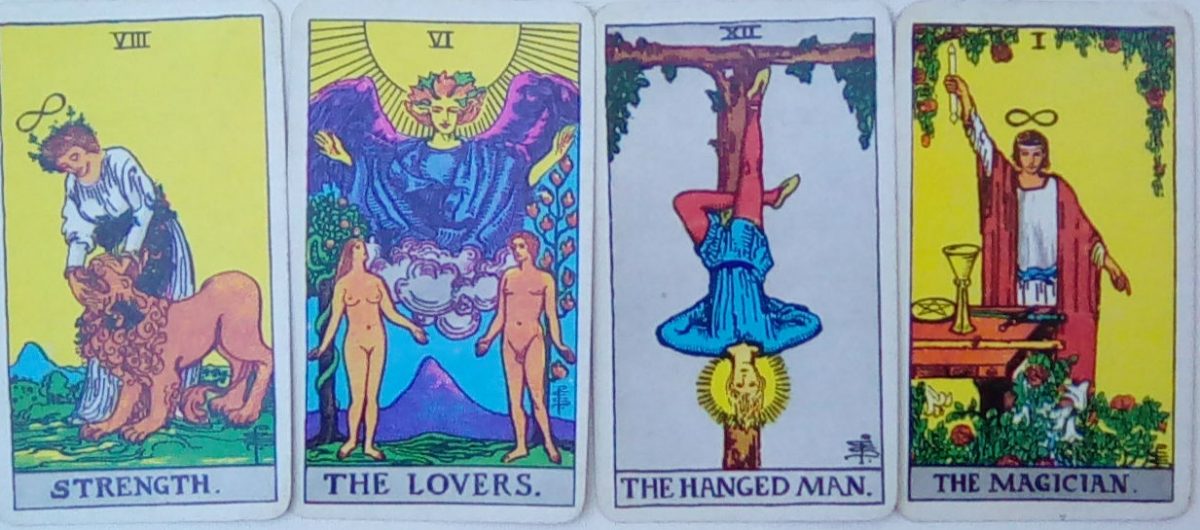
A man is hanging upside down by one foot. His hands are behind his back. He isn’t going anywhere, and there doesn’t appear to be anything he can do about it.

And yet there is something peculiar about him.

He doesn’t seem particularly bothered by the situation.

In the familiar Rider-Waite-Smith version, Arthur Edward Waite goes considerably further and gives the man a halo, transforming the image into something approaching spiritual illumination. But the essential image is much older than Waite’s deck. Earlier Tarot de Marseille versions already show the same strange figure hanging upside down with an unexpectedly composed expression.

So perhaps we don’t need the halo to understand him.

Instead, let’s look at what is actually happening to this man.

The Hanged Man Poster – 13 X 19 – Available on Etsy

What’s in the Card?

1. Suspension: Life Has Come to a Stop

The most obvious thing about The Hanged Man is that he is suspended.

He isn’t walking somewhere. He isn’t working on something. He isn’t fighting an enemy or pursuing a goal.

He’s literally going nowhere.

That’s very different from many of the other figures in the Major Arcana. The Charioteer is moving forward. The Hermit has deliberately withdrawn from the world. The Magician is actively manipulating the objects on his table.

The Hanged Man can do none of those things.

His normal activities have been interrupted.

We all encounter periods like this. A plan stalls. A relationship enters limbo. An illness interrupts our routines. We’re waiting for somebody else’s decision. Something we depended upon disappears. We simply don’t know what comes next.

Our natural response is usually:

“How do I get things moving again?”

But The Hanged Man raises a different possibility.

Perhaps, for the moment, we aren’t supposed to be moving.

Sometimes suspension is not an empty space between important events. The suspension itself is the experience.

2. Powerlessness: He Cannot Change His Circumstances

This brings us to the more uncomfortable aspect of the card.

The Hanged Man isn’t merely resting.

He’s powerless.

One foot is tied to the structure above him. His hands are behind his back. Whatever brought him into this situation, he cannot simply decide that he’s had enough, stand up and walk away.

That makes The Hanged Man a remarkably useful card for situations involving things outside our control.

We tend to associate personal power with the ability to change circumstances. If something is wrong, we fix it. If a door is closed, we find another door. If something isn’t working, we try harder.

Usually that’s excellent advice.

But sometimes there genuinely isn’t anything we can do.

And continuing to struggle against an unchangeable situation doesn’t necessarily give us more power. Sometimes it merely exhausts us.

The Hanged Man confronts us with one of life’s most difficult truths:

There are circumstances we cannot control.

The question then becomes not “How do I control this?” but:

“How am I going to live while this is true?”

Tarot and the Art of Alignment – Available on Amazon

3. Reversed Perspective: The World Looks Completely Different

Now something interesting happens.

Because the Hanged Man cannot go anywhere, his perspective changes instead.

Quite literally, his world has turned upside down.

The trees, the earth, the sky, other people—everything familiar is suddenly being seen from an unfamiliar angle.

Nothing necessarily changed in the outside world.

His position within it changed.

This may be the great gift hidden inside the card.

When our usual methods stop working, we may begin questioning assumptions we never previously thought to question.

What if success isn’t what I thought it was?

What if this relationship isn’t what I believed it was?

What if the thing I’ve been desperately pursuing isn’t actually what I need?

What if the situation I’ve been calling a disaster looks entirely different when viewed from another angle?

The Hanged Man doesn’t necessarily give us the answers.

He interrupts our habitual way of looking for them.

Sometimes we don’t acquire a new perspective because we’re wise enough to seek one.

Sometimes life turns us upside down until we have no choice.

4. Serenity: Acceptance Without Defeat

And finally we come to the strangest feature of the entire card.

The Hanged Man looks serene.

That’s remarkable.

If his face showed terror, the card would be about victimization.

If he were struggling against his restraints, it would be about imprisonment.

If he looked defeated, it would be about despair.

But he doesn’t.

Somehow, this man who cannot move, cannot escape and cannot control his circumstances has found peace within them.

That doesn’t necessarily mean he likes what has happened.

Acceptance isn’t approval.

Nor does acceptance mean that he will remain suspended forever.

It simply means that he has stopped fighting the reality of the present moment.

There is an enormous psychological difference between:

“This must not be happening.”

and:

“This is happening. What now?”

The first keeps us locked in combat with reality itself.

The second gives us somewhere to stand—even when, like The Hanged Man, we aren’t technically standing at all.

The Four Lessons of The Hanged Man

Taken together, the picture gives us four stages:

Suspension: My normal life has stopped.

Powerlessness: I cannot presently change this situation.

Reversed Perspective: Since I cannot change the situation, perhaps I can see it differently.

Serenity: I can stop fighting what I cannot presently change.

That’s considerably richer than simply defining The Hanged Man as “waiting” or “sacrifice.”

Sometimes the card may indeed indicate a sacrifice. Sometimes it may simply tell us to wait.

But at its deepest level, The Hanged Man seems to address one of the most difficult human experiences:

What do we do when there is nothing we can do?

His answer is extraordinary.

We stop.

We surrender the struggle—not necessarily forever, but for now.

We allow ourselves to see the situation from an entirely different perspective.

And perhaps we discover that peace does not always have to wait until the problem has been solved.

When The Hanged Man Appears in a Reading

When The Hanged Man appears, it may be useful to ask:

* Where has my life become suspended?

* What am I trying to control that I genuinely cannot control right now?

* What might this situation look like if I turned my assumptions upside down?

* What would acceptance look like if I stopped confusing acceptance with defeat?

The Hanged Man does not promise that someone is about to cut the rope.

He offers something stranger and perhaps more valuable:

the possibility of finding peace while we’re still hanging there.

What If Your Destiny Isn’t to Become Rich?

Exploring the idea that we’re not just here to get rich.

Spend a few minutes browsing YouTube or social media and you’ll quickly discover that almost everyone seems to know your destiny.

Apparently, you’re supposed to become wealthy.

Manifest abundance.

Drive the right car.

Live in the right house.

Travel the world.

And, of course, achieve financial freedom.

There’s nothing inherently wrong with any of those goals. The question is whether they’re everyone’s destiny.

I’m not convinced they are.

The Feeling That Something Is Missing

Most of us have experienced a quiet feeling that we’re here for some larger purpose.

Even when life is going reasonably well, there can be a sense that something remains unfinished.

It’s as though we’re being gently called toward a life that is more authentic, more meaningful, and somehow more fully our own.

But what exactly is that calling? Some people say it’s destiny.

Two Ways of Looking at Destiny

Over the years, I’ve noticed that most spiritual teachings seem to fall into one of two broad models.

The first is what I call the Earth School Model.

According to this view, we reincarnate again and again in order to learn lessons, overcome limitations, and gradually evolve spiritually.

Life is a classroom.

Every challenge is part of the curriculum.

The second is what I call the Actualization Model.

Instead of asking, “What lessons am I here to learn?” it asks:

“Who am I here to become?”

This idea reminds me of psychologist Abraham Maslow’s famous hierarchy of needs.

At the very top of his pyramid wasn’t wealth.

It wasn’t fame.

It wasn’t status.

It was self-actualization—becoming the fullest expression of your authentic self.

I find that idea deeply compelling.

The Prosperity Trap

Somewhere during the twentieth century, something interesting happened.

The New Thought movement, with its emphasis on affirmations, visualization, and the creative power of the mind, gradually merged with American ideas about success and capitalism.

Before long, spiritual growth and financial success became almost interchangeable.

Manifestation came to mean one thing:

More money.

Now, don’t misunderstand me.

There’s absolutely nothing wrong with financial security.

Most of us would welcome a little more of it.

But if we believe that every soul reincarnated primarily to become rich, we end up with a rather curious picture of human existence. Can we really imagine that we’ve come back again and again because we should all be more like Elon Musk?

Imagine a shepherd whose deepest fulfillment comes from tending goats in the mountains.

Or a teacher whose greatest joy is helping children learn to read.

Or an artist who creates beauty that quietly changes people’s lives.

Would we really say that these people have somehow missed their destiny because they didn’t become millionaires?

I don’t think so.

Their success may have very little to do with the size of their bank account.

Listening for Your Own Call

One of the central ideas in my book, Tarot and the Art of Alignment, is that destiny isn’t something someone else can define for you.

It isn’t found in a bestselling seminar or a motivational slogan.

It arises from discovering your own authentic nature.

For one person, that path may indeed involve building a successful business.

For another, it may involve raising a family, creating art, caring for others, teaching, healing, or living a quiet life close to nature.

The Tarot doesn’t ask us to pursue someone else’s dream.

It asks us to discover our own.

Perhaps the real purpose of life isn’t to become rich.

Perhaps it’s to become ourselves.

And in the end, that may be the greatest success of all.

Now available – Tarot Meditation Kits

Love, Limerence, and The Ace of Cups? How to Heal Obsessive Attraction with Self-Generated Love

Ever fallen in love with someone you couldn’t have? Psychologists call it “limerence,” but spiritually it’s more than just a crush. This post explores the difference between obsessive attraction and true love, why we sometimes fall for the “wrong” people, and how to heal by generating love from within. Featuring insights from psychology, past-life theory, Ram Dass, and the Ace of Cups, it’s a guide to shifting from longing to self-created wholeness.

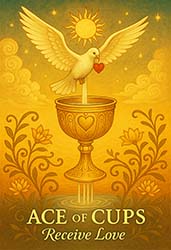
Ace of Cups – A Tarot affirmation poster available at Synergy Studio.

Did you ever fall in love with someone you shouldn’t have?  Someone who was unavailable, but you still felt intensely attracted to them?

Maybe it was your next door neighbor who was happily married.  Maybe it was a co-worker and you KNEW that a work place romance would be a disaster.  Hell, maybe it was your 8th grade teacher who was just SO perfect in every way.

GETTING CRUSHED

We used to call that, “getting a crush,” on someone.  We meet someone and we just know that we’re supposed to be together, even though everything else is saying, “No, you’re not.”

Psychologists – as psychologists tend to do – have invented a new term for it which is, “limerence.”  Here’s a definition:

Limerence is an involuntary, intense, romantic obsession characterized by intrusive thoughts and a longing for emotional reciprocation, often leading to emotional suffering due to unmet romantic needs.”

In other words, having a crush on someone you probably shouldn’t have a crush on.

IT’S ALL PERFECTLY NATURAL

Now, this has been going on ever since the world began and, of course, it’s caused a passel of trouble. Marriages end, people lose their jobs, reputations and careers are destroyed.  All in the name of love.

Which is puzzling, isn’t it?  Love is supposed to be this grand, wonderful adventure that lets us soar to new heights on the wings of the person we’re in love with.  So why is all of this so painful and frustrating?  

THE CALM, INNER VOICE

I had a teaching dream once about spirit guides and spiritual guidance.  I call them, “teaching dreams,” because they’re very lucid, very clear and they usually have to do with some issue that’s really bothering me.

The subject of this dream was, “How do I distinguish true spiritual guidance from my own desires and ego?”

And the answer was that spiritual guidance is never harsh, never critical, never ominous.  It’s always gentle, loving, and kind and leaves us feeling nurtured rather than criticized or beaten up.

The same principle applies to falling in love.  If it feels sweet and kind, it’s probably real love.  If it involves obsessive thinking, insecurity, self-doubt, or criticism . . . hey, it may be a hell of a crush, but it ain’t love.

WHY DOES IT HAPPEN?

Why do we fall in love with people who aren’t, “right,” for us?

Psychologists, philosophers and playwrights have been trying to figure that one out for hundreds of years and really haven’t made much progress.

My personal theory is that these are relationships that are, “out of time.”  And I don’t mean that in the sense of, “Whoops, we’re out of time.”

Rather, what I’m talking about is old relationships from previous incarnations that have been displaced in time.  The feelings are still there, but they’re no longer appropriate in their old form.

Perhaps we were married to someone or had a super, sizzling hot sexual affair with them two lifetimes ago.  Because of that intense attraction, we meet them again in this lifetime.

Only – guess what? – they’re married to someone else.  Or they’re our teacher or mentor.  Or perhaps we’re straight, but they’re the same sex that we are.

The feelings are just as intense.  The desire to be with them is just as strong.  But it just ain’t happening this go-round.

WHAT SHOULD WE DO?

Well . . . nothing, in most cases.  Just observe it and sit with it.  Realize that you love this person but that the love has to take a different form than romantic love.

We can feel it.  We can cherish it.  But we don’t have to act on it.  If there’s a huge internal conflict about getting romantically or sexually involved with someone, that’s not a very good way to start out, is it?

FILL YOUR HEART WITH LOVE

Ram Dass said that we frequently mistake other people as the source of love, rather than realizing that they’re just vehicles that get us to the love.

When we’re seriously crushing on someone we shouldn’t be crushing on, we feel that as a loss, as a deficit, as if we’ve got this Grand Canyon sized hole in our hearts that only they can fill.

Fortunately, we’ve got this wonderful part of our energy systems called, “the heart chakra.”    It can generate an infinite amount of love because love actually IS infinite.  

We can sit down at any time or place and just meditate on love, meditate on that chakra filling up with that sweet, kind essence that is love and the feeling of not being complete immediately goes away.

IT ISN’T THEM, IT’S US

We’ve been programmed into believing that love always flows out of someone else and into us.  That if someone, “out there,” doesn’t love us, we won’t get the love we need.

That’s really the source of the pain in limerence.  We’re convinced that without that other person’s love, we’re just going to be miserable and unfulfilled.  We can’t get to the love we want and so it hurts.

Not true.

We create our own love, in our own hearts.  We receive love when we open our heart centers and intentionally, consciously fill them up.

THE ACE OF CUPS

When we look at the Ace of Cups we can see this message very clearly.  The cup is our heart and the love isn’t flowing out of another person into the cup.  It’s flowing straight out of the Universe.  Love is everywhere.  It’s a Universal energy and we just need to open ourselves to receiving it.  If we occasionally receive it from another person, that’s great.

But if we don’t, that’s not a tragedy and it doesn’t need to be painful. The source of love is always in our own hearts.

“Just the Tarot,” by Dan Adair – A kindle ebook available on Amazon

King of Swords

The meaning of the King of Swords in a Tarot reading. This includes definitions for both the upright and reversed positions of the card.

A serious looking man sits on a throne grasping a sword in his right hand.  His body is entirely covered except for his hands and his face.

Upright: This indicates a very strong, unemotional, tough person.  It may be the questioners employer or a professional such as a doctor or a lawyer.  This is a person who is extremely competent and could be of great help but the card itself doesn’t indicate that he or she WILL help, just that they could.  This may indicate a dark haired, emotionally cold, highly intelligent person.

“Just the Tarot,” by Dan Adair – available on Amazon

Reversed:  A tough, strong individual, as in the upright position, but in this case there is an element of aggression, even violence.  A demanding, unpleasant individual, possibly with dark hair.

EXAMPLES:  A boss who is nice enough but is really only interested in getting the job done and doesn’t want to hear about your problems or personal life.

An incredibly competent doctor who views you as a case rather than as a person.