As Above, So Below.
As Within, So Without.
— The Kybalion
Most discussions of The Tower card in the Tarot focus almost entirely on what is happening in a person’s outer world.
And that’s understandable. It’s a dramatic card.
When The Tower appears, we think of events like divorce, losing a job, bankruptcy, foreclosure, the collapse of a relationship, or some other sudden upheaval. The outer destruction can be breathtaking.
But as the old Hermetic principle suggests, whatever is happening in our outer lives is also reflected in our inner lives.
When the structure of our exterior world collapses, something often collapses inside us as well.
That inner destruction is what we used to call a nervous breakdown.
Everything we believed to be true is suddenly called into question. Relationships with people we trusted crumble into dust. Beliefs we held dear for most of our lives are revealed to be false. The future we thought we understood disappears.
We find ourselves psychologically adrift. We have lost our place in the world, and we cannot seem to figure out how to get back to normal.
In Jungian terms, The Tower can be understood as the sudden and sometimes catastrophic dismantling of a rigid psychological structure. An outgrown persona, a false framework, or a collection of deeply held illusions can no longer withstand reality.
Something has to give.
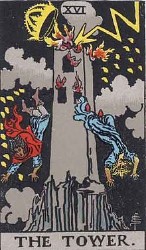
And the symbols contained in The Tower provide a remarkably clear roadmap of that process.
THE CROWN
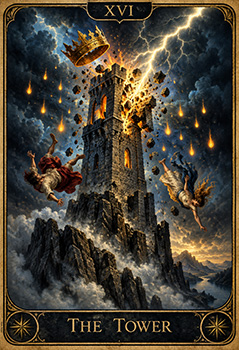
At the top of the tower is a crown, blasted away by the lightning strike.
Psychologically, the crown can represent the sovereignty of the conscious ego—the part of us that believes it understands what is happening and has things under control.
To put that more plainly, we all have to believe in ourselves.
When we get up in the morning, we need to believe that we are sane, that the world is reasonably predictable, and that what we do during the day will make sense and help keep us safe.
That is the everyday ego.
It goes to work. It pays the bills. It buys the groceries. It makes appointments. It solves problems. It deals with all those other human beings who are out there trying to do exactly the same thing.
Most of the time, it does a pretty good job.
But what happens when our predictable, manageable world completely falls apart?
What happens when we discover that our partner has been cheating on us? What happens when we lose the job we thought was secure? What happens when our finances collapse, our health fails, or something else occurs that simply cannot be fitted into the story we have been telling ourselves?
That wonderful daily wizard—the ego—suddenly doesn’t look so powerful.
The part of us that we believed would always keep us safe, solve the problem, and keep the car between the white lines suddenly has no idea what to do.
There is an old expression heard in twelve-step programs:
“My best thinking got me here.”
That is the crown being blown off the tower.
THE LIGHTNING STRIKE
And the moment we finally realize that we have really and truly lost control can feel like being struck by lightning.
It comes as a sudden flash of recognition—a crisis of the mind.
We may have spent months or even years denying that anything was seriously wrong.
“No,” we tell ourselves, “my partner couldn’t possibly be cheating on me. Those secretive phone calls and motel receipts don’t necessarily mean anything.”
Or perhaps we keep telling ourselves that we are just a little short financially this month.
Yes, we were short last month too. And the month before that. But things will turn around. We just need to tighten the budget a little more.
Until suddenly the truth becomes impossible to avoid.
We realize that we have been lying to ourselves.
And we are in real trouble.
That is the lightning strike.
The illusion doesn’t gradually fade away. For one terrible instant, we see through it.
And once we have seen the truth, we cannot completely unsee it.
THE FALLING FIGURES
The two figures blasted from the tower can represent the parts of ourselves that can no longer remain protected inside the old psychological structure.
We cannot hide in our intellectualizations and rationalizations anymore.
We built this magnificent structure called “my life.”
It protected us. It gave us an identity. It told us who we were, what mattered, whom we could trust, and what tomorrow was supposed to look like.
Now we have been thrown out of that safe little nest.
We are in psychological free fall.
There is nothing to hold on to because the things we once held on to are precisely the things that are collapsing.
But there is another way to look at those falling figures.
They are being grounded.
Literally.
They are falling out of an artificial structure and back toward the earth.
Toward reality.
The experience may hurt like hell. It may scare us half to death. But if we survive the fall, we have something we did not have while we were safely locked inside the tower:
The possibility of starting over.
Because now we have to.
THE GOLDEN SPARKS
Look carefully at the Waite-Smith Tower and something else is falling alongside the two figures.
Twenty-two golden drops or sparks surround the tower.
There are several ways of interpreting them. From a Jungian perspective, we might see them as psychic energy released when an old structure breaks apart. Spiritually, they can suggest something even more intriguing: illumination arriving in the middle of catastrophe.
The card is not simply about destruction.
It is about the destruction of a structure that can no longer contain who we are becoming.
At the very moment our old world is falling apart, new possibilities are appearing.
That doesn’t make the destruction pleasant.
It doesn’t mean we should pretend that loss isn’t loss, or pain isn’t pain.
But it suggests that destruction and creation may sometimes be two parts of the same process.
We cannot discover who we really are while clinging desperately to an identity built from fear, illusion, habit, or other people’s expectations.
The curse of The Tower is that everything we believed in may be falling apart.
The blessing is that we are finally free to discover what remains when it does.
And from there, we can begin again.
INDIVIDUATION
Perhaps the greatest difficulty with The Tower is that it feels like an ending.
Our world has been blown apart.
But psychologically, the ending may only be one stage in the process Carl Jung called individuation—the lifelong process of becoming a more whole and authentic individual.
As I said at the beginning, we all need a coherent story about ourselves in order to function.
But when that story becomes increasingly dependent upon denial, rationalization, self-deception, or an identity we have outgrown, maintaining it requires more and more energy.
Eventually reality catches up with us.
Eventually the false edifice comes tumbling down.
Jung used another wonderfully complicated word that is particularly appropriate to The Tower: enantiodromia.
Put very simply, it describes the tendency of something pushed too far in one direction to produce movement toward its opposite.
Psychologically, what we refuse to acknowledge does not simply disappear. The more rigidly we cling to one side of ourselves or one version of reality, the more pressure can accumulate in what has been excluded.
Eventually something breaks through.
In the language of Tarot, lightning strikes the tower.
When we become stuck in our own falsehoods—in the stories we tell ourselves and sometimes everyone around us—life has an uncomfortable way of getting us unstuck.
One way or another.
The false structure is burned down to its foundations so that something more authentic can eventually be built in its place.
And that may be the most important thing to understand about The Tower.
We naturally stare at the lightning.
We stare at the flames.
We stare at the people falling through the darkness.
But the destruction is not the entire story.
The Tower is also the clearing of ground.
Something false has ended.
Something real can now begin.
Yes, the burning tower is what catches our attention. But the deeper message of The Tower may be the healing that becomes possible after the destruction.



One thought on “The Tower Card – Anatomy of a Nervous Breakdown”