The Tower Is About the Basement, Not the Top Floor

The freedom hidden in The Tower card – starting all over.

When we glance at The Tower card, our eyes naturally go to the most dramatic part of the image.

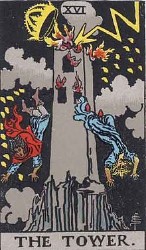
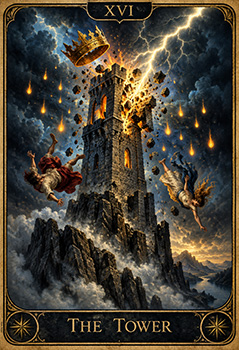
A mighty tower has been struck by lightning. Flames erupt from the windows. The occupants, hurled into the air by the force of the blast, are plunging toward a very unpleasant landing.

Yikes.

It’s one of the most feared cards in the Tarot. Whether it appears upright or reversed, The Tower usually signals upheaval, disruption, loss, or sudden change.

But here’s the thing:

The Tower isn’t really about the top of the tower.

It’s about the basement.

The Importance of Foundations

Like a Saturn return in astrology, The Tower destroys whatever is built on a weak foundation.

Notice that the lightning strike isn’t the whole story. Lightning hits buildings all the time. What turns a lightning strike into a catastrophe is the condition of the structure itself.

The real lesson of The Tower is that most of us build our lives on foundations we rarely examine.

Our assumptions.

Our beliefs.

Our fears.

Our relationships.

Our careers.

Our identities.

We construct elaborate towers on top of these foundations and then spend years assuming they’ll stand forever.

Until they don’t.

Eliphas Levi and the Wrong Turn

Part of the reason The Tower has such a grim reputation comes from an interpretation popularized by the nineteenth-century occultist Eliphas Levi.

Levi identified the card with the Tower of Babel from the Bible.

The problem is that the story doesn’t really fit.

The Tower of Babel wasn’t destroyed by lightning. According to the story, God punished its builders by confusing their languages so they could no longer communicate.

The deeper message of Babel is that humanity was punished for its pride. The builders reached too high, became too ambitious, and were struck down for their arrogance.

Once this idea attached itself to The Tower card, the interpretation began drifting toward a very Christian notion of guilt and punishment.

Something bad happened.

Therefore you must have done something wrong.

God, Karma, Fate, or the Universe is simply giving you what you deserve.

It’s a comforting theory because it suggests that bad things only happen for a reason.

Unfortunately, life doesn’t always work that way.

Just The Tarot, by Dan Adair – Available on Amazon

The “Shit Happens” Principle

One of the hardest truths to accept is that sometimes terrible things happen for no obvious reason.

A good person gets sick.

A devoted spouse is abandoned.

A careful driver gets hit by a drunk driver.

Someone loses their job, their savings, and their sense of security all within a few months.

When these things happen, we immediately begin searching for explanations.

What did they do wrong?

What lesson are they supposed to learn?

What hidden flaw attracted the disaster?

Sometimes there may be a lesson.

Sometimes there isn’t.

Sometimes shit just happens.

That’s not a very comforting answer, but it’s often a truthful one.

The Pendulum

The Kybalion offers a useful way of looking at this.

According to the Principle of Rhythm, life moves like a pendulum.

Good times are followed by difficult times.

Difficult times are followed by good times.

The pendulum swings one way and then the other.

There is nothing personal about it.

The tides come in and go out.

The moon waxes and wanes.

Seasons change.

Life moves in cycles.

The Tower often appears when we’ve forgotten that truth and begun acting as though our present circumstances are permanent.

The Gift Hidden Inside The Tower

As painful as The Tower can be, it contains an unexpected gift.

It reveals what isn’t working.

A loveless marriage ends.

A dead-end career collapses.

An identity built on appearances falls apart.

A belief system that no longer serves us is shattered.

At the time, these experiences can feel catastrophic.

Years later, many people look back and realize that The Tower didn’t destroy their lives.

It destroyed the illusion that their lives were built on solid ground.

And once the illusion is gone, something remarkable becomes possible.

Rebuilding.

That is the hidden blessing of The Tower.

Very few people willingly tear down their lives and start over.

The Tower does it for us.

Not because we are being punished.

Not because God is angry.

Not because the Universe is keeping score.

But because whatever was false can no longer support the weight placed upon it.

The Tower clears the ground.

What we build next is up to us.

As Kris Kristofferson famously wrote:

“Freedom’s just another word for nothing left to lose.”

Strange as it may sound, that’s the freedom The Tower offers.

Not the freedom to avoid change.

The freedom to begin again.

THE DEVIL CARD AND FREEDOM

Exploring the element of choice with The Devil card.

It’s always a little scary to get The Devil card in a Tarot reading.  Based on the famous illustration of Eliphas Levi’s Baphomet, we see a large, horny critter with bat wings looming over a hapless couple in chains.  Not only do they look miserable, but their tails are actually on fire.  

Which has always seemed like a bit of an overreaction to me.  It’s bad enough to take away their clothes and chain them to a black altar.  Lighting their tails on fire is just plain mean.

When we get this card in a reading, we can assume that (a) we are personally in a really bad, low-vibration place or (b) we’re involved with someone else who’s in that sort of a space.  

There’s also a school of thought that The Devil card can indicate black magic.  Perhaps we pissed off someone and they whomped a hoodoo on us.  Maybe that person we broke it off with romantically is spending their Saturday nights burning black candles and sticking pins into a picture of us.

And that can be true.  I don’t want to downplay that possibility, but it tends to miss one of the most important messages of this card, which is CHOICE.  

When we get involved in or stay in a really dark place, it’s the matter of whether we choose to be there that determines whether it’s evil.

THE CHAINS AROUND OUR NECKS

There are so many things that we think of as being, “evil,” that can feel like chains around our necks.  

Drug addiction.

Alcoholism.

Abusive relationships.

Codependency.

All of those can feel as if we’re literally enslaved.  We may know in our hearts that we’re in a really bad space and feel constant misery over it.  But, without help, we may be powerless to escape from the bottle, the needle in the arm, the slap across the face.

Sadly, there are many people who casually assume that people in those situations just don’t want to be free of them.  We saw that in the so-called, “war on drugs,” where the advice was, “just say no to drugs.”  

The reality of being an addict, of course, is that you CAN’T say no to drugs.  That’s why we call them addicts, right?

We also see it in the judgment that people ladle out to women who are enmeshed in abusive relationships.  “Why don’t you just leave him” we ask.  “What’s wrong with you?”

What’s wrong with them is that they don’t know HOW to leave an abusive relationship.

And codependents may lose their entire lives “saving,” other people because they haven’t got a clue about how to set up healthy boundaries.

So, in all of these situations, there’s one element in common:  a lack of choice.  And you can’t make a choice to be evil if you can’t make a choice at all.

HOW LOOSE ARE THE CHAINS?

When we zoom in a little closer on The Devil card, we make an astonishing discovery:

Their hands are free and the chains around the couple’s necks are so loose that they could easily be lifted right over their heads.  

In other words, their apparent slavery is entirely a matter of choice.  They could, at any moment, remove the chains and walk away, but they CHOOSE not to do it.

This was actually a major change in the way that this card was designed.  In the older, Marseille deck we see the same couple, but their hands are bound tightly behind them and the ropes around their necks can’t be moved.  

A.E. Waite and Pamela Coleman Smith deliberately decided to incorporate the element of choice in portraying evil when they designed this card.  

Why did they take this radical step?

MENTAL ILLNESS AND EVIL

The Waite-Smith Tarot deck was released in 1909, which was the tail end of the Victorian Era in England.  This period saw massive changes in the way humans lived, mainly brought on by the Industrial Revolution and mass manufacturing.  

One of the areas that saw the greatest changes was the legal system and the ways in which we think about crime.  In particular, what emerged was the concept that a person couldn’t commit a crime if they were insane.  

In a nutshell, if a person was so deranged that they didn’t know what they were doing was wrong, or if they had an irresistible impulse that made it impossible for them to NOT act in a particular way, then they weren’t making a CHOICE to commit a crime and couldn’t be found guilty of it.

For us, that notion is completely commonplace.  Not guilty by reason of insanity is a phrase that we hear all the time.  But that idea of choice determining evil wasn’t in play until about 150 years ago and I’m guessing that’s why we saw the change in The Devil card.  

WHY IT’S IMPORTANT

Now, you may be wondering what all of this has to do with doing an actual Tarot reading and that’s a fair question.

There’s a subtle nuance here that’s important to recognize and that has to do with freedom.  The people portrayed in The Devil card are free to walk away from what they’re doing.

Which really feels counter-intuitive.  When we look at the card, we see that they’re chained and completely dominated by the Devil critter.  At first glance, it seems that they’re not free at all.

But they are.  They’re not insane.  They’re not compelled to be there.  They choose to be there.

And so, when we pull this card in a reading, we can emphasize that.  We can actually look at this card and tell a client, “Yeah, you’re in a bad space, but you can change all of that.  You don’t have to go on being miserable.  You can walk away from it and be free.”

And that’s HUGE.  That gives the client agency in a situation where they may feel totally trapped.  It tells them that their freedom is in their own hands, if they decide to take it.

ALTERNATIVES

Now, again, I want to emphasize that this isn’t the only interpretation of The Devil card.  If, for instance, we saw the Devil paired with The Moon, then we might actually be looking at issues like insanity or serious delusions.

If we saw The Devil paired with The Magician reversed, we might infer that there really IS some black magic going on.  Always look at the surrounding cards.

By far and away, though, The Devil is a card of choice, of choosing to live in negativity and low vibrations.  That’s not good news, of course – no one wants to exist like that.  But freedom grows out of choices and that IS good news.

“Just the Tarot,” by Dan Adair.  Available on Amazon.

REVERSE ENGINEERING A BAD READING

Changing a negative reading to a positive reading by using the lesson that needs to be learned.

Available on Amazon

If we read Tarot cards for long enough, we will eventually pull a bad reading. Sometimes it’s a really, really bad reading.  You know:  Death, The Tower, 10 of Swords, and maybe a few other horrible seeming cards thrown in.  

After all, everyone has ups and downs.  Everyone goes in and out of the light.  Bad things happen to good people and vice versa.

The completely natural reaction to that is to freak out and think, “Oh, I’m so screwed.”  And then we may batten down our psychological hatches, load our pockets full of protective crystals and charms, and go forth into the world, fully expecting to be hit by a bolt of lightning.

IT’S NOT CARVED IN STONE

A better approach is to remember that Tarot readings are never carved in stone.  They’re a snapshot of the present moment, a prediction of how things are going to turn out if they continue along the present course.

Yes, they are eerily reliable.  If the Tarot predicts that something is going to happen – good, bad, or neutral – it usually does.

But that’s primarily because we forget that we have free will and we can make choices.  By acknowledging what’s happening right now and getting to work on it, we can alter the outcome of those readings.  In a phrase, we can look at the problems that the Tarot is predicting and reverse engineer them so that they don’t happen.

HERE’S AN EXAMPLE

Let’s look at a simple three card reading.  The question of the reading is, “Where am I aligning with my life’s purpose?”

1 – Where does the energy flow most freely? – The Tower reversed.

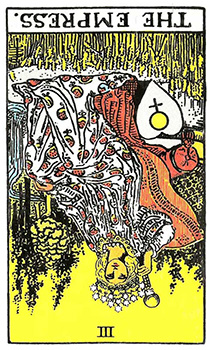
2 – Where does the greatest resistance occur? – The Empress reversed.

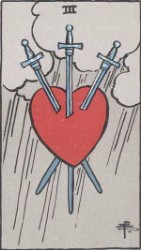
3 – What lesson needs to be learned at this point? – The Three of Swords

Now, if we were to just look at that sequence of cards as they lay on the table, it’s not a very positive reading.  The Tower reversed warns of serious destruction.  The Empress reversed is a loss of abundance.  The Three of Swords is heartbreak.

If we were just reading this predictively, we’d say, “Okay, this person is going to get hit by something heavy, he’ll lose his abundance, and it will break his heart.”  

When we look at it symbolically, in the context of the actual reading, though, we see a far different message.

The energy is flowing most freely where the person is consciously dismantling false foundations and lies in his own life (The Tower, reversed.)  He’s unable to receive abundance because he can’t open to it (Empress reversed.). AND the reason that he can’t open to it is because his heart, his trust, has been seriously wounded in the past (Three of Swords.)

REVERSING IT

Now, as I said, none of this is carved in stone and all of this can be changed.  So, what does this person need to do to flip the reading to something more positive?

We look directly at the last card – what lesson needs to be learned – for guidance.  This person needs to heal his heart.  When he heals his heart, that will enable him to trust the world and receive the abundance that he deserves.  When he heals his heart and learns to trust the world, then the false foundation of The Tower reversed becomes a real foundation that’s based on love.

If we were to put in purely energetic terms, this person has been deeply wounded emotionally, resulting in his heart chakra being blocked.  His heart chakra being blocked has kept him from being able to receive abundance.  His inability to receive abundance has caused him to question the basis for his existence, which is the falling Tower.

CAUSE AND EFFECT

When we use this approach, we cease to look at a Tarot reading as if it’s just a prediction and we start to look at it as a puzzle that can be solved.  We don’t just see that bad things may be about to happen – we see WHY they’re about to happen.

And if we can change the WHY, we can change the HOW.

There are about a kajillion different Tarot spreads out there, but most of them will have a, “lesson card.”  That card may be called:

– what needs to be learned;

– hidden forces;

– causal factors;

– opposing forces, etc.

That’s the card that we want to focus in on when we’re trying to reverse engineer a bad reading.  We don’t want to take an attitude of, “Well, shit happens.”  We want to figure out why it’s happening and then reverse those forces with an opposite energy.

In the example above, the client had a broken heart (AKA, a blocked heart chakra) and so the solution was to bring love into his heart.  A simple Metta meditation, done every day, began to cultivate more compassion, understanding, and love.

The, “lesson,” will probably be different with each client, of course.  It may be that their issue is addiction (The Devil) or a need for more solitude (The Hermit) or a lack of direction (Seven of Cups.)

Whatever the lesson card may be, that’s the keystone that holds the whole reading together.  Figure out what the client needs to learn, and you figure out what’s happening to her and why.  

Don’t just look at the effect – look at the cause.  And that will change the effect.

Tarot and the Root Chakra – Part Three – Finding Healing

Resources for Healing the Root Chakra – Part Three in a series on Tarot and the Root Chakra.

Root Chakra Meditation Poster – Available on Etsy.

This is the last of a three part series on Tarot and the root chakra.  In the first part, “10 Tarot Cards That May Indicate a Blocked Root Chakra (1st Chakra)” we looked at some of the cards that are signposts for root chakra issues.  In the second part, “Understanding the Root Chakra More Deeply: Safety, Survival, and the Foundations of Self,” we explored some of the devastating effects that problems with our root chakra can cause in our adult lives.  

Of course, for any problem, we should also lay out some solutions, so in this post I’ve compiled some of the resources that I’ve personally used and found to be dependable.  If you’re aware of other resources that you’d like to see listed here, please don’t hesitate to write and let me know.

BOOKS:

Energy Rules: Deflect Negative Vibrations and Own Your Energy by Alla Svirinskaya.  This was originally published under the name of, “Own Your Energy,” and is a wonderful explanation of the chakras and meridian system by a world renowned energy healer.  She also has some interesting thoughts about energy vampires and how to preserve your unique energy identity.

Chakras Made Easy: Seven Keys to Awakening and Healing the Energy Body (Made Easy series) by Anodea Judith. A complete guide to understanding, working with and developing your connection to your chakra system for healing and transformation.  I’ve had this one in my library for several years and it’s one of the best and most complete explanations of the chakra system.

Root Chakra: The Ultimate Guide to Opening, Balancing, and Healing Muladhara (The Seven Chakras) by Mari Silva – Understand the role of your root chakra and learn how to keep it healthy and happy.  Silva has written extensively about the chakra system and this is short, easy read on the root chakra.

Unblocked: A Revolutionary Approach to Tapping into Your Chakra Empowerment Energy to Reclaim Your Passion, Joy, and Confidence by Margaret Lynch Raniere and David Raniere – This is centered around using EFT tapping to unblock your chakras, but does a very deep dive into the lower four chakras.  She especially covers how a blocked root chakra can lead to a weak sense of personal identity and severely affect our ability to attract abundance.

VIDEOS

Unblock Your SuperPowers – Chakra One – by Margaret Lynch Raniere – This is a really nice series covering that lower four chakras, which is an explanation of her book.  About an hour long and packed with good ideas.

10 Minute Root Chakra Guided Meditation – by Great Meditations – Great Meditations has several chakra meditations up and they’re all good.  If you have trouble meditating (or even if you don’t) this is a wonderful resource for quick, powerful visualizations.

Grounding with the First Chakra – Part One – by Sonia Choquette – Sonia, of course, is one of the best spiritual teachers out there and this is a wonderful three part series with many tips for immediate grounding.

10 min Chakra Meditation Series~Note C~1st~Root Chakra with Tibetan Bowls~No Vocals – by Temple Sounds – A quick sound meditation designed to stimulate the root chakra through vibrations.

Balance Your Chakras Using Tapping – Chakra #1 – by Helen McConnell Tapping Into Higher Consciousness – EFT tapping to heal root chakra blocks.

Yoga Nidra for the Root Chakra – 30 Minute Yoga Nidra for the Root Chakra with Costa Rican Jungle Soundscape – by Ally Boothroyd, Sarovara Yoga – All of her yoga Nidra videos are incredibly healing and this one is specifically for root chakra.

“Just the Tarot,” by Dan Adair – available on Amazon

Understanding the Root Chakra More Deeply: Safety, Survival, and the Foundations of Self

Exploring the causes of root chakra issues, the second in a three part series on Tarot and the root chakra.

In my previous post, “10 Tarot Cards That May Indicate a Blocked Root Chakra,” we explored how Tarot can reveal energetic patterns related to fear, insecurity, survival struggles, and grounding issues. Those are all first chakra issues.

So now, let’s look at the Root Chakra in a little more depth.

The Root Chakra, or Muladhara, is located at the base of the spine and is traditionally associated with the color red. It serves as the energetic foundation of the chakra system, governing our sense of safety, survival, stability, and belonging.

Its symbol is a four-petaled lotus, often interpreted as representing the four directions—north, south, east, and west—symbolizing our connection to the physical world and our grounded presence within it.

Its seed syllable, or bija mantra, is LAM, a sound traditionally used in meditation to strengthen and activate Root Chakra energy.

When balanced, this chakra allows us to feel safe in our bodies and secure in the world. When blocked, however, it can create profound ripple effects throughout every other area of life.

CHAKRAS AND DEVELOPMENTAL PSYCHOLOGY

One of the most interesting things about chakra work is that it’s really a method of developmental psychology.  

What do we mean by that?  

Developmental psychology posits that there are certain, “goals,” that we have to achieve as we develop into complete human beings and achieving one goal helps us to achieve the next goal.  

To use a really simple example that’s become a cliche’, we have to learn how to walk before we run.  When we look at an infant, we can see that that’s literally true:  the child’s body has to develop the muscular strength  to walk before she can run.

In the same sense, the child has to learn to make sounds before he can make words and has to learn what words mean before he can make sentences.  Each developmental step leads into the next.

The important point here is that if we don’t fully achieve the first step, it makes it more difficult to achieve the next step.

While all of that is going on with our physical bodies, there’s a similar development happening with our energetic bodies, i.e. the chakra system. 

 Each chakra actually develops at a particular phase of our lives and – if it doesn’t develop right – that causes problems in the next chakra, which causes problems in the next chakra, and so on.

LOWER CHAKRA DEVELOPMENTAL STAGES

Chakra One (Root Chakra)

Womb to 12 months

Develops our sense of safety, security, and trust in life.

Chakra Two (Sacral Chakra)

6 months to 2 years

Develops personal identity, emotional experience, and selfhood.

Chakra Three (Solar Plexus Chakra)

18 months to 3.5 years

Develops ego strength, confidence, and our ability to project ourselves into the world.

Chakra Four (Heart Chakra)

3.5 years to 7 years

Develops our ability to form loving, healthy relationships.

Here’s how that looks in the lower chakras:

So, if the first chakra doesn’t develop correctly, then we don’t feel safe in the world.  

If we don’t feel safe in the world, then we’ll try to hide who we really are, so the second chakra won’t develop well.  

If we try to hide who we really are, then we’ll never have the confidence to project ourselves into the world in a healthy way, so the third chakra won’t develop.  

And if we don’t have a strong ego structure, then we can’t develop healthy relationships, so the fourth chakra becomes stunted.

Each step leads to the next, right?

FIRST CHAKRA ISSUES

In her powerful book: “Unblocked: A Revolutionary Approach to Tapping into Your Chakra Empowerment Energy to Reclaim Your Passion, Joy, and Confidence”, Margaret Lynch Raniere suggests that the Inner Child essentially lives within the Root Chakra.

This is a profound concept because it means the first chakra contains the earliest energetic blueprint for:

* Safety

* Security

* Trust

* Survival

* Worthiness of care

According to this model, Root Chakra healing often comes down to two essential early-life questions:

1. Did we feel safe?

2. Were our needs met?

The answers to these questions become deeply wired into both our nervous systems and our energetic systems.

“Just the Tarot,” by Dan Adair – Available on Amazon

DID WE FEEL SAFE?

That’s actually a fairly complex question.  If we were born into extremely abusive or dysfunctional families, it’s fairly easy to surmise that we didn’t feel safe.  If we were being slapped around or screamed at as a helpless infant, obviously we wouldn’t feel safe.  

Remember, though, that the first chakra forms – not just in our first year – but also in the womb.  During that period when we were gestating inside of our mother’s bodies, we were basically immersed in whatever chemicals and hormones SHE was feeling.  

And so the second part of this question is, “Did our mothers feel safe?”  

Because, for that period that we were in the womb, her nervous system was our nervous system.

For instance, if our family was going through a period of extreme stress during the time that we were gestating, we can reasonably conclude that our mothers were producing really high levels of cortisol and adrenaline in their bodies.  If they were depressed, they may have had chronically low levels of serotonin. And so did we.

Put another way, if our mothers didn’t feel safe, then we didn’t feel safe.  

Whatever they were feeling is the emotional set point that we had when we entered the world.  If they were extremely anxious, then we were extremely anxious.  If they were depressed, then we were depressed.

And we carry that forward into the rest of our lives.  If we felt unsafe as infants, we’ll be in chronic low level fight or flight reactions as adults.  We’ll be hyper-vigilant, always looking for the next threat.  

We may be ungrounded and unfocused because it’s literally painful to be in our own bodies.  

We may even be attracted to people who MAKE us feel unsafe as a way to validate our feelings.

WERE OUR NEEDS BEING MET?

As Raniere pointed out, we might think of the needs of an infant as a continuing series of irritations followed by being soothed.  

In a healthy family, that runs like this:

 Irritation:  I’m hungry.  Soothing:  someone fed me.

Irritation:  I’m cold.  Soothing:  someone covers me.

Irritation:  I’m scared.  Soothing: someone holds me.

That sets up a pattern in the nervous system whereby we feel that our needs will always be met.  And if our needs are met, then we feel safe and secure in the world.

Now, again, we may think of an infant’s needs not being met in terms of the extremes of child neglect.  If a child isn’t held and loved they can actually die from failure to thrive.  But not having your needs met can exist over a broad spectrum.

We may, for instance, have good, loving parents who simply have too many kids.  Raniere touches on this with the fact that she had 8 siblings who also needed to be taken care of by her parents.  

As we were talking about in the preceding section, we may have had a mother who was suffering from deep depression or a physical illness and simply couldn’t provide the care that we needed.

And as Gabor Mate’ has pointed out, it’s possible that our parents adopted a child-rearing philosophy where they thought it was actually good for the infant to ignore her needs.  If you just let the baby sit its crib and cry, they’ll learn patience, right?  

Whatever the reasons, if our needs weren’t being met as infants, that sets up in our first chakra as the expectation that our needs won’t be met as adults.  

We can drift into codependent relationships where we’re constantly over-giving in the hopes that our partners will at least meet some of our needs.  

We can intentionally seek out partners who aren’t capable of meeting our needs in order to validate our expectations.

Even worse, we may learn to ignore our needs and fail to take care of ourselves as adults.  The pattern we learned was, “Something is irritating me and I’m not going to be soothed, so I have to just live with it.”  Our levels of self-care, self-love, and self-compassion may be almost non-existent.

MOVING ON TO SOME SOLUTIONS

So in the first post in this series, we looked at some Tarot cards that may indicate that we have a blocked first chakra.  In this post, we looked at how that happens.  In the next post, I’ll gather together a list of really good resources to help us heal the root chakra and regain a sense of safety in our lives.

Because when we reclaim our foundation, we reclaim the possibility of building a life rooted not in fear—but in genuine security.

10 Tarot Cards That May Indicate a Blocked Root Chakra (1st Chakra)

Ten tarot cards that may indicate a blocked first chakra.

When we begin exploring Tarot through the lens of the chakra system, the 1st chakra, or Root Chakra (Muladhara), is one of the most essential places to start.

Located at the base of the spine, the Root Chakra governs our sense of safety, survival, grounding, and physical stability. It is the energetic foundation upon which all other aspects of self-expression are built. If this chakra is balanced, we tend to feel secure, present, connected to our bodies, and capable of navigating the world with confidence.

When blocked or imbalanced, however, Root Chakra issues may manifest as:

* Chronic fear or anxiety

* Survival struggles

* Money insecurity

* Health concerns

* Feeling unsafe or unsupported

* Living in constant fight-or-flight mode

* Restlessness or inability to settle

* Feeling ungrounded, “spacey,” or disconnected

* Difficulty trusting life

Energetically, this chakra develops during the earliest stage of life—from the womb through approximately 12 months of age—making it deeply connected to our primal sense of security and belonging.

In many ways, a blocked Root Chakra can make it difficult to fully express our gifts, creativity, and higher spiritual potential because part of us is still focused on basic safety.

In an upcoming post, we’ll take a deeper look at Root Chakra healing and explore some of the powerful teachings of Margaret Lynch Raniere in her groundbreaking book, Unblocked: A Revolutionary Approach to Tapping into Your Chakra Empowerment Energy to Reclaim Your Passion, Joy, and Confidence.

For now, let’s explore 10 Tarot cards that may suggest Root Chakra imbalance and what they could reveal.

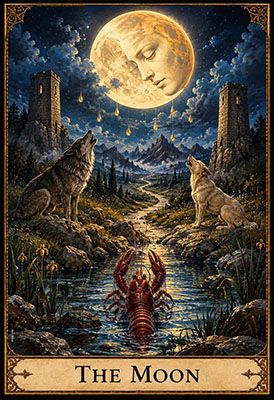
1. The Moon

The Moon often points to deep subconscious fears, uncertainty, and emotional confusion.

When connected to Root Chakra issues, this card may indicate:

* Fear-based living

* Unclear survival instincts

* Anxiety rooted in early developmental experiences

* Difficulty distinguishing real threats from imagined ones

A blocked Root Chakra may leave us feeling as though the ground beneath us is unstable—very much the territory of The Moon.

2. Five of Pentacles

This is one of the clearest indicators of Root Chakra distress.

It may reflect:

* Financial hardship

* Scarcity mindset

* Fear of abandonment

* Physical illness

* Feeling unsupported

The Five of Pentacles often highlights core wounds around survival, security, and belonging.

3. Four of Pentacles (Reversed)

While upright, this card can show attempts to create security, reversed it may suggest:

* Fear-driven instability

* Money anxiety

* Difficulty holding onto resources

* Feeling unsafe or ungrounded

This reversal can point to instability in one’s foundational energy.

4. Nine of Swords

This card often represents chronic worry, sleeplessness, and nervous system overload.

From a Root Chakra perspective:

* Fight-or-flight patterns

* Hypervigilance

* Trauma-based fear

* Difficulty relaxing into safety

The body may remain in survival mode even when danger is absent.

5. The Tower

The Tower can represent major disruptions to safety structures.

Possible Root Chakra themes include:

* Sudden loss of stability

* Security crises

* Physical or emotional upheaval

* Fear of collapse

This card may indicate foundational wounds being activated.

6. The Devil

The Devil often reflects fear, material bondage, or trauma patterns.

In relation to the Root Chakra:

* Survival programming

* Scarcity beliefs

* Fear-based attachment

* Feeling trapped by insecurity

This card can reveal deeply ingrained patterns rooted in primal fear.

7. Seven of Cups

This card may not seem obvious, but it can indicate dissociation or lack of grounding.

Signs include:

* Spaciness

* Escapism

* Fantasy over practical reality

* Difficulty staying present

Blocked Root energy can sometimes lead people to disconnect from reality rather than inhabit it fully.

8. Knight of Swords

This card may signal overactive nervous system energy.

Potential indicators:

* Restlessness

* Hyperactivity

* Constant urgency

* Survival-driven action

Instead of grounded stability, there is perpetual motion and mental overstimulation.

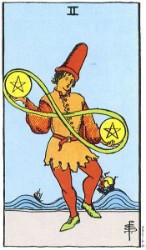
9. Two of Pentacles

This card may suggest instability in balancing material concerns.

It can point toward:

* Financial juggling

* Overwhelm

* Lack of grounded routine

* Survival stress

Life may feel precarious rather than rooted.

10. The Fool (Reversed)

While upright The Fool can symbolize trust, reversed it may reveal:

* Fear of stepping forward

* Lack of trust in life

* Instability

* Poor grounding

This may indicate that foundational fears are interfering with growth.

Final Thoughts

A blocked Root Chakra doesn’t necessarily mean failure—it often means there are foundational issues calling for healing.

Tarot can help illuminate these patterns by showing us where fear, scarcity, instability, or early survival programming may still be influencing our lives.

The good news? Awareness is the first step toward transformation.

By recognizing these Tarot indicators, we can begin addressing the deeper energetic roots of our struggles and move toward greater grounding, safety, and empowerment.

In our next post, we’ll dive further into Root Chakra healing practices and explore Margaret Lynch Raniere’s innovative work on chakra empowerment.

Because when the foundation is strong, everything else can rise.

Just the Tarot, by Dan Adair – Available on Amazon

THE TOWER CARD AND THE HOUSE OF GOD

Why was The Tower card once called, “The House of God?”

We all know the basic definition of The Tower card:  destruction.  When it appears in a reading, it tells us that massive change is on the way.  It can signal divorces, loss of employment, and many other difficult life-changing events.  I’ve described it in the past as having our lives blasted right down to the studs.

Depending on which deck you use, you may have heard different names for The Tower card.  Some call it The Lightning Struck Tower.  Some refer to it as The Blasted Tower.  Most of us just call it The Tower.  There’s an interesting twist, though, in the name that a much older Tarot deck applied to it.

THE HOUSE OF GOD

In the Marseilles Tarot deck, which is a style that emerged in France in the 1500s, The Tower is referred to as, “La Maison Dieu.”  Which means, “The House of God.”  

That’s  a very peculiar name for destruction, isn’t it?

What do we automatically think of when we hear the term, “House of God?”  A church, of course.  So is The Lightning Struck Tower actually a Lightning Struck Church?

Hmmm . . .

NOT GOD

Now, if the card had been labelled as, “The Finger of God,” or even just, “God,” it would have made more sense theologically.  

The Middle Ages were a hyper-religious time in European history and, of course, Christianity was the dominant religion.  As I’ve noted in previous posts, the God of the Old Testament acted very much like a bipolar alcoholic who was off his medications.  He was constantly rampaging around causing floods or blowing up cities or throwing people out of gardens because they ate an apple.  

If that was your concept of God, then, of course, you might associate him with complete destruction of your life.  “Uh, oh . . .  God’s pissed off at me for some reason, so he’s going to smash me like a bug.”

But the thing is, God is most notable in the Tarot by his absence.  True, there are devils and angels and popes and priestesses, but there isn’t one single card that shows a god.

So if it wasn’t the wrath of God that the Tarot was trying to depict, what was it?

IT’S NOT THE TOWER OF BABEL

The French occultist, Eliphas Levi, created a rabbit hole that a lot of subsequent scholars have jumped into.  For no particular reason, he looked at The Tower card and announced that it was a depiction of the Tower of Babel.

If you’re not familiar with that myth, here’s a brief recap:  at one point, all humans spoke the same language.  Since they were able to communicate, they decided to build a tower that would reach all the way to heaven.  That pissed God off and he cursed them so that they’d all speak different languages and couldn’t complete their construction project.

Now, nowhere in the Tower of Babel myth is there any indication that the tower was struck by lightning.  And nowhere in the Tower card, is there any indication that the people falling out of the tower are trying to talk to each other.  

In other words, the only thing that the Tower of Babel and The Tower card have in common is the word, “tower.”

One really unfortunate result of that confusion is that The Tower is now associated with hubris and arrogance.  Like the builders of the Tower of Babel, people who draw the card are supposedly being punished for their pride.  Again, there’s no evidence for that whatsoever.  You can be a perfectly good person and still have that Tower energy blow through your life.

THE INQUISITION

So, again . . . why call it The House of God?

We have to remember that the Tarot is basically a system for predicting the future, or what we loosely call fortune telling.  And the Bible – the operating manual for the Christian church – is very much against it.

“Let no one be found among you who sacrifices their son or daughter in the fire, who practices divination or sorcery, interprets omens, engages in witchcraft.”  – Book of Deuteronomy 18:10–12.

There are several other examples, but suffice it to say the church was against fortune telling and the punishment was death.

The Inquisition was reaching its peak during the exact same time frame that the Tarot first emerged.  Priests were merrily torturing, maiming, and burning anyone whom they considered to be practicing witchcraft.  

In a very real sense, then, the church itself – the House of God – could be viewed as complete destruction for both the Tarot and those who used it for divination.  

THE DEFINITION IS THE SAME

The basic definition of The Tower remains the same, of course.  It signifies an almost complete destruction of a person’s way of living or thinking.  Upright, it shows that the destruction is coming and reversed, it shows that it’s already happened.

It IS fascinating, though, to conjecture about what those early Tarot designers might have been trying to tell us.  Were they saying that the church itself was evil?

Were they warning other occultists to keep the true meanings of the cards concealed or risk persecution?

Were they warning against the ultimate effect of rigid belief systems?

Were they, perhaps, predicting the eventual destruction of the church system – the House of God?

We’ll never really know.  In an age when we’re once again seeing the rise of religious fundamentalism and intolerance, though, it might serve us well to ponder those very questions.

“Just the Tarot,” by Dan Adair – Available on Amazon

What Are Tarot Archetypes (And Why They Matter)?

The influence of Tarot archetypes in our lives.

The Empress Abundance Poster – available on Etsy

In any serious discussion of the Tarot, you’ll hear people referring to the Major Arcana as “archetypes.”

Which sounds very impressive… but also raises a perfectly reasonable question:

What, exactly, is an archetype?

The idea goes all the way back to Plato, but in modern usage it’s most often associated with the Swiss psychologist Carl Jung.

Jung defined archetypes as:

Universal, inherited patterns of thought or imagery that exist in the collective unconscious of all human beings.

Which is a fine scholarly definition… but for most of us, it lands somewhere around:

“Huh?”

So instead of trying to define archetypes academically, let’s talk about how they actually show up in real life—especially through the Tarot.

The Major Arcana

If you’re reading a Tarot blog, you probably already know the basics.  The Tarot is divided into two parts, the Minor Arcana and the Major Arcana.

• The Minor Arcana (Wands, Cups, Pentacles, Swords) deal with everyday life.

• The Major Arcana (22 cards) deal with something deeper.

The images of the Major Arcana are the ancient core of the Tarot, dating back to the 15th century (and possibly earlier). The Minor Arcana didn’t even get illustrated scenes until the Waite-Smith deck in 1909.

So when we talk about archetypes in Tarot, we’re really talking about the Major Arcana.

They’re Not Personal

Here’s the first—and most important—thing to understand:

Archetypes are not personal.

Now, I know that sounds strange, because they feel very personal.

If you pull Death or The Tower in a reading, it doesn’t feel abstract. It feels like the universe just singled you out and dropped a piano on your head.

But here’s the shift:

• Minor Arcana = things you’re generating and can influence

• Major Arcana = larger forces moving through your life

For example:

• Two of Cups → You’re falling in love.  Those are personal dynamics, like the type of person you find attractive, are you feeling lonely, do you want a partner?

• The Lovers → Love as an energy is active in your life (archetypal force.). The energy isn’t something you’re creating and it’s not attached to any one person.  It’s just moving through your life.

In other words:

You don’t create archetypes—you experience them.

Sometimes They’re Collective

Archetypes don’t just affect individuals—they can sweep through entire cultures.

Jung noticed this before World War II when many of his German patients reported eerily similar dreams of White men riding black horses through the night—images that seemed to foreshadow the rise of Nazism. He interpreted this as a collective archetype emerging.

And honestly, you don’t have to look far to see this kind of thing in today’s politics.

We’ve all watched people we’ve known for years suddenly shift—sometimes dramatically—in beliefs, behavior, or identity. It can feel almost like they’ve been “taken over.”

From an archetypal perspective, that’s not entirely wrong.

These are psychic weather systems—and sometimes whole populations get caught in them.

The important takeaway?

Just because an energy is present doesn’t mean you have to identify with it.

Shelter in Place

Obviously, not all archetypes are pleasant.

• The Tower → destruction

• The Moon → confusion, illusion, emotional instability

• The Devil → addiction, entrapment, shadow patterns

So what do you do when one of these shows up?

You’ve got two main options.

1. Shelter in Place

Sometimes the best strategy is simple:

Ride it out.

Think of a tornado. You don’t go out and negotiate with it. You don’t try to “manifest” it away.

You get into the storm shelter and wait.

Life sometimes does this:

• Relationship ends

• Job disappears

• Everything falls apart at once

That’s Tower energy.

And sometimes the wisest response is:

“Okay… this is happening. Let’s survive it.”  Hunker down and wait for it to go away.

2. Rise Above It

The Kybalion talks about this strategy quite a bit.

Even if you can’t control the event, you can control your response.

You can:

• shift your perspective

• regulate your emotions

• choose your interpretation

For instance, with The Tower, you can respond to it in one of two ways.

• “This is a disaster. I lost my job, my partner divorced me, I’m out of money. My life is ruined.”

OR

• “This is a reset. I get to rebuild from scratch. My old life is gone, so I get to build my new life exactly as I want it.”

The external event is the same.

The internal vibration is not.

And that makes all the difference.  We haven’t, “cured,” what happened to us, but we’ve vastly diminished it effects on us.

Invoking the Positive Archetypes

Here’s where things get interesting.

Even though archetypes aren’t created by us…

We can align with them.

Think of it less as control and more as tuning in.

Examples:

• Feeling stuck financially? → work with The Empress (abundance, growth)

• Struggling with confidence? → invoke The Emperor (authority, structure)

• Feeling lonely? → connect with The Lovers (connection, union)

• Burned out? → step into The Hermit (withdrawal, restoration)

This can be done through:

• meditation

• visualization

• journaling

• even just keeping the image nearby

You’re not creating the energy.

You’re opening yourself to it and inviting it’s power into your life.

 Conclusion

So what is an archetype, really?

It’s not just a symbol.

It’s not just a psychological idea.

It’s more like a living pattern of energy that moves through human experience.

Sometimes it lifts us.

Sometimes it breaks us open.

Sometimes it sweeps through entire cultures like a storm.

But here’s the key:

You are not powerless in the face of archetypes.

You may not control when they appear,

but you do have a say in how you meet them.

You can:

• recognize them

• name them

• step back from them

• align with the ones that serve you

And over time, something interesting happens:

Instead of being tossed around by these forces…

You start to navigate them.

And that’s really what Tarot is for.

“Just the Tarot,” by Dan Adair – Available on Amazon

The Emperor: Sacred Structure and the Protection of Creativity

A look at the roles of Yin and Yang energies in the process of creativity.

The Emperor and the Empress are obviously paired cards—one female and the other male. But if we stop at gender, we miss their deeper meaning entirely.

On a more profound level, they represent the Yin and Yang energies that exist within every human being.

Every woman has testosterone in her body. Every man has estrogen. Wholeness comes not from exaggerating one pole and suppressing the other, but from integrating both. Strength and compassion. Power and vulnerability. Fierceness and tenderness.

This is what the ancient Yin–Yang symbol illustrates so elegantly: Yin contains Yang, and Yang contains Yin.

When these energies are balanced, they produce whole, grounded human beings. When they are separated and exaggerated, they produce caricatures.

That’s where we find emotionally stunted men obsessed with dominance and control. That’s where we find people who abdicate their agency entirely and wait for someone else to take care of their lives.

Me Tarzan. You Jane.

Man strong. Woman weak.

This is not balance. This is Yang attempting to overwhelm Yin. But Yin and Yang are not enemies. They are partners.

Creation requires both.

The Peculiar Paradox of Yin Energy

Modern culture often assumes that Yang energy—the active, assertive, masculine principle—is the true creative force, while Yin energy is passive or secondary.

Nature shows us exactly the opposite.

Consider procreation. A man’s biological contribution to the creation of a child may take minutes. But the woman’s body then undertakes nine months of continuous creation—growing, forming, and sustaining new life from her own substance.

She gives birth. She nourishes the infant. She does the creating.

THE YIN ENERGY DOES 99% OF THE WORK OF CREATION.

This pattern appears everywhere.

The receptive, Yin principle is not inert. It is generative. It is the matrix from which life emerges.

The Kybalion expresses this clearly: the feminine principle does the creative work. The masculine principle directs and structures it.

Without Yin, nothing would exist.

The Artist and the Subconscious

We see this same pattern in the creative process.

When we imagine an artist, we picture someone standing at an easel, brush in hand, actively painting.

But the visible act of painting is only the final stage.

Long before the brush touches the canvas, the image has already been forming in the artist’s subconscious mind. It grows invisibly. It gestates. It organizes itself.

We call this “inspiration,” as if it appeared suddenly.

But inspiration is the flowering of something that has been developing quietly within.

The conscious mind—the Yang principle—provides skill, technique, discipline, and execution. But the image itself emerges from the Yin subconscious.

Again, the receptive principle does the creative work.

The Function of the Emperor

Does this mean the Emperor—the Yang principle—is unnecessary?

Not at all.

The Emperor is essential.

The Empress creates. The Emperor protects and stabilizes what she creates.

Consider the garden.

The Empress is the lush, living growth. She is the fertile soil, the green leaves, the flowing water. She is life itself.

But without structure, the garden cannot reach its full potential.

The Emperor builds the raised beds. He enriches the soil. He installs irrigation. He builds the fence to keep the deer out.

He does not create the life. He ensures its survival. The Emperor provides continuity. He creates the conditions under which life can flourish and endure.

The Emperor Is Always Grounded in the Empress

In my own Emperor affirmation card, I made a subtle but important change. The Emperor still sits on his stone throne, armored and immovable.

But I surrounded him with life.

Emperor Affirmation Poster – available on Etsy

Because the Emperor does not exist independently of the Empress. He exists to protect her. He exists to serve creation. Within each of us, the Emperor is the part that creates structure for our creative and emotional lives.

If you are an artist, your Emperor sets up your studio, organizes your materials, and protects your time.

If you are a writer, your Emperor establishes the discipline to write regularly and brings your work into the world.

If you are in a relationship, your Emperor establishes boundaries that protect emotional safety and mutual respect.

The Emperor does not suppress the Empress.

He protects her so she can fully express herself.

When the Emperor Is Separated from the Empress

When the Emperor loses his connection to the Empress, he becomes distorted.

His structure serves nothing. His authority protects nothing.

He becomes the petty tyrant. The rigid bureaucrat. The hollow authoritarian. His armor is empty. He enforces rules not to protect life, but to compensate for his own inner disconnection.

True authority does not arise from domination. It arises from service to life.

The Emperor’s true purpose is not control. It is protection. He is the guardian of the garden. He is the structure that allows creativity to endure.

He is sovereignty in service of life itself.

When we see beyond the illusion of gender, the deeper purpose of these archetypes becomes clear. The Empress and the Emperor are not separate beings, but complementary forces within each of us. One creates. The other protects what has been created. One generates life from the invisible depths. The other builds the structure that allows that life to endure. 

Our true purpose is not to choose between them, but to embody both—to allow our inner Empress to bring forth creativity, love, and vision, and to allow our inner Emperor to establish the boundaries, discipline, and stability that allow those creations to survive and flourish in the world. When these two forces work in harmony, we cease to live reactively and begin to live sovereignly, shaping a life that is both fertile and enduring.

The Empress and the Courage to Be “Unproductive”

The Empress Archetype and Relaxation as a Way to Nurture Creativity.

In my Empress affirmation poster, I paired her image with the words:

Nurture Creativity

This may be one of the most misunderstood instructions in the entire Tarot.

  Empress Affirmation Poster – Available on Etsy

Because most of us have been trained to believe that creativity comes from effort. From discipline. From pushing harder. From sitting at the desk and refusing to get up until something happens.

That approach belongs to The Emperor.

The Empress operates differently.

She does not force growth.

She allows it.

She creates the conditions in which growth becomes inevitable.

Creativity Cannot Be Forced

Every creative person eventually encounters this paradox.

The harder you try to force creativity, the more it retreats.

You sit at your desk, determined to produce something brilliant. Hours pass. Nothing happens. Your mind feels like dry soil.

And then, days later—while taking a walk, washing dishes, or doing something completely unrelated—an idea appears effortlessly.

It arrives whole.

Not constructed, but received.

Albert Einstein understood this phenomenon. When asked how he discovered the theory of relativity, he didn’t describe grinding intellectual labor. He said simply:

“It just dropped in while I was playing the piano.”

He wasn’t forcing the insight.

He was allowing it.

This is Empress energy.

The Forgotten Value of Leisure

The philosopher Josef Pieper wrote a remarkable book titled Leisure as the Basis of Culture. In it, he argues that leisure is not the absence of productivity, but its foundation.

Leisure, in its true sense, is not laziness in the modern, pejorative sense. It is a state of receptive openness.

It is the willingness to stop forcing.

Pieper observed that culture itself—art, philosophy, music, science—arises not from frantic effort, but from spaces of inward stillness.

When we allow ourselves to be idle, something deeper begins to move.

The soil replenishes itself.

Modern society often treats leisure as wasteful. We are taught that our worth is tied to constant activity. But creativity obeys older, quieter laws.

Seeds do not grow faster because you stare at them.

They grow because the conditions are right.

“Just the Tarot,” by Dan Adair – available on Amazon

Julia Cameron and the Act of Creative Nurturing

Julia Cameron’s The Artist’s Way remains one of the most practical and psychologically accurate guides to creativity ever written.

Her central insight is simple: creativity must be nurtured.

Not commanded.

She encourages practices like morning pages and artist dates—not to produce finished work, but to create space for the creative self to emerge naturally.

These practices are Empress practices.

They say to the creative mind:

You are safe here.

You are allowed to emerge in your own time.

And when that safety is present, creativity begins to flow again.

The Courage to Be “Lazy”

This is perhaps the most radical lesson of The Empress.

You must allow yourself to be, at times, unproductive.

Not because you are weak.

But because you are cultivating fertility.

What appears to be inactivity is often incubation.

Beneath the surface, ideas are forming. Connections are being made. Your subconscious is doing its work.

If you constantly demand output, you exhaust the system that produces it.

The Empress reminds us that rest is not the opposite of creation.

It is part of creation.

Nurture Creativity

The Empress does not shout. She does not command. She invites.

She reminds us that creativity is not a machine, but a living process.

It responds to kindness.

It responds to patience.

It responds to nourishment.

When you stop trying to force creativity and begin nurturing it instead, something remarkable happens.

Ideas begin to arrive again.

Quietly.

Effortlessly.

Like seeds finding their way toward the light.

So when The Empress appears in your readings—or quietly makes herself known in your life—it is not a signal to push harder. It is an invitation to soften. She asks you to step out of the mentality of force and into the rhythm of cultivation. To rest without guilt. To follow your curiosity. To trust that creativity, like all living things, emerges when it is nourished rather than commanded.

 She reminds you that you are not a machine designed for constant output, but a garden capable of extraordinary growth. Your task is not to force the flowers to bloom, but to tend the soil and allow them to emerge in their own time.