The Magician and Learning to Hide Your Magic

Magic might exist best in silence.

The internet has made the world’s spiritual traditions available to anyone with a curious mind. In the space of an afternoon you can watch videos on Tarot, meditation, astrology, Wicca, Hermetic philosophy, or ancient shamanic practices.

That kind of openness creates an illusion that every spiritual subject is now safe to discuss openly.

Unfortunately, that isn’t always true.

The Price of Being Different

The word eccentric simply means “off center.”

Imagine society as a great circle. Most people live comfortably near the middle, sharing many of the same assumptions about life, religion, and reality. They may disagree about politics, music, or sports, but the foundation of their worldview is remarkably similar.

A spiritual journey often carries us away from that center.

We begin asking unusual questions. We become interested in synchronicity, Tarot, meditation, dreams, symbols, or ancient traditions. We may even come to believe in things that many people dismiss without a second thought.

Naturally, we’re excited.

Whenever we discover something meaningful, our first instinct is to share it with the people we love.

And that can be a grave mistake.

The people listening may smile politely while privately wondering whether we’ve lost our grip on reality. Sometimes the judgment remains unspoken. 

Occasionally it comes back with surprising force from people we trusted completely and that can feel especially devastating.
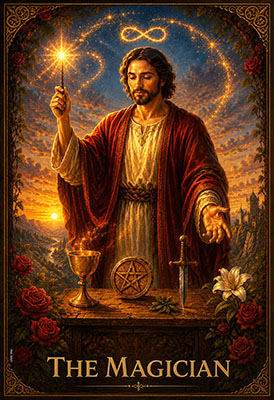
The Magician – 13 X 19 inch poster by Dan Adair – Available on Etsy

Protecting Young Beliefs

This is especially important when you’re just beginning your spiritual exploration.

New beliefs are like tender seedlings pushing through the soil. They aren’t yet strong enough to withstand harsh weather.

They need time.

They need experience.

Most of all, they need protection.

Sharing those fragile discoveries with someone who has already decided they’re nonsense is like inviting someone to stomp through your garden wearing heavy boots.

The damage isn’t necessarily that they change your mind.

The damage is that they plant seeds of doubt before your own understanding has had time to mature.

History Is Shorter Than You Think

It’s easy to assume that hostility toward unconventional spiritual practices belongs to the distant past.

We remember the witch trials and the Inquisition, when innocent people were imprisoned, tortured, or killed because they were suspected of practicing forbidden arts.

Yet fear of the occult has appeared much more recently.

During the Satanic Panic of the 1980s, innocent people were accused of bizarre crimes involving imagined occult rituals. The most famous example was the McMartin Preschool case in California, where extraordinary accusations dominated headlines despite the complete lack of supporting evidence. 

Witnesses testified that Virginia McMartin, who ran a day care center for preschoolers in Manhattan Beach was, “leading children into secret underground tunnels where they dressed up as witches and flew around in the air.  Other parents made similarly shocking allegations about McMartin Preschool, accusing the employees of cannibalism, blood-drinking and infant sacrifice.”

Only 40 years ago, right here in the United States, a county attorney indicted a woman for dressing up like a witch and flying around the air.

Let that sink in.

Why the Magician Keeps Silent

There is an interesting clue in the very word,  “occult.”

It simply means, “hidden.”

We usually think of hidden knowledge—teachings that are not widely known—but perhaps there is another lesson as well.

Some things are best kept private, even from people we thought we could trust.

There is quiet wisdom in that.

Not every insight needs to become a public discussion.

Not every ritual needs an audience.

Not every spiritual experience needs to be explained.

Sometimes the greatest magic grows best in silence.

The greatest secrets of Western Occultism were passed down from adept to student, always hidden from the prying eyes of the crowds, the priests, and the judges.  That’s how they survived through the many years of the Dark Ages.  Perhaps that’s how they’ll survive again.

That is one of The Magician’s deepest lessons—not simply learning how to work with unseen forces, but learning when to keep them unseen.
Available on Etsy as a downloadable PDF book.

THE TOWER CARD AND THE HOUSE OF GOD

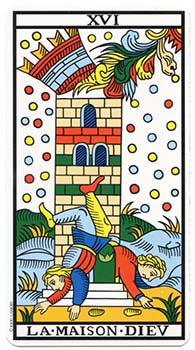
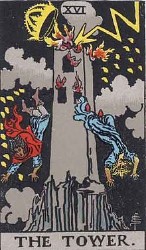
Why was The Tower card once called, “The House of God?”

We all know the basic definition of The Tower card:  destruction.  When it appears in a reading, it tells us that massive change is on the way.  It can signal divorces, loss of employment, and many other difficult life-changing events.  I’ve described it in the past as having our lives blasted right down to the studs.

Depending on which deck you use, you may have heard different names for The Tower card.  Some call it The Lightning Struck Tower.  Some refer to it as The Blasted Tower.  Most of us just call it The Tower.  There’s an interesting twist, though, in the name that a much older Tarot deck applied to it.

THE HOUSE OF GOD

In the Marseilles Tarot deck, which is a style that emerged in France in the 1500s, The Tower is referred to as, “La Maison Dieu.”  Which means, “The House of God.”  

That’s  a very peculiar name for destruction, isn’t it?

What do we automatically think of when we hear the term, “House of God?”  A church, of course.  So is The Lightning Struck Tower actually a Lightning Struck Church?

Hmmm . . .

NOT GOD

Now, if the card had been labelled as, “The Finger of God,” or even just, “God,” it would have made more sense theologically.  

The Middle Ages were a hyper-religious time in European history and, of course, Christianity was the dominant religion.  As I’ve noted in previous posts, the God of the Old Testament acted very much like a bipolar alcoholic who was off his medications.  He was constantly rampaging around causing floods or blowing up cities or throwing people out of gardens because they ate an apple.  

If that was your concept of God, then, of course, you might associate him with complete destruction of your life.  “Uh, oh . . .  God’s pissed off at me for some reason, so he’s going to smash me like a bug.”

But the thing is, God is most notable in the Tarot by his absence.  True, there are devils and angels and popes and priestesses, but there isn’t one single card that shows a god.

So if it wasn’t the wrath of God that the Tarot was trying to depict, what was it?

IT’S NOT THE TOWER OF BABEL

The French occultist, Eliphas Levi, created a rabbit hole that a lot of subsequent scholars have jumped into.  For no particular reason, he looked at The Tower card and announced that it was a depiction of the Tower of Babel.

If you’re not familiar with that myth, here’s a brief recap:  at one point, all humans spoke the same language.  Since they were able to communicate, they decided to build a tower that would reach all the way to heaven.  That pissed God off and he cursed them so that they’d all speak different languages and couldn’t complete their construction project.

Now, nowhere in the Tower of Babel myth is there any indication that the tower was struck by lightning.  And nowhere in the Tower card, is there any indication that the people falling out of the tower are trying to talk to each other.  

In other words, the only thing that the Tower of Babel and The Tower card have in common is the word, “tower.”

One really unfortunate result of that confusion is that The Tower is now associated with hubris and arrogance.  Like the builders of the Tower of Babel, people who draw the card are supposedly being punished for their pride.  Again, there’s no evidence for that whatsoever.  You can be a perfectly good person and still have that Tower energy blow through your life.

THE INQUISITION

So, again . . . why call it The House of God?

We have to remember that the Tarot is basically a system for predicting the future, or what we loosely call fortune telling.  And the Bible – the operating manual for the Christian church – is very much against it.

“Let no one be found among you who sacrifices their son or daughter in the fire, who practices divination or sorcery, interprets omens, engages in witchcraft.”  – Book of Deuteronomy 18:10–12.

There are several other examples, but suffice it to say the church was against fortune telling and the punishment was death.

The Inquisition was reaching its peak during the exact same time frame that the Tarot first emerged.  Priests were merrily torturing, maiming, and burning anyone whom they considered to be practicing witchcraft.  

In a very real sense, then, the church itself – the House of God – could be viewed as complete destruction for both the Tarot and those who used it for divination.  

THE DEFINITION IS THE SAME

The basic definition of The Tower remains the same, of course.  It signifies an almost complete destruction of a person’s way of living or thinking.  Upright, it shows that the destruction is coming and reversed, it shows that it’s already happened.

It IS fascinating, though, to conjecture about what those early Tarot designers might have been trying to tell us.  Were they saying that the church itself was evil?

Were they warning other occultists to keep the true meanings of the cards concealed or risk persecution?

Were they warning against the ultimate effect of rigid belief systems?

Were they, perhaps, predicting the eventual destruction of the church system – the House of God?

We’ll never really know.  In an age when we’re once again seeing the rise of religious fundamentalism and intolerance, though, it might serve us well to ponder those very questions.

“Just the Tarot,” by Dan Adair – Available on Amazon