The Tower Is About the Basement, Not the Top Floor

The freedom hidden in The Tower card – starting all over.

When we glance at The Tower card, our eyes naturally go to the most dramatic part of the image.

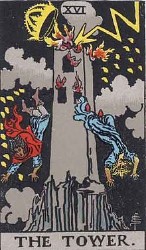
A mighty tower has been struck by lightning. Flames erupt from the windows. The occupants, hurled into the air by the force of the blast, are plunging toward a very unpleasant landing.

Yikes.

It’s one of the most feared cards in the Tarot. Whether it appears upright or reversed, The Tower usually signals upheaval, disruption, loss, or sudden change.

But here’s the thing:

The Tower isn’t really about the top of the tower.

It’s about the basement.

The Importance of Foundations

Like a Saturn return in astrology, The Tower destroys whatever is built on a weak foundation.

Notice that the lightning strike isn’t the whole story. Lightning hits buildings all the time. What turns a lightning strike into a catastrophe is the condition of the structure itself.

The real lesson of The Tower is that most of us build our lives on foundations we rarely examine.

Our assumptions.

Our beliefs.

Our fears.

Our relationships.

Our careers.

Our identities.

We construct elaborate towers on top of these foundations and then spend years assuming they’ll stand forever.

Until they don’t.

Eliphas Levi and the Wrong Turn

Part of the reason The Tower has such a grim reputation comes from an interpretation popularized by the nineteenth-century occultist Eliphas Levi.

Levi identified the card with the Tower of Babel from the Bible.

The problem is that the story doesn’t really fit.

The Tower of Babel wasn’t destroyed by lightning. According to the story, God punished its builders by confusing their languages so they could no longer communicate.

The deeper message of Babel is that humanity was punished for its pride. The builders reached too high, became too ambitious, and were struck down for their arrogance.

Once this idea attached itself to The Tower card, the interpretation began drifting toward a very Christian notion of guilt and punishment.

Something bad happened.

Therefore you must have done something wrong.

God, Karma, Fate, or the Universe is simply giving you what you deserve.

It’s a comforting theory because it suggests that bad things only happen for a reason.

Unfortunately, life doesn’t always work that way.

Just The Tarot, by Dan Adair – Available on Amazon

The “Shit Happens” Principle

One of the hardest truths to accept is that sometimes terrible things happen for no obvious reason.

A good person gets sick.

A devoted spouse is abandoned.

A careful driver gets hit by a drunk driver.

Someone loses their job, their savings, and their sense of security all within a few months.

When these things happen, we immediately begin searching for explanations.

What did they do wrong?

What lesson are they supposed to learn?

What hidden flaw attracted the disaster?

Sometimes there may be a lesson.

Sometimes there isn’t.

Sometimes shit just happens.

That’s not a very comforting answer, but it’s often a truthful one.

The Pendulum

The Kybalion offers a useful way of looking at this.

According to the Principle of Rhythm, life moves like a pendulum.

Good times are followed by difficult times.

Difficult times are followed by good times.

The pendulum swings one way and then the other.

There is nothing personal about it.

The tides come in and go out.

The moon waxes and wanes.

Seasons change.

Life moves in cycles.

The Tower often appears when we’ve forgotten that truth and begun acting as though our present circumstances are permanent.

The Gift Hidden Inside The Tower

As painful as The Tower can be, it contains an unexpected gift.

It reveals what isn’t working.

A loveless marriage ends.

A dead-end career collapses.

An identity built on appearances falls apart.

A belief system that no longer serves us is shattered.

At the time, these experiences can feel catastrophic.

Years later, many people look back and realize that The Tower didn’t destroy their lives.

It destroyed the illusion that their lives were built on solid ground.

And once the illusion is gone, something remarkable becomes possible.

Rebuilding.

That is the hidden blessing of The Tower.

Very few people willingly tear down their lives and start over.

The Tower does it for us.

Not because we are being punished.

Not because God is angry.

Not because the Universe is keeping score.

But because whatever was false can no longer support the weight placed upon it.

The Tower clears the ground.

What we build next is up to us.

As Kris Kristofferson famously wrote:

“Freedom’s just another word for nothing left to lose.”

Strange as it may sound, that’s the freedom The Tower offers.

Not the freedom to avoid change.

The freedom to begin again.
THE TOWER CARD AND THE HOUSE OF GOD

Why was The Tower card once called, “The House of God?”

We all know the basic definition of The Tower card:  destruction.  When it appears in a reading, it tells us that massive change is on the way.  It can signal divorces, loss of employment, and many other difficult life-changing events.  I’ve described it in the past as having our lives blasted right down to the studs.

Depending on which deck you use, you may have heard different names for The Tower card.  Some call it The Lightning Struck Tower.  Some refer to it as The Blasted Tower.  Most of us just call it The Tower.  There’s an interesting twist, though, in the name that a much older Tarot deck applied to it.

THE HOUSE OF GOD

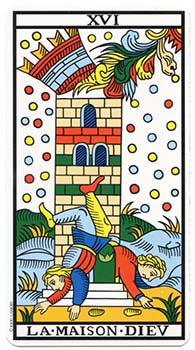
In the Marseilles Tarot deck, which is a style that emerged in France in the 1500s, The Tower is referred to as, “La Maison Dieu.”  Which means, “The House of God.”  

That’s  a very peculiar name for destruction, isn’t it?

What do we automatically think of when we hear the term, “House of God?”  A church, of course.  So is The Lightning Struck Tower actually a Lightning Struck Church?

Hmmm . . .

NOT GOD

Now, if the card had been labelled as, “The Finger of God,” or even just, “God,” it would have made more sense theologically.  

The Middle Ages were a hyper-religious time in European history and, of course, Christianity was the dominant religion.  As I’ve noted in previous posts, the God of the Old Testament acted very much like a bipolar alcoholic who was off his medications.  He was constantly rampaging around causing floods or blowing up cities or throwing people out of gardens because they ate an apple.  

If that was your concept of God, then, of course, you might associate him with complete destruction of your life.  “Uh, oh . . .  God’s pissed off at me for some reason, so he’s going to smash me like a bug.”

But the thing is, God is most notable in the Tarot by his absence.  True, there are devils and angels and popes and priestesses, but there isn’t one single card that shows a god.

So if it wasn’t the wrath of God that the Tarot was trying to depict, what was it?

IT’S NOT THE TOWER OF BABEL

The French occultist, Eliphas Levi, created a rabbit hole that a lot of subsequent scholars have jumped into.  For no particular reason, he looked at The Tower card and announced that it was a depiction of the Tower of Babel.

If you’re not familiar with that myth, here’s a brief recap:  at one point, all humans spoke the same language.  Since they were able to communicate, they decided to build a tower that would reach all the way to heaven.  That pissed God off and he cursed them so that they’d all speak different languages and couldn’t complete their construction project.

Now, nowhere in the Tower of Babel myth is there any indication that the tower was struck by lightning.  And nowhere in the Tower card, is there any indication that the people falling out of the tower are trying to talk to each other.  

In other words, the only thing that the Tower of Babel and The Tower card have in common is the word, “tower.”

One really unfortunate result of that confusion is that The Tower is now associated with hubris and arrogance.  Like the builders of the Tower of Babel, people who draw the card are supposedly being punished for their pride.  Again, there’s no evidence for that whatsoever.  You can be a perfectly good person and still have that Tower energy blow through your life.

THE INQUISITION

So, again . . . why call it The House of God?

We have to remember that the Tarot is basically a system for predicting the future, or what we loosely call fortune telling.  And the Bible – the operating manual for the Christian church – is very much against it.

“Let no one be found among you who sacrifices their son or daughter in the fire, who practices divination or sorcery, interprets omens, engages in witchcraft.”  – Book of Deuteronomy 18:10–12.

There are several other examples, but suffice it to say the church was against fortune telling and the punishment was death.

The Inquisition was reaching its peak during the exact same time frame that the Tarot first emerged.  Priests were merrily torturing, maiming, and burning anyone whom they considered to be practicing witchcraft.  

In a very real sense, then, the church itself – the House of God – could be viewed as complete destruction for both the Tarot and those who used it for divination.  

THE DEFINITION IS THE SAME

The basic definition of The Tower remains the same, of course.  It signifies an almost complete destruction of a person’s way of living or thinking.  Upright, it shows that the destruction is coming and reversed, it shows that it’s already happened.

It IS fascinating, though, to conjecture about what those early Tarot designers might have been trying to tell us.  Were they saying that the church itself was evil?

Were they warning other occultists to keep the true meanings of the cards concealed or risk persecution?

Were they warning against the ultimate effect of rigid belief systems?

Were they, perhaps, predicting the eventual destruction of the church system – the House of God?

We’ll never really know.  In an age when we’re once again seeing the rise of religious fundamentalism and intolerance, though, it might serve us well to ponder those very questions.

“Just the Tarot,” by Dan Adair – Available on Amazon

The Devil Tarot Card

The meaning of The Devil Card in the Tarot. Definitions for the card in the upright and reversed positions are included.

devil (1)

The Baphomet devil, horned and with huge bat wings, perches on a black cube.  His legs are those of a goat and his feet are talons. He holds his right hand aloft and the palm of it seems to be incised with obscure symbols.  In his left hand he holds a flaming torch. A nude female and male stand before him with their backs turned to him. They have horns and chains, which bind them to the cube, are draped loosely around their necks.  They also have tails and the devil seems to have lit the man’s tail on fire.

Upright: There are a lot of symbolic elements in this card, so let’s take them one at a time and work through them.  The man and the woman hearken back to the nude couple in The Lovers card, but there is nothing sacred or blessed about their relationship  They are chained, enslaved, and reduced to their lowest levels of feeling and being.

The enslavement may be on the obvious level of some sort of twisted sexuality.  Perhaps there is some level of bondage and domination going on in their sex lives that has gone way too far.

The enslavement may be on the physical level itself.  A love of materialism, money, a constant need for new and expensive toys.

It may fall in the area of addictions to substances that destroy the spirit and soul, such as meth, heroin, and excessive amounts of alcohol.  There’s a saying in Alcoholics Anonymous: “Booze gave me wings and then took away the sky.”

Whatever the form of bondage, it is to some extent self-imposed.  Note how loosely the chains hang around their necks. They could easily slip them over their heads and walk from their slavery, yet they don’t.  By not fighting for their freedom they are cooperating with their slavery.

There’s another element here that many of the New Age tarot books tend to ignore or gloss over and that’s Black Magic.  When The Devil shows up in a reading it’s possible that someone is directing malevolent magic against the questioner or that he or she is engaging in it.

If this card shows up in a reading about employment it’s possible that the questioner is chained to a job that he hates but can’t leave because of financial obligations.  If it shows up in a reading about relationships it’s possible that there’s going to be a lot of sex in the questioners future. A lot. Hot. Steamy. Sex.

Reversed:  This shows that liberation may be at hand in the immediate future.  The questioner will do something to escape the spiritual and/or physical enslavement that she is currently involved in.  May show the end of a really bad relationship.

If you have questions about this card or its meaning in one of your readings, please don’t hesitate to leave a comment.  I’ll get back to you as soon as I can.

A Few Additional Thoughts About the Devil and . . . ahem . . .S – E – X.

It’s interesting to note that Eliphas Levi, the occultist who first sketched the goat of Baphomet that appears on the devil card, didn’t consider the devil to be such a bad dude at all.  In fact, he wrote:

“The flame of intelligence shining between his horns is the magic light of the universal balance, the image of the soul elevated above matter, as the flame, whilst being tied to matter, shines above it. “

He actually considered the devil to be a symbol of balance and integration of polar opposites.  And there are those elements in the depictions of the devil in the earlier versions of the Tarot.

mardevil (1)

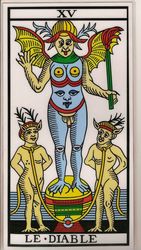
We see here that the devil is very much hermaphroditic having both breasts and a penis.  (As a folk artist I REALLY like the little face on his belly.) We can also see that this devil  is much more along the lines of the christian perception of the devil and the two people in the card look much less like humans and much more like imps.  Or flying monkeys, maybe.

So what prompted Waite to switch to the Levi version of the devil?  Well, you’d probably have to say sex. Or sex, sex, and more sex.

Waite described the humans on the card as being Adam and Eve after they’d been driven out of the garden of eden.  “The figures are tailed to signify the animal nature but there is human intelligence in their features . . .”

Their ANIMAL nature!  Whoa . . .

We have to keep in mind that Waite was very much a creature of the late Victorian era.  Women, for the most part, were still held up as being naturally, “pure,” and sex – if it was discussed at all – was left to the medical books and gentlemens’ clubs.  One physician noted that,

“the majority of women (happily for them) are not very much troubled by sexual feeling of any kind. What men are habitually, women are only exceptionally.’

Troubled by sexual feelings . . . how terrible for the men.

And they were TRULY troubled by their sexual feelings.  One commonly held belief was that excessive masturbation would inevitably drive you insane.  Fortunately, the Victorians were able to respond to this threat rationally and so they manufactured a safe and effective anti-masturbation device for men:

masturbation-device_290x290 (1)

No, I’m not kidding.  That’s actually on display at the Science Museum in London and models of it were being sold as late as the 1920s.

So given that background you can understand some of the changes that Waite made to the devil card.  Despite his spiffy bat wings the devil is quite obviously a goat, an animal famous for its’ prodigious sexual appetites.  The woman in the card is actually standing quite primly, except for being totally naked, and has her little hands pointed outwards in the same pose favored by today’s beauty pageant contestants.

The man, on the other hand, has one hand extended toward the woman and the devil is lighting his tail on FIRE!!!  No doubt IN – flaming his base, animalistic, sexual drive. If only the poor guy had an anti-masturbation protector to keep that critter between his legs under control.

Alas, he doesn’t have one and so both he and the poor, normally totally pure woman with a pomegranate tail are CHAINED to the altar of the devil, slaves of their genitals!  Well . . . his genitals. The woman has genitals but she doesn’t feel them. Everyone knows that.

“Just the Tarot,” by Dan Adair – a kindle ebook available on Amazon