Tarot and the Two Kinds of Desire:  Filling the Hole and Expressing the Soul

Exploring the sources of true happiness.

One of the major themes in my new book, Tarot and the Art of Alignment, is how to use the Tarot to create greater happiness and satisfaction in our lives.

But that raises an important question:

What do we really mean by happiness?

Most of us assume that all desires are the same.

We want more money.

We want a better relationship.

We want a bigger house.

We want status, recognition, and success.

But what if there are actually two very different kinds of desire?

And what if one of them leads to lasting fulfillment while the other keeps us trapped in an endless cycle of wanting?

Are We Really Happy?

Studies about happiness are fascinating because they sometimes seem to completely contradict one another.

On the one hand, surveys consistently show that most Americans report being satisfied with their lives. According to a 2024 study conducted by the Centers for Disease Control, the overwhelming majority of Americans describe themselves as satisfied or very satisfied.

That’s kind of astounding, isn’t it?

If that were the whole story, we might expect to step outside and find people skipping down the street singing, “Zip-a-Dee-Doo-Dah” and celebrating the sheer joy of being alive.

Yet another study found that 61% of Americans experience loneliness on a regular basis, with a substantial number reporting that they feel isolated much of the time.

So which is it?

Are we happy?

Or are we lonely?

Are our desires being fulfilled?

The answer, I believe, lies in understanding that there are two very different kinds of desire operating within us.
Desire #1: Filling the Hole

Wharton School senior fellow Matthew Killingsworth conducted research suggesting that money does, in fact, increase happiness.

At first glance, that seems to confirm the modern assumption that more money equals a better life.

And to a certain extent, that’s true. But . . . buried in that study is the fact that it takes a LOT of money to be happy all of the time. Billionaires are very happy campers – the rest of us, not so much. The statistics show that you have to be making at least $175,500 per year to crack into that money = happiness paradigm.

Over half of the people in the United States make less than $75,000 a year. So, quite literally, money is NOT going to buy them happiness.

The problem is that most of us unconsciously continue to believe that it will.

We begin to believe that happiness is always just one purchase away.

Maybe a new car will make us happy.

Maybe a larger house will make us happy.

Maybe the latest phone, computer, or gadget will finally make us feel successful and secure.

Sometimes these things do make us happy—for a little while. Then the novelty wears off. The new car becomes the old car. The new computer crashes. The bigger house develops problems.

And before long we’re looking for the next thing that will finally make us feel complete.

At its core, this desire is driven by a feeling of lack.

It whispers:

“You don’t have enough.”

And because you don’t have enough:

“You aren’t enough.”

This kind of desire attempts to fill an inner emptiness with outer possessions.

The problem is that the hole never stays filled for very long.

Desire #2: Expressing the Soul

There is a second kind of desire that stands in stark contrast to the first.

Rather than trying to fill an inner void, it seeks to express something that already exists within us.

Carl Jung called it individuation.

Abraham Maslow called it self-actualization.

The Buddhists speak of dharma.

Most people simply call it purpose or destiny.

This desire isn’t asking: “What can I get?” It’s asking: “Who am I meant to become?”

At some level, most of us sense that we are here for a reason. We feel drawn toward certain experiences, certain talents, certain ways of contributing to the world.

For one person, that calling may involve art. For another, healing. For another, teaching, parenting, writing, building, serving, or leading.

The details differ, but the underlying experience is the same. Something inside us wants to become fully expressed.

The tragedy is that many of us lose touch with that calling.

From childhood onward, we’re taught to fit in, conform, and follow the established path. Schools, institutions, social expectations, and sometimes even our own families encourage us to become what is expected rather than what is authentic.

Over time, we begin to forget the dreams that we felt so vividly as children. We lose sight of the deeper reason we came here. And then we wonder why life feels empty.

We don’t have meaning in our lives and so life feels meaning-less.

Alignment = Happiness

This second desire contains the secret of lasting happiness.

The more closely we align with our authentic purpose, the more alive we feel. The farther we drift from it, the more restless, dissatisfied, and disconnected we become.

This doesn’t mean life suddenly becomes easy (although it frequently does.) It means life becomes meaningful.

And meaning has a remarkable ability to sustain us even through difficulty.

This is where Tarot enters the picture.

Rather than using the cards exclusively to predict future events, we can use them as a mirror that reflects our deeper purpose.

We can ask:

* What am I here to learn?

* What gifts am I meant to develop?

* Where am I out of alignment?

* What is trying to emerge through me?

In Tarot and the Art of Alignment, I introduce a process called the Soul Reading, designed to help uncover those answers.

Once we begin to understand who we are and why we’re here, the Tarot becomes more than a tool for prediction.

It becomes a tool for alignment.

And alignment, more than money, possessions, status, or recognition, is where lasting happiness is found.
Tarot and the Art of Alignment: A New Way to Read the Cards

For years I’ve been fascinated by a simple question: What if Tarot isn’t primarily about predicting the future? That question eventually grew into my new book, Tarot and the Art of Alignment.

For years, I’ve been fascinated by a simple question:

What if Tarot isn’t primarily about predicting the future?

What if the cards are actually showing us where we’re aligned—or misaligned—with our deeper path?

That question eventually grew into my new book, Tarot and the Art of Alignment.

Of course, behind that question lies another one that human beings have been asking for thousands of years:

Why am I here?

We phrase it in many different ways:

* What is my purpose in life?

* Do I have some sort of destiny?

* Why did I incarnate in this place and time?

* Or, on particularly difficult days: What in the HELL is all of this about?

Philosophers, psychologists, and spiritual teachers have all recognized that human beings have a deep need for meaning in their lives. It isn’t enough to simply wake up, go to work, buy things, pursue pleasure, and repeat the process until our inevitable deaths.

We long for something more.

We need a sense of purpose. We need to feel that our lives matter, that our struggles and triumphs are part of a larger story. Without that sense of meaning, life can begin to feel exactly what the word suggests: meaningless.

Over time, it began to dawn on me that the answer to those questions might be found in the Tarot.

Most of us use the cards to ask questions about the future:

* What is my week going to be like?

* Should I take this job?

* Is this relationship headed somewhere meaningful?

* Am I making the right decision?

When we stop and think about it, that’s actually a remarkable process.

Whenever we lay out the cards, we operate from the assumption that we’re tapping into a source of wisdom greater than our ordinary awareness. Whether we call that source Spirit, the Universe, God/dess, Higher Self, Angels, Guides, or simply the deeper unconscious mind, we trust that the cards can reveal information we don’t consciously possess.

And if that greater source can offer guidance about a career decision, a relationship, or whether we’re headed in the right direction, then surely it can help us answer the most important question of all:

Why am I here?

That realization led me to begin experimenting with a different way of reading the cards.

Instead of asking the Tarot to predict what might happen next, I began asking it to reveal who I am, why I’m here, and whether my life is aligned with my deeper purpose.

I also began using the cards as an ongoing check-in system—a way of determining whether I was moving toward greater alignment or drifting away from it.

This book is the result.

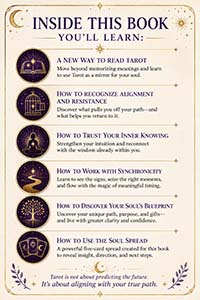
Rather than teaching hundreds of card meanings to memorize, the book explores a different approach. It shows how Tarot can become a mirror that helps us recognize alignment, resistance, intuition, synchronicity, and purpose.

At its heart, Tarot and the Art of Alignment is about learning to see the cards as a conversation with the deeper self.

The Tarot has always been rich with symbols, archetypes, and spiritual lessons. Yet many readers become trapped in the endless task of memorizing meanings and predicting outcomes. This book shifts the focus from fortune-telling to self-discovery. The question is no longer, “What will happen to me?” but rather, “Who am I becoming?”

Through the practices and spreads presented in the book, you’ll learn how to identify the beliefs that keep you stuck, reconnect with your intuition, recognize meaningful patterns and synchronicities, and uncover the deeper purpose that has been quietly calling to you all along.

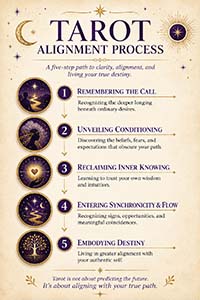
At the heart of the book is a model I call The Tarot Alignment Process.

The first step is Remembering the Call. This is the moment when we become conscious of our deep hunger for meaning and purpose. We stop drifting through life and begin to recognize that something within us is calling for a more authentic way of living.

The second step is Unveiling Conditioning. Here we examine the beliefs, fears, expectations, and assumptions that have caused us to forget who we really are. We explore the ways that family, culture, education, and society have shaped our identity—and often obscured our deeper truth.

The third step is Reclaiming Inner Knowing. Through Tarot and self-reflection, we begin to trust our own wisdom again. We learn to listen to the quiet voice within that knows why we came into this life and what we are here to contribute.

The fourth step is Entering Synchronicity and Flow. We discover how our emotions, life circumstances, and meaningful coincidences can serve as guides, helping us recognize when we are moving in harmony with our deeper purpose.

And finally, the fifth step is Embodying Destiny. Rather than seeking occasional moments of inspiration, we learn how to stay aligned over time, using the Tarot as an ongoing tool for guidance, self-correction, and growth.

Looking back, I realize that I’ve spent years exploring these themes through Tarot readings, blog posts, synchronicity, personal experience, and spiritual study. This book is my attempt to gather all of those threads together into a single framework.

Over the next several weeks, I’ll be exploring many of these ideas here on the blog, including alignment and resistance, synchronicity, the Soul Spread, and why difficult Tarot readings may not be bad news at all.

If those topics interest you, I hope you’ll join me for the journey.

Tarot and the Art of Alignment

The book is now available as an Amazon Kindle edition:

Tarot and the Art of Alignment – Kindle Edition

Or as a downloadable PDF edition:

Tarot and the Art of Alignment – Downloadable PDF Edition

Remember:

Tarot is not about predicting the future.

It’s about aligning with your true path.

THE TOWER CARD AND THE HOUSE OF GOD

Why was The Tower card once called, “The House of God?”

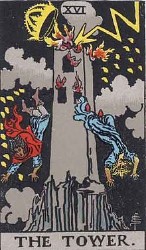
We all know the basic definition of The Tower card:  destruction.  When it appears in a reading, it tells us that massive change is on the way.  It can signal divorces, loss of employment, and many other difficult life-changing events.  I’ve described it in the past as having our lives blasted right down to the studs.

Depending on which deck you use, you may have heard different names for The Tower card.  Some call it The Lightning Struck Tower.  Some refer to it as The Blasted Tower.  Most of us just call it The Tower.  There’s an interesting twist, though, in the name that a much older Tarot deck applied to it.

THE HOUSE OF GOD

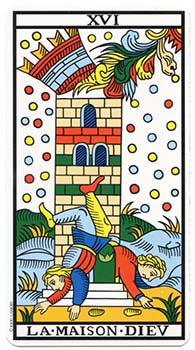
In the Marseilles Tarot deck, which is a style that emerged in France in the 1500s, The Tower is referred to as, “La Maison Dieu.”  Which means, “The House of God.”  

That’s  a very peculiar name for destruction, isn’t it?

What do we automatically think of when we hear the term, “House of God?”  A church, of course.  So is The Lightning Struck Tower actually a Lightning Struck Church?

Hmmm . . .

NOT GOD

Now, if the card had been labelled as, “The Finger of God,” or even just, “God,” it would have made more sense theologically.  

The Middle Ages were a hyper-religious time in European history and, of course, Christianity was the dominant religion.  As I’ve noted in previous posts, the God of the Old Testament acted very much like a bipolar alcoholic who was off his medications.  He was constantly rampaging around causing floods or blowing up cities or throwing people out of gardens because they ate an apple.  

If that was your concept of God, then, of course, you might associate him with complete destruction of your life.  “Uh, oh . . .  God’s pissed off at me for some reason, so he’s going to smash me like a bug.”

But the thing is, God is most notable in the Tarot by his absence.  True, there are devils and angels and popes and priestesses, but there isn’t one single card that shows a god.

So if it wasn’t the wrath of God that the Tarot was trying to depict, what was it?

IT’S NOT THE TOWER OF BABEL

The French occultist, Eliphas Levi, created a rabbit hole that a lot of subsequent scholars have jumped into.  For no particular reason, he looked at The Tower card and announced that it was a depiction of the Tower of Babel.

If you’re not familiar with that myth, here’s a brief recap:  at one point, all humans spoke the same language.  Since they were able to communicate, they decided to build a tower that would reach all the way to heaven.  That pissed God off and he cursed them so that they’d all speak different languages and couldn’t complete their construction project.

Now, nowhere in the Tower of Babel myth is there any indication that the tower was struck by lightning.  And nowhere in the Tower card, is there any indication that the people falling out of the tower are trying to talk to each other.  

In other words, the only thing that the Tower of Babel and The Tower card have in common is the word, “tower.”

One really unfortunate result of that confusion is that The Tower is now associated with hubris and arrogance.  Like the builders of the Tower of Babel, people who draw the card are supposedly being punished for their pride.  Again, there’s no evidence for that whatsoever.  You can be a perfectly good person and still have that Tower energy blow through your life.

THE INQUISITION

So, again . . . why call it The House of God?

We have to remember that the Tarot is basically a system for predicting the future, or what we loosely call fortune telling.  And the Bible – the operating manual for the Christian church – is very much against it.

“Let no one be found among you who sacrifices their son or daughter in the fire, who practices divination or sorcery, interprets omens, engages in witchcraft.”  – Book of Deuteronomy 18:10–12.

There are several other examples, but suffice it to say the church was against fortune telling and the punishment was death.

The Inquisition was reaching its peak during the exact same time frame that the Tarot first emerged.  Priests were merrily torturing, maiming, and burning anyone whom they considered to be practicing witchcraft.  

In a very real sense, then, the church itself – the House of God – could be viewed as complete destruction for both the Tarot and those who used it for divination.  

THE DEFINITION IS THE SAME

The basic definition of The Tower remains the same, of course.  It signifies an almost complete destruction of a person’s way of living or thinking.  Upright, it shows that the destruction is coming and reversed, it shows that it’s already happened.

It IS fascinating, though, to conjecture about what those early Tarot designers might have been trying to tell us.  Were they saying that the church itself was evil?

Were they warning other occultists to keep the true meanings of the cards concealed or risk persecution?

Were they warning against the ultimate effect of rigid belief systems?

Were they, perhaps, predicting the eventual destruction of the church system – the House of God?

We’ll never really know.  In an age when we’re once again seeing the rise of religious fundamentalism and intolerance, though, it might serve us well to ponder those very questions.

“Just the Tarot,” by Dan Adair – Available on Amazon

The Empress and the Courage to Be “Unproductive”

The Empress Archetype and Relaxation as a Way to Nurture Creativity.

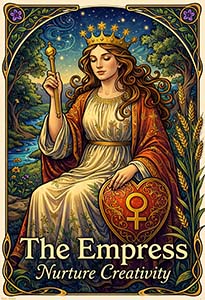
In my Empress affirmation poster, I paired her image with the words:

Nurture Creativity

This may be one of the most misunderstood instructions in the entire Tarot.

  Empress Affirmation Poster – Available on Etsy

Because most of us have been trained to believe that creativity comes from effort. From discipline. From pushing harder. From sitting at the desk and refusing to get up until something happens.

That approach belongs to The Emperor.

The Empress operates differently.

She does not force growth.

She allows it.

She creates the conditions in which growth becomes inevitable.

Creativity Cannot Be Forced

Every creative person eventually encounters this paradox.

The harder you try to force creativity, the more it retreats.

You sit at your desk, determined to produce something brilliant. Hours pass. Nothing happens. Your mind feels like dry soil.

And then, days later—while taking a walk, washing dishes, or doing something completely unrelated—an idea appears effortlessly.

It arrives whole.

Not constructed, but received.

Albert Einstein understood this phenomenon. When asked how he discovered the theory of relativity, he didn’t describe grinding intellectual labor. He said simply:

“It just dropped in while I was playing the piano.”

He wasn’t forcing the insight.

He was allowing it.

This is Empress energy.

The Forgotten Value of Leisure

The philosopher Josef Pieper wrote a remarkable book titled Leisure as the Basis of Culture. In it, he argues that leisure is not the absence of productivity, but its foundation.

Leisure, in its true sense, is not laziness in the modern, pejorative sense. It is a state of receptive openness.

It is the willingness to stop forcing.

Pieper observed that culture itself—art, philosophy, music, science—arises not from frantic effort, but from spaces of inward stillness.

When we allow ourselves to be idle, something deeper begins to move.

The soil replenishes itself.

Modern society often treats leisure as wasteful. We are taught that our worth is tied to constant activity. But creativity obeys older, quieter laws.

Seeds do not grow faster because you stare at them.

They grow because the conditions are right.

“Just the Tarot,” by Dan Adair – available on Amazon

Julia Cameron and the Act of Creative Nurturing

Julia Cameron’s The Artist’s Way remains one of the most practical and psychologically accurate guides to creativity ever written.

Her central insight is simple: creativity must be nurtured.

Not commanded.

She encourages practices like morning pages and artist dates—not to produce finished work, but to create space for the creative self to emerge naturally.

These practices are Empress practices.

They say to the creative mind:

You are safe here.

You are allowed to emerge in your own time.

And when that safety is present, creativity begins to flow again.

The Courage to Be “Lazy”

This is perhaps the most radical lesson of The Empress.

You must allow yourself to be, at times, unproductive.

Not because you are weak.

But because you are cultivating fertility.

What appears to be inactivity is often incubation.

Beneath the surface, ideas are forming. Connections are being made. Your subconscious is doing its work.

If you constantly demand output, you exhaust the system that produces it.

The Empress reminds us that rest is not the opposite of creation.

It is part of creation.

Nurture Creativity

The Empress does not shout. She does not command. She invites.

She reminds us that creativity is not a machine, but a living process.

It responds to kindness.

It responds to patience.

It responds to nourishment.

When you stop trying to force creativity and begin nurturing it instead, something remarkable happens.

Ideas begin to arrive again.

Quietly.

Effortlessly.

Like seeds finding their way toward the light.

So when The Empress appears in your readings—or quietly makes herself known in your life—it is not a signal to push harder. It is an invitation to soften. She asks you to step out of the mentality of force and into the rhythm of cultivation. To rest without guilt. To follow your curiosity. To trust that creativity, like all living things, emerges when it is nourished rather than commanded.

 She reminds you that you are not a machine designed for constant output, but a garden capable of extraordinary growth. Your task is not to force the flowers to bloom, but to tend the soil and allow them to emerge in their own time.

The Influence of The Hierophant

The Influence of The Hierophant Card When Paired With Other Major Arcana, Including Definitions for Each Pairing.

In the absence of a regular blog post for today, I’d like to offer a reference chart detailing the influence of The Hierophant when paired with the other cards of the Major Arcana.

The Hierophant represents tradition, spiritual authority, teaching, sacred structures, and shared belief systems. When this card appears, it often asks:

• What do you believe?

• Where did those beliefs come from?

• Are you conforming… or consciously committing?

Please feel free to print this and use it as a quick reference in your readings. Or, if you prefer, you can download a PDF version here. Just click the link and, when it opens, select Print from your browser menu.

The Hierophant + The Fool

A new spiritual path begins; stepping into tradition with fresh eyes.

Reversed: Rebellion without reflection; rejecting structure simply to avoid commitment.

The Hierophant + The Magician

Teaching what you know; manifesting through spiritual principles.

Reversed: Manipulating belief systems; using doctrine for personal gain.

“Just the Tarot,” by Dan Adair – Available on Amazon

The Hierophant + The High Priestess

Outer tradition meets inner knowing; balancing doctrine with intuition.

Reversed: Conflict between personal truth and institutional belief.

The Hierophant + The Empress

Sacred nurturing; honoring family or cultural traditions around love and creativity.

Reversed: Restrictive roles around gender, parenting, or creative expression.

The Hierophant + The Emperor

Institutional authority; law, governance, or structured religion.

Reversed: Oppressive systems; authoritarian belief structures.

The Hierophant + The Lovers

Commitment blessed by tradition; marriage, vows, sacred partnership.

Reversed: Choosing love outside of conventional expectations.

The Hierophant + The Chariot

Driving forward with faith; disciplined spiritual progress.

Reversed: Dogmatic certainty; forcing beliefs onto others.

The Hierophant + Strength

Moral courage; gentle adherence to deeply held values.

Reversed: Internal conflict between instinct and conditioning.

The Hierophant + The Hermit

Spiritual teacher and spiritual seeker; mentorship or formal study.

Reversed: Breaking away from tradition to seek personal truth.

The Hierophant + Wheel of Fortune

Destined encounters with teachers or belief systems.

Reversed: Clinging to outdated doctrines during change.

The Hierophant + Justice

Ethical accountability; living in alignment with stated values.

Reversed: Hypocrisy; preaching principles not practiced.

The Hierophant + The Hanged Man

Spiritual surrender; re-evaluating long-held beliefs.

Reversed: Martyrdom rooted in rigid ideology.

The Hierophant + Death

Transformation of belief systems; shedding old doctrines.

Reversed: Fear of spiritual evolution; resisting theological change.

The Hierophant + Temperance

Balanced faith; integrating different traditions harmoniously.

Reversed: Spiritual confusion; incompatible belief blending.

The Hierophant + The Devil

Religious guilt; toxic conditioning; spiritual bondage.

Reversed: Breaking free from oppressive belief systems.

The Hierophant + The Tower

Collapse of institutional structures; crisis of faith.

Reversed: Quiet deconstruction of long-held doctrines.

The Hierophant + The Star

Renewed faith; spiritual hope; inspired teaching.

Reversed: Disillusionment with organized belief systems.

The Hierophant + The Moon

Hidden doctrines; subconscious conditioning; fear-based teachings.

Reversed: Seeing through illusion; questioning inherited fears.

The Hierophant + The Sun

Joyful faith; spiritual clarity; enlightened tradition.

Reversed: Childlike rebellion against structure without understanding.

The Hierophant + Judgment

Spiritual awakening; answering a higher calling within tradition.

Reversed: Rejecting external authority to follow inner calling.

The Hierophant + The World

Completion of a spiritual cycle; mastery within a tradition.

Reversed: Feeling confined by cultural or institutional identity.

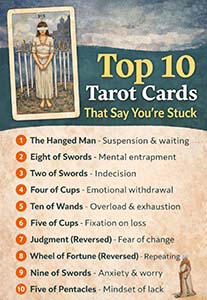
The Top Ten Tarot Cards That Indicate You’re Stuck

A concise, Tarot-based guide to the ten cards that most often indicate feeling stuck, stalled, or unable to move forward — and what each one reveals about the deeper source of that stuckness.

Being “stuck” in Tarot rarely means something is broken or hopeless. It usually means energy is stalled, attention is misdirected, or a transition is incomplete. These cards point to places where movement is paused — and where a shift is quietly waiting to happen.

Here are the ten cards that most often signal that kind of stuckness.

1. The Hanged Man

Stuck because of suspension or waiting.

This card indicates a pause imposed by timing, perspective, or the need for surrender. Progress isn’t possible yet because something deeper is still rearranging.

2. Eight of Swords

Stuck because of limiting beliefs or mental loops.

You feel trapped, restricted, or powerless — but the restriction is largely internal. The situation may not be as closed as it feels.

3. Two of Swords

Stuck because of indecision or avoidance.

Movement is blocked by a refusal to choose, usually because neither option feels safe or pleasant.

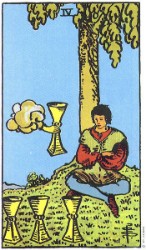
4. Four of Cups

Stuck because of emotional disengagement.

Nothing feels interesting or meaningful enough to respond to. Opportunities may exist, but the heart isn’t open to them yet.

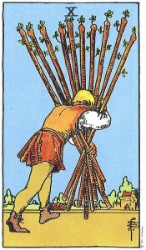
5. Ten of Wands

Stuck because of overload or exhaustion.

You’re carrying too much. Forward motion is technically possible, but not sustainable in the current state.

6. Five of Cups

Stuck because of grief or fixation on loss.

Attention is anchored in what’s gone wrong, making it hard to see what remains or what could still grow.

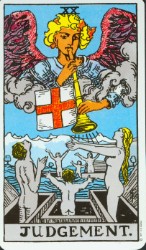
7. Judgment (Reversed)

Stuck because of self-doubt or fear of stepping into a new identity.

The call to change is present, but something inside is resisting answering it.

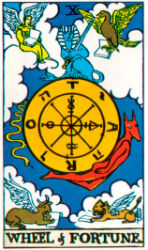
8. Wheel of Fortune (Reversed)

Stuck because of repeating patterns or feeling caught in cycles.

Life feels like it’s looping instead of evolving. This often points to unconscious habits or unresolved lessons.

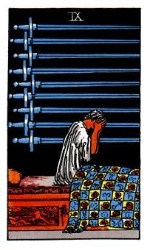
9. Nine of Swords

Stuck because of anxiety, rumination, or worry.

The mind is so busy anticipating problems that it can’t access solutions or rest.

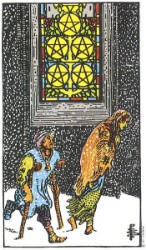
10. Five of Pentacles

Stuck because of a mindset of lack or survival.

Fear around resources, support, or worthiness makes it difficult to imagine improvement or receive help.

A Note on “Stuckness” in Tarot

In Tarot, being stuck is rarely a punishment or a failure. It’s usually a sign that:

• something internal needs to shift before something external can move,

• a lesson is still integrating,

• or attention needs to be redirected.

These cards don’t say “nothing will ever change.”

They say: this is the part of the story where motion pauses and meaning is being formed.

That’s often where the most important change begins.

And if you’re wondering when you’re going to get unstuck, then check out my other post:  The Top Ten Tarot Cards Indicating Something is About to Change.

“Just the Tarot,” by Dan Adair – available on Amazon