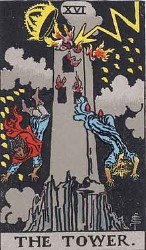
THE TOWER CARD AND THE HOUSE OF GOD

Why was The Tower card once called, “The House of God?”

We all know the basic definition of The Tower card:  destruction.  When it appears in a reading, it tells us that massive change is on the way.  It can signal divorces, loss of employment, and many other difficult life-changing events.  I’ve described it in the past as having our lives blasted right down to the studs.

Depending on which deck you use, you may have heard different names for The Tower card.  Some call it The Lightning Struck Tower.  Some refer to it as The Blasted Tower.  Most of us just call it The Tower.  There’s an interesting twist, though, in the name that a much older Tarot deck applied to it.

THE HOUSE OF GOD

In the Marseilles Tarot deck, which is a style that emerged in France in the 1500s, The Tower is referred to as, “La Maison Dieu.”  Which means, “The House of God.”  
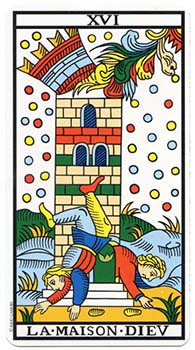
That’s  a very peculiar name for destruction, isn’t it?

What do we automatically think of when we hear the term, “House of God?”  A church, of course.  So is The Lightning Struck Tower actually a Lightning Struck Church?

Hmmm . . .

NOT GOD

Now, if the card had been labelled as, “The Finger of God,” or even just, “God,” it would have made more sense theologically.  

The Middle Ages were a hyper-religious time in European history and, of course, Christianity was the dominant religion.  As I’ve noted in previous posts, the God of the Old Testament acted very much like a bipolar alcoholic who was off his medications.  He was constantly rampaging around causing floods or blowing up cities or throwing people out of gardens because they ate an apple.  

If that was your concept of God, then, of course, you might associate him with complete destruction of your life.  “Uh, oh . . .  God’s pissed off at me for some reason, so he’s going to smash me like a bug.”

But the thing is, God is most notable in the Tarot by his absence.  True, there are devils and angels and popes and priestesses, but there isn’t one single card that shows a god.

So if it wasn’t the wrath of God that the Tarot was trying to depict, what was it?

IT’S NOT THE TOWER OF BABEL

The French occultist, Eliphas Levi, created a rabbit hole that a lot of subsequent scholars have jumped into.  For no particular reason, he looked at The Tower card and announced that it was a depiction of the Tower of Babel.

If you’re not familiar with that myth, here’s a brief recap:  at one point, all humans spoke the same language.  Since they were able to communicate, they decided to build a tower that would reach all the way to heaven.  That pissed God off and he cursed them so that they’d all speak different languages and couldn’t complete their construction project.

Now, nowhere in the Tower of Babel myth is there any indication that the tower was struck by lightning.  And nowhere in the Tower card, is there any indication that the people falling out of the tower are trying to talk to each other.  

In other words, the only thing that the Tower of Babel and The Tower card have in common is the word, “tower.”

One really unfortunate result of that confusion is that The Tower is now associated with hubris and arrogance.  Like the builders of the Tower of Babel, people who draw the card are supposedly being punished for their pride.  Again, there’s no evidence for that whatsoever.  You can be a perfectly good person and still have that Tower energy blow through your life.

THE INQUISITION

So, again . . . why call it The House of God?

We have to remember that the Tarot is basically a system for predicting the future, or what we loosely call fortune telling.  And the Bible – the operating manual for the Christian church – is very much against it.

“Let no one be found among you who sacrifices their son or daughter in the fire, who practices divination or sorcery, interprets omens, engages in witchcraft.”  – Book of Deuteronomy 18:10–12.

There are several other examples, but suffice it to say the church was against fortune telling and the punishment was death.

The Inquisition was reaching its peak during the exact same time frame that the Tarot first emerged.  Priests were merrily torturing, maiming, and burning anyone whom they considered to be practicing witchcraft.  

In a very real sense, then, the church itself – the House of God – could be viewed as complete destruction for both the Tarot and those who used it for divination.  

THE DEFINITION IS THE SAME

The basic definition of The Tower remains the same, of course.  It signifies an almost complete destruction of a person’s way of living or thinking.  Upright, it shows that the destruction is coming and reversed, it shows that it’s already happened.

It IS fascinating, though, to conjecture about what those early Tarot designers might have been trying to tell us.  Were they saying that the church itself was evil?

Were they warning other occultists to keep the true meanings of the cards concealed or risk persecution?

Were they warning against the ultimate effect of rigid belief systems?

Were they, perhaps, predicting the eventual destruction of the church system – the House of God?

We’ll never really know.  In an age when we’re once again seeing the rise of religious fundamentalism and intolerance, though, it might serve us well to ponder those very questions.

“Just the Tarot,” by Dan Adair – Available on Amazon

What Are Tarot Archetypes (And Why They Matter)?

The influence of Tarot archetypes in our lives.

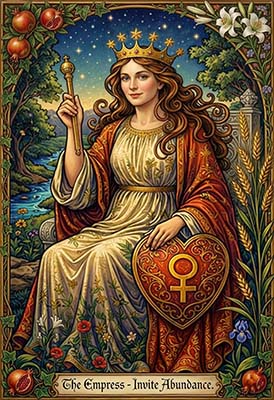
The Empress Abundance Poster – available on Etsy

In any serious discussion of the Tarot, you’ll hear people referring to the Major Arcana as “archetypes.”

Which sounds very impressive… but also raises a perfectly reasonable question:

What, exactly, is an archetype?

The idea goes all the way back to Plato, but in modern usage it’s most often associated with the Swiss psychologist Carl Jung.

Jung defined archetypes as:

Universal, inherited patterns of thought or imagery that exist in the collective unconscious of all human beings.

Which is a fine scholarly definition… but for most of us, it lands somewhere around:

“Huh?”

So instead of trying to define archetypes academically, let’s talk about how they actually show up in real life—especially through the Tarot.

The Major Arcana

If you’re reading a Tarot blog, you probably already know the basics.  The Tarot is divided into two parts, the Minor Arcana and the Major Arcana.

• The Minor Arcana (Wands, Cups, Pentacles, Swords) deal with everyday life.

• The Major Arcana (22 cards) deal with something deeper.

The images of the Major Arcana are the ancient core of the Tarot, dating back to the 15th century (and possibly earlier). The Minor Arcana didn’t even get illustrated scenes until the Waite-Smith deck in 1909.

So when we talk about archetypes in Tarot, we’re really talking about the Major Arcana.

They’re Not Personal

Here’s the first—and most important—thing to understand:

Archetypes are not personal.

Now, I know that sounds strange, because they feel very personal.

If you pull Death or The Tower in a reading, it doesn’t feel abstract. It feels like the universe just singled you out and dropped a piano on your head.

But here’s the shift:

• Minor Arcana = things you’re generating and can influence

• Major Arcana = larger forces moving through your life

For example:

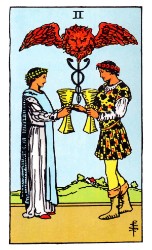
• Two of Cups → You’re falling in love.  Those are personal dynamics, like the type of person you find attractive, are you feeling lonely, do you want a partner?

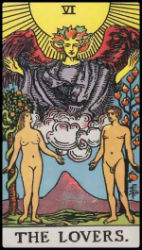
• The Lovers → Love as an energy is active in your life (archetypal force.). The energy isn’t something you’re creating and it’s not attached to any one person.  It’s just moving through your life.

In other words:

You don’t create archetypes—you experience them.

Sometimes They’re Collective

Archetypes don’t just affect individuals—they can sweep through entire cultures.

Jung noticed this before World War II when many of his German patients reported eerily similar dreams of White men riding black horses through the night—images that seemed to foreshadow the rise of Nazism. He interpreted this as a collective archetype emerging.

And honestly, you don’t have to look far to see this kind of thing in today’s politics.

We’ve all watched people we’ve known for years suddenly shift—sometimes dramatically—in beliefs, behavior, or identity. It can feel almost like they’ve been “taken over.”

From an archetypal perspective, that’s not entirely wrong.

These are psychic weather systems—and sometimes whole populations get caught in them.

The important takeaway?

Just because an energy is present doesn’t mean you have to identify with it.

Shelter in Place

Obviously, not all archetypes are pleasant.

• The Tower → destruction

• The Moon → confusion, illusion, emotional instability

• The Devil → addiction, entrapment, shadow patterns

So what do you do when one of these shows up?

You’ve got two main options.

1. Shelter in Place

Sometimes the best strategy is simple:

Ride it out.

Think of a tornado. You don’t go out and negotiate with it. You don’t try to “manifest” it away.

You get into the storm shelter and wait.

Life sometimes does this:

• Relationship ends

• Job disappears

• Everything falls apart at once

That’s Tower energy.

And sometimes the wisest response is:

“Okay… this is happening. Let’s survive it.”  Hunker down and wait for it to go away.

2. Rise Above It

The Kybalion talks about this strategy quite a bit.

Even if you can’t control the event, you can control your response.

You can:

• shift your perspective

• regulate your emotions

• choose your interpretation

For instance, with The Tower, you can respond to it in one of two ways.

• “This is a disaster. I lost my job, my partner divorced me, I’m out of money. My life is ruined.”

OR

• “This is a reset. I get to rebuild from scratch. My old life is gone, so I get to build my new life exactly as I want it.”

The external event is the same.

The internal vibration is not.

And that makes all the difference.  We haven’t, “cured,” what happened to us, but we’ve vastly diminished it effects on us.

Invoking the Positive Archetypes

Here’s where things get interesting.

Even though archetypes aren’t created by us…

We can align with them.

Think of it less as control and more as tuning in.

Examples:

• Feeling stuck financially? → work with The Empress (abundance, growth)

• Struggling with confidence? → invoke The Emperor (authority, structure)

• Feeling lonely? → connect with The Lovers (connection, union)

• Burned out? → step into The Hermit (withdrawal, restoration)

This can be done through:

• meditation

• visualization

• journaling

• even just keeping the image nearby

You’re not creating the energy.

You’re opening yourself to it and inviting it’s power into your life.

 Conclusion

So what is an archetype, really?

It’s not just a symbol.

It’s not just a psychological idea.

It’s more like a living pattern of energy that moves through human experience.

Sometimes it lifts us.

Sometimes it breaks us open.

Sometimes it sweeps through entire cultures like a storm.

But here’s the key:

You are not powerless in the face of archetypes.

You may not control when they appear,

but you do have a say in how you meet them.

You can:

• recognize them

• name them

• step back from them

• align with the ones that serve you

And over time, something interesting happens:

Instead of being tossed around by these forces…

You start to navigate them.

And that’s really what Tarot is for.

“Just the Tarot,” by Dan Adair – Available on Amazon

Running It By the Numbers: The Numerology Behind the Tarot Suits

Running It By the Numbers explores the numerological structure behind the Tarot suits from Ace through Ten.

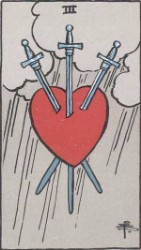
When we look at the Tarot, it’s easy to get lost in the images, stories, and archetypes of each card. But underneath the pictures, symbols, and personalities lies a beautifully simple structure: number.

In each suit — Wands, Cups, Swords, and Pentacles — the cards numbered One through Ten follow a consistent energetic progression. The suit shows where the energy is playing out (creativity, emotion, thought, or material life), and the number shows how that energy is unfolding.

So let’s run it by the numbers.

Below you’ll find the numerological meaning of the cards from Ace (One) through Ten, and how that meaning expresses itself across all four suits.

One (Ace): Beginnings, Seeds, Potential

Ones represent the spark.

They are beginnings, raw potential, the moment when something new is offered into your life.

Numerologically, One is unity, origin, and creative impulse — the first expression of energy.

In Tarot:

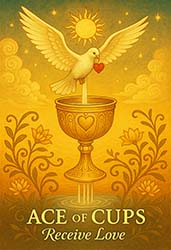
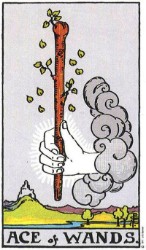
• Aces show opportunities.

• They don’t guarantee outcomes — they offer possibility.

Each Ace says: “Here is a seed. Will you plant it?”

Two: Balance, Choice, Polarity

Twos represent the moment when the One becomes aware of an “other.”

Numerologically, Two is duality, relationship, contrast, and choice.

In Tarot:

• Twos often show balance, tension, or decision.

• They ask you to relate — to a person, a feeling, a path, or a truth.

Twos say: “Now that something exists, how will you engage with it?”

Three: Growth, Expansion, Expression

Threes are the first moment of outward growth.

Numerologically, Three is creativity, expression, and development.

In Tarot:

• Threes show movement, growth, collaboration, and early results.

• Something is starting to take form.

Threes say: “This is beginning to live and move in the world.”

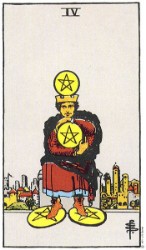
Four: Structure, Stability, Foundation

Fours bring form, boundaries, and stability.

Numerologically, Four is structure, order, and grounding.

In Tarot:

• Fours stabilize the energy of the suit.

• They create something solid enough to rest on — or sometimes something rigid enough to get stuck in.

Fours say: “Let’s make this real and sustainable.”

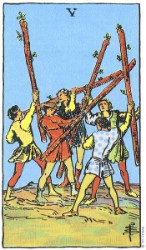
Five: Disruption, Challenge, Change

Fives introduce instability.

Numerologically, Five is movement, friction, and necessary disruption.

In Tarot:

• Fives often show conflict, loss, challenge, or tension.

• They shake what has become too fixed.

Fives say: “Something needs to change — even if it’s uncomfortable.”

Six: Harmony, Integration, Adjustment

Sixes restore balance after the disruption of Five.

Numerologically, Six is harmony, healing, and realignment.

In Tarot:

• Sixes often show cooperation, support, generosity, or healing.

• They smooth what was roughened.

Sixes say: “Let’s bring this back into balance.”

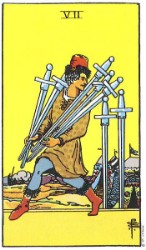
Seven: Assessment, Testing, Inner Work

Sevens are a pause for evaluation.

Numerologically, Seven is reflection, inner work, and spiritual testing.

In Tarot:

• Sevens often show challenges that are internal, subtle, or strategic.

• They ask you to examine your approach.

Sevens say: “Is this truly aligned — and is this worth continuing?”

Eight: Power, Mastery, Momentum

Eights represent focused energy and effective action.

Numerologically, Eight is power, movement, and manifestation.

In Tarot:

• Eights show work, effort, discipline, and progress.

• Things move quickly here, for better or worse.

Eights say: “Apply yourself. This can be accomplished.”

Nine: Fulfillment, Culmination, Near Completion

Nines bring things close to completion.

Numerologically, Nine is culmination, wisdom, and harvest.

In Tarot:

• Nines often show satisfaction, insight, or emotional/spiritual fullness.

• They can also show isolation, depending on the suit.

Nines say: “This cycle is almost complete — what have you learned?”

Ten: Completion, Overflow, Transition

Tens complete the cycle — and often overwhelm it.

Numerologically, Ten is completion that tips over into excess, leading back toward a new beginning.

In Tarot:

• Tens show endings, fulfillment, or overload.

• They signal that a cycle has run its course.

Tens say: “This is complete. It’s time to release and begin again.”

In Summary

Across every suit, the numbers tell a story:

1. Seed

2. Choice

3. Growth

4. Structure

5. Disruption

6. Harmony

7. Assessment

8. Effort

9. Fulfillment

10. Completion

When you read Tarot “by the numbers,” you gain a deeper sense of where you are in a process — not just what’s happening, but what stage it’s in.

And that can be incredibly clarifying.

Because sometimes the most important message isn’t what is happening…

…but where you are in the journey.

“Just the Tarot,” by Dan Adair – available on Amazon

Taking Religion Out of the Tarot – A Look at the Real Tarot Deck

For centuries, Christianity condemned Tarot as witchcraft — yet hidden Christian symbols helped the cards survive the Inquisition. This post uncovers how those overlays disguised the deck’s true archetypal roots.

“Are Tarot cards evil?”

That’s one of the most common Google searches on the Tarot and I assume it comes from people who were raised as, “good Christian folks.”  After all, for centuries Christianity has railed against the Tarot.  Preachers and pastors are still screaming that the cards are the gateways to the Devil and dangerous tools of shadowy occultists.

One of the weird things about that is the Tarot actually contains a strong Christian thread that was intentionally stitched into the deck as camouflage.  It’s chock full of angels and not so subtle allusions to the Bible.  Without them, the Tarot would never have survived the Inquisition.

So let’s take a little closer look at how the Church’s iron grip shaped the early Tarot, what Christian symbols were embedded to disguise it, and what the cards may have actually looked like before that clever cover was sewn in.

TAROT WAS BORN IN DANGEROUS TIMES

The first historical references to the Tarot are in Europe in the 1450s.  Right in the middle of one of history’s most brutal religious crackdowns:  the Inquisition.  It’s hard for us to imagine it today, but ANY sort of fortune telling or divination could mean an automatic death sentence.

The Bible was explicit in its warnings. Leviticus 19:31 commands: “Do not turn to mediums or necromancers; do not seek them out, and so make yourselves unclean by them.”

We may casually lay out a reading today, curious as to what the cards can tell us.  To the Church, though, there was nothing casual about it.  It was witchcraft.  And witchcraft meant torture, trials, and being put to a horrible death.

The death toll from the Inquisition is still debated.  Some historians estimate the death toll from the Catholic Church’s witch hunts as, “low” as 30,000 victims.  Others, like Leonard Shlain in, “The Alphabet Versus the Goddess” place the number as high as 10 million.

Whatever the numbers actually were, the climate of terror was real, daily, and all pervasive.  So how did the Tarot survive?

HOW THE TAROT HID IN PLAIN SIGHT

The disguise of what the Tarot actually is was quite brilliant.

First, the makers announced that it was a card game, plain and simple.  Nothing to see here.   It’s just poker, only with archetypes.

 And then they wove Christian symbols directly into the deck.

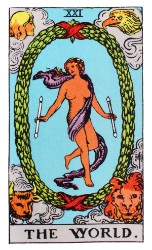
Take The World card.  It’s four corner symbols – lion, ox, eagle, and angel – aren’t just random.  They’re the traditional symbols of the four evangelists:  Matthew, Mark, Luke, and John.

Even more striking are the Four Cardinal Virtues, lifted straight out of Catholic theology:

Justice

Temperance

Fortitude (Strength)

Prudence

By embedding these virtues, the creators of the deck could claim that the Tarot promoted Christian morality rather than undermining it.  It was a survival tactic:  “See – these aren’t pagan symbols.  Ripping up a Tarot deck is just like ripping up a Bible.”

Prudence eventually vanished from the deck (see my previous post, “Dear Prudence – The Mysterious Case of the Missing Tarot Card”), but the other three virtues remain mainstays of the Major Arcana to this day.

WHAT DID THE ORIGINAL DECK LOOK LIKE?

So what happens if we get rid of the Christian overlays, the cards that don’t really belong in the deck?

What remains are the raw archetypes.  Timeless figures like The Fool, The Magician, The Lovers, The Devil, The Wheel of Fortune and Death.  Those cards pulse with universal energies that transcend any single religion.

A question that arises naturally out of this is:  if we’re getting rid of the Virtue cards, why not get rid of The Hierophant, too?  After all, it was originally known as, “The Pope,” and what could be more Catholic than that?  The answer is The Hierophant is nothing but The High Priest in disguise and is the partner card to The High Priestess in the same way that the Emperor is linked to The Empress.

Beneath the Christian veneer lies a much older symbolic system, one that might have looked very different if it hadn’t been forced to wear this mask.

WHERE DID THE TAROT REALLY COME FROM?

Contrary to many modern assumptions, the Tarot did NOT evolve out of Christianity.  

Instead, it seems to have appeared fully formed in the mid-1400s, as though it had been carried forward from some older source.  What that source was – Ancient Egypt or an even older, lost esoteric tradition – remains a mystery.

What’s clear is this:  the Christian layer was camouflage, not origin.  It was a survival strategy, not a birthing.

SEEING THE REAL DECK

The, ‘Christian Themes’ in the Tarot were never a part of the original deck.  They were just part of a clever disguise to get past the censors of the Inquisition.

When we peel back that layer, what we find is a universal language of archetypes.  The Fool, Magician, Death, The Star – these are symbols that speak to something much deeper than mere religious dogma.

And so the question remains:  when we lay the cards out today, are we seeing the archetypes themselves?  Or the clever veil that once kept them alive?

“Just the Tarot” by Daniel Adair – a kindle ebook available on amazon.

Dear Prudence – The Mysterious Case of the Missing Tarot Card

An examination of the mysterious Prudence Card that vanished from the original Tarot decks.

The Prudence Tarot Card

Did you know that there was a card that simply vanished out of the Tarot deck?  Poof!  Like it never existed, and its existence isn’t even known, except to a few historians and Tarot scholars.

THE PRUDENCE CARD

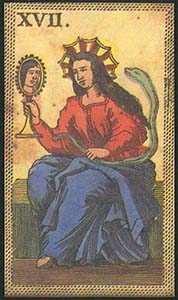
The card was known as, “Prudence,” and – as you can see – it depicted a woman looking into a mirror while a snake keeps her company.  A very strange image, indeed.

It appeared in one of the first known Tarot decks, known as the Visconti-Sforza deck.  This was about the year 1450 and, although the images were crude by today’s standards, for the most part they represent the same themes we see in our modern Tarot decks.  Except for Prudence.  What in the hell is SHE doing in there?

WHY PRUDENCE WAS INCLUDED

To understand why Prudence made her way into the Tarot, we really have to look at what was happening in Europe in the 1400s.

Can you say, “Inquisition?”  Sure you can.  

This was a time when the Catholic Inquisition was in full swing and even the hint of fortune telling could get you burned at the stake as a witch.  The Tarot is – quite obviously – a tool for divination and so they needed to disguise what it really was.

The first ploy was to say that it was just a simple card game.  You know . . . it’s just poker, only with archetypes.  Nothing to see here.

The second trick was to include so much Christian imagery that the priests and torturers would be thrown off of the scent.  In order to do that, they included the ‘four cardinal virtues’ of the Catholic Church.  They are:

JUSTICE

TEMPERANCE

FORTITUDE (AKA Strength)

PRUDENCE

Put quite simply, these cards are nothing but camouflage for the real, original Tarot deck.  

SO WHAT HAPPENED TO HER?

The obvious question here is, “Why did Prudence disappear?”  Why did the other, “virtue cards,” remain while she went away to wherever ex-Tarot-cards live?

Most scholars suggest that the messages she was meant to convey – reflection, wisdom, self-knowledge – were simply absorbed by other cards.   They feel that The Hermit card in particular had all of those qualities, so perhaps Prudence simply wasn’t necessary.  

In modern terms, we could say that her job description was eliminated.  Which sounds like bullshit, doesn’t it?

My personal theory is that Prudence may have been just a little too Pagan for their purposes.  It’s a very strange card. The image of a woman, a snake and a mirror conjure up memories of mythological creatures like Medusa or Hathor.  Perhaps the artist who created the Visconti-Sforza deck was tipping his hand a little too much with this depiction and they needed to hide her.

Whatever the reason, Prudence faded into obscurity, leaving the Tarot a little leaner, but much more mysterious.

PROBLEMS FOR THE OCCULTISTS

The presence of Prudence would have created a major problem for the Victorian occultists – who really brought the Tarot back to life – had they known about her.

They were bound and determined that there was some secret, ancient path hidden away in the Tarot cards and – by god – they were going to find it.  In the 19th century, Eliphas Levi had correlated the 22 cards of the Major Arcana with the 22 letters of the Hebrew alphabet.  He went on to create an elaborate system where he divided the 22 cards into three groups of 7, which echoed the Kabbalistic Tree of Life.

Arthur Edward Waite, who published the Waite deck that we’re all so familiar with, was so determined to make the deck fit into a numerology scheme that he actually changed the order of the cards.  He flipped the numbers so that Strength took the place of Justice and Justice became Strength.  Who cares about history, right?

And, after all of the many years they put into organizing the 22 cards of the Major Arcanum into tidy systems, it turns out there were actually 23 cards.

Well, hell.

CLOSING THOUGHTS

The disappearance of Prudence is more than just a historical footnote.  It reminds us that our knowledge of the Tarot is constantly evolving and it leaves some tantalizing questions.

Why did this ONE card disappear, and not the other virtue cards?

Was the Tarot truly designed as a mystical system disguised as a game?

Does it carry Egyptian or even Atlantean symbols that were concealed from the religious authorities?

The mystery endures and the Tarot invites us to keep looking.

“Just the Tarot,” by Daniel Adair – A kindle ebook available on Amazon

Pamela Colman Smith – The Real Genius Behind the Waite-Rider Tarot Deck

A look into the life of Pamela Colman-Smith, the pixie genius who designed the Waite Tarot Deck.

The most popular Tarot deck in the world is the The Rider Tarot Deck authored by A.E. Waite and published by the Rider Company.  The illustrations in the deck were done by Pamela Colman Smith and it’s been within recent memory that people have started referring to it as the Waite-Smith deck.  The standard description of it is that the illustrations were prepared by Pamela Colman Smith, “under the directions of A.E. Waite.”

It might be more accurate to say that the illustrations were prepared by her DESPITE the instructions of A.E. Waite.

Pamela_Colman_Smith_

PAMELA COLMAN SMITH

She’s one of the more fascinating people in the history of modern occultism.  She had a wonderful smile and was so tiny that she was nicknamed, “Pixie.” As she was growing up her family shuttled between London, Jamaica, and New York and she spent several years living in Kingston and absorbed much of the Jamaican culture.  Her mother was an artist and she, too, developed artistic talents at an early age and began attending the Pratt Art Institute in New York at the age of 15.

By the age of 21 both of her parents had died and she moved by herself to London where she supported herself working as an illustrator, author, and set designer for theatrical productions.  It was there that she met the poet William Butler Yeats who introduced her A.E. Waite, one of the founding member of the Hermetic Order of the Golden Dawn. Shortly thereafter Waite commissioned her to illustrate his Tarot deck and the rest is history.

But that’s where it really gets interesting.

There have been many, many people who have claimed that they were channeling some sort of a higher power that guided their creativity and, “co-created,” with them.  Painters, sculptors, writers who felt the presence of a greater power than themselves literally telling them what to paint, carve, or write. Some of them talk about spirit guides, others describe the guides as angels, a few might even think that god was talking to them.

It is my strong belief that this is exactly what happened to Pamela Smith when she created the Waite deck.

Consider this:  Smith created ALL 78 cards between April and October of 1909.  That means that for that 6 month period she was pumping out an average of 13 highly complex illustrations a month.  As an artist I can tell you that’s nearly impossible.

There is also strong evidence that Waite may have had fairly precise instructions about the Major Arcana but Smith pretty much invented the illustrations for the Minor Arcana herself, even using some of her close friends as models.  With the sheer volume of illustrations she produced and her admittedly short exposure to occultism, you have to think that those pictures were almost painting themselves.

And, finally, there is the evidence of the nature of A.E. Waite himself.  He was, to put it mildly, one incredibly boring old fart. Shortly after Smith produced the cards Waite published a book called The Pictorial Key to the Tarot (Dover Occult) Here’s just a bit of his definition for the card The Magician:

“With further reference to what I have called the sign of life and its’ connexion with the number 8, it may be remembered that Christian Gnosticism speaks of rebirth in Christ as a change, ‘unto the Ogdoad.’ “

And it gets a lot worse.  Can you imagine having a drink with that guy?

The Waite-Smith tarot deck is truly magical.  Every card is beautiful and tells its’ own unique story.  That magic definitely didn’t flow out of A.E. Waite. It flowed out of the eyes and soul of Pixie.  She was in the groove and some higher force was using her mind and her hands to bring those cards into being.  Aren’t we lucky that happened?


Disclaimer: “As an Amazon Associate I earn from qualifying purchases.”

“Just the Tarot,” by Dan Adair – available on Amazon