The Empress and the Abundance of the Heart

The Empress and the abundance of love.

Would you like to be an Empress?

You might read that sentence and think:

“Who, me? The muffler’s about to fall off my car. I can barely pay the rent. The kids need new shoes that I can’t afford, and my apartment looks like a disaster area.

Do I want to be an Empress? Yeah… right.”

What Does an Empress Look Like?

Let’s take a minute to really look at the Empress card before you rule yourself out.
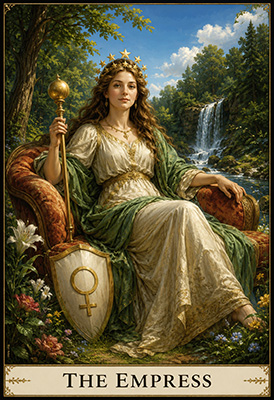
The Empress Poster – 13 X 19 Inches – Available on Etsy

What do we see?

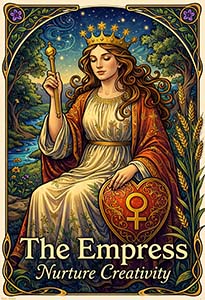
A beautiful woman reclining comfortably on a simple couch. She’s wearing a flowing robe, and her head is crowned with stars. In one hand she loosely holds a scepter topped with a golden globe. Resting beside her is a shield bearing the symbol of Venus.

Behind her stretches a peaceful forest, with a waterfall flowing gently through it beneath a clear blue sky.

What else do you see?

If your answer is, “Nothing,” you got that one exactly right.

What’s Missing?

When we hear the word Empress, certain images immediately come to mind.

Royal courts.

Tables groaning beneath crystal goblets and golden dishes.

Ladies-in-waiting glittering with jewels.

Magnificent ivory thrones.

You know…

Money.

Power.

Status.

Truckloads of doe-ray-me.

Not This Empress

Yet none of those things appear in this card.

She’s reclining on a simple seat instead of an elaborate throne.

There are no servants.

No palace.

No symbols of worldly power.

Yes, she carries a scepter, but she holds it so casually that it almost feels like an afterthought. Her crown is made of stars rather than jewels. Even her shield bears not a lion or dragon, but the symbol of Venus—the emblem of love.

The forest, the waterfall, and the open sky are her royal hall.

What does that tell us?

The Empress and Abundance

The Empress is often described as the archetype of abundance.

But this is a very different kind of abundance.

It isn’t measured in bank accounts or luxury cars.

She doesn’t need possessions to convince herself she’s wealthy.

Her richness flows outward from her.

It doesn’t flow inward from the things she owns.

Her abundance is written upon her shield:

Love.

So how do we incorporate that Empress energy into our own lives?

The Empress and Filling the Well

Julia Cameron observed that creativity is not a bottomless well.

Eventually the well must be refilled.

Sooner or later, the creative life asks us to stop producing and simply receive.

The Empress understands this instinctively.

She would probably tell us that resting isn’t the opposite of creating.

Resting is creating.

When we step away from frantic schedules and consciously enjoy the beauty already surrounding us, we’re expressing Empress energy.

Reading.

Walking.

Listening to music.

Cooking.

Taking a bath.

Watching clouds drift across the sky.

Standing outside beneath the moon.

These aren’t interruptions to creativity.

They’re how creativity breathes.

They’re how we absorb the abundance that already exists simply because we’re alive.

The Empress as a Spiritual Practice

Perhaps the most important symbol in the entire card is the small shield bearing the sign of Venus.

It reminds us that love isn’t something we have to earn.

It isn’t something we have to chase.

And it isn’t something other people give us permission to experience.

Love is our birthright.

It already lives within us.

It flows from the heart rather than into it.

That means we can practice Empress energy every single day.

Making our homes beautiful.

Growing flowers.

Lighting a scented candle.

Preparing a meal with care.

Creating peaceful spaces.

Being fully present in our own lives.

These simple acts may seem ordinary.

The Empress would call them sacred.

Becoming the Empress

So…

Would you like to be an Empress?

Perhaps you already are.

The Empress doesn’t ask how much money is in your bank account, what kind of car you drive, or whether your furniture belongs in a palace.

She asks a much quieter question.

Can you recognize the abundance that’s already present in this moment?

Can you slow down long enough to appreciate beauty?

Can you create a little more peace?

Can you let love flow outward into the world through the smallest acts of everyday life?

If you can…

Then you’re already wearing the crown of stars.
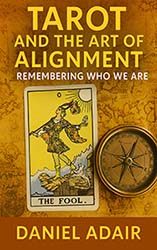
Tarot and the Art of Alignment – Available on Amazon

The Empress and the Courage to Be “Unproductive”

The Empress Archetype and Relaxation as a Way to Nurture Creativity.

In my Empress affirmation poster, I paired her image with the words:

Nurture Creativity

This may be one of the most misunderstood instructions in the entire Tarot.

  Empress Affirmation Poster – Available on Etsy

Because most of us have been trained to believe that creativity comes from effort. From discipline. From pushing harder. From sitting at the desk and refusing to get up until something happens.

That approach belongs to The Emperor.

The Empress operates differently.

She does not force growth.

She allows it.

She creates the conditions in which growth becomes inevitable.

Creativity Cannot Be Forced

Every creative person eventually encounters this paradox.

The harder you try to force creativity, the more it retreats.

You sit at your desk, determined to produce something brilliant. Hours pass. Nothing happens. Your mind feels like dry soil.

And then, days later—while taking a walk, washing dishes, or doing something completely unrelated—an idea appears effortlessly.

It arrives whole.

Not constructed, but received.

Albert Einstein understood this phenomenon. When asked how he discovered the theory of relativity, he didn’t describe grinding intellectual labor. He said simply:

“It just dropped in while I was playing the piano.”

He wasn’t forcing the insight.

He was allowing it.

This is Empress energy.

The Forgotten Value of Leisure

The philosopher Josef Pieper wrote a remarkable book titled Leisure as the Basis of Culture. In it, he argues that leisure is not the absence of productivity, but its foundation.

Leisure, in its true sense, is not laziness in the modern, pejorative sense. It is a state of receptive openness.

It is the willingness to stop forcing.

Pieper observed that culture itself—art, philosophy, music, science—arises not from frantic effort, but from spaces of inward stillness.

When we allow ourselves to be idle, something deeper begins to move.

The soil replenishes itself.

Modern society often treats leisure as wasteful. We are taught that our worth is tied to constant activity. But creativity obeys older, quieter laws.

Seeds do not grow faster because you stare at them.

They grow because the conditions are right.

“Just the Tarot,” by Dan Adair – available on Amazon

Julia Cameron and the Act of Creative Nurturing

Julia Cameron’s The Artist’s Way remains one of the most practical and psychologically accurate guides to creativity ever written.

Her central insight is simple: creativity must be nurtured.

Not commanded.

She encourages practices like morning pages and artist dates—not to produce finished work, but to create space for the creative self to emerge naturally.

These practices are Empress practices.

They say to the creative mind:

You are safe here.

You are allowed to emerge in your own time.

And when that safety is present, creativity begins to flow again.

The Courage to Be “Lazy”

This is perhaps the most radical lesson of The Empress.

You must allow yourself to be, at times, unproductive.

Not because you are weak.

But because you are cultivating fertility.

What appears to be inactivity is often incubation.

Beneath the surface, ideas are forming. Connections are being made. Your subconscious is doing its work.

If you constantly demand output, you exhaust the system that produces it.

The Empress reminds us that rest is not the opposite of creation.

It is part of creation.

Nurture Creativity

The Empress does not shout. She does not command. She invites.

She reminds us that creativity is not a machine, but a living process.

It responds to kindness.

It responds to patience.

It responds to nourishment.

When you stop trying to force creativity and begin nurturing it instead, something remarkable happens.

Ideas begin to arrive again.

Quietly.

Effortlessly.

Like seeds finding their way toward the light.

So when The Empress appears in your readings—or quietly makes herself known in your life—it is not a signal to push harder. It is an invitation to soften. She asks you to step out of the mentality of force and into the rhythm of cultivation. To rest without guilt. To follow your curiosity. To trust that creativity, like all living things, emerges when it is nourished rather than commanded.

 She reminds you that you are not a machine designed for constant output, but a garden capable of extraordinary growth. Your task is not to force the flowers to bloom, but to tend the soil and allow them to emerge in their own time.

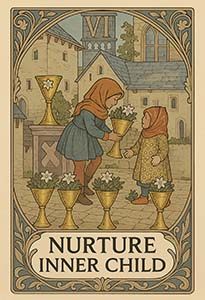
The Six of Cups — Protecting the Inner Child of Your Art

The Six of Cups reminds us that our creativity flows from the innocence of the inner child. Protecting that child means honoring your art, choosing who sees it, and never letting careless criticism silence your joy.

When Beauty Meets Criticism

Have you ever created something you thought was beautiful — a painting, an essay, even a garden — and when you finally shared it, the first thing someone did was point out the flaws? Instead of seeing what you were trying to express, they zeroed in on what they thought was wrong.

There’s always a tension between creating and sharing. When we make something real — assuming we’re not just hacking away — we’re revealing a piece of our heart, our soul, our lived experience. A careless critique can feel like a personal attack. It can leave us feeling exposed, vulnerable, even ashamed.

The Inner Child at Play

Picasso once said, “All children are born artists; the problem is to remain an artist as we grow up.” Creativity flows from the same source as play — from the child who once molded mud into castles or splashed finger paints across paper just for the joy of it.

That inner child still lives inside us, but it’s easily wounded. A thoughtless comment can silence it. A dismissive tone can make it retreat. And when that happens, the creative flow — the very essence of who we are — begins to dry up.

The Birth of the Critic

Mel Brooks joked that with the birth of art came the inevitable afterbirth — the critic. And he wasn’t wrong. If you take your creativity seriously, you’ll eventually encounter people who feel compelled to “fix” your work.

Julia Cameron wrote that before we can become good artists, we must first give ourselves permission to be bad ones. Every artist, writer, gardener, or musician produces clumsy beginnings — and even seasoned creators sometimes turn out a piece that just doesn’t land.

The creative process is messy and human. Yet while you’re admiring what went right, someone else may focus only on what went wrong.

The Wound of the Inner Artist

Cameron also warned that exposing your inner artist to harsh criticism is the emotional equivalent of child abuse. It’s like taking the eager, innocent child who offers you their finger painting and saying, “That’s terrible. You don’t really have any talent, do you?”

If you choose a creative life, criticism is inevitable. Some people simply won’t resonate with your vision, and occasionally you’ll make something that misses the mark. That’s part of the territory. But you can — and must — protect your inner artist with the same fierce loyalty you’d show a child under attack.

Learning by Heart

I became an artist late in life and am entirely self-taught. I picked up a mallet and chisel and learned to carve wood through trial, error, and stubborn joy. I learned to paint the same way.

Looking back, I can see how rough those early pieces were — primitive, awkward, untrained — and yet they were full of life. I still remember the pride I felt each time I saw progress take shape beneath my hands.

Claiming the title artist took courage. The first time I walked into a gallery and asked, “Would you show my work?” was absolutely terrifying.

A Pact of Protection

One simple, unbreakable pact guides me still: when someone criticizes my art, that’s the last time they see my art.

Showing your work is an act of intimacy — an unveiling of something deeply personal. The art flows from the child within you, and that child deserves protection.