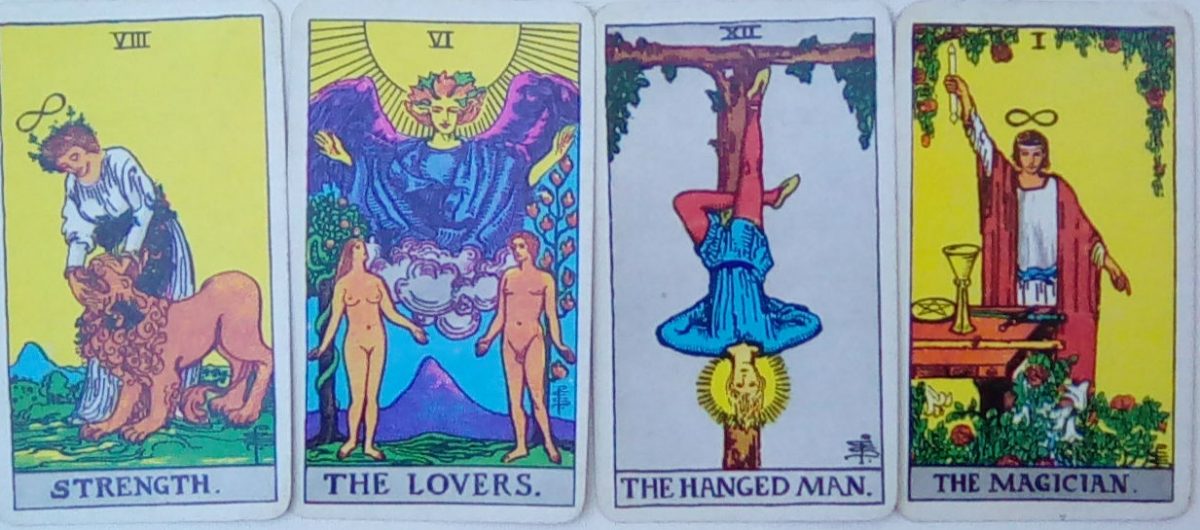
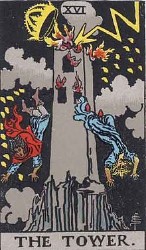
We all know the basic definition of The Tower card: destruction. When it appears in a reading, it tells us that massive change is on the way. It can signal divorces, loss of employment, and many other difficult life-changing events. I’ve described it in the past as having our lives blasted right down to the studs.
Depending on which deck you use, you may have heard different names for The Tower card. Some call it The Lightning Struck Tower. Some refer to it as The Blasted Tower. Most of us just call it The Tower. There’s an interesting twist, though, in the name that a much older Tarot deck applied to it.
THE HOUSE OF GOD
In the Marseilles Tarot deck, which is a style that emerged in France in the 1500s, The Tower is referred to as, “La Maison Dieu.” Which means, “The House of God.”
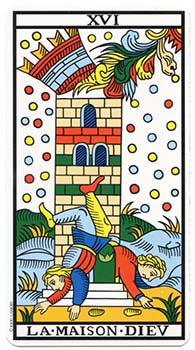
That’s a very peculiar name for destruction, isn’t it?
What do we automatically think of when we hear the term, “House of God?” A church, of course. So is The Lightning Struck Tower actually a Lightning Struck Church?
Hmmm . . .
NOT GOD
Now, if the card had been labelled as, “The Finger of God,” or even just, “God,” it would have made more sense theologically.
The Middle Ages were a hyper-religious time in European history and, of course, Christianity was the dominant religion. As I’ve noted in previous posts, the God of the Old Testament acted very much like a bipolar alcoholic who was off his medications. He was constantly rampaging around causing floods or blowing up cities or throwing people out of gardens because they ate an apple.
If that was your concept of God, then, of course, you might associate him with complete destruction of your life. “Uh, oh . . . God’s pissed off at me for some reason, so he’s going to smash me like a bug.”
But the thing is, God is most notable in the Tarot by his absence. True, there are devils and angels and popes and priestesses, but there isn’t one single card that shows a god.
So if it wasn’t the wrath of God that the Tarot was trying to depict, what was it?
IT’S NOT THE TOWER OF BABEL
The French occultist, Eliphas Levi, created a rabbit hole that a lot of subsequent scholars have jumped into. For no particular reason, he looked at The Tower card and announced that it was a depiction of the Tower of Babel.
If you’re not familiar with that myth, here’s a brief recap: at one point, all humans spoke the same language. Since they were able to communicate, they decided to build a tower that would reach all the way to heaven. That pissed God off and he cursed them so that they’d all speak different languages and couldn’t complete their construction project.
Now, nowhere in the Tower of Babel myth is there any indication that the tower was struck by lightning. And nowhere in the Tower card, is there any indication that the people falling out of the tower are trying to talk to each other.
In other words, the only thing that the Tower of Babel and The Tower card have in common is the word, “tower.”
One really unfortunate result of that confusion is that The Tower is now associated with hubris and arrogance. Like the builders of the Tower of Babel, people who draw the card are supposedly being punished for their pride. Again, there’s no evidence for that whatsoever. You can be a perfectly good person and still have that Tower energy blow through your life.
THE INQUISITION
So, again . . . why call it The House of God?
We have to remember that the Tarot is basically a system for predicting the future, or what we loosely call fortune telling. And the Bible – the operating manual for the Christian church – is very much against it.
“Let no one be found among you who sacrifices their son or daughter in the fire, who practices divination or sorcery, interprets omens, engages in witchcraft.” – Book of Deuteronomy 18:10–12.
There are several other examples, but suffice it to say the church was against fortune telling and the punishment was death.
The Inquisition was reaching its peak during the exact same time frame that the Tarot first emerged. Priests were merrily torturing, maiming, and burning anyone whom they considered to be practicing witchcraft.
In a very real sense, then, the church itself – the House of God – could be viewed as complete destruction for both the Tarot and those who used it for divination.
THE DEFINITION IS THE SAME
The basic definition of The Tower remains the same, of course. It signifies an almost complete destruction of a person’s way of living or thinking. Upright, it shows that the destruction is coming and reversed, it shows that it’s already happened.
It IS fascinating, though, to conjecture about what those early Tarot designers might have been trying to tell us. Were they saying that the church itself was evil?
Were they warning other occultists to keep the true meanings of the cards concealed or risk persecution?
Were they warning against the ultimate effect of rigid belief systems?
Were they, perhaps, predicting the eventual destruction of the church system – the House of God?
We’ll never really know. In an age when we’re once again seeing the rise of religious fundamentalism and intolerance, though, it might serve us well to ponder those very questions.


