The Empath’s Calling: A Tarot Spread for Discovering Your Purpose

Being an empath is about more than simply feeling other people’s emotions. How can we use our sensitivity to make a positive difference in the world? Discover the Empath’s Calling Spread, a five-card Tarot reading designed to reveal your unique gifts, identify obstacles, and guide you toward conscious action and spiritual growth.

I think it’s fair to assume that many Tarot readers are also empaths, to one degree or another. After all, as I explained in my free ebook, What the Tarot Cards Want, each Tarot card represents a particular type of energy that’s present in a person’s life. And who better to recognize and interpret energy than an empath?

The internet is, of course, overflowing with videos, articles, and books about being an empath and how to deal with it. I’ve watched quite a few of those videos and read a number of the books, and it seems to me that most of the material boils down to two main points.

First, there’s the personal revelation: My life was a mess before I realized I was an empath. I never felt like I fit in, I was overwhelmed by other people’s emotions, and I sometimes wondered if there was something wrong with me. Now I understand that I’m not crazy. I’m just an empath.

Second, there’s the spiritual revelation: Empaths are here for a special purpose. We have gifts that are needed during this period of human transformation, and we’re supposed to be doing something to help raise the consciousness of humanity and make life better here on the earth plane.

And then, unfortunately, we seem to run into a blank wall.

As empaths, we may genuinely want to participate in making life better for others. Of course we do! But exactly how are we supposed to accomplish that?

Some of the advice is certainly useful. Build strong boundaries so that you know where other people’s emotions end and yours begin. Stay centered and grounded. Learn how to clear your energy field. Recognize that you don’t have to absorb someone else’s suffering in order to understand it.

All excellent suggestions.

But beyond that, much of the advice seems to suggest that we’re simply supposed to hang out and be . . . um . . . empath-ey.

Empathish.

Super-duper empathetic.

And somehow, through the mysterious workings of the universe, our mere presence will contribute to the spiritual evolution of humanity.

Well, maybe. But I suspect there’s a little more to it than that.

Which brings us to a much more interesting question:

How do I actually use my empathic abilities in ways that will help other people? What am I supposed to be doing with this gift?

And that’s the question that inspired me to create a new Tarot spread.
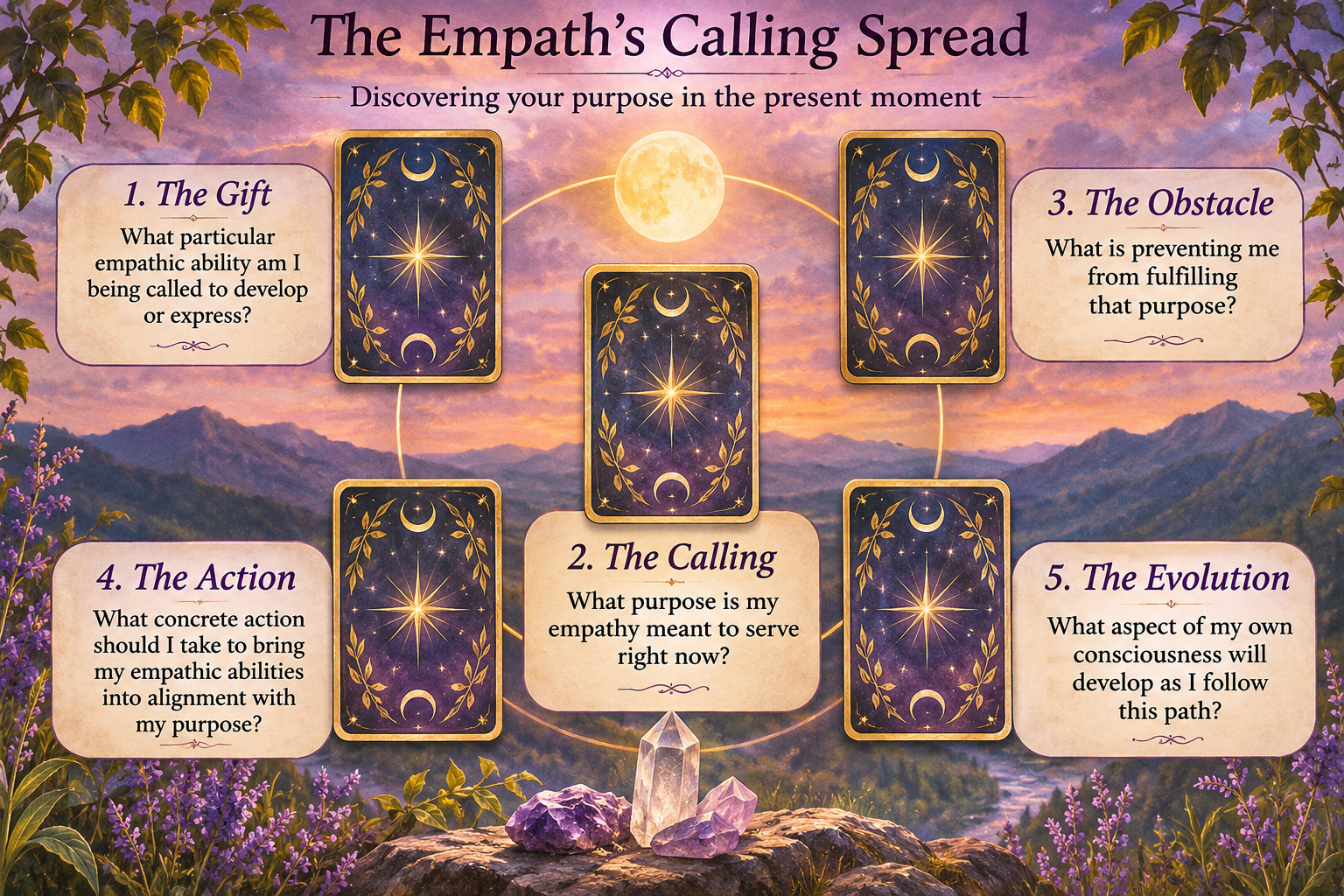
THE EMPATH’S CALLING SPREAD

The Empath’s Calling Spread is a simple five-card Tarot reading designed to help us discover what, exactly, we’re being called to work on at this particular moment in our lives.

Rather than attempting to reveal some grand cosmic destiny, the spread focuses on the present. What abilities are asking to be developed? What obstacles are standing in the way? And, most importantly, what practical steps can we take to bring our empathic abilities into alignment with a meaningful purpose?

(To get a free, downloadable copy of the Empath’s Calling Spread, click here and then save the image.)

Card 1 — The Gift

What particular empathic ability am I being called to develop or express?

Not all empaths function in the same way. Some are natural healers, while others are gifted listeners, artists, teachers, or intuitive observers. Some have an extraordinary ability to recognize emotional patterns, while others seem to understand what people need before those needs have even been expressed.

This card identifies the particular quality or ability that is asking for expression in your life right now.

Card 2 — The Calling

What purpose is my empathy meant to serve right now?

This is the central card of the reading.

Rather than asking about some grand spiritual mission that might unfold over the next twenty years, we’re looking for the immediate direction in which your sensitivity can make a meaningful contribution.

Where is your empathy needed? What kind of contribution are you being called to make at this stage of your development?

Card 3 — The Obstacle

What is preventing me from fulfilling that purpose?

Sometimes the greatest obstacle to using our empathic abilities is the way we experience those abilities ourselves.

This card might reveal emotional overwhelm, poor boundaries, self-doubt, misplaced responsibility for other people’s happiness, or even a fundamental misunderstanding of what empathy actually requires.

It may also reveal an old belief or emotional pattern that needs to be addressed before we can move forward.

Card 4 — The Action

What concrete action should I take to bring my empathic abilities into alignment with my purpose?

This is where the reading becomes practical.

We’re not looking for an abstract spiritual aspiration or a vague suggestion to raise our vibrations. We’re looking for something we can actually do.

Perhaps it’s developing a particular skill, establishing healthier boundaries, beginning a creative project, or learning how to listen without taking responsibility for someone else’s suffering.

Whatever the answer, this card points toward action rather than passive contemplation.

Card 5 — The Evolution

What aspect of my own consciousness will develop as I follow this path?

This final card brings the reading back to our own spiritual development.

What will we learn about ourselves as we begin using our empathic abilities more consciously? What inner quality will strengthen? What old limitation might we transcend?

The underlying idea is that helping others and developing ourselves are not necessarily separate activities. When empathy is expressed in a healthy, conscious way, both can happen simultaneously.

THE UNDERLYING PHILOSOPHY

There’s an important distinction built into this spread:

An empath’s purpose may not be to feel more, but to learn how to use what they feel.

Consider an empath who unconsciously absorbs the suffering of everyone around them. That person may believe that being overwhelmed by other people’s emotions is simply the price of being sensitive.

But what good does it do to absorb another person’s suffering if the only result is that now two people are suffering instead of one?

Perhaps that empath’s real calling is to develop discernment: to recognize another person’s pain, understand it, and respond compassionately without taking it on as their own.

Another empath might discover that their gift is the ability to translate emotional understanding into art, writing, music, or teaching.

Still another might discover that their immediate spiritual assignment is simply to establish healthy boundaries and learn to say no.

That last possibility is especially interesting because it challenges the assumption that spiritual service always means giving more of ourselves.

Sometimes the most important thing we can do is learn to stop giving ourselves away.

You’ll also notice that I deliberately avoided including a card that asks, “Whom am I supposed to help?”

That question can easily reinforce the idea that an empath exists primarily to serve other people’s needs. It can encourage the very patterns of self-sacrifice, emotional exhaustion, and misplaced responsibility that so many empaths struggle with in the first place.

Instead, the spread asks us to develop our own abilities, discover our own direction, and take responsibility for our own spiritual evolution.

And that brings me to something rather interesting that happened when I tried the spread myself.

IT STARTS WITH WORKING ON YOURSELF

When I did my own Empath’s Calling reading, I was surprised to discover that most of the cards were concerned with working on myself rather than learning how to interact with other people.

The King of Cups Reversed, for example, emphasized the need to develop greater emotional balance and mastery. Rather than being carried along by emotional currents, I needed to learn how to remain centered within them.

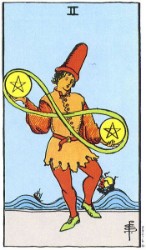
The Two of Cups Reversed pointed toward another important lesson: self-love. It suggested that the emotional understanding and compassion I might readily extend to other people needed to be directed inward as well.

And the Eight of Pentacles reminded me that becoming a healthy, effective empath is a practice. It’s something that requires patience, attention, and the willingness to develop our abilities through conscious effort.

In other words, the cards weren’t telling me to rush out and save the world.

They were telling me to get my own house in order first.

And I found that rather refreshing.

Your reading will probably be quite different from mine because we’re all at different places in our development, with different abilities, experiences, and challenges.

Nevertheless, I suspect that many readings will return to a similar underlying question:

How do we, as empaths, learn to care for our own emotional and spiritual well-being so that we can move out into the world as a positive, healing presence?
FROM SENSITIVITY TO CONSCIOUS ACTION

Too often, discussions about being an empath focus almost exclusively on how the world affects us.

How do other people’s emotions influence our moods? How do we protect ourselves from negative energy? How do we avoid becoming overwhelmed by the suffering, anger, and anxiety of the people around us?

Those are legitimate questions, and learning to manage our sensitivity is certainly important.

But they represent only one side of the equation.

The other side is considerably more empowering.

Instead of asking only how the world affects us, we can begin asking how we want to affect the world.

We can learn to move beyond simply experiencing empathy and begin expressing it consciously, creatively, and constructively.

We can stop thinking of our sensitivity as something that merely happens to us and begin recognizing it as an ability we can develop, refine, and direct.

And perhaps that’s where the real spiritual calling of an empath begins.

Not in feeling everyone else’s pain. Not in sacrificing ourselves for the sake of others. And certainly not in waiting around for the universe to reveal some magnificent cosmic mission.

But in the quieter, more deliberate work of becoming emotionally balanced, spiritually grounded, and conscious of how we use our gifts.

Because ultimately, the goal isn’t simply to be an empath. It’s to become a healthy, conscious, and effective one.

And the Empath’s Calling Spread is one way to begin that journey.
How Many Clarifier Cards Are Too Many in Tarot?

How many clarifier cards should you draw in a Tarot reading? Clarifiers can bring valuable insight to a confusing card, but draw too many and they may muddy the message rather than clarify it. Learn when to draw an extra card, when to stop, and how to recognize when the Tarot has already given you the answer.

How Many Clarifier Cards Are Too Many?

There comes a moment in almost every Tarot reading when you turn over a card, look at it for a while, and think:

“What the hell does that mean?”

So you pull another card to clarify it.

Unfortunately, the second card isn’t much help. You pull another. That one introduces an entirely new problem, so you pull another one. Ten minutes later, your innocent three-card spread has turned into a fifteen-card archaeological dig, and you’re considerably more confused than when you started.

Such are the perils of the clarifier card.

A clarifier is simply an additional Tarot card drawn to give you more information about a card already on the table. Used properly, it’s an extremely useful technique.

Suppose you’re asking about a new job opportunity and the Moon appears. That’s meaningful, but there are several possibilities. Is something being concealed? Are your own fears clouding your judgment? Is the situation simply too undeveloped for you to know what’s happening yet?

So you ask:

“What is the Moon referring to in this reading?”

You draw the Seven of Swords.

Now you’ve learned something. The Moon hasn’t disappeared or been replaced by the Seven of Swords. Instead, the Seven has narrowed the field. There may be information you don’t have, something occurring behind the scenes, or someone who isn’t being entirely straightforward.

That’s a clarifier doing its job.

The difficulty begins when we use clarifiers for something else entirely: trying to get a different answer.

Imagine asking whether a romantic relationship has a future and drawing the Eight of Cups.

You don’t particularly like that, so you ask for clarification.

Ten of Swords.

That’s even worse.

Another clarifier: Five of Cups.

By now the Tarot is practically standing on the table with a bullhorn, but you keep going.

And then—The Star!

Aha! You knew it! Everything is going to work out!

Except that isn’t clarification. You simply kept drawing until the deck produced a card you liked.

It’s an especially easy trap to fall into when you’re reading for yourself.

So how many clarifiers should you draw?

There isn’t an official Tarot rule, but mine is simple:

One clarifier is usually enough. Two should be the absolute maximum.

If the first additional card doesn’t make the situation clearer, I may occasionally draw a second. After that, I stop.

Because by then, the problem probably isn’t that there aren’t enough cards on the table. The problem is that I haven’t understood what they’re saying yet.

Five more cards aren’t necessarily going to fix that. More likely, they’ll give me five additional symbols, relationships and possible interpretations to sort through.

Sometimes the most productive response to a confusing reading is to walk away from it.

Write the cards down. Take a photograph. Go make coffee. Look at the spread again in an hour, or even the next day. Once you’ve stopped wrestling with it, the meaning will often become perfectly apparent.

Another way to avoid unnecessary clarifiers is to give the clarifier a specific question.

Don’t merely think, “Clarify this.”

Ask exactly what you need to know.

If you draw the Tower, you might ask:

“What area of my life does the Tower refer to?”

If you draw the Seven of Cups:

“What am I failing to see clearly?”

If you draw the Two of Swords:

“What decision am I avoiding?”

Now the extra card has a defined purpose rather than simply adding another symbol to an already complicated reading.

There’s also another possibility we sometimes overlook: perhaps the original card is ambiguous because ambiguity itself is the answer.

The Moon is a wonderful example. You ask what’s going to happen in a situation and draw the Moon. Naturally, you want to know more.

But the Moon may be saying that there isn’t anything more you can know right now.

You don’t have all the information. Events are developing out of sight. Emotion may be interfering with perception. The situation hasn’t settled into a definite form.

If that’s the message, drawing six more cards to force certainty out of the deck defeats the purpose. The Tarot may already have given you its answer:

You don’t know yet.

There’s one more useful question to ask yourself before reaching for another card:

“Am I trying to understand this reading, or am I trying to make myself feel better?”

Those aren’t the same thing.

A clarifier drawn because you’re genuinely trying to understand a card can be tremendously helpful. A clarifier drawn because the answer makes you anxious can easily lead to one more card, then another, then another—until eventually you find the reassurance you wanted.

At that point, you’re no longer listening to the Tarot.

You’re negotiating with it.

And Tarot is a lousy negotiating partner.

So before drawing anything else, give the original card a chance to speak. Look at its imagery. Think about its traditional meanings. Consider its position in the spread and its relationship to the cards around it. Ask yourself why that particular card appeared in answer to that particular question.

Quite often, you’ll discover that the clarification was already there.

And when it genuinely isn’t?

Draw one card.

Maybe two.

But if you’ve drawn eight clarifiers and you’re still confused, put the deck down.

The Tarot has probably already said what it has to say.

What Should You Do When a Tarot Reading Makes No Sense?

What do you do when a Tarot reading makes absolutely no sense? Before assuming the cards have failed, consider what they may be reflecting. Mental confusion, rapid life changes, hidden information, or simple denial can all produce a seemingly muddled reading. Learn how to recognize underlying patterns, step back from confusing cards, and trust that sometimes the best answer is simply: more will be revealed.

There are times, especially when you’re new to reading Tarot cards, when you lay out a reading and it makes absolutely no sense. Not only does it seem to have nothing to do with what’s happening in your life, but the cards don’t even seem to connect with each other.

So what do you do when that happens?

I’ve found that a good first step is to step back, look at the cards, scratch your head, and say: “What in the HELL does that mean?”

It doesn’t solve the reading, but it clears the air.

There are, however, some questions we can ask that may help.

HOW’S YOUR HEAD?

I’ve found that I’m most likely to get muddled readings when I’M muddled.

In other words, it’s not the cards’ energy. It’s my energy.

After all, when we lay out a Tarot reading, it’s a snapshot of what’s happening in our lives at that particular moment. It may tell us something about what’s happened in the immediate past, what’s going on right now, and what’s likely to happen in the immediate future.

If I’ve got a head full of fuzz because I haven’t been taking care of myself energetically, that’s exactly what’s going to show up in the reading. If I’m anxious or a bit hyper, if my thoughts are bouncing all over the place like a pinball, the reading may bounce all over the place, too.

Feed Your Head – Available on Etsy

It isn’t that the cards AREN’T working—it’s that they are. They’re mirroring back to me exactly what my current reality looks like. If my thoughts don’t make any sense, neither will the reading.

ARE THINGS CHANGING IN YOUR LIFE?

There are times in everyone’s life when things change very rapidly.

We can be plodding along, getting up in the morning, going to work, doing our jobs. Life is perfectly normal.

Then suddenly we feel as if we’ve been thrown into a blender.

Perhaps we come home from work and discover that our partner has moved out. Perhaps we’re suddenly transferred to a new office and have to move. Perhaps we wake up one morning and think, “Man, none of this makes any sense. I’m starting over.”

When our lives are in flux, our readings may be in flux, too.

If things are changing so rapidly that we can’t keep up with them, the cards may simply be reflecting that reality. When things begin to settle down, the readings often will, too.

IS THERE A LOT OF RATIONALIZATION OR DENIAL GOING ON?

This can apply when we’re doing readings for ourselves, but it can be particularly important when we’re reading for other people.

It’s perfectly natural for all of us to try to present ourselves in the most positive light. Sometimes, however, we take that to the extreme of completely denying what’s really going on in our lives.

You may sit down to do a reading for someone who appears to have it all together. They’re well dressed. They’ve got a good job, a loving partner, and 2.5 beautiful children.

That’s what they’re projecting to the world—and perhaps to themselves. But underneath the image of the perfect life, they’re a mess. Their partner is emotionally abusive, their children are having trouble in school, their credit cards are maxed out, and they’re behind on their house payments.

So you lay out the cards. The reading reflects all of that.

And they look at you and say, “That’s not right. Everything in my life is wonderful.”

The cards may be telling the truth, but the questioner isn’t.

SO WHAT DO WE DO?

The solutions to all of these scenarios are fairly straightforward.

1. Wait and do the reading again later. If you’re extremely upset, physically exhausted, very anxious, or mentally scattered, you’re probably not going to get a clear reading.

Get some rest. Meditate. Do some EFT tapping. Clear your energy.

When you’re clearer, your reading may be clearer, too.

2. Accept the chaos until it settles down.

If everything in your life is upside down and sideways, you’re probably not going to get a nice, orderly reading.

If you don’t know what the hell is going on in your life, why should the cards pretend otherwise?

Once things begin to settle, your readings may begin to make more sense.

3. Remember that the cards may actually be one hundred percent accurate—but there are factors you aren’t aware of.

If the questioner is lying to you, withholding information, or simply unable to see what’s happening in their own life, a reading may LOOK as if it doesn’t make sense when it actually does.  And if we’re lying to ourselves, we may genuinely be unable to see the patterns in our lives, even when they’re laid out in front of us.

The missing ingredient may simply be information.

LOOK FOR UNDERLYING PATTERNS

Another thing we can do with a muddled reading is stop trying to interpret every individual card and look at the reading as a whole.

Are nearly all of the cards reversed? That may indicate that much of what’s happening is internal, blocked, delayed, or being experienced subjectively rather than expressed openly in the world.

Is one suit predominating?

If you get a reading that’s almost entirely Cups, emotion and relationships may be overwhelming everything else.

If Swords dominate, there may be too much thinking, worrying, conflict, analysis, or mental agitation.

Too many Wands may indicate that you’re pushing too hard, trying to do too much, or running on nervous energy and sheer willpower.

And if Pentacles dominate, you may be overly focused on money, work, security, possessions, or the practical realities of life.

You don’t necessarily have to understand every card to understand what the reading is telling you.

WHAT ABOUT THE MAJOR ARCANA?

Are there a lot of Major Arcana cards?

This can be an especially important clue when your life has gone topsy-turvy. Any card from the Major Arcana can act like a bright, flashing light saying:

“Pay attention. This is important.”

If you have several Major Arcana cards in a single reading, you may be dealing with something larger than the ordinary events of the day. Major forces may be at work in your life. An old pattern may be ending. A new phase may be beginning. Something fundamental may be shifting.

And if that shift is still underway, it may be impossible to see exactly where it’s taking you.

BE PATIENT

There’s a saying in 12-Step groups: More will be revealed.

And that’s often true with the Tarot.

If a reading doesn’t seem to make any sense, wait a few days and look at it again. If it still doesn’t make sense, set it aside and come back to it later.

Very often you’ll discover that the cards were astonishingly accurate. There was simply a piece of the puzzle you didn’t have yet. As a little time goes by, the missing pieces emerge—and suddenly the reading makes sense.

If you’re a beginner, I’d actually encourage you to keep a Tarot journal.

Write down your readings—especially the ones that make no sense—and then go back and check them after a few days or a few weeks.

I think you’ll be surprised at what you find.

Can You Read Tarot for Yourself?

Can you read Tarot cards for yourself? Absolutely—but self-readings come with both advantages and pitfalls. Learn why reading Tarot for yourself can be remarkably insightful, how personal blind spots can affect your interpretations, and why repeatedly asking the cards the same question usually creates more confusion than clarity.

A question that many newly minted Tarot readers ask is, “Can I do readings for myself?”

And the answer to that is: Oh, hell, yes.

People have been doing Tarot readings for themselves for as long as people have been reading Tarot cards.

It’s not an unreasonable question, though. In all the years I’ve been doing Tarot readings, I’ve heard the same statement from several people:

“You can’t do readings for yourself. Everyone knows that.”

I’ve never been able to track down exactly who “everyone” is, or where they came up with this rule, but the idea is definitely out there.

So, just to be definitive about it: it’s wrong.

The Advantages of Reading for Yourself

The most obvious advantage of reading for yourself is that nobody knows you quite like you know yourself.

And that means there’s often much less guesswork involved in figuring out what the cards mean.

For instance, suppose a card like The Devil comes up in your reading. Someone who doesn’t know you can make a series of educated guesses based on the traditional meanings of the card.

“Ummm . . . there could be a problem with addiction in your life. Or perhaps there’s an unhealthy or obsessive sexual element involved. Or you might be refusing to recognize some pattern of self-harm . . .”

But they don’t really know, because they don’t really know you.

You, on the other hand, can look at the same card and immediately realize:

“Yeah, I’m drinking too much.”

Or:

“I really shouldn’t be having an affair with the neighbor’s wife.”

Or:

“I really need to quit sticking pins in that voodoo doll of my boss.”

That simple self-knowledge can make a reading much easier and clearer than one you might get from a stranger. You already know the cast of characters, the circumstances, and the history. The card doesn’t have to explain the whole situation to you. It only has to point at it.

The Disadvantages of Reading for Yourself

The major disadvantage of reading for yourself is that—guess what?—we’re all human.

We rationalize. We deny. We conveniently overlook things. And many of us have a somewhat inflated—or at least carefully edited—image of ourselves.

Sometimes we can look at cards that are giving us a very, very clear message and simply say:

“Nope. That’s not me.”

Psychologist Jennifer Freyd coined the term “betrayal blindness” to describe the way people can sometimes remain unaware of betrayal when recognizing it would threaten an important relationship or situation.

To use an extreme example, someone might be married to an absolute cheating horn dog—a partner who is screwing around with other women all week long and twice on Sunday—but she simply cannot allow herself to see it.

She finds the motel receipts, the lipstick on the collar, and the condoms in the glove box, but somehow there’s a perfectly reasonable explanation for all of it.

That same person probably isn’t going to see the truth in the Tarot cards either.

She might lay out a reading that practically screams that her partner is a no-good, lying, cheating lowlife, and she’ll still find some way to interpret the cards differently.

And we all have areas of our lives where we deceive ourselves.

For most of us they aren’t quite that dramatic, but the blind spots are still there. Someone else reading for us may spot those inconsistencies immediately, while we unconsciously find ways to explain them away.

That’s the real danger of reading for yourself. It isn’t that the cards somehow stop working when you’re the person shuffling them.

It’s that you may not want to hear what they’re saying.

Don’t Obsess

There’s one other warning about reading for yourself that’s worth mentioning:

Don’t obsess.

In other words, don’t fall into the pattern of constantly reading the cards, looking for one more clue about what you’re supposed to do.

And that’s tempting. Believe me.

After all, when you’re reading for yourself, the readings are free and you can do as many of them as you want.

But realistically, Tarot readings tend to fall into two broad categories.

The first kind is crystal clear. It tells you, in effect:

“This is what’s happening. This is what you need to do. And this is probably what will happen if you don’t do it.”

The second kind—which is much less common—is muddled. The cards don’t seem to form a coherent message, or several contradictory possibilities seem to be in play.

In my experience, that usually means the situation itself hasn’t settled yet. Too many things are moving around, and you simply need to wait until the dust clears.

Either way, doing another seventeen readings probably isn’t going to help.

If you’ve already received a clear reading, the answer isn’t going to change just because you keep asking the question.

And if the reading is genuinely muddled, it probably isn’t going to become clear until the situation itself becomes clearer.

All you’re likely to get from repeatedly throwing the cards is frustration, confusion, and a big fat waste of your time.

Keep Reading

So, by all means, read Tarot for yourself.

Just be reasonable about it, and remember that self-knowledge cuts both ways. Knowing your own life intimately can make a reading extraordinarily clear—but your own biases and blind spots can occasionally make the obvious invisible.

Unless there’s a specific problem I need to address, I usually do one predictive reading at the beginning of each week. It gives me a general feel for the energies and circumstances I’m likely to encounter.

It’s a simple four-card reading:

1 — What are the current conditions?
2 — What needs to be done?
3 — What factors are working against me?
4 — What is the probable outcome?

And that’s it.

That gives me all the information I need to stumble through the week.

Sometimes the reading surprises me. Sometimes it tells me something I already suspected. And sometimes I don’t fully understand what a card was talking about until several days later.

But the point isn’t to consult the Tarot every fifteen minutes.

The point is to get the message, think about it, and then go live your life.

How Do I Know Which Tarot Meaning is the Right One?

Which Tarot card meanings should you believe when different books and websites give you different answers? Learn why the images in the Waite-Smith Tarot are one of the best guides to understanding what the cards actually mean—and why sometimes the simplest approach to reading Tarot is simply to look at the pictures.

WHICH TAROT CARD MEANING SHOULD YOU BELIEVE?

One of the questions a lot of beginning Tarot readers have is, “Which definition should I believe?”

If I find two different definitions of the same card that seem to say completely different things, which one should I use?

Actually, that’s not as much of a problem as many new readers might think. You can skim through the various Tarot sites on the internet and discover that most of the definitions are remarkably homogeneous. If anything, there’s sometimes a troubling lack of imagination in them.

Still, there are differences, and those differences can affect your ability to read the cards.

One book might stress that The Emperor brings order and structure, while another views him as rigid and controlling. One site might describe The Hierophant as organized religion, while another sees him as a teacher, mentor or guru figure.

So how do you decide?

THE PAMELA COLMAN SMITH COLORING BOOK

A good starting point for any reader is simply to LOOK at the cards. What are they actually saying?

And I don’t mean, “What vibe am I picking up from this card?” I mean literally look at what the image portrays.

The best place to learn how to do that is the Waite-Smith Tarot deck. The artist behind that deck, Pamela Colman Smith—also known as Pixie—did a phenomenal job of portraying the essence of each card. In a very real sense, the images ARE the definitions.

Each one is a little visual story that tells you what the card is about.

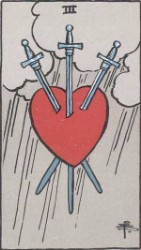
The Three of Swords shows a heart pierced by three swords. It means heartache.

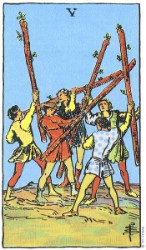
The Five of Wands shows five guys wailing away at each other with sticks. It means conflict, competition or vigorous engagement.

The Eight of Pentacles shows a man sitting at his workbench carving pentacles. It means work, practice and developing skill.

The Three of Cups shows three people raising their goblets and dancing together. It means celebration, friendship and having a good time.

Not too hard, right?

If you’re a beginning reader, start with those pictures and those stories. Think of the Waite-Smith deck almost as a coloring book in which every picture tells a story. Your first job is simply to learn how to read the pictures.

WHEN THE DEFINITIONS ARE WRONG

There ARE times when standard Tarot definitions have drifted away from the images on the cards. When that happens, you can use the artwork itself to double-check the definition.

Let me give you an example.

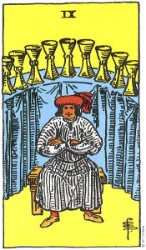
Take a look at the Nine of Cups. What do you actually see?

When I was learning the Tarot many, many years ago, a common interpretation of this card was an individual who is doing well materially but has a certain air of smugness and self-satisfaction about him.

And that’s pretty much what Colman Smith portrayed. He isn’t smiling so much as smirking. His body language—crossed arms and widely planted legs—practically screams that this is somebody who is very pleased with himself.

It wasn’t necessarily a BAD card. It simply wasn’t a particularly elevated one.

Fast-forward to today, and the Nine of Cups is frequently called “the wish card.” Whatever you want, you can have. Your wishes are coming true.

Really?

Is that what you see in this picture? Rainbows and unicorns?

Obviously not.

That doesn’t mean every modern interpretation of the Nine of Cups is useless. But it does mean we should occasionally stop repeating definitions we’ve inherited and ask a very simple question: Does this interpretation actually fit the card?

The Waite-Smith deck gives us a remarkably useful visual reality check. If a definition bears little resemblance to the picture, it’s worth questioning the definition.

IS THIS A SHALLOW APPROACH?

There are plenty of self-professed experts who will tell you that the Tarot is incredibly complicated and deep.

And they’re right.

Tarot symbolism can be profound and extremely complex. You can spend years studying these cards and continue finding new layers of meaning in them.

But if you’re a beginning reader, you don’t need to worry about all of that right now.

As time goes by, you may want to take a much deeper dive into the cards. You may want to explore numerology, astrology, Kabbalah, alchemy and the various occult traditions that influenced the Tarot.

That can come later. Fortunately, A. E. Waite and Pamela Colman Smith did much of that work for you, and they embedded an enormous amount of it in the deck.

For now, you can do something much simpler.

Pick up the cards. Lay out a reading. Look at the pictures.

What story are they telling you?

That’s where Tarot reading begins.

I also offer a free beginner’s Tarot course here on the website, so if you’re just getting started, you may want to give that a quick read.

But above all, keep it simple.

And keep it fun.

Why Do I Keep Getting the Same Tarot Card Over and Over?

Why does the same Tarot card keep appearing in your readings? A repeating card may point to stuck energy, an important person in your life, or something you haven’t been willing to see. Learn why Tarot sometimes repeats itself—and what that persistent card may be asking you to notice.

One of the spookier things that can happen to a new Tarot reader is getting the same card over and over again.

No matter how many readings you do, there it is. It may drift around to different positions in the spread. It may appear as an answer to completely different questions. You shuffle thoroughly, cut the deck, and perhaps even put the cards away for a few days.

And then you do another reading. There it is again.

It can begin to feel as though the card is glued to your aura.

Oddly enough, this can also be one of the most reassuring experiences in Tarot. There are 78 cards in a standard deck, so when one particular card begins appearing with remarkable persistence, it certainly gets your attention.

So what does it mean?

In my experience, there are three basic reasons a Tarot card may keep appearing:

1. Stuck energy — something in your life isn’t changing.

2. A particular person — someone important is being represented by the card.

3. Something you aren’t acknowledging — an important situation or energy needs your attention.

STUCK ENERGY

A Tarot reading doesn’t really “predict the future.” Instead, it gives us a snapshot of what’s happening in our lives right now and then suggests the probable outcome if those forces continue moving in the same direction.

To use a very simple example, suppose you get the Two of Cups—falling in love—followed by the Three of Swords—heartbreak.

That might suggest that the new romance you’re entering isn’t likely to work out. But that’s not written in stone, because nothing is written in stone. The cards are essentially saying:

“This is where things appear to be heading if nothing changes.”

And nothing changing is one reason certain cards may constantly reappear. If we’re stuck in a loop in which we keep doing the same things over and over, the cards representing that pattern may simply keep coming back.

And here’s the deal: we’re not supposed to stay the same. Human beings are constantly learning, changing and evolving. If the Tarot keeps throwing the same card at you, it may be pointing toward a pattern that needs to change.

In the example above, perhaps you keep falling in love with people who eventually hurt you. At some point, stop looking at them and start looking at yourself.

Why am I doing this? Why am I repeatedly attracted to people who can’t fulfill me or meet my needs?

The repeating Tarot card may not be telling you what is going to happen next. It may be telling you what you keep doing.

PEOPLE

There are times when another person exerts a particularly strong influence on our lives, and we need to be aware of what they’re doing. When that happens, the Tarot may repeatedly produce the same card to represent that person and call our attention to them.

There’s nothing particularly unusual about cards representing people. The Court Cards have traditionally served that function, but other cards can do it as well.

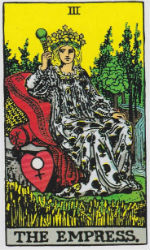
For instance, if you’re involved with someone who is particularly loving and nurturing, The Empress may appear prominently because she embodies those qualities.

I’ve found, though, that repeating cards representing people can become particularly noticeable when there’s conflict involved—when someone else’s actions may be affecting you in ways you need to recognize.

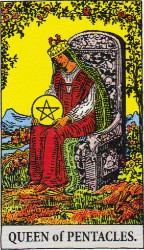
For example, I was once involved in a contested probate, and the Queen of Pentacles reversed kept appearing.

In another context, the reversed Queen of Pentacles might suggest a need for self-nurturing, insecurity around material matters, or energies that have become overly focused on possessions and control.

But when she represents another person, the interpretation can be quite different. As Sasha Fenton rather memorably puts it:

“This lady will win if involved in a fight with the questioner, especially if money is involved.”

That was certainly an interesting card to have repeatedly appearing during a legal dispute over an estate. To me, the message was clear: pay attention to this person. Don’t underestimate her. Money and material interests are central to what’s happening.

So when one card keeps popping up—particularly during a troubled or stressful period—ask yourself:

Could this card represent someone in my life? Is the Tarot pointing a great big flashing neon arrow at someone and saying:

“Pay attention to this one.”

DENIAL

Human beings can go to amazing lengths to avoid seeing something when we really don’t want to see it.

Psychologist Jennifer Freyd coined the term “betrayal blindness” to describe the way people may remain unaware of, or fail to fully acknowledge, betrayal when it threatens an important relationship or situation.

Imagine, for example, a woman whose husband is cheating on her.

The evidence may be sitting right there in plain sight: unexplained motel receipts, long private phone calls, suspicious messages on social media. But somehow she doesn’t put the pieces together.

Then one day something happens and suddenly everything clicks and she asks “How could I have been so blind?”

As the old cliché puts it: “Denial ain’t a river in Egypt.”

And Tarot doesn’t seem to have much patience with denial. If there’s something in your life that is vitally important for you to acknowledge and deal with, the cards may keep pointing toward it over and over again until you’re finally willing to look.

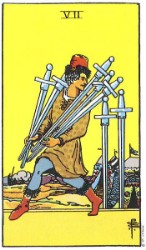
In the situation we just described, perhaps the Seven of Swords—traditionally associated with secrecy, deception and things happening behind the scenes—keeps appearing.

At first, the woman may be genuinely puzzled. “What in the world does that have to do with me?”

But the card keeps coming back.

Seven of Swords.

Seven of Swords.

Seven of Swords.

Eventually, instead of asking what the card means, she begins asking a much more useful question: “What am I not seeing?”

And that’s when she may finally start noticing those motel receipts.

TAKE THE BLINDERS OFF

If we wanted to sum all of this up in one sentence, it might simply be: Take the blinders off.

Or perhaps: take off the rose-colored glasses.

When the Tarot repeatedly gives us the same card, the most useful response isn’t necessarily to reshuffle the deck and ask the question again.

It’s to stop. Look at the card.

And ask yourself: Why does this particular message keep coming back?

Am I stuck in a pattern? Does this card represent someone who is having an important influence on my life? Is there something happening that I don’t want to acknowledge?

Sometimes the card that won’t go away is precisely the card we most need to understand.

Tarot can be remarkably patient. It can whisper the same message very gently for a very long time. But it can also be remarkably persistent.

At a certain point, you have a choice: deal with the issue—or quit asking the cards about it.

What you can’t do is keep asking the same question and expect the Tarot to tell you something different.

Should You Read Reversed Tarot Cards Differently?

Should you interpret reversed Tarot cards differently—or simply turn them upright and read them normally? This post explores both approaches, including reversals as blocked, weakened, excessive, or inwardly directed energy, and shows how understanding the card’s basic energy can make reversals far easier to interpret.

You turn over a Tarot card and there it is:

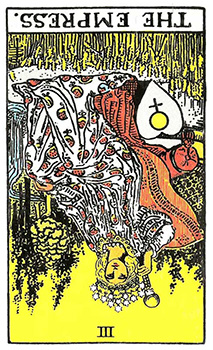
The Empress—upside down.

Now what?

If you’re new to Tarot, reversed cards can make an already complicated subject seem twice as difficult. You finally begin learning the meanings of 78 cards, only to discover that some books provide an entirely separate meaning for every card when it appears reversed.

Suddenly it seems as though you’re expected to memorize 156 Tarot cards. Fortunately, you aren’t.

The real question isn’t whether you should read a reversed card. Obviously, the card is still part of the reading. The question is whether you should interpret that card differently because it appeared upside down.

Some Tarot readers do. Others simply turn the card upright and interpret it normally, allowing the question, its position in the spread and the surrounding cards to determine which aspects of the card apply. Neither approach is inherently right or wrong.

So let’s look at what reversals can add to a reading—and whether you actually need them.

WHAT IS A REVERSED TAROT CARD?

A reversed card is simply a Tarot card that appears upside down in a reading.

Some readers deliberately shuffle their decks so that cards can appear in either direction and consider the reversed orientation part of the message. Other readers don’t assign any special significance to orientation. If a card appears upside down, they simply turn it upright and read the card normally.

This doesn’t mean they’re ignoring the reversed card or rejecting its more difficult meanings. Quite the opposite. They consider those meanings to be already contained within the card.

For example, The Emperor can represent healthy structure, leadership and stability. But Emperor energy can also become rigid, authoritarian and controlling. A reader who uses reversals might associate some of those more difficult qualities with The Emperor reversed.

A reader who doesn’t use reversals may see exactly the same qualities in an upright Emperor, depending upon the question and the card’s position in the spread. The difference isn’t necessarily in what the card can mean. It’s in how the reader determines which meaning applies.

WHAT DOES A REVERSED CARD MEAN?

Here’s where things become interesting.

There is no single rule.

A reversed card might suggest that the upright energy is:

* Blocked or frustrated

* Weakened

* Excessive or out of balance

* Turned inward

* Delayed or incomplete

* Being resisted

* Expressing its more difficult or shadow qualities

Occasionally, the reversed card may even suggest something close to the opposite of its usual meaning.

That’s much more sophisticated than simply saying: Upright = good. Reversed = bad. In fact, some reversed cards can be quite encouraging.

The Devil reversed might suggest breaking free from an unhealthy attachment. The Eight of Swords reversed might indicate recognizing that you aren’t nearly as trapped as you believed.

Meanwhile, an apparently wonderful card such as The Sun reversed could suggest that happiness is available but something is preventing you from fully experiencing it.

Reversals aren’t necessarily negative. They can simply show us that something unusual is happening to the card’s energy.

REVERSALS AS BLOCKED ENERGY

One of the easiest ways to begin working with reversals is to think of them as blocked energy.

Every Tarot card represents a particular kind of energy or experience.

The Magician wants to create.

The Empress wants to nurture.

The Chariot wants to move forward.

The Star wants to shine.

When one of those cards appears reversed, we can ask: What is preventing this energy from expressing itself naturally?

The reversed Magician might suggest unused ability or uncertainty about your own power.

The reversed Empress might indicate difficulty nurturing yourself—or nurturing everyone else until you’ve exhausted yourself.

The reversed Chariot might represent plenty of effort but no clear direction.

The reversed Star might indicate that your light is still there, but you’ve temporarily lost confidence in it.

The original meaning of the card hasn’t disappeared. Something has happened to it.

SOMETIMES THERE’S TOO MUCH OF A GOOD THING

A reversal can also suggest excess. Sometimes the problem isn’t too little of the card’s energy. It’s too much.

The Emperor’s structure can become rigid control.

The Hermit’s solitude can become isolation.

The Four of Pentacles’ stability can become possessiveness.

The Knight of Swords’ determination can become reckless action.

In this approach, the reversed card acts almost like a warning light: This energy has moved out of balance. That’s particularly useful in psychological or self-development readings because a reversal can reveal where an otherwise healthy quality has become exaggerated.

REVERSALS CAN TURN THE ENERGY INWARD

There’s another way of interpreting reversals that I particularly like.

Sometimes an upright card can represent energy being expressed in the external world, while the reversed card suggests that the same process is taking place internally.

The Queen of Cups upright might describe compassion and emotional sensitivity directed toward other people. Reversed, she might ask you to direct some of that compassion toward yourself.

The Magician upright might indicate using your abilities to create something in the world. Reversed, he might suggest discovering abilities within yourself that haven’t yet found outward expression.

This interpretation won’t work for every card or every reading. But that’s the point. Reversals aren’t formulas. They’re additional information.

DO REVERSED CARDS MEAN THE OPPOSITE?

Sometimes—but I wouldn’t make that the automatic assumption.

Consider The Hermit. Upright, The Hermit can represent solitude, contemplation and turning inward in search of wisdom.

If we simply reverse that meaning, does The Hermit reversed mean being sociable and going to a party? Probably not. It might indicate too much isolation.

Or perhaps the person desperately needs solitude but isn’t getting it.

Maybe they’ve found something during their period of introspection that now needs to be brought back into the world.

Instead of asking:

What’s the opposite of The Hermit?

Try asking: What has happened to the energy of The Hermit?

That opens considerably more interesting possibilities.

WHY SOME READERS DON’T USE REVERSALS

There’s a very good argument for not assigning reversed cards separate meanings: The Tarot already contains an enormous range of human experience.

We certainly don’t have a shortage of difficult cards.

The Tower, Devil, Three of Swords, Five of Pentacles and Ten of Swords are perfectly capable of telling us when something has gone wrong.

More importantly, every Tarot card already contains both light and shadow.

The Emperor can represent healthy structure or oppressive control.

The Hermit can represent valuable solitude or unhealthy isolation.

The Moon can represent intuition or confusion.

The Four of Pentacles can represent financial stability or fearfully clinging to what you possess.

You don’t necessarily need to turn a card upside down to access those meanings. The question being asked, the position of the card within the spread and the cards surrounding it can provide the context.

That’s why a reader who doesn’t use reversals isn’t reading only the “positive half” of Tarot. They’re reading the entire spectrum of meaning contained within each upright card.

BUT REVERSALS HAVE ONE BIG ADVANTAGE

They get your attention.

Suppose The Emperor appears in a position labeled: What’s preventing me from moving forward?

Even upright, that position tells us that some aspect of Emperor energy may be causing difficulty. Perhaps there’s too much structure, too much control or an unwillingness to deviate from the plan.

But if The Emperor appears reversed, we receive an additional visual signal: Something about this energy isn’t functioning normally.

A reversed card interrupts the visual flow of a spread. It makes us stop and look again. It’s almost as though Tarot has underlined the card.

And that can be extremely useful.

WHAT IF HALF THE READING IS REVERSED?

This is where reversals can become more interesting than individual card meanings.

If one card is reversed, look closely at that card. If most of the spread is reversed, look at the pattern.

Perhaps the situation is stalled. Perhaps there’s tremendous internal activity but very little outward movement. Perhaps someone is resisting change. Perhaps energy is being blocked in several different areas.

Or perhaps you accidentally turned half the deck upside down while shuffling.

Never underestimate the mystical power of bad shuffling.

SHOULD BEGINNERS USE REVERSALS?

I’d suggest learning the basic meanings of the cards first.

Not because reversals are especially difficult, but because understanding the fundamental energy of a card makes its reversal much easier to interpret.

If you understand The Chariot as directed movement, determination and willpower, you don’t need to memorize an entirely separate paragraph for The Chariot reversed.

You can simply ask: What happens when Chariot energy isn’t working properly?

Maybe there’s no direction.

Maybe determination has become obsession.

Maybe you’re trying to control something that can’t be controlled.

Maybe you’re pushing ahead when you should stop.

Now you aren’t memorizing another Tarot definition. You’re thinking about the card. And that’s ultimately a much better way to learn Tarot.

SO—SHOULD YOU INTERPRET REVERSED CARDS DIFFERENTLY?

You don’t have to.

If a reversed card appears, you can turn it upright and interpret the full range of meanings contained within that card. The question, spread position and surrounding cards can tell you whether its constructive or difficult qualities are being expressed.

Or you can leave it reversed and treat its orientation as one more piece of information in the reading.

Neither method gives you a more “authentic” Tarot reading. They’re simply different systems.

If you do choose to use reversals, however, I think there’s a much more useful question than: “What does this card mean upside down?”

Ask instead: “What has happened to the energy of this card?”

Is it blocked? Weakened? Exaggerated? Turned inward? Delayed? Being resisted?

Once you begin thinking about reversals that way, you don’t have another 78 definitions to memorize.

You simply have another way of looking at the 78 cards you already know.

The Influence of The Hierophant

The Influence of The Hierophant Card When Paired With Other Major Arcana, Including Definitions for Each Pairing.

In the absence of a regular blog post for today, I’d like to offer a reference chart detailing the influence of The Hierophant when paired with the other cards of the Major Arcana.

The Hierophant represents tradition, spiritual authority, teaching, sacred structures, and shared belief systems. When this card appears, it often asks:

• What do you believe?

• Where did those beliefs come from?

• Are you conforming… or consciously committing?

Please feel free to print this and use it as a quick reference in your readings. Or, if you prefer, you can download a PDF version here. Just click the link and, when it opens, select Print from your browser menu.

The Hierophant + The Fool

A new spiritual path begins; stepping into tradition with fresh eyes.

Reversed: Rebellion without reflection; rejecting structure simply to avoid commitment.

The Hierophant + The Magician

Teaching what you know; manifesting through spiritual principles.

Reversed: Manipulating belief systems; using doctrine for personal gain.

“Just the Tarot,” by Dan Adair – Available on Amazon

The Hierophant + The High Priestess

Outer tradition meets inner knowing; balancing doctrine with intuition.

Reversed: Conflict between personal truth and institutional belief.

The Hierophant + The Empress

Sacred nurturing; honoring family or cultural traditions around love and creativity.

Reversed: Restrictive roles around gender, parenting, or creative expression.

The Hierophant + The Emperor

Institutional authority; law, governance, or structured religion.

Reversed: Oppressive systems; authoritarian belief structures.

The Hierophant + The Lovers

Commitment blessed by tradition; marriage, vows, sacred partnership.

Reversed: Choosing love outside of conventional expectations.

The Hierophant + The Chariot

Driving forward with faith; disciplined spiritual progress.

Reversed: Dogmatic certainty; forcing beliefs onto others.

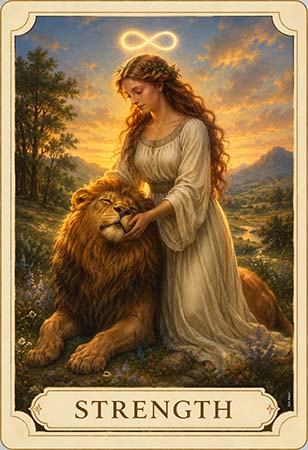
The Hierophant + Strength

Moral courage; gentle adherence to deeply held values.

Reversed: Internal conflict between instinct and conditioning.

The Hierophant + The Hermit

Spiritual teacher and spiritual seeker; mentorship or formal study.

Reversed: Breaking away from tradition to seek personal truth.

The Hierophant + Wheel of Fortune

Destined encounters with teachers or belief systems.

Reversed: Clinging to outdated doctrines during change.

The Hierophant + Justice

Ethical accountability; living in alignment with stated values.

Reversed: Hypocrisy; preaching principles not practiced.

The Hierophant + The Hanged Man

Spiritual surrender; re-evaluating long-held beliefs.

Reversed: Martyrdom rooted in rigid ideology.

The Hierophant + Death

Transformation of belief systems; shedding old doctrines.

Reversed: Fear of spiritual evolution; resisting theological change.

The Hierophant + Temperance

Balanced faith; integrating different traditions harmoniously.

Reversed: Spiritual confusion; incompatible belief blending.

The Hierophant + The Devil

Religious guilt; toxic conditioning; spiritual bondage.

Reversed: Breaking free from oppressive belief systems.

The Hierophant + The Tower

Collapse of institutional structures; crisis of faith.

Reversed: Quiet deconstruction of long-held doctrines.

The Hierophant + The Star

Renewed faith; spiritual hope; inspired teaching.

Reversed: Disillusionment with organized belief systems.

The Hierophant + The Moon

Hidden doctrines; subconscious conditioning; fear-based teachings.

Reversed: Seeing through illusion; questioning inherited fears.

The Hierophant + The Sun

Joyful faith; spiritual clarity; enlightened tradition.

Reversed: Childlike rebellion against structure without understanding.

The Hierophant + Judgment

Spiritual awakening; answering a higher calling within tradition.

Reversed: Rejecting external authority to follow inner calling.

The Hierophant + The World

Completion of a spiritual cycle; mastery within a tradition.

Reversed: Feeling confined by cultural or institutional identity.

The Influence of The Emperor Card

The Emperor in Tarot represents structure, authority, and the disciplined use of power. When paired with the other Major Arcana, his influence reveals how stability, order, and leadership shape every phase of life—from creative beginnings and relationships to transformation and mastery. This chart offers quick interpretations of The Emperor in combination with all 22 Major cards, including reversed meanings. Perfect for Tarot readers seeking deeper insight or a printable reference for their readings.

In the absence of a regular blog post for today, I’d like to offer a chart detailing the influence of The Emperor card when paired with the other cards of the Major Arcana. Please feel free to print this and use it for reference in your readings.

Or, if you’d prefer, you can download a PDF version here. Just click on the link and, when it comes up, go to your browser menu and select Print.

The Emperor + The Fool

Establishing order within spontaneity; bringing discipline to new beginnings.

Reversed: Rigidity crushes adventure; fear of chaos blocks growth.

The Emperor + The Magician

Structured willpower manifests results; mastery through disciplined focus.

Reversed: Control issues distort creativity; misuse of authority for personal gain.

The Emperor + The High Priestess

Balancing logic and intuition; wisdom gains form through structure.

Reversed: Repression of the intuitive or feminine; ignoring inner guidance.

The Emperor + The Empress

Perfect union of order and creativity; leadership joined with nurturing power.

Reversed: Domination smothers harmony; imbalance between authority and compassion.

The Emperor + The Hierophant

Law, tradition, and moral authority combine; social order strengthened.

Reversed: Dogmatism or oppressive systems; blind obedience replaces wisdom.

The Emperor + The Lovers

Commitment grounded in integrity; love stabilized through loyalty and structure.

Reversed: Control in relationships; emotional manipulation disguised as protection.

The Emperor + The Chariot

Directed ambition achieves victory; leadership in motion.

Reversed: Power struggle; lack of self-control undermines success.

The Emperor + Strength

Calm authority; inner strength expressed through steady leadership.

Reversed: Harshness; using force instead of gentle courage.

The Emperor + The Hermit

Solitary leadership; wisdom applied in governance or mentorship.

Reversed: Isolation through pride; refusal to listen to guidance.

The Emperor + Wheel of Fortune

Mastering change through stability; fate meets steady will.

Reversed: Resistance to life’s cycles; attempts to control the uncontrollable.

The Emperor + Justice

Fair authority; order maintained through truth and balance.

Reversed: Corruption, hypocrisy, or biased rulings; justice twisted by ego.

The Emperor + The Hanged Man

Surrendering control to gain new perspective; discipline through acceptance.

Reversed: Stubbornness; refusal to yield or adapt leads to downfall.

The Emperor + Death

Transformation of power structures; endings that lead to renewal.

Reversed: Fear of change; clinging to obsolete authority.

The Emperor + Temperance

Measured leadership; control balanced by moderation and patience.

Reversed: Extremism; misuse of authority through lack of balance.

The Emperor + The Devil

The darker side of control; domination and attachment to power.

Reversed: Breaking free from tyranny or self-imposed limitations.

The Emperor + The Tower

Collapse of rigid systems; false structures destroyed to rebuild truthfully.

Reversed: Denial delays the inevitable; abuse of power leads to ruin.

The Emperor + The Star

Hope finds structure; inspired vision made practical through planning.

Reversed: Cynicism and loss of faith; suppression of creative dreams.

The Emperor + The Moon

Authority guided (or confused) by emotion and illusion.

Reversed: Paranoia or manipulation; losing control through fear and fantasy.

The Emperor + The Sun

Confidence and vitality in leadership; stability brings joy and success.

Reversed: Arrogance; demanding recognition rather than earning respect.

The Emperor + Judgement

Accountability; renewal through responsibility and moral clarity.

Reversed: Refusal to own past actions; defensiveness when challenged.

The Emperor + The World

Achievement through mastery and structure; completion of a lasting legacy.

Reversed: Fear of letting go; rigidity blocks full integration.

“Just the Tarot,” by Dan Adair – A Kindle E-book available on Amazon

The Influence of The Empress Card

The Empress in Tarot embodies creativity, abundance, and nurturing energy. When paired with the other Major Arcana, her influence reveals how growth, harmony, and fertility play out in every area of life—from relationships and intuition to cycles of transformation. This chart offers quick interpretations of The Empress in combination with all 22 Major cards, including reversed meanings. Perfect for Tarot readers seeking deeper insights or printable reference material.

In the absence of a regular blog post for today, I would like to offer a chart detailing the influence of The Empress Tarot card when paired with the other cards of the Major Arcana. Please feel free to print this and use it for reference in your readings.

Or, if you’d prefer, you can download a PDF version here. Just click on the link and when it comes up, go to your browser menu and click on print.

The Empress + The Fool – Nurturing new beginnings. Creative innocence finds fertile ground.

Reversed: Overprotection stifles growth; immaturity in creativity.

The Empress + The Magician – Manifesting abundance through intention and artistry.

Reversed: Manipulating creativity; false appearances of growth.

The Empress + The High Priestess – Balance of intuition and creativity; inner wisdom flowering into expression.

Reversed: Repressed intuition blocks creativity; confusion in nurturing roles.

The Empress + The Emperor – Harmony between creation and structure; nurturing power within order.

Reversed: Domination suppresses creativity; imbalance between control and flow.

The Empress + The Hierophant – Sacred traditions inspire fertile creativity; nurturing spiritual communities.

Reversed: Stagnation within rigid traditions; blocked feminine wisdom.

The Empress + The Lovers – Love as a fertile union; creativity fueled by harmony and relationship.

Reversed: Codependency; love smothered rather than nurtured.

The Empress + The Chariot – Creative direction with determination; abundance set into motion.

Reversed: Lack of discipline wastes creative potential; scattered nurturing energy.

The Empress + Strength – Gentle power; nurturing builds resilience.

Reversed: Overindulgence weakens; misplaced compassion.

The Empress + The Hermit – Creativity drawn from solitude; nurturing wisdom within.

Reversed: Isolation stifles growth; withdrawal from fertile opportunities.

The Empress + Wheel of Fortune – Cycles of abundance; harvests following seasons of sowing.

Reversed: Bad luck in creativity; loss of balance in life’s rhythms.

The Empress + Justice – Fairness in nurturing roles; creativity guided by truth.

Reversed: Biased nurturing; injustice in relationships or creative endeavors.

The Empress + The Hanged Man – Creative surrender; new perspectives nurture growth.

Reversed: Stagnation, unwillingness to release control in nurturing.

The Empress + Death – Transformation gives birth to new creation; fertile endings.

Reversed: Resistance to endings; clinging smothers growth.

The Empress + Temperance – Harmony in creativity; nurturing balance and wholeness.

Reversed: Excess stifles balance; nurturing turns to enabling.

The Empress + The Devil – Passionate creativity; fertility bound to desire.

Reversed: Enslavement by overindulgence; blocked nurturing energy.

The Empress + The Tower – Creative breakthroughs; fertile destruction clearing ground for new growth.

Reversed: Suppression of necessary change; smothering collapse.

The Empress + The Star – Hope renewed through nurturing; creativity as healing.

Reversed: Disappointment in creative outcomes; blocked inspiration.

The Empress + The Moon – Intuitive creativity; fertile imagination guided by dreams.

Reversed: Illusion clouds nurturing; confusion in creative flow.

The Empress + The Sun – Joyful abundance; creativity flourishing in light.

Reversed: Overexposure or lack of clarity in nurturing roles.

The Empress + Judgment – Rebirth through nurturing; creativity aligned with higher calling.

Reversed: Misuse of nurturing power; denial of creative responsibility.

The Empress + The World – Completion of cycles; fulfillment through creation and nurture.

Reversed: Lack of closure; unfulfilled creative potential.

“Just the Tarot,” by Dan Adair – A kindle ebook available on Amazon