The Emperor and the Empress: Two Very Different Ways of Living

The Emperor seeks control, structure, and achievement. The Empress finds abundance through harmony, receptivity, and enjoyment of life. Discover what these two Tarot archetypes reveal about Western culture—and how balancing their energies can lead to a happier, more fulfilling life.

The Emperor and the Empress are obviously two of the paired cards in the Tarot, but they represent two very different kinds of energy.

In fact, I would maintain that they represent two fundamentally different ways of being in the world.

They aren’t simply personality traits or psychological tendencies. They represent two different philosophies about how life works, how we should approach it, and what we need to do to find happiness and abundance.

The Emperor believes that we create a good life by taking control of it. The Empress believes that we create a good life by learning to live in harmony with it.

And here’s where things get interesting: Western civilization has largely embraced the Emperor’s approach to life, while treating the Empress’s philosophy as something vaguely impractical.

But is the Emperor’s way necessarily the better one?

Forget the Genders

We probably shouldn’t even have to say this anymore, but when we talk about Empress energy and Emperor energy, we’re not talking about males versus females.

The Empress isn’t simply the feminine side of the Emperor, and the Emperor isn’t the Empress without breasts.

Every human being contains masculine and feminine qualities, yin and yang, testosterone and estrogen. If the Empress turns up in our Tarot reading, she may well represent a woman in our lives. Or she may represent a man with a great deal of yin energy.

And the Emperor can just as easily represent a woman who approaches life through discipline, structure, and control.

What we’re really talking about are two different orientations toward existence.

And whichever one predominates in our personality can profoundly influence how we experience the world.
Empress Energy: Living in Harmony With Life
As I wrote in my free ebook:

“The Empress wants abundance. She wants you to embrace the richness of life, nurture what you love, and allow your creativity to flourish.”

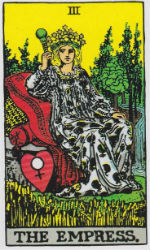
Take a good look at the Empress in the Rider-Waite-Smith Tarot.

She’s reclining comfortably on something resembling a luxurious settee rather than a formal throne. She holds a scepter of power, but she grips it loosely, almost as an afterthought.

She’s surrounded by lush vegetation, ripening wheat, and flowing water. Her shield bears the symbol of Venus, the planet traditionally associated with love, beauty, and pleasure.

There’s no palace, no fortress, and no indication that she’s particularly concerned about defending her territory.

She seems to be telling us, “I exist in the natural world, and the natural world is my palace and my riches.”

The Empress doesn’t need to conquer the world to enjoy its abundance.

She already belongs to it.

And that distinction is enormously important.

Emperor Energy: Creating Order From Chaos

Now let’s look at the Emperor.

As I wrote in that same ebook:

“The Emperor wants order. He wants you to take command of your life, establish a solid foundation, and create the structures necessary to achieve your goals.”

The Emperor presents a very different picture.

He’s an older man, dressed in armor, sitting on a massive stone throne. One assumes he has a rigid spine and a terrible case of hemorrhoids from sitting on that thing, but he’s definitely in command.

And look at his surroundings.

There are no lush gardens, no ripening fields, and no flowing streams. Behind him are barren mountains, hard and unyielding.

Where the Empress inhabits a living landscape, the Emperor occupies a landscape of stone.

His throne is decorated with rams’ heads, symbols of Aries, the astrological sign associated with Mars, initiative, and assertive action.

Everything about the card suggests strength, authority, discipline, and control.

The Emperor doesn’t simply accept the world as he finds it. He intends to shape it according to his will.

And that brings us to the essential difference between these two archetypes.

The Empress works with life. The Emperor works upon life.

Neither approach is inherently wrong, but they can produce radically different experiences of existence.

The Empress’s Way of Living

I don’t think it’s entirely coincidental that the Empress precedes the Emperor in the Tarot’s sequence of Major Arcana.

We might interpret her position as representing something more fundamental than the structures of civilization: our original relationship with the natural world.

Before we build cities, establish governments, create schedules, and invent five-year plans, we’re living creatures participating in a living universe.

And that’s the world of the Empress.

A person with a predominance of Empress energy tends to approach life with openness, receptivity, and trust.

Such a person may find abundance in a beautiful sunset, an affectionate friendship, a garden full of flowers, or the simple pleasure of sitting quietly with a cup of coffee.

Abundance isn’t necessarily measured in dollars and possessions. It’s measured in the richness of experience.

In many respects, this resembles the Taoist concept of wu wei, often translated as effortless action or non-forcing. Wu wei doesn’t mean sitting around doing nothing. It means acting in harmony with the natural movement of things rather than constantly struggling against them.

Think of a gardener.

The gardener doesn’t create the mysterious force that makes a seed germinate. He prepares the soil, plants the seed, provides water, and allows nature to do what nature does. He participates in the process without trying to dominate it.

That’s Empress energy.

She nurtures, encourages, and cultivates. And she trusts that life has its own creative intelligence.

The Emperor’s Way of Living

The Emperor, on the other hand, is what we’d call a take-charge sort of person.

He wants to organize, construct, regulate, and improve his environment.

He’d take one look at the Empress’s beautiful garden and immediately start drawing up plans.

“Okay, we obviously need a sprinkler system in here. I think the planter boxes should go over there, and the grass is getting a little overgrown. I’ll start weed-whacking right away.”

And before you know it, the Empress’s garden has become a landscaping project with a budget, a timetable, and a quarterly performance review.

Now, there’s nothing inherently wrong with any of that.

Without Emperor energy, we’d have a difficult time building houses, organizing communities, or accomplishing anything that requires sustained effort and planning.

The Emperor gives us structure. He establishes boundaries, creates systems, and provides the discipline necessary to turn ideas into practical realities.

But there’s a fundamental assumption underlying his approach to life. The world is something that needs to be managed.

Where the Empress sees a natural order in which she participates, the Emperor sees an environment that can be improved through deliberate intervention.

The Empress asks, “How can I live in harmony with what is?”

The Emperor asks, “How can I change what is into what I want it to be?”

And that distinction becomes particularly interesting when we look at the culture in which we live.

Western Civilization: The Emperor’s Kingdom

If you want to understand how thoroughly Emperor energy dominates Western culture, just listen to the language we use.

We’re constantly being told to take control of our lives, master our emotions, conquer our fears, overcome obstacles, and achieve our goals.

We talk about winning the battle against disease, fighting poverty, conquering nature, and dominating the competition.

Even our relationship with ourselves is frequently described in terms of struggle.

We need more self-discipline. More willpower. Better time management. Greater productivity. And if we’re not accomplishing enough, we’re probably not trying hard enough.

In other words, we need to become better Emperors.

From childhood onward, we’re encouraged to compete, achieve, accumulate, and demonstrate measurable success. Our schools reward performance. Our workplaces reward productivity. Our economic system rewards growth.

We even turn relaxation into something that needs to be scheduled and optimized.

There’s a certain absurdity in being told that we should practice mindfulness for twenty minutes every morning because scientific studies suggest it will make us more productive at work. Apparently, even inner peace needs to justify itself with a favorable return on investment.

Now, I’m not suggesting that Western civilization has produced nothing worthwhile.

Quite the contrary.

The Emperor’s capacity for planning, organization, and disciplined action has given us extraordinary achievements in science, medicine, engineering, and technology.

But every philosophy has its limitations. And when one particular approach to life becomes so dominant that we scarcely recognize the alternatives, we can lose something important.

We can forget how to simply be.

We can become so preoccupied with improving our lives that we forget to enjoy them. And we can become so determined to control our circumstances that we experience anything beyond our control as a personal failure.

Perhaps most importantly, we can begin to believe that abundance is something we must constantly struggle to obtain rather than something we can also discover in the world around us.

That’s where the Empress has something important to teach us.
The Problem With Too Much Empress Energy

Now, I have to admit that Empress energy appeals to me more than Emperor energy. Probably because I’m fairly lazy.

But the Empress has her shadow side, too.

Taken to an extreme, her receptivity can become passivity.

Her trust in the natural flow of life can become an excuse for avoiding responsibility. And her appreciation of the present moment can turn into a reluctance to make necessary changes.

We see this occasionally in the New Age movement.

Someone spends hours visualizing a beautiful new life, repeating affirmations, and attempting to raise their vibrations. And then they sit back and wait for the UPS driver to magically deliver whatever they’ve been manifesting.

Unfortunately, the universe doesn’t always operate on a home-delivery schedule.

Even the most beautiful garden needs someone to pull the weeds occasionally. The Empress’s wisdom lies in cooperating with life, not withdrawing from it.

And that’s where a healthy dose of Emperor energy becomes useful.

The Problem With Too Much Emperor Energy

The Emperor’s shadow is considerably more familiar to most of us.

When his desire for order becomes excessive, he turns controlling, rigid, and authoritarian.

Everything must happen according to his plan. Every problem must have a solution. Every situation must be managed.

And every person in his immediate environment is expected to cooperate.

His motto becomes “My way or the highway.” And sooner or later, his friends and family take the highway.

But there’s another, more subtle problem with excessive Emperor energy.

It creates the illusion that we can control far more of life than we actually can. We can make plans, establish goals, and work diligently toward achieving them.

But we can’t control the economy, the weather, other people’s decisions, or the countless unpredictable events that shape our lives.

And the more tightly we cling to the illusion of control, the more anxious and frustrated we become when reality refuses to cooperate.

The Emperor’s greatest strength—his ability to impose order—can become his greatest weakness when he forgets that not everything needs to be controlled.

Sometimes the most intelligent thing we can do is stop pushing.

Finding the Balance

As usual, the answer seems to lie somewhere between the two extremes.

We need the Emperor’s ability to plan, organize, and act decisively. But we also need the Empress’s ability to relax, appreciate, nurture, and trust.

The Emperor can help us plant a garden.

The Empress reminds us to sit in it occasionally and enjoy the flowers.

And perhaps that’s the real secret to balancing these two archetypes.

Use the Emperor to create the conditions for a good life. Use the Empress to actually experience that life.

Make your plans, but don’t keep a daily organizer under your pillow. Work toward your goals, but don’t become so obsessed with the future that you overlook the present.

And recognize that sometimes the most productive thing you can do is absolutely nothing.

There’s an interesting principle frequently encountered in visualization and manifestation practices: the more we appreciate what we already have, the more receptive we become to experiencing abundance.

Whether we interpret that metaphysically or psychologically, there’s something valuable in the idea. Gratitude shifts our attention away from what is missing and toward what is already present.

And that shift can profoundly change our experience of life.

To put it in very simple terms, if the Universe gives you a gift and you don’t say thank you, don’t expect to get more presents.

Perhaps We Need a Little More Empress

I suspect that one of the great challenges of modern Western life is that we’ve become so thoroughly conditioned by Emperor energy that we scarcely recognize how much of our behavior it governs.

We measure our worth by what we accomplish. We measure success by what we accumulate. And we measure the quality of our lives by how closely reality conforms to our expectations.

But the Empress offers a radically different possibility.

What if life isn’t primarily a problem to be solved?

What if the natural world isn’t simply a collection of resources to be managed?

And what if happiness isn’t something waiting for us at the end of a long series of accomplishments? What if it’s something we can experience right now?

The Emperor will always have an important place in our lives. We need his discipline, his courage, and his capacity to turn dreams into reality.

But perhaps we’ve allowed him to occupy the throne for a little too long. Perhaps it’s time to invite the Empress back into the kingdom.

After all, the Emperor may know how to build a magnificent palace.

But the Empress knows how to make it a place worth living in.
The Emperor: Sacred Structure and the Protection of Creativity

A look at the roles of Yin and Yang energies in the process of creativity.

The Emperor and the Empress are obviously paired cards—one female and the other male. But if we stop at gender, we miss their deeper meaning entirely.

On a more profound level, they represent the Yin and Yang energies that exist within every human being.

Every woman has testosterone in her body. Every man has estrogen. Wholeness comes not from exaggerating one pole and suppressing the other, but from integrating both. Strength and compassion. Power and vulnerability. Fierceness and tenderness.

This is what the ancient Yin–Yang symbol illustrates so elegantly: Yin contains Yang, and Yang contains Yin.

When these energies are balanced, they produce whole, grounded human beings. When they are separated and exaggerated, they produce caricatures.

That’s where we find emotionally stunted men obsessed with dominance and control. That’s where we find people who abdicate their agency entirely and wait for someone else to take care of their lives.

Me Tarzan. You Jane.

Man strong. Woman weak.

This is not balance. This is Yang attempting to overwhelm Yin. But Yin and Yang are not enemies. They are partners.

Creation requires both.

The Peculiar Paradox of Yin Energy

Modern culture often assumes that Yang energy—the active, assertive, masculine principle—is the true creative force, while Yin energy is passive or secondary.

Nature shows us exactly the opposite.

Consider procreation. A man’s biological contribution to the creation of a child may take minutes. But the woman’s body then undertakes nine months of continuous creation—growing, forming, and sustaining new life from her own substance.

She gives birth. She nourishes the infant. She does the creating.

THE YIN ENERGY DOES 99% OF THE WORK OF CREATION.

This pattern appears everywhere.

The receptive, Yin principle is not inert. It is generative. It is the matrix from which life emerges.

The Kybalion expresses this clearly: the feminine principle does the creative work. The masculine principle directs and structures it.

Without Yin, nothing would exist.

⸻

The Artist and the Subconscious

We see this same pattern in the creative process.

When we imagine an artist, we picture someone standing at an easel, brush in hand, actively painting.

But the visible act of painting is only the final stage.

Long before the brush touches the canvas, the image has already been forming in the artist’s subconscious mind. It grows invisibly. It gestates. It organizes itself.

We call this “inspiration,” as if it appeared suddenly.

But inspiration is the flowering of something that has been developing quietly within.

The conscious mind—the Yang principle—provides skill, technique, discipline, and execution. But the image itself emerges from the Yin subconscious.

Again, the receptive principle does the creative work.

⸻

The Function of the Emperor

Does this mean the Emperor—the Yang principle—is unnecessary?

Not at all.

The Emperor is essential.

The Empress creates. The Emperor protects and stabilizes what she creates.

Consider the garden.

The Empress is the lush, living growth. She is the fertile soil, the green leaves, the flowing water. She is life itself.

But without structure, the garden cannot reach its full potential.

The Emperor builds the raised beds. He enriches the soil. He installs irrigation. He builds the fence to keep the deer out.

He does not create the life. He ensures its survival. The Emperor provides continuity. He creates the conditions under which life can flourish and endure.

⸻

The Emperor Is Always Grounded in the Empress

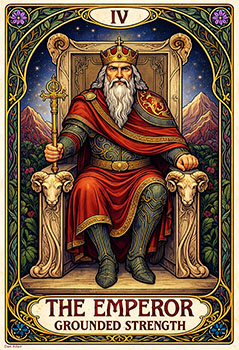
In my own Emperor affirmation card, I made a subtle but important change. The Emperor still sits on his stone throne, armored and immovable.

But I surrounded him with life.

Emperor Affirmation Poster – available on Etsy

Because the Emperor does not exist independently of the Empress. He exists to protect her. He exists to serve creation. Within each of us, the Emperor is the part that creates structure for our creative and emotional lives.

If you are an artist, your Emperor sets up your studio, organizes your materials, and protects your time.

If you are a writer, your Emperor establishes the discipline to write regularly and brings your work into the world.

If you are in a relationship, your Emperor establishes boundaries that protect emotional safety and mutual respect.

The Emperor does not suppress the Empress.

He protects her so she can fully express herself.

When the Emperor Is Separated from the Empress

When the Emperor loses his connection to the Empress, he becomes distorted.

His structure serves nothing. His authority protects nothing.

He becomes the petty tyrant. The rigid bureaucrat. The hollow authoritarian. His armor is empty. He enforces rules not to protect life, but to compensate for his own inner disconnection.

True authority does not arise from domination. It arises from service to life.

The Emperor’s true purpose is not control. It is protection. He is the guardian of the garden. He is the structure that allows creativity to endure.

He is sovereignty in service of life itself.

When we see beyond the illusion of gender, the deeper purpose of these archetypes becomes clear. The Empress and the Emperor are not separate beings, but complementary forces within each of us. One creates. The other protects what has been created. One generates life from the invisible depths. The other builds the structure that allows that life to endure. 

Our true purpose is not to choose between them, but to embody both—to allow our inner Empress to bring forth creativity, love, and vision, and to allow our inner Emperor to establish the boundaries, discipline, and stability that allow those creations to survive and flourish in the world. When these two forces work in harmony, we cease to live reactively and begin to live sovereignly, shaping a life that is both fertile and enduring.

The Empress and the Courage to Be “Unproductive”

The Empress Archetype and Relaxation as a Way to Nurture Creativity.

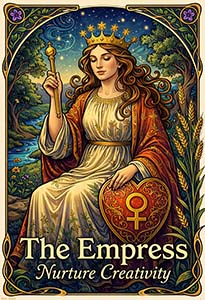
In my Empress affirmation poster, I paired her image with the words:

Nurture Creativity

This may be one of the most misunderstood instructions in the entire Tarot.

  Empress Affirmation Poster – Available on Etsy

Because most of us have been trained to believe that creativity comes from effort. From discipline. From pushing harder. From sitting at the desk and refusing to get up until something happens.

That approach belongs to The Emperor.

The Empress operates differently.

She does not force growth.

She allows it.

She creates the conditions in which growth becomes inevitable.

Creativity Cannot Be Forced

Every creative person eventually encounters this paradox.

The harder you try to force creativity, the more it retreats.

You sit at your desk, determined to produce something brilliant. Hours pass. Nothing happens. Your mind feels like dry soil.

And then, days later—while taking a walk, washing dishes, or doing something completely unrelated—an idea appears effortlessly.

It arrives whole.

Not constructed, but received.

Albert Einstein understood this phenomenon. When asked how he discovered the theory of relativity, he didn’t describe grinding intellectual labor. He said simply:

“It just dropped in while I was playing the piano.”

He wasn’t forcing the insight.

He was allowing it.

This is Empress energy.

The Forgotten Value of Leisure

The philosopher Josef Pieper wrote a remarkable book titled Leisure as the Basis of Culture. In it, he argues that leisure is not the absence of productivity, but its foundation.

Leisure, in its true sense, is not laziness in the modern, pejorative sense. It is a state of receptive openness.

It is the willingness to stop forcing.

Pieper observed that culture itself—art, philosophy, music, science—arises not from frantic effort, but from spaces of inward stillness.

When we allow ourselves to be idle, something deeper begins to move.

The soil replenishes itself.

Modern society often treats leisure as wasteful. We are taught that our worth is tied to constant activity. But creativity obeys older, quieter laws.

Seeds do not grow faster because you stare at them.

They grow because the conditions are right.

“Just the Tarot,” by Dan Adair – available on Amazon

Julia Cameron and the Act of Creative Nurturing

Julia Cameron’s The Artist’s Way remains one of the most practical and psychologically accurate guides to creativity ever written.

Her central insight is simple: creativity must be nurtured.

Not commanded.

She encourages practices like morning pages and artist dates—not to produce finished work, but to create space for the creative self to emerge naturally.

These practices are Empress practices.

They say to the creative mind:

You are safe here.

You are allowed to emerge in your own time.

And when that safety is present, creativity begins to flow again.

The Courage to Be “Lazy”

This is perhaps the most radical lesson of The Empress.

You must allow yourself to be, at times, unproductive.

Not because you are weak.

But because you are cultivating fertility.

What appears to be inactivity is often incubation.

Beneath the surface, ideas are forming. Connections are being made. Your subconscious is doing its work.

If you constantly demand output, you exhaust the system that produces it.

The Empress reminds us that rest is not the opposite of creation.

It is part of creation.

Nurture Creativity

The Empress does not shout. She does not command. She invites.

She reminds us that creativity is not a machine, but a living process.

It responds to kindness.

It responds to patience.

It responds to nourishment.

When you stop trying to force creativity and begin nurturing it instead, something remarkable happens.

Ideas begin to arrive again.

Quietly.

Effortlessly.

Like seeds finding their way toward the light.

So when The Empress appears in your readings—or quietly makes herself known in your life—it is not a signal to push harder. It is an invitation to soften. She asks you to step out of the mentality of force and into the rhythm of cultivation. To rest without guilt. To follow your curiosity. To trust that creativity, like all living things, emerges when it is nourished rather than commanded.

 She reminds you that you are not a machine designed for constant output, but a garden capable of extraordinary growth. Your task is not to force the flowers to bloom, but to tend the soil and allow them to emerge in their own time.

The Magician — Become Your Magic

Integrating the Magician archetype into our lives.

It’s a foundational premise of the Tarot that we are all our own Magicians.

We create our lives through imagination, intention, will, and attention. The tools are already on the table. The energy is already within us. We shouldn’t need gurus, occult masters, or spiritual middlemen to “activate” anything for us — because our creative power is our birthright.

So why do so many of us wander in circles?

Why do we feel disconnected from our own magic?

Why do we feel driven by outside forces instead of guided by our internal compass?

If we want to fully integrate the Magician archetype into our lives, it may help to examine what the Magician is not.

Because sometimes clarity comes from contrast.

The Magician Isn’t Self-Doubt Disguised as Humility

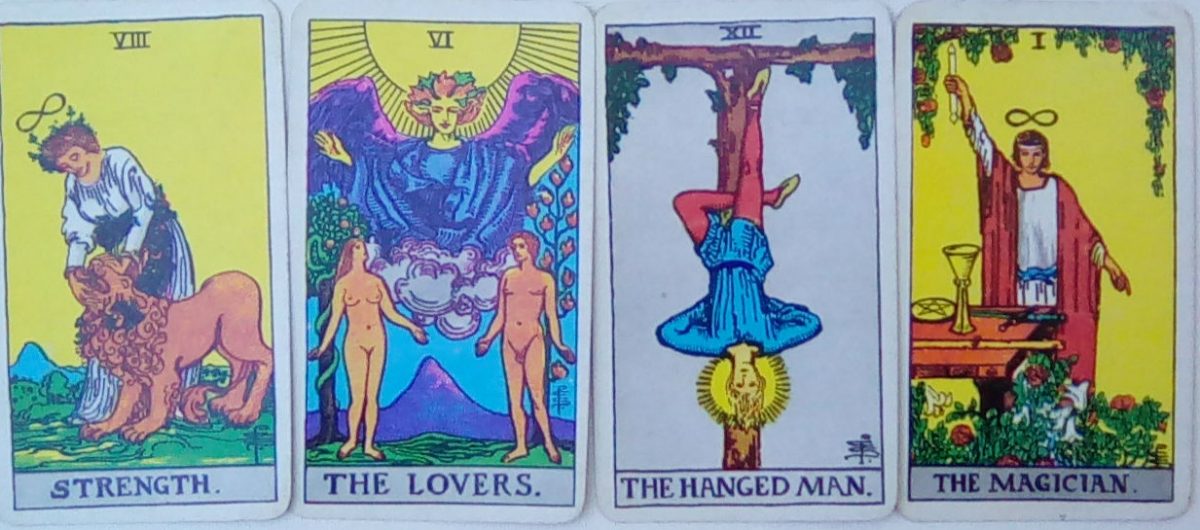
When we look at the traditional Magician card, we see the tools laid out clearly: the cup, the sword, the pentacle, and the wand. Nothing is missing.

The problem is not a lack of tools. The problem is the refusal to pick them up.

How many books go unwritten because someone thinks, “Who am I to write a book?”

How many paintings never see the light of day because someone thinks, “I didn’t go to art school.”

Self-doubt often masquerades as humility. It sounds modest. It sounds careful. It even sounds wise.

But it’s usually fear.

The Magician does not deny his gifts. He uses them.

Every one of us has talents, perspectives, experiences, and insights that no one else on the planet possesses in exactly the same configuration. The moment we stop apologizing for that uniqueness and begin using it, we step into our magic.

“Just the Tarot,” by Dan Adair – available on Amazon

The Magician Isn’t Scattered Energy

The Magician is focused intention.

One hand points to heaven. One hand points to earth. Energy flows through him with direction and clarity.

This doesn’t mean we can’t have many interests. It means we choose what matters most right now — and we concentrate.

If you want to be a writer, write daily.

If you want to open a nursery, start gathering pots and soil.

If you want to transform your life, choose one consistent action and repeat it.

Scattered energy feels busy. Focused energy creates results.

The Magician understands hierarchy. He knows what matters today — and he pours his will into that.

The Magician Isn’t Manipulation

The Magician archetype is often misunderstood as charm, persuasion, or cleverness.

But true magic isn’t about bending others to your will.

Manipulation says, “I can’t do this on my own, so I need to control the room.”

The authentic Magician says, “I am aligned. I will act. And the world will respond accordingly.”

There’s a profound difference between influence and integrity.

The Magician’s power comes from alignment — not trickery.

The Magician Isn’t Performance Instead of Authenticity

There are two kinds of magicians in the world: the illusionist and the integrated.

The stage magician dazzles. Distracts. Redirects attention. Pulls rabbits from hats.

The integrated Magician is quieter.

He doesn’t need to perform spirituality. He doesn’t need to announce his power. He doesn’t need to posture as enlightened.

He simply acts in alignment with who he is.

In our modern world, it’s easy to confuse visibility with mastery. A quick scroll through social media will reveal countless self-proclaimed “masters” selling certainty.

The true Magician doesn’t need the spotlight.

His magic works because it is authentic.

The Magician Isn’t Unintegrated Knowledge

There’s an old Sufi saying: You can load a donkey down with holy books, but it won’t make him wise.

The same applies to spiritual study.

You can memorize Tarot definitions, chakra systems, Hermetic principles, and mystical philosophies. But until those teachings become embodied, they remain decoration.

The Magician integrates.

He doesn’t just study the tools — he uses them.

He doesn’t just read about transformation — he practices it.

He doesn’t just speak about power — he becomes it.

Knowledge becomes magic when it moves from concept to action.

Become Your Magic

So what is The Magician, then?

He is integration.

He is the moment you realize the tools have been there all along.

He is the decision to stop waiting for permission.

He is the willingness to focus your energy.

He is the courage to act authentically.

He is the discipline to practice what you claim to believe.

The wand raised to heaven and the hand pointing to earth symbolize alignment — vision grounded in action. Inspiration translated into reality.

When we stop outsourcing our power — to gurus, critics, algorithms, trends, or fear — we begin to feel that alignment inside ourselves.

We stop asking, “Who am I to do this?”

And we begin asking, “Why not me?”

The real magic was never in the costume.

It was in the willingness to use what you already possess.

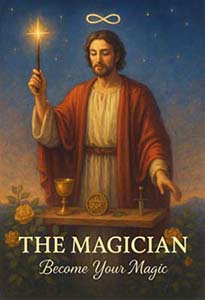
That’s why my affirmation for this card is:

Become Your Magic.

Magician Affirmation Poster – available on Etsy

Not find it.

Not earn it.

Not prove it.

Become it.

Because the tools are already on the table.

The only question left is:

Will you pick them up?