The Hermit and the Light No One Was Meant to See

Exploring the nature of solitude as exemplified in The Hermit card.

Why do we let our lights shine?

There’s an old country and western song that proclaims, “You can’t be a beacon if your light don’t shine.”

But suppose you don’t want to be a beacon? Should your light still shine?

The Hermit is one of the most interesting paradoxes of the Tarot.

We see an old man standing alone on a mountain peak, holding a lantern high above his head so that its light shines into the darkness.

Only…

There’s nobody there.

The number of people who are actually seeing his light appears to be exactly zero.

That tiny detail invites us to question one of the most common interpretations of the card.

Most Tarot books tell us that The Hermit has withdrawn from society, gained wisdom through solitude, and is now returning to share that wisdom with humanity.

It’s a beautiful story.

The problem is that the card itself never tells us that story.

There is no path leading back to civilization. There is no village waiting below. There are no followers gathering around him. The image simply shows a solitary man standing quietly on a mountain, holding up a lamp.

Perhaps another wanderer on a distant peak catches sight of it. Maybe a passing Yeti looked over and wondered, “I wonder what that old dude is up to?”

Perhaps no one sees it.

The picture doesn’t seem very concerned with the audience.

The Hermit – 13 X 19 inch poster by Dan Adair – Available on Etsy

The Hero’s Journey

The traditional interpretation may come from one of humanity’s oldest myths.

The hero enters the wilderness, gains wisdom, and returns transformed.

Jesus withdraws into the desert.

The Buddha leaves the palace before awakening beneath the Bodhi tree.

The knights search for the Holy Grail.

Frodo returns to the Shire.

We’re so accustomed to this pattern that we naturally assume The Hermit must be following it as well.

Surely no one would choose to live alone forever.

Surely solitude is only a temporary stage before returning to the world.

But is that really what we’re looking at?

The Nature of the Hermit

In an earlier post, I suggested that there are many expressions of the Hermit archetype.

Some people withdraw because life has wounded them. They need silence to heal. Eventually, they return.

Others retreat for a season to study, write, pray, or rediscover themselves.

But the true Hermit is something different.

Solitude isn’t a strategy.

It isn’t therapy.

It isn’t preparation for the next chapter.

It is simply his nature.

He isn’t hiding from humanity.

He isn’t waiting for humanity.

He’s exactly where he belongs.

If he retreats only so that he can eventually come back and teach everyone else, then he isn’t really a Hermit at all. He’s simply taking a very long vacation.

The Hermit in the Tarot doesn’t appear to be preparing for a return.

He simply stands on his mountain with his lamp.

The Lamp

So why hold the lantern aloft?

If it isn’t meant to illuminate the world, what is it illuminating?

Perhaps the answer is beautifully simple.

The Hermit is illuminating himself.

That is the real purpose of his solitude.

Away from the endless noise of civilization, he can finally hear his own thoughts.

He can meditate.

He can write.

He can ask the deepest questions without someone else’s voice rushing in to answer them.

He is discovering who he really is.

John Muir captured that spirit perfectly when he wrote:

“I’d rather be in the mountains thinking about God than in church thinking about the mountains.”

The Hermit’s mountain is not an escape from life.

It is the place where life finally becomes quiet enough to hear.

The Gift of the Hermit

Ironically, people who truly become themselves often end up helping others without ever intending to.

Someone may see the light from that distant mountain and find hope.

Someone may read the Hermit’s journal centuries later.

Someone may simply be inspired by knowing that another human being lived authentically.

But that isn’t why the Hermit holds the lamp.

Helping others is a beautiful consequence.

It is not the purpose.

The purpose is to live honestly.

To know yourself.

To become the person you were created to be, even if no one is watching.

Perhaps that’s the greatest lesson of The Hermit.

Not every light is meant to attract a crowd.

Some lights exist simply because they are true.
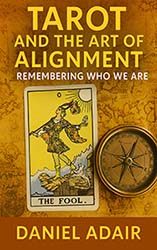
Available on Etsy as a downloadable PDF book

Temperance in the Tarot

The meaning of the Temperance card in the Tarot, including definitions for both the upright and reverse positions.

temperance

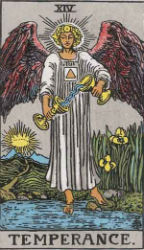
An angel stands on the edge of a placid body of water, one foot on the ground and one foot in the water.  She holds a chalice in each hand and is pouring water from one into the other. A shining solar disk is on her forehead and a triangle is emblazoned upon her chest.  A road runs off into the distance where a crown glows like the sun just beyond a range of mountains.

Upright: This is one of those cards that’s always sweet to find in your reading.  It basically means nothing’s wrong and everything’s right. You’re in the flow and life is good.

This card often appears after the questioner has gone through a difficult phase in life and has earned a period of peace through his or her hard work.  It may indicate tranquility in life in general or in specific areas of life such as relationships, work, or home. Look at the surrounding cards for clues.

Above all else, this card talks about balance and peace.  Psychologists interpret water as representing emotions in dreams.  The angel has one foot in the water and one foot on land, indicating that she can fully indulge in emotions while staying well grounded.

This is not a card of gain, per se.  The water being poured from one cup to the other is not increasing, it stays the same.  The message is that the questioner has enough just as it is.

Reversed – This may indicate a period of intemperance of some sort.  It could be drinking too much, partying too much, working too much, even worrying too much.  The key here is to carve out a little time for peaceful reflection and rest. Do some yoga or tai chi.  Curl up with a book. Take a bubble bath. Chill.

If you have questions about this card or its meaning in one of your readings, please don’t hesitate to leave a comment.  I’ll get back to you as soon as I can.

A Few Extra Thoughts About Temperance

Temperance is one of the most under-defined cards in the Major Arcana, so it can be kind of fun to look at.  The standard quickie definition is that it stands for moderation which is probably true on a certain level since the card was, indeed, originally named, “Moderation.”

So, if a questioner draws the Temperance card you can just say, “Well, it looks like this is a period of moderation and balance in your life.”  If it’s reversed you can just say, “You’re really drinking like a swine, you sot.”

Just kidding.  

“You may be overdoing your recreational libations a tiny bit.”  There, that’s better.

Aleister Crowley named this card, “Art,” in his Thoth Tarot deck.  A trifle puzzling until you realize that he was referring to the art of alchemy.  And there is strong symbolism in the card showing the mixing of two different elements in the two chalices just as the alchemists did in their rituals and experiments.

Arthur E. Waite flipped off into some weird place with his definition, stating:  “All of the conventional symbols are renounced herein . . . So also are the conventional meanings.”

Okay . . .  I’m guessing they didn’t know that the hell to make of it, either.

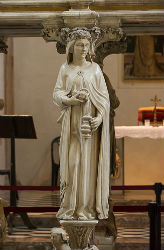
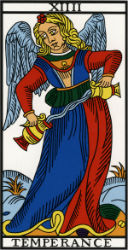
This particular image – a woman pouring water from one jug to another – was actually all over Europe prior to the first recorded publication of the Tarot.

temperance2

That might be expected since Temperance is one of the four cardinal virtues of the catholic church.  The usual take on it is that the woman is mixing water with wine, thus diluting the effects of alcohol and showing temperance.

But then the Tarot – as usual – does something a little weird with the image.  The woman is converted into an angel, even in the very early decks. Why?

temperance3

My theory – and it’s only a theory – is that the card may refer to another meaning of the word, “temperance.”  As in, “to temper.”

If you want to make a metal harder or more flexible you add other metals to it when it’s in a molten state to change the composition of the material.  You take it’s basic nature and you add something that changes it but builds on that basic nature without destroying it.

This card might very well refer to the adding of a, “divine element,” to basic human nature.

We’ve all seen the, “ancient aliens,” shows where they expound on the fact that something radical happened at one point in our species history.  We share so many of the characteristics of our simian cousins that the link between us and the apes is undeniable. Yet, somehow, sometime, somewhere, something happened that caused us to be entirely different is so many ways.  We developed agriculture, art, philosophy, science, religions, etc., etc., etc.

The ancient aliens take on it is that some higher species flew down in their space gizmos and fiddled around with our basic DNA to manipulate us into a more advanced  species. Just exactly WHY they did that isn’t quite clear. Maybe they were on a picnic and they were bored.

An equally unprovable theory (which I happen to like better) is that human souls began incarnating in simian bodies and that the DNA changed over time to match the souls.  Thus the angel mixing up a fresh brew of whatever is in those two chalices, literally adding a, “divine spark,” to the body of an ape.

Dr. Candace Perk demonstrated that our brains manufacture neuropeptides that match our emotional states and that these bond with receptor cells throughout the body.  Without going into too many boring details our emotions literally manufacture our bodies cells and that recurs about every 2 months.

So why couldn’t a Higher Soul in a simian body literally remanufacture it?

It’s an intriguing question.  I’d always looked at the road in the background of this card as leading AWAY from the angel and the distant crown as a goal to be achieved through the practice of moderation.  But maybe that’s the road that the angel just walked down, from the divine . . . to us.

Sound too weird to be true?  Hey . . . Donald Trump is the President of the United States.  All weirdness is now on the table.

Just the Tarot by Dan Adair, a kindle ebook available on Amazon