I think it’s fair to assume that many Tarot readers are also empaths, to one degree or another. After all, as I explained in my free ebook, What the Tarot Cards Want, each Tarot card represents a particular type of energy that’s present in a person’s life. And who better to recognize and interpret energy than an empath?
The internet is, of course, overflowing with videos, articles, and books about being an empath and how to deal with it. I’ve watched quite a few of those videos and read a number of the books, and it seems to me that most of the material boils down to two main points.
First, there’s the personal revelation: My life was a mess before I realized I was an empath. I never felt like I fit in, I was overwhelmed by other people’s emotions, and I sometimes wondered if there was something wrong with me. Now I understand that I’m not crazy. I’m just an empath.
Second, there’s the spiritual revelation: Empaths are here for a special purpose. We have gifts that are needed during this period of human transformation, and we’re supposed to be doing something to help raise the consciousness of humanity and make life better here on the earth plane.
And then, unfortunately, we seem to run into a blank wall.
As empaths, we may genuinely want to participate in making life better for others. Of course we do! But exactly how are we supposed to accomplish that?
Some of the advice is certainly useful. Build strong boundaries so that you know where other people’s emotions end and yours begin. Stay centered and grounded. Learn how to clear your energy field. Recognize that you don’t have to absorb someone else’s suffering in order to understand it.
All excellent suggestions.
But beyond that, much of the advice seems to suggest that we’re simply supposed to hang out and be . . . um . . . empath-ey.
Empathish.
Super-duper empathetic.
And somehow, through the mysterious workings of the universe, our mere presence will contribute to the spiritual evolution of humanity.
Well, maybe. But I suspect there’s a little more to it than that.
Which brings us to a much more interesting question:
How do I actually use my empathic abilities in ways that will help other people? What am I supposed to be doing with this gift?
And that’s the question that inspired me to create a new Tarot spread.
THE EMPATH’S CALLING SPREAD
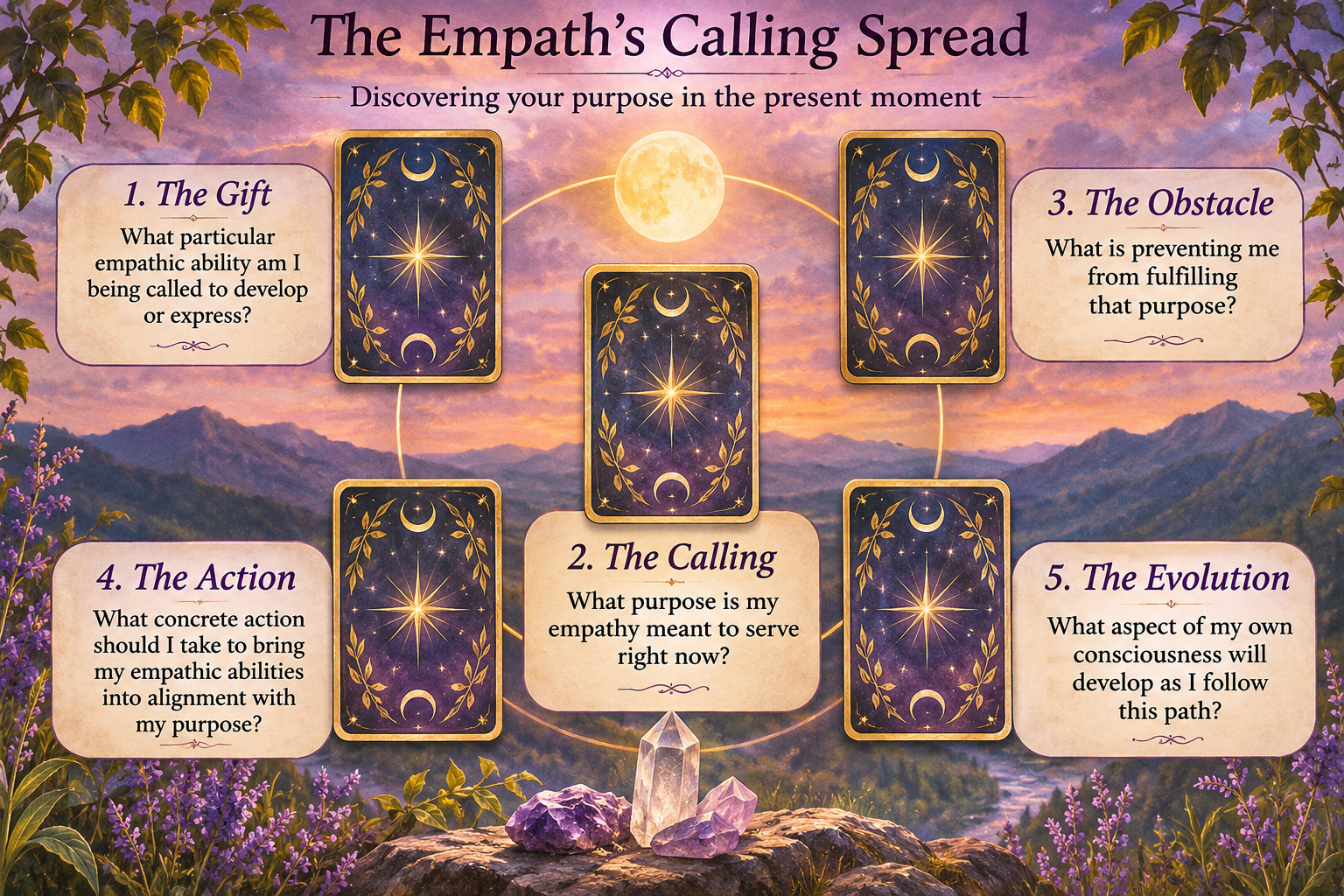
The Empath’s Calling Spread is a simple five-card Tarot reading designed to help us discover what, exactly, we’re being called to work on at this particular moment in our lives.
Rather than attempting to reveal some grand cosmic destiny, the spread focuses on the present. What abilities are asking to be developed? What obstacles are standing in the way? And, most importantly, what practical steps can we take to bring our empathic abilities into alignment with a meaningful purpose?
(To get a free, downloadable copy of the Empath’s Calling Spread, click here and then save the image.)
Card 1 — The Gift
What particular empathic ability am I being called to develop or express?
Not all empaths function in the same way. Some are natural healers, while others are gifted listeners, artists, teachers, or intuitive observers. Some have an extraordinary ability to recognize emotional patterns, while others seem to understand what people need before those needs have even been expressed.
This card identifies the particular quality or ability that is asking for expression in your life right now.
Card 2 — The Calling
What purpose is my empathy meant to serve right now?
This is the central card of the reading.
Rather than asking about some grand spiritual mission that might unfold over the next twenty years, we’re looking for the immediate direction in which your sensitivity can make a meaningful contribution.
Where is your empathy needed? What kind of contribution are you being called to make at this stage of your development?
Card 3 — The Obstacle
What is preventing me from fulfilling that purpose?
Sometimes the greatest obstacle to using our empathic abilities is the way we experience those abilities ourselves.
This card might reveal emotional overwhelm, poor boundaries, self-doubt, misplaced responsibility for other people’s happiness, or even a fundamental misunderstanding of what empathy actually requires.
It may also reveal an old belief or emotional pattern that needs to be addressed before we can move forward.
Card 4 — The Action
What concrete action should I take to bring my empathic abilities into alignment with my purpose?
This is where the reading becomes practical.
We’re not looking for an abstract spiritual aspiration or a vague suggestion to raise our vibrations. We’re looking for something we can actually do.
Perhaps it’s developing a particular skill, establishing healthier boundaries, beginning a creative project, or learning how to listen without taking responsibility for someone else’s suffering.
Whatever the answer, this card points toward action rather than passive contemplation.
Card 5 — The Evolution
What aspect of my own consciousness will develop as I follow this path?
This final card brings the reading back to our own spiritual development.
What will we learn about ourselves as we begin using our empathic abilities more consciously? What inner quality will strengthen? What old limitation might we transcend?
The underlying idea is that helping others and developing ourselves are not necessarily separate activities. When empathy is expressed in a healthy, conscious way, both can happen simultaneously.
THE UNDERLYING PHILOSOPHY
There’s an important distinction built into this spread:
An empath’s purpose may not be to feel more, but to learn how to use what they feel.
Consider an empath who unconsciously absorbs the suffering of everyone around them. That person may believe that being overwhelmed by other people’s emotions is simply the price of being sensitive.
But what good does it do to absorb another person’s suffering if the only result is that now two people are suffering instead of one?
Perhaps that empath’s real calling is to develop discernment: to recognize another person’s pain, understand it, and respond compassionately without taking it on as their own.
Another empath might discover that their gift is the ability to translate emotional understanding into art, writing, music, or teaching.
Still another might discover that their immediate spiritual assignment is simply to establish healthy boundaries and learn to say no.
That last possibility is especially interesting because it challenges the assumption that spiritual service always means giving more of ourselves.
Sometimes the most important thing we can do is learn to stop giving ourselves away.
You’ll also notice that I deliberately avoided including a card that asks, “Whom am I supposed to help?”
That question can easily reinforce the idea that an empath exists primarily to serve other people’s needs. It can encourage the very patterns of self-sacrifice, emotional exhaustion, and misplaced responsibility that so many empaths struggle with in the first place.
Instead, the spread asks us to develop our own abilities, discover our own direction, and take responsibility for our own spiritual evolution.
And that brings me to something rather interesting that happened when I tried the spread myself.
IT STARTS WITH WORKING ON YOURSELF
When I did my own Empath’s Calling reading, I was surprised to discover that most of the cards were concerned with working on myself rather than learning how to interact with other people.
The King of Cups Reversed, for example, emphasized the need to develop greater emotional balance and mastery. Rather than being carried along by emotional currents, I needed to learn how to remain centered within them.
The Two of Cups Reversed pointed toward another important lesson: self-love. It suggested that the emotional understanding and compassion I might readily extend to other people needed to be directed inward as well.
And the Eight of Pentacles reminded me that becoming a healthy, effective empath is a practice. It’s something that requires patience, attention, and the willingness to develop our abilities through conscious effort.
In other words, the cards weren’t telling me to rush out and save the world.
They were telling me to get my own house in order first.
And I found that rather refreshing.
Your reading will probably be quite different from mine because we’re all at different places in our development, with different abilities, experiences, and challenges.
Nevertheless, I suspect that many readings will return to a similar underlying question:
How do we, as empaths, learn to care for our own emotional and spiritual well-being so that we can move out into the world as a positive, healing presence?
FROM SENSITIVITY TO CONSCIOUS ACTION
Too often, discussions about being an empath focus almost exclusively on how the world affects us.
How do other people’s emotions influence our moods? How do we protect ourselves from negative energy? How do we avoid becoming overwhelmed by the suffering, anger, and anxiety of the people around us?
Those are legitimate questions, and learning to manage our sensitivity is certainly important.
But they represent only one side of the equation.
The other side is considerably more empowering.
Instead of asking only how the world affects us, we can begin asking how we want to affect the world.
We can learn to move beyond simply experiencing empathy and begin expressing it consciously, creatively, and constructively.
We can stop thinking of our sensitivity as something that merely happens to us and begin recognizing it as an ability we can develop, refine, and direct.
And perhaps that’s where the real spiritual calling of an empath begins.
Not in feeling everyone else’s pain. Not in sacrificing ourselves for the sake of others. And certainly not in waiting around for the universe to reveal some magnificent cosmic mission.
But in the quieter, more deliberate work of becoming emotionally balanced, spiritually grounded, and conscious of how we use our gifts.
Because ultimately, the goal isn’t simply to be an empath. It’s to become a healthy, conscious, and effective one.
And the Empath’s Calling Spread is one way to begin that journey.