Why Do I Keep Getting the Same Tarot Card Over and Over?

Why does the same Tarot card keep appearing in your readings? A repeating card may point to stuck energy, an important person in your life, or something you haven’t been willing to see. Learn why Tarot sometimes repeats itself—and what that persistent card may be asking you to notice.

One of the spookier things that can happen to a new Tarot reader is getting the same card over and over again.

No matter how many readings you do, there it is. It may drift around to different positions in the spread. It may appear as an answer to completely different questions. You shuffle thoroughly, cut the deck, and perhaps even put the cards away for a few days.

And then you do another reading. There it is again.

It can begin to feel as though the card is glued to your aura.

Oddly enough, this can also be one of the most reassuring experiences in Tarot. There are 78 cards in a standard deck, so when one particular card begins appearing with remarkable persistence, it certainly gets your attention.

So what does it mean?

In my experience, there are three basic reasons a Tarot card may keep appearing:

1. Stuck energy — something in your life isn’t changing.

2. A particular person — someone important is being represented by the card.

3. Something you aren’t acknowledging — an important situation or energy needs your attention.

STUCK ENERGY

A Tarot reading doesn’t really “predict the future.” Instead, it gives us a snapshot of what’s happening in our lives right now and then suggests the probable outcome if those forces continue moving in the same direction.
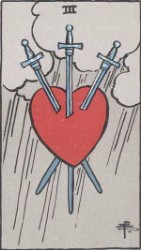
To use a very simple example, suppose you get the Two of Cups—falling in love—followed by the Three of Swords—heartbreak.

That might suggest that the new romance you’re entering isn’t likely to work out. But that’s not written in stone, because nothing is written in stone. The cards are essentially saying:

“This is where things appear to be heading if nothing changes.”

And nothing changing is one reason certain cards may constantly reappear. If we’re stuck in a loop in which we keep doing the same things over and over, the cards representing that pattern may simply keep coming back.

And here’s the deal: we’re not supposed to stay the same. Human beings are constantly learning, changing and evolving. If the Tarot keeps throwing the same card at you, it may be pointing toward a pattern that needs to change.

In the example above, perhaps you keep falling in love with people who eventually hurt you. At some point, stop looking at them and start looking at yourself.

Why am I doing this? Why am I repeatedly attracted to people who can’t fulfill me or meet my needs?

The repeating Tarot card may not be telling you what is going to happen next. It may be telling you what you keep doing.
PEOPLE

There are times when another person exerts a particularly strong influence on our lives, and we need to be aware of what they’re doing. When that happens, the Tarot may repeatedly produce the same card to represent that person and call our attention to them.

There’s nothing particularly unusual about cards representing people. The Court Cards have traditionally served that function, but other cards can do it as well.

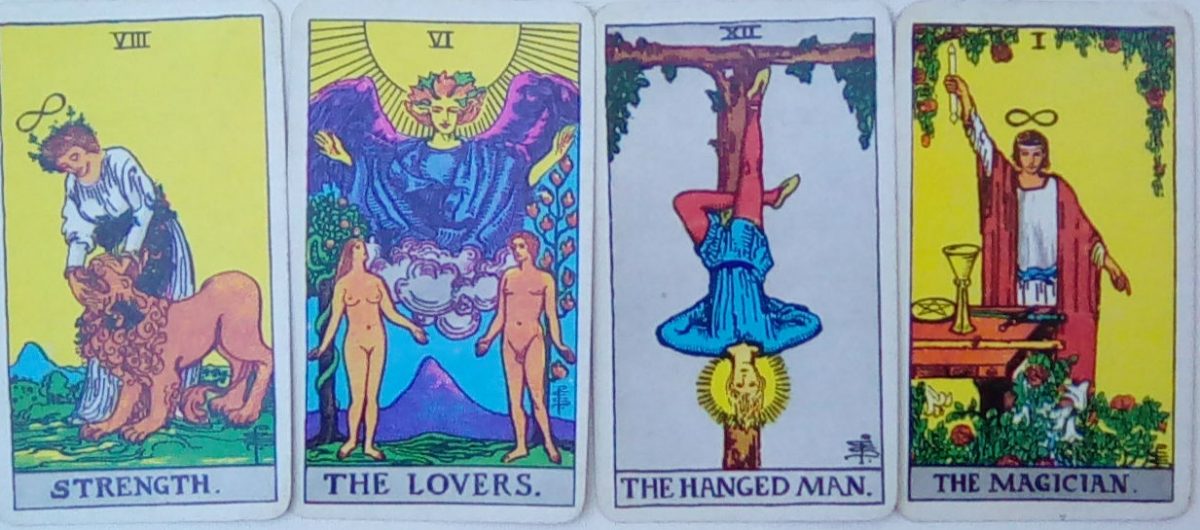
For instance, if you’re involved with someone who is particularly loving and nurturing, The Empress may appear prominently because she embodies those qualities.

I’ve found, though, that repeating cards representing people can become particularly noticeable when there’s conflict involved—when someone else’s actions may be affecting you in ways you need to recognize.

For example, I was once involved in a contested probate, and the Queen of Pentacles reversed kept appearing.
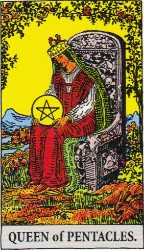
In another context, the reversed Queen of Pentacles might suggest a need for self-nurturing, insecurity around material matters, or energies that have become overly focused on possessions and control.

But when she represents another person, the interpretation can be quite different. As Sasha Fenton rather memorably puts it:

“This lady will win if involved in a fight with the questioner, especially if money is involved.”

That was certainly an interesting card to have repeatedly appearing during a legal dispute over an estate. To me, the message was clear: pay attention to this person. Don’t underestimate her. Money and material interests are central to what’s happening.

So when one card keeps popping up—particularly during a troubled or stressful period—ask yourself:

Could this card represent someone in my life? Is the Tarot pointing a great big flashing neon arrow at someone and saying:

“Pay attention to this one.”
DENIAL

Human beings can go to amazing lengths to avoid seeing something when we really don’t want to see it.

Psychologist Jennifer Freyd coined the term “betrayal blindness” to describe the way people may remain unaware of, or fail to fully acknowledge, betrayal when it threatens an important relationship or situation.

Imagine, for example, a woman whose husband is cheating on her.

The evidence may be sitting right there in plain sight: unexplained motel receipts, long private phone calls, suspicious messages on social media. But somehow she doesn’t put the pieces together.

Then one day something happens and suddenly everything clicks and she asks “How could I have been so blind?”

As the old cliché puts it: “Denial ain’t a river in Egypt.”

And Tarot doesn’t seem to have much patience with denial. If there’s something in your life that is vitally important for you to acknowledge and deal with, the cards may keep pointing toward it over and over again until you’re finally willing to look.
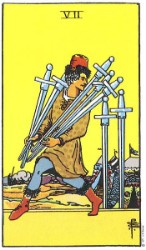
In the situation we just described, perhaps the Seven of Swords—traditionally associated with secrecy, deception and things happening behind the scenes—keeps appearing.

At first, the woman may be genuinely puzzled. “What in the world does that have to do with me?”

But the card keeps coming back.

Seven of Swords.

Seven of Swords.

Seven of Swords.

Eventually, instead of asking what the card means, she begins asking a much more useful question: “What am I not seeing?”

And that’s when she may finally start noticing those motel receipts.

TAKE THE BLINDERS OFF

If we wanted to sum all of this up in one sentence, it might simply be: Take the blinders off.

Or perhaps: take off the rose-colored glasses.

When the Tarot repeatedly gives us the same card, the most useful response isn’t necessarily to reshuffle the deck and ask the question again.

It’s to stop. Look at the card.

And ask yourself: Why does this particular message keep coming back?

Am I stuck in a pattern? Does this card represent someone who is having an important influence on my life? Is there something happening that I don’t want to acknowledge?

Sometimes the card that won’t go away is precisely the card we most need to understand.

Tarot can be remarkably patient. It can whisper the same message very gently for a very long time. But it can also be remarkably persistent.

At a certain point, you have a choice: deal with the issue—or quit asking the cards about it.

What you can’t do is keep asking the same question and expect the Tarot to tell you something different.
Blasted Towers, Bad Ju-Ju, and the Unluckiest Card in the Tarot

A look at the five unluckiest cards in the Tarot deck.

I recently received an email from a reader who asked, “What’s the unluckiest Tarot card?”  I had to scratch my head about that one because the whole concept of good luck versus bad luck can get pretty complex.  Nonetheless, there are some Tarot cards that can always be considered harbingers of bad luck

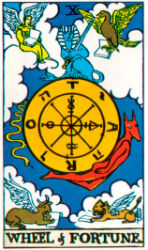
THE WHEEL OF FORTUNE, REVERSED

The Wheel of Fortune, Reversed, is the most obvious choice for a, “bad luck,” card.  We actually talk about luck in terms of good fortune and bad fortune and that’s what this card is all about.  It depicts life as a wheel, where sometimes our luck is ascending and expanding and sometimes it’s descending and decreasing.  When The Wheel of Fortune, Reversed, shows up in a reading it indicates that we’re in for a patch of bad luck.

The Kybalion, which is a book about Hermetic Magic, compared it to the pendulum of a clock.  The pendulum swings first in one direction and then back in the other.  Life can be seen in much the same way:  sometimes we’re swinging into really good luck and then we swing back into a period of bad luck.

The obvious underlying message is to just hang on, because things will inevitably change.  When we can stand back and look at good luck/bad luck as a rhythmic cycle, then periods of ill fortune will affect us much less severely.  We just need to stay centered and calm and wait for the cycle to reverse itself.

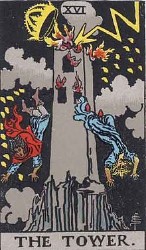
THE TOWER

Also known as, “the lightning struck tower,” and, “the blasted tower,” The Tower would probably be my pick as THE unluckiest card in the deck.  

“Just the Tarot,” by Dan Adair – complete definitions, layouts, and instructions for reading Tarot cards, available on Amazon.

At it’s most severe level, it can indicate that everything that you’ve loved and invested in is about to be blasted right down to the ground.  The last time that I had it showing up in my personal readings, my life partner died, I lost my house, and I was involved in a horrible law suit over the probate of the estate.  It can be that bad, depending on the other cards in the reading, but it usually isn’t.

On a mundane level, The Tower is usually just a powerful warning that we’ve gone down the wrong path and the Universe is about to provide a course correction.  Perhaps we’ve been treating our fellow employees badly and – Shazam – we’re suddenly fired or demoted.  Or perhaps we’ve been emotionally abusive or neglectful of our lover and they leave us for someone else.

In my experience, there’s always a level of hubris involved with this card.  We’re not only taking things for granted, but we’re also being arrogant.  We’re assuming that everything is under our control and the Universe is going to show us that we’re not.

The most positive message in this card – which we usually fail to appreciate at the time – is that we get to completely start over.  It’s like that line from, Me and Bobby McGee:  “Freedom’s just another word for nothing left to lose.”  When our lives (or our projects or relationships, etc.) have been blasted right down to the foundations, we have the freedom to consciously design something new and better.

DEATH

Even if it isn’t the unluckiest card in the deck, Death definitely wins the award for the creepiest card in the Tarot.  In her wonderful book, “Fortune Telling by Tarot Cards,” Sasha Fenton puts it in this perfectly understated, British way:  “This card usually puts the wind up people when it appears . . .”

Yes.

Now, first of all, I have never seen the Death card appear before someone’s death.  It will pop up after someone has died, but it’s usually just a comment on what’s happened.  It’s more like, “Well, you’ve lost someone you loved, so you’re dealing with death and grief.”

What it can indicate, though, is that there’s going to be a radical, life changing turn in events in a person’s life.  The querent is suddenly going to find herself going in a completely different direction than she has in the past.  In an emotional and spiritual sense, it really is as if their previous life has died and they’re off in a completely new direction.

I knew a woman who had been happily married for 15 years, had a home, a loving husband, and 2 kids.  She woke up one morning with this thought ringing in her head:  “Shit, I’m not in love with him anymore and I hate my life.”  Within six months she’d obtained a divorce, turned custody of her children over to her ex-husband and was working as a river guide in West Texas.  That’s the kind of radical change that we’re talking about here.

Whether that kind of change is good luck or bad luck is just a matter of interpretation.  If it’s something that we consciously plan, we usually view it as good fortune.  If it was something that was forced on us by circumstance, we may think it was bad fortune.

JUSTICE, REVERSED

I’m a little hesitant to include the Justice card in this list because it has more to do with people and circumstances than luck per se.  Nonetheless, it’s frequently seen as bad luck so I’ll stick it in here.

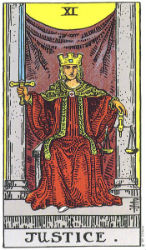
Classically, as you might guess from the image, Justice has to do with the legal system.  If we’re involved in some sort of litigation and Justice is upright, it can mean that we’ll prevail.  If it’s reversed, it can mean that we’ll lose.

On a personal level, it can mean that the people around you – your family, co-workers, boss, etc. – are making judgements about you and they’re not good if the card is reversed.  

Losing a court case can obviously be seen as bad luck.  Or it can be seen as a sign that we have a bad case, a bad lawyer, or a bad judge.  In the same way, having people we care about judging us harshly can be seen as being treated unfairly.  Or it might be that we’re being jerks and we need to clean up our acts.

Justice, Reversed, can be a sign of a bad luck to come, but it also serves as a warning.  It’s saying, “You’re about to have some bad luck, so you need to take a careful look at your own actions before that happens.”

TEN OF SWORDS

It doesn’t take but a glance at the Ten of Swords to realize that there’s some serious bad ju-ju happening here.  If we’re lying face down stuck full of swords like a human pin cushion, something’s a little wrong. This card can indicate treachery, deceit or a very, very bad ending to a relationship or a job.

The suit of Swords symbolizes our personal power.  That’s the way that we project ourselves out into the world.  There’s nothing innately wrong with that.  Whether it’s standing up to a school yard bully when we were kids or pushing hard for a project we really believe in at work, there are always times when we have to be a bit aggressive.

But . . . when we’re overly and chronically aggressive, that puts us into a power cycle. We’re trying to dominate other people and run over their emotions and desires.  We become the school yard bully instead of the person standing up to the bully.  We see this mentality frequently with primitive men who brag about being the, “alpha dog.”  It’s dominance for the sake of dominance, rather than for the sake of getting anything done.

The message of this card is the old cliche’: live by the sword, die by the sword.  If we’ve been treating other people harshly, if we’ve been abusive in our love relationships, or domineering in work relationships, we’ve got some bad karma heading our way.

So those are the top five, “bad luck,” cards in the Tarot deck.  There are, of course, other cards that may indicate bad fortune in one aspect or another of our lives, but these are the red flags.  And, of course, we should always remember that a Tarot reading is just a snap shot in time.  It tells us what’s likely to happen, but we have the free will to change it.