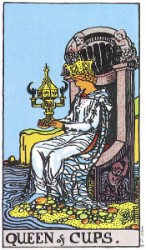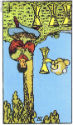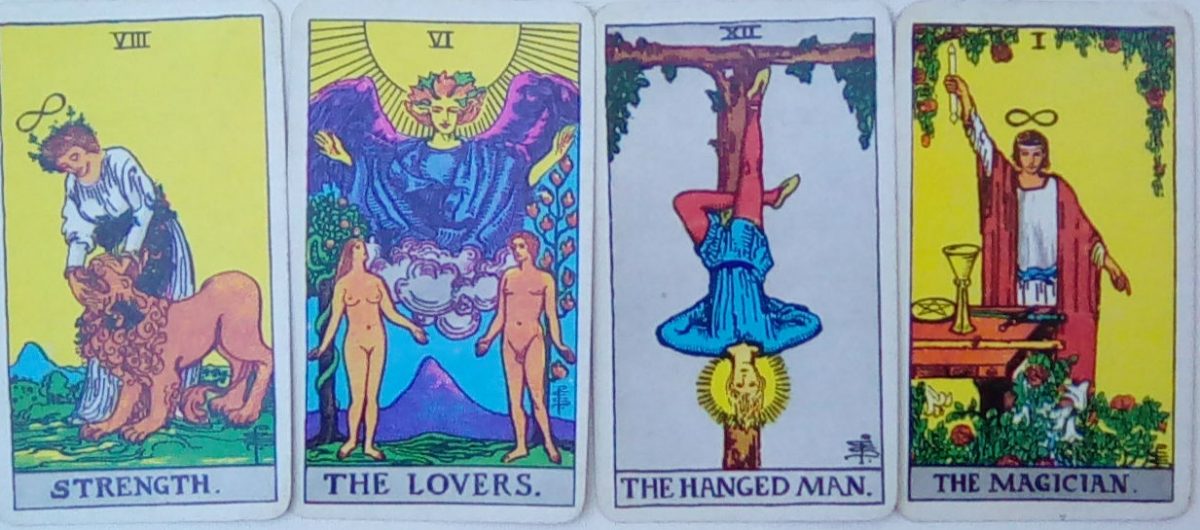
One of the spookier things that can happen to a new Tarot reader is getting the same card over and over again.
No matter how many readings you do, there it is. It may drift around to different positions in the spread. It may appear as an answer to completely different questions. You shuffle thoroughly, cut the deck, and perhaps even put the cards away for a few days.
And then you do another reading. There it is again.
It can begin to feel as though the card is glued to your aura.
Oddly enough, this can also be one of the most reassuring experiences in Tarot. There are 78 cards in a standard deck, so when one particular card begins appearing with remarkable persistence, it certainly gets your attention.
So what does it mean?
In my experience, there are three basic reasons a Tarot card may keep appearing:
1. Stuck energy — something in your life isn’t changing.
2. A particular person — someone important is being represented by the card.
3. Something you aren’t acknowledging — an important situation or energy needs your attention.
STUCK ENERGY
A Tarot reading doesn’t really “predict the future.” Instead, it gives us a snapshot of what’s happening in our lives right now and then suggests the probable outcome if those forces continue moving in the same direction.
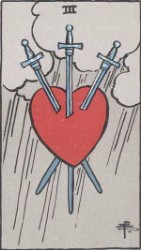
To use a very simple example, suppose you get the Two of Cups—falling in love—followed by the Three of Swords—heartbreak.
That might suggest that the new romance you’re entering isn’t likely to work out. But that’s not written in stone, because nothing is written in stone. The cards are essentially saying:
“This is where things appear to be heading if nothing changes.”
And nothing changing is one reason certain cards may constantly reappear. If we’re stuck in a loop in which we keep doing the same things over and over, the cards representing that pattern may simply keep coming back.
And here’s the deal: we’re not supposed to stay the same. Human beings are constantly learning, changing and evolving. If the Tarot keeps throwing the same card at you, it may be pointing toward a pattern that needs to change.
In the example above, perhaps you keep falling in love with people who eventually hurt you. At some point, stop looking at them and start looking at yourself.
Why am I doing this? Why am I repeatedly attracted to people who can’t fulfill me or meet my needs?
The repeating Tarot card may not be telling you what is going to happen next. It may be telling you what you keep doing.
PEOPLE
There are times when another person exerts a particularly strong influence on our lives, and we need to be aware of what they’re doing. When that happens, the Tarot may repeatedly produce the same card to represent that person and call our attention to them.
There’s nothing particularly unusual about cards representing people. The Court Cards have traditionally served that function, but other cards can do it as well.
For instance, if you’re involved with someone who is particularly loving and nurturing, The Empress may appear prominently because she embodies those qualities.
I’ve found, though, that repeating cards representing people can become particularly noticeable when there’s conflict involved—when someone else’s actions may be affecting you in ways you need to recognize.
For example, I was once involved in a contested probate, and the Queen of Pentacles reversed kept appearing.

In another context, the reversed Queen of Pentacles might suggest a need for self-nurturing, insecurity around material matters, or energies that have become overly focused on possessions and control.
But when she represents another person, the interpretation can be quite different. As Sasha Fenton rather memorably puts it:
“This lady will win if involved in a fight with the questioner, especially if money is involved.”
That was certainly an interesting card to have repeatedly appearing during a legal dispute over an estate. To me, the message was clear: pay attention to this person. Don’t underestimate her. Money and material interests are central to what’s happening.
So when one card keeps popping up—particularly during a troubled or stressful period—ask yourself:
Could this card represent someone in my life? Is the Tarot pointing a great big flashing neon arrow at someone and saying:
“Pay attention to this one.”

DENIAL
Human beings can go to amazing lengths to avoid seeing something when we really don’t want to see it.
Psychologist Jennifer Freyd coined the term “betrayal blindness” to describe the way people may remain unaware of, or fail to fully acknowledge, betrayal when it threatens an important relationship or situation.
Imagine, for example, a woman whose husband is cheating on her.
The evidence may be sitting right there in plain sight: unexplained motel receipts, long private phone calls, suspicious messages on social media. But somehow she doesn’t put the pieces together.
Then one day something happens and suddenly everything clicks and she asks “How could I have been so blind?”
As the old cliché puts it: “Denial ain’t a river in Egypt.”
And Tarot doesn’t seem to have much patience with denial. If there’s something in your life that is vitally important for you to acknowledge and deal with, the cards may keep pointing toward it over and over again until you’re finally willing to look.
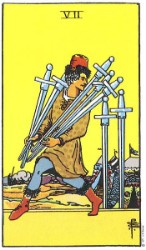
In the situation we just described, perhaps the Seven of Swords—traditionally associated with secrecy, deception and things happening behind the scenes—keeps appearing.
At first, the woman may be genuinely puzzled. “What in the world does that have to do with me?”
But the card keeps coming back.
Seven of Swords.
Seven of Swords.
Seven of Swords.
Eventually, instead of asking what the card means, she begins asking a much more useful question: “What am I not seeing?”
And that’s when she may finally start noticing those motel receipts.
TAKE THE BLINDERS OFF
If we wanted to sum all of this up in one sentence, it might simply be: Take the blinders off.
Or perhaps: take off the rose-colored glasses.
When the Tarot repeatedly gives us the same card, the most useful response isn’t necessarily to reshuffle the deck and ask the question again.
It’s to stop. Look at the card.
And ask yourself: Why does this particular message keep coming back?
Am I stuck in a pattern? Does this card represent someone who is having an important influence on my life? Is there something happening that I don’t want to acknowledge?
Sometimes the card that won’t go away is precisely the card we most need to understand.
Tarot can be remarkably patient. It can whisper the same message very gently for a very long time. But it can also be remarkably persistent.
At a certain point, you have a choice: deal with the issue—or quit asking the cards about it.
What you can’t do is keep asking the same question and expect the Tarot to tell you something different.