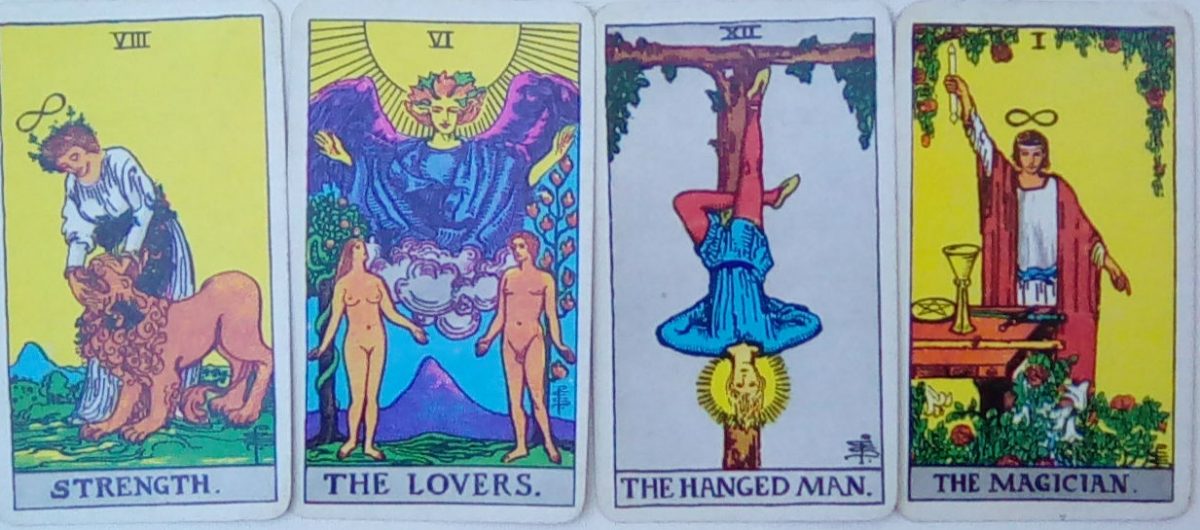

A question that many newly minted Tarot readers ask is, “Can I do readings for myself?”
And the answer to that is: Oh, hell, yes.
People have been doing Tarot readings for themselves for as long as people have been reading Tarot cards.
It’s not an unreasonable question, though. In all the years I’ve been doing Tarot readings, I’ve heard the same statement from several people:
“You can’t do readings for yourself. Everyone knows that.”
I’ve never been able to track down exactly who “everyone” is, or where they came up with this rule, but the idea is definitely out there.
So, just to be definitive about it: it’s wrong.
The Advantages of Reading for Yourself
The most obvious advantage of reading for yourself is that nobody knows you quite like you know yourself.
And that means there’s often much less guesswork involved in figuring out what the cards mean.
For instance, suppose a card like The Devil comes up in your reading. Someone who doesn’t know you can make a series of educated guesses based on the traditional meanings of the card.

“Ummm . . . there could be a problem with addiction in your life. Or perhaps there’s an unhealthy or obsessive sexual element involved. Or you might be refusing to recognize some pattern of self-harm . . .”
But they don’t really know, because they don’t really know you.
You, on the other hand, can look at the same card and immediately realize:
“Yeah, I’m drinking too much.”
Or:
“I really shouldn’t be having an affair with the neighbor’s wife.”
Or:
“I really need to quit sticking pins in that voodoo doll of my boss.”
That simple self-knowledge can make a reading much easier and clearer than one you might get from a stranger. You already know the cast of characters, the circumstances, and the history. The card doesn’t have to explain the whole situation to you. It only has to point at it.
The Disadvantages of Reading for Yourself
The major disadvantage of reading for yourself is that—guess what?—we’re all human.
We rationalize. We deny. We conveniently overlook things. And many of us have a somewhat inflated—or at least carefully edited—image of ourselves.
Sometimes we can look at cards that are giving us a very, very clear message and simply say:
“Nope. That’s not me.”
Psychologist Jennifer Freyd coined the term “betrayal blindness” to describe the way people can sometimes remain unaware of betrayal when recognizing it would threaten an important relationship or situation.
To use an extreme example, someone might be married to an absolute cheating horn dog—a partner who is screwing around with other women all week long and twice on Sunday—but she simply cannot allow herself to see it.
She finds the motel receipts, the lipstick on the collar, and the condoms in the glove box, but somehow there’s a perfectly reasonable explanation for all of it.
That same person probably isn’t going to see the truth in the Tarot cards either.
She might lay out a reading that practically screams that her partner is a no-good, lying, cheating lowlife, and she’ll still find some way to interpret the cards differently.
And we all have areas of our lives where we deceive ourselves.
For most of us they aren’t quite that dramatic, but the blind spots are still there. Someone else reading for us may spot those inconsistencies immediately, while we unconsciously find ways to explain them away.
That’s the real danger of reading for yourself. It isn’t that the cards somehow stop working when you’re the person shuffling them.
It’s that you may not want to hear what they’re saying.
Don’t Obsess
There’s one other warning about reading for yourself that’s worth mentioning:
Don’t obsess.
In other words, don’t fall into the pattern of constantly reading the cards, looking for one more clue about what you’re supposed to do.
And that’s tempting. Believe me.
After all, when you’re reading for yourself, the readings are free and you can do as many of them as you want.
But realistically, Tarot readings tend to fall into two broad categories.
The first kind is crystal clear. It tells you, in effect:
“This is what’s happening. This is what you need to do. And this is probably what will happen if you don’t do it.”
The second kind—which is much less common—is muddled. The cards don’t seem to form a coherent message, or several contradictory possibilities seem to be in play.
In my experience, that usually means the situation itself hasn’t settled yet. Too many things are moving around, and you simply need to wait until the dust clears.
Either way, doing another seventeen readings probably isn’t going to help.
If you’ve already received a clear reading, the answer isn’t going to change just because you keep asking the question.
And if the reading is genuinely muddled, it probably isn’t going to become clear until the situation itself becomes clearer.
All you’re likely to get from repeatedly throwing the cards is frustration, confusion, and a big fat waste of your time.
Keep Reading
So, by all means, read Tarot for yourself.
Just be reasonable about it, and remember that self-knowledge cuts both ways. Knowing your own life intimately can make a reading extraordinarily clear—but your own biases and blind spots can occasionally make the obvious invisible.
Unless there’s a specific problem I need to address, I usually do one predictive reading at the beginning of each week. It gives me a general feel for the energies and circumstances I’m likely to encounter.
It’s a simple four-card reading:
1 — What are the current conditions?
2 — What needs to be done?
3 — What factors are working against me?
4 — What is the probable outcome?
And that’s it.
That gives me all the information I need to stumble through the week.
Sometimes the reading surprises me. Sometimes it tells me something I already suspected. And sometimes I don’t fully understand what a card was talking about until several days later.
But the point isn’t to consult the Tarot every fifteen minutes.
The point is to get the message, think about it, and then go live your life.

