NEW FREE TAROT EBOOK: WHAT THE TAROT CARDS WANT

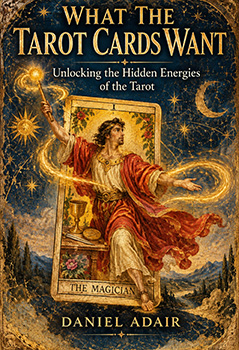
Announcing What the Tarot Cards Want: Unlocking the Hidden Energies of the Tarot, a free illustrated ebook exploring all 78 Tarot cards from a fresh perspective. Discover what each card’s energy wants to express, what may be blocking it, and how to work with that energy through practical affirmations. Download your free copy today!

I’m delighted to announce the publication of my newest Tarot book, What the Tarot Cards Want: Unlocking the Hidden Energies of the Tarot.

And the best part? It’s absolutely free!

This illustrated book takes a different approach to understanding the Tarot.

Most of us approach a Tarot reading by asking what the cards mean or what they’re predicting about our future.

But what if we asked a different question?

What do the cards WANT?

The premise is simple: Each of the 78 Tarot cards represents a unique type of energy that’s trying to express itself in our lives.

The Magician wants us to recognize our abilities and put them to work. The Ace of Cups wants us to open our hearts to love and emotional connection. The Eight of Wands wants us to embrace movement and momentum.

But sometimes those energies are blocked by our fears, beliefs, habits, or circumstances.

That’s where this book comes in.

Each of the 78 illustrated card definitions explores three questions:

* What does the card want? What energy is trying to express itself?

* What blocks it? What might be preventing that energy from manifesting?

* How can we work with it? Each card includes affirmations designed to help us consciously align with its energy.

The result is a practical Tarot reference guide that shifts the emphasis from predicting the future to actively participating in creating it.

I’ve included an original illustration for every card, along with a clickable table of contents so you can quickly find the definitions you’re looking for.

I’m offering the book as a free karma gift to the Tarot community. No registration, no email address, and no strings attached.

Discover What the Tarot Cards Want and Download Your Free Copy

DOWNLOAD HERE

I hope you enjoy it, and that it gives you a fresh perspective on those 78 remarkable little pieces of cardboard.

Happy reading!

Daniel Adair

How Do I Know Which Tarot Meaning is the Right One?

Which Tarot card meanings should you believe when different books and websites give you different answers? Learn why the images in the Waite-Smith Tarot are one of the best guides to understanding what the cards actually mean—and why sometimes the simplest approach to reading Tarot is simply to look at the pictures.

WHICH TAROT CARD MEANING SHOULD YOU BELIEVE?

One of the questions a lot of beginning Tarot readers have is, “Which definition should I believe?”

If I find two different definitions of the same card that seem to say completely different things, which one should I use?

Actually, that’s not as much of a problem as many new readers might think. You can skim through the various Tarot sites on the internet and discover that most of the definitions are remarkably homogeneous. If anything, there’s sometimes a troubling lack of imagination in them.

Still, there are differences, and those differences can affect your ability to read the cards.

One book might stress that The Emperor brings order and structure, while another views him as rigid and controlling. One site might describe The Hierophant as organized religion, while another sees him as a teacher, mentor or guru figure.

So how do you decide?

THE PAMELA COLMAN SMITH COLORING BOOK

A good starting point for any reader is simply to LOOK at the cards. What are they actually saying?

And I don’t mean, “What vibe am I picking up from this card?” I mean literally look at what the image portrays.

The best place to learn how to do that is the Waite-Smith Tarot deck. The artist behind that deck, Pamela Colman Smith—also known as Pixie—did a phenomenal job of portraying the essence of each card. In a very real sense, the images ARE the definitions.

Each one is a little visual story that tells you what the card is about.

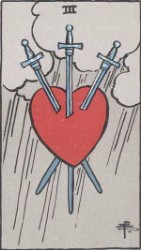
The Three of Swords shows a heart pierced by three swords. It means heartache.

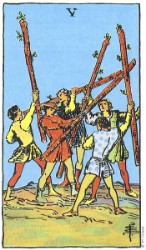
The Five of Wands shows five guys wailing away at each other with sticks. It means conflict, competition or vigorous engagement.

The Eight of Pentacles shows a man sitting at his workbench carving pentacles. It means work, practice and developing skill.

The Three of Cups shows three people raising their goblets and dancing together. It means celebration, friendship and having a good time.

Not too hard, right?

If you’re a beginning reader, start with those pictures and those stories. Think of the Waite-Smith deck almost as a coloring book in which every picture tells a story. Your first job is simply to learn how to read the pictures.

WHEN THE DEFINITIONS ARE WRONG

There ARE times when standard Tarot definitions have drifted away from the images on the cards. When that happens, you can use the artwork itself to double-check the definition.

Let me give you an example.

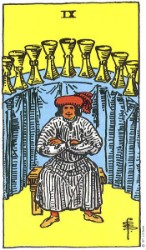
Take a look at the Nine of Cups. What do you actually see?

When I was learning the Tarot many, many years ago, a common interpretation of this card was an individual who is doing well materially but has a certain air of smugness and self-satisfaction about him.

And that’s pretty much what Colman Smith portrayed. He isn’t smiling so much as smirking. His body language—crossed arms and widely planted legs—practically screams that this is somebody who is very pleased with himself.

It wasn’t necessarily a BAD card. It simply wasn’t a particularly elevated one.

Fast-forward to today, and the Nine of Cups is frequently called “the wish card.” Whatever you want, you can have. Your wishes are coming true.

Really?

Is that what you see in this picture? Rainbows and unicorns?

Obviously not.

That doesn’t mean every modern interpretation of the Nine of Cups is useless. But it does mean we should occasionally stop repeating definitions we’ve inherited and ask a very simple question: Does this interpretation actually fit the card?

The Waite-Smith deck gives us a remarkably useful visual reality check. If a definition bears little resemblance to the picture, it’s worth questioning the definition.

IS THIS A SHALLOW APPROACH?

There are plenty of self-professed experts who will tell you that the Tarot is incredibly complicated and deep.

And they’re right.

Tarot symbolism can be profound and extremely complex. You can spend years studying these cards and continue finding new layers of meaning in them.

But if you’re a beginning reader, you don’t need to worry about all of that right now.

As time goes by, you may want to take a much deeper dive into the cards. You may want to explore numerology, astrology, Kabbalah, alchemy and the various occult traditions that influenced the Tarot.

That can come later. Fortunately, A. E. Waite and Pamela Colman Smith did much of that work for you, and they embedded an enormous amount of it in the deck.

For now, you can do something much simpler.

Pick up the cards. Lay out a reading. Look at the pictures.

What story are they telling you?

That’s where Tarot reading begins.

I also offer a free beginner’s Tarot course here on the website, so if you’re just getting started, you may want to give that a quick read.

But above all, keep it simple.

And keep it fun.

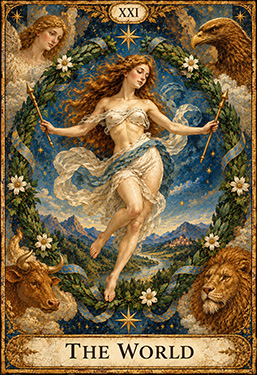
The World – The Dance of Life

The World marks the completion of the Tarot’s great journey—but every ending contains a new beginning. Explore the card’s mysterious wands, its connection to The Fool and The Magician, and the symbolism of dance, rebirth, integration, and divine play.

As the final card of the Major Arcana, The World is both the end of a cycle and the beginning of a new one.

Yes, we’ve come to the end of the long journey through the archetypes. The lessons have been learned, the trials endured, and the pieces brought together. But Tarot doesn’t really have an ending. The moment one journey is completed, another begins.

The World isn’t a period.

It’s a doorway.

THE WREATH — COMPLETION AND REBIRTH

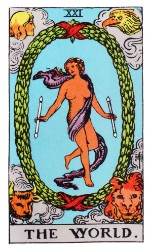
The most obvious symbol of completion is the enormous wreath surrounding the central figure.

But look at its peculiar shape. Rather than being perfectly circular, the wreath forms a long oval. It can easily suggest an opening, a portal—and perhaps even the shape of the birth canal.

Seen that way, the figure isn’t simply standing triumphantly inside a wreath celebrating what she has accomplished. She’s passing through it. She’s arriving at the destination and simultaneously being born into another world.

That’s one of the great paradoxes of The World: completion and beginning are the same event. Every genuine transformation eventually requires us to leave behind the person who began the journey.

THE FOOL, THE WORLD, AND THE DANCE OF LIFE

At the very beginning of the Tarot journey we encountered The Fool.

He’s filled with such exuberance that he practically dances toward the edge of a cliff. He doesn’t know where he’s going. He hasn’t experienced the Magician, the Lovers, Death, the Devil, the Tower, the Moon or any of the other archetypal encounters awaiting him.

He simply steps forward.

Now look at the figure in The World.

She’s dancing, too. But this is a very different dance. The Fool dances because he doesn’t yet know what lies ahead. The World dances because she does.

She has traveled through the entire cycle and somehow recovered the joyous freedom with which she began it.

This idea has a fascinating parallel in Hindu philosophy.

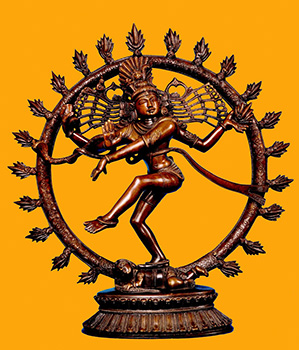
Shiva as Nataraja—the Lord of the Dance—is portrayed dancing within a great circle of flame. His dance represents the ceaseless movement of existence: creation, preservation, destruction and renewal.

The visual resemblance to The World is striking: a dancing figure surrounded by a circular boundary representing something vastly larger than the individual.

Hindu traditions also give us the wonderful concept of līlā, usually translated as “divine play.” Līlā suggests that creation doesn’t necessarily arise because the divine lacks something or needs to accomplish some desperately important objective. Creation can be understood as spontaneous expression—something closer to art, music, play or dance.

An artist paints. A musician plays. A dancer dances. Creation creates.

This doesn’t mean that suffering is unreal or that life should never be taken seriously. It suggests something subtler: beneath all our struggling, planning and attempts to control events, there may be another way of participating in existence.

We can dance with it.

The woman in The World is being born into something new, but she isn’t grimacing with effort. She’s having a hell of a lot of fun doing it.

THE MAGICIAN, THE WORLD, AND INTEGRATION

There’s another fascinating connection between The World and one of the earliest cards in the Major Arcana.

The woman holds two peculiar short, double-ended wands loosely in her hands. We’ve seen that wand before. The Magician holds one.

But notice the difference in how the two figures use them.

The Magician raises his wand deliberately toward heaven while pointing his other hand toward Earth. His entire posture communicates intention:

I will make something happen.

He channels divine power into manifestation. He gathers the four elemental tools before him and consciously directs his will.

The World no longer needs to do that. She holds two wands, perfectly balanced on either side of her body. She isn’t pointing them anywhere. She isn’t commanding anything. She almost seems to be playing with them.

They’ve become part of the dance.

The Magician uses magic. The World embodies it.

At the beginning of the journey, we have to learn that we possess creative power. We have to discover intention, will, concentration and the ability to shape our lives. But perhaps there comes a point when even that must be surrendered.

The Magician says: I am creating my world.

The World says: I am the creation.

The World Tarot Poster – Available on etsy

THE MAGIC CIRCLE

Now notice the four mysterious figures occupying the corners of the card: the human or angel, eagle, bull and lion.

They have a long symbolic history extending far beyond Tarot, but within the Tarot’s esoteric correspondences they can be associated with the four fixed signs of the zodiac:

Aquarius — Air

Scorpio — Water

Taurus — Earth

Leo — Fire

Once again, all four elements are present. We encountered them on the Magician’s table at the beginning of the journey. Now they surround The World.

This gives the card an almost ritual quality. In Western ceremonial magic, the four directions and their elemental correspondences can be invoked around a ritual space. Symbolically, then, we can imagine the dancing woman standing within a great magic circle surrounded by the forces of creation.

But something has fundamentally changed.

The Magician stood before the elements and manipulated their symbols. The World dances among them.

Mind, emotion, body and spirit are no longer competing forces that need to be brought under control. They have become parts of a larger whole. That is integration.

And perhaps that’s what The World ultimately means by completion. Not perfection. Not reaching a place where nothing difficult will ever happen again.

Wholeness.

WHEN THE WORLD APPEARS IN YOUR READING

When The World appears in a reading, something has come full circle.

A long process may be reaching completion. You may finally understand something that once confused you, finish something you’ve worked toward for a long time, or realize that you’ve simply outgrown a particular chapter of your life.

But don’t mistake completion for stagnation. The World almost always contains the seed of what comes next.

You may be standing at exactly that strange threshold where you can look backward and say, “I’ve finished,” while simultaneously looking forward and realizing, “Now I begin again.”

The card can also indicate integration. Pieces of yourself that once seemed contradictory may finally be learning to coexist. The intellectual, emotional, physical and spiritual parts of your life may be finding their proper relationship with one another.

And sometimes The World offers an even simpler message:

Stop trying so hard to control the dance.

You’ve learned more than you realize. You have the tools. You’ve survived the journey.

Now loosen your grip on the wands.

Listen for the music.

And dance.

The Hanged Man Tarot Card: Finding Peace When You Can’t Move Forward

Explore The Hanged Man Tarot card as a symbol of suspension, powerlessness, reversed perspective and radical acceptance—and discover what it means when you cannot force life forward.

At first glance, The Hanged Man seems like a rather unpleasant Tarot card.

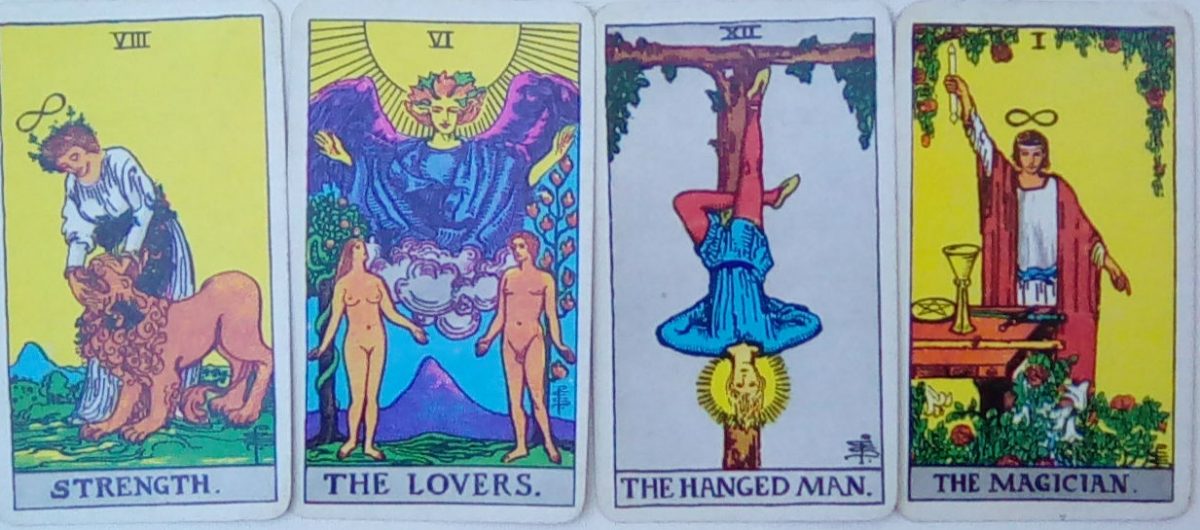
A man is hanging upside down by one foot. His hands are behind his back. He isn’t going anywhere, and there doesn’t appear to be anything he can do about it.

And yet there is something peculiar about him.

He doesn’t seem particularly bothered by the situation.

In the familiar Rider-Waite-Smith version, Arthur Edward Waite goes considerably further and gives the man a halo, transforming the image into something approaching spiritual illumination. But the essential image is much older than Waite’s deck. Earlier Tarot de Marseille versions already show the same strange figure hanging upside down with an unexpectedly composed expression.

So perhaps we don’t need the halo to understand him.

Instead, let’s look at what is actually happening to this man.

The Hanged Man Poster – 13 X 19 – Available on Etsy

What’s in the Card?

1. Suspension: Life Has Come to a Stop

The most obvious thing about The Hanged Man is that he is suspended.

He isn’t walking somewhere. He isn’t working on something. He isn’t fighting an enemy or pursuing a goal.

He’s literally going nowhere.

That’s very different from many of the other figures in the Major Arcana. The Charioteer is moving forward. The Hermit has deliberately withdrawn from the world. The Magician is actively manipulating the objects on his table.

The Hanged Man can do none of those things.

His normal activities have been interrupted.

We all encounter periods like this. A plan stalls. A relationship enters limbo. An illness interrupts our routines. We’re waiting for somebody else’s decision. Something we depended upon disappears. We simply don’t know what comes next.

Our natural response is usually:

“How do I get things moving again?”

But The Hanged Man raises a different possibility.

Perhaps, for the moment, we aren’t supposed to be moving.

Sometimes suspension is not an empty space between important events. The suspension itself is the experience.

2. Powerlessness: He Cannot Change His Circumstances

This brings us to the more uncomfortable aspect of the card.

The Hanged Man isn’t merely resting.

He’s powerless.

One foot is tied to the structure above him. His hands are behind his back. Whatever brought him into this situation, he cannot simply decide that he’s had enough, stand up and walk away.

That makes The Hanged Man a remarkably useful card for situations involving things outside our control.

We tend to associate personal power with the ability to change circumstances. If something is wrong, we fix it. If a door is closed, we find another door. If something isn’t working, we try harder.

Usually that’s excellent advice.

But sometimes there genuinely isn’t anything we can do.

And continuing to struggle against an unchangeable situation doesn’t necessarily give us more power. Sometimes it merely exhausts us.

The Hanged Man confronts us with one of life’s most difficult truths:

There are circumstances we cannot control.

The question then becomes not “How do I control this?” but:

“How am I going to live while this is true?”

Tarot and the Art of Alignment – Available on Amazon

3. Reversed Perspective: The World Looks Completely Different

Now something interesting happens.

Because the Hanged Man cannot go anywhere, his perspective changes instead.

Quite literally, his world has turned upside down.

The trees, the earth, the sky, other people—everything familiar is suddenly being seen from an unfamiliar angle.

Nothing necessarily changed in the outside world.

His position within it changed.

This may be the great gift hidden inside the card.

When our usual methods stop working, we may begin questioning assumptions we never previously thought to question.

What if success isn’t what I thought it was?

What if this relationship isn’t what I believed it was?

What if the thing I’ve been desperately pursuing isn’t actually what I need?

What if the situation I’ve been calling a disaster looks entirely different when viewed from another angle?

The Hanged Man doesn’t necessarily give us the answers.

He interrupts our habitual way of looking for them.

Sometimes we don’t acquire a new perspective because we’re wise enough to seek one.

Sometimes life turns us upside down until we have no choice.

4. Serenity: Acceptance Without Defeat

And finally we come to the strangest feature of the entire card.

The Hanged Man looks serene.

That’s remarkable.

If his face showed terror, the card would be about victimization.

If he were struggling against his restraints, it would be about imprisonment.

If he looked defeated, it would be about despair.

But he doesn’t.

Somehow, this man who cannot move, cannot escape and cannot control his circumstances has found peace within them.

That doesn’t necessarily mean he likes what has happened.

Acceptance isn’t approval.

Nor does acceptance mean that he will remain suspended forever.

It simply means that he has stopped fighting the reality of the present moment.

There is an enormous psychological difference between:

“This must not be happening.”

and:

“This is happening. What now?”

The first keeps us locked in combat with reality itself.

The second gives us somewhere to stand—even when, like The Hanged Man, we aren’t technically standing at all.

The Four Lessons of The Hanged Man

Taken together, the picture gives us four stages:

Suspension: My normal life has stopped.

Powerlessness: I cannot presently change this situation.

Reversed Perspective: Since I cannot change the situation, perhaps I can see it differently.

Serenity: I can stop fighting what I cannot presently change.

That’s considerably richer than simply defining The Hanged Man as “waiting” or “sacrifice.”

Sometimes the card may indeed indicate a sacrifice. Sometimes it may simply tell us to wait.

But at its deepest level, The Hanged Man seems to address one of the most difficult human experiences:

What do we do when there is nothing we can do?

His answer is extraordinary.

We stop.

We surrender the struggle—not necessarily forever, but for now.

We allow ourselves to see the situation from an entirely different perspective.

And perhaps we discover that peace does not always have to wait until the problem has been solved.

When The Hanged Man Appears in a Reading

When The Hanged Man appears, it may be useful to ask:

* Where has my life become suspended?

* What am I trying to control that I genuinely cannot control right now?

* What might this situation look like if I turned my assumptions upside down?

* What would acceptance look like if I stopped confusing acceptance with defeat?

The Hanged Man does not promise that someone is about to cut the rope.

He offers something stranger and perhaps more valuable:

the possibility of finding peace while we’re still hanging there.
Tarot, Synchronicity, and Cactus Chewing: Notes on Revising My Book

I’ve just released a revised edition of my book, “Just the Tarot” — newly formatted for Kindle, with added quick-reference charts and a fresh cover. In the process of revisiting the material, I found myself reflecting on Tarot as a powerful “synchronicity machine” — a simple but profound way to communicate with the Universe. This post is part update, part spiritual meditation, and part love letter to what Tarot can really do.

I just finished revising and publishing the new edition of my e-book, Just the Tarot, and, boy, THAT was a bitch. After weeks and weeks of writing and formatting, my immediate reaction is, “I’m so happy with how this turned out,” and also, “I’d rather chew on a cactus than do that again.”

There was also a little ambiguity about the content itself. I wrote the original edition during one of the most intense periods of my life. My life partner had just died, I was about an inch away from bankruptcy, and my entire world was crumbling around me.

In Tarot parlance: The Tower and Death.

During periods like that, we’re pulling in a LOT of spiritual assistance and living in heavy archetypes, so I was very pleased with the actual content. As I re-read it, I realized that I’d been channeling some pretty potent insights on the card definitions and really didn’t want to change much at all.

In addition to the longer, more expansive interpretations, I’ve added some quick reference charts for all 78 cards with one- or two-sentence definitions for upright and reversed meanings. I also threw in a couple more layouts, tweaked the writing here and there, and painted a spiffy new cover for the book.

So it remains pretty much what I set out to do when I wrote it eight years ago. It’s a basic, totally dependable, sturdy little book that continues to be a great reference for both new and more experienced readers. No metaphysics. No wild theories about what the Tarot really means. No decoding secret methods or unlocking hidden mystical maps.

Just a book that says:

“If you want to read Tarot cards, this is how you do it, and this is what the cards mean.”

You know… Just the Tarot.

Reflections on the Tarot

As I did the re-write, I inevitably pondered a bit on WHY we read Tarot cards. When we sit down and lay out a reading, what is it that we’re actually looking for?

When we’re young, of course, the two main topics are love and money.

Well… love, money, and sex.

When you’re reading the cards for anyone under 40, the questions usually sound something like:

• Does he/she find me attractive?

• Should we go out on another date?

• Should I go to bed with him/her?

• Should we move in together?

• Is he/she cheating on me?

And in the second category:

• I really hate my job. Should I look for another one?

• Am I going to get promoted?

• How can I make more money?

• Can I afford that new car?

• Should I go back to school?

In other words, the questions are mainly predictive. As in: What’s going to happen? Am I going to like it? And, by the way, am I going to get laid?

That’s where most of us start out in our Tarot adventure.

Synchronicity and Tarot

As the many years of reading Tarot have passed, though, I’ve come to realize that the most important part of a Tarot reading is synchronicity.

I once read a brilliant line in a Tarot forum that stuck with me:

“The Tarot is a synchronicity machine.”

Every time we sit down to do a reading, we engage the field of synchronicity.

I’m not going to get into a long rap here about synchronicity (though if you’re curious, check out my earlier post, Finding Meaning with Synchronicity). The main point I want to make is this:

WHEN WE TALK TO THE UNIVERSE, THE UNIVERSE TALKS BACK.

And that’s actually a big, fat deal.

We’re in a sort of post-religion, post-scientific-revolution phase of humanity. A lot of us have rejected the old, superstitious, patriarchal, hate-based formal religions. Those beliefs have been replaced by the scientific model, which basically says, “There are no gods or goddesses, no angels, no spirit guides, and certainly no magic.”

Which has left a great big hole in our hearts.

It’s left us feeling alone and isolated in what science tells us is essentially a dead universe.

But when we engage with the synchronistic field, the Universe starts giving us answers to our questions. We might ask, “What should I do about my job?” — and suddenly we’ve got clues dropping out of nowhere.

Maybe we get a surprise promotion.

Maybe the jobs section of the newspaper blows down the street and wraps around our ankles.

Maybe a friend opens a new business and hires us on the spot.

And underneath all of that is a HUGE shift away from the old idea of being all alone in a cold, impersonal cosmos. Suddenly we realize that not only is the Universe alive — it actually cares about us and is helping us. Personally.

The whole damn Universe cares about little old you and me.

What a trip!

If you scroll through the internet for a bit, you’ll find that there’s a massive industry dedicated to helping people reach that exact point — spiritually and psychologically. Books, videos, workshops, seminars — all trying to teach people how to establish a relationship with the Universe, their spirit guides, their angels.

But really?

All we need to do is pick up a deck of Tarot cards, ask a question, and lay out a reading.

It’s that simple.

You don’t have to be a psychic.

You don’t have to meditate for years.

You don’t need to channel, astral travel, or decode ancient texts.

Just pick up the cards, ask a question — and the Universe will talk back to you.

Yes, YOU.  

Just the Tarot, By Dan Adair – a kindle ebook available on Amazon.

Harnessing the Power of Mentalism: How the Magician Card Can Help You Manifest Your Desires

Discover how the Magician tarot card and the Principle of Mentalism from The Kybalion can help you manifest your desires by aligning thought and intention.

Have you ever tried to manifest something—a job, a relationship, a more abundant life—only to feel like nothing’s happening?  

As you probably know, there are hundreds of manifestation methods and techniques out there, each of them 100% guaranteed to bring us happiness, wealth, and a great sex life.  So why are so many of us still stumbling along, sad, poor, and . . . well . . . un-laid?

Here’s the truth: manifestation isn’t just about saying the right words, finding the right method or doing the right ritual. It begins with our minds. According to the ancient Hermetic wisdom of The Kybalion, “The All is Mind”—meaning that everything in the universe begins in thought. This is known as the Principle of Mentalism, and it’s the foundation of all true manifestation work.

Why Manifestation Often Fails (And How Mentalism Can Help)

Here are the most common reasons why manifestation doesn’t work :

• We’re trying to manifest from a place of fear or lack.  We’re so wrapped up in what we don’t have, that that’s all we can think about.  And whatever we think about is exactly what we’re going to get.

• Our conscious desire doesn’t match our unconscious beliefs.  If we’re convinced subconsciously that we don’t deserve love, we won’t find love.  If we’re convinced that we don’t deserve abundance, we’ll stay poor.

• Our thoughts and emotions are scattered or unfocused.  And undoing that is a learning process.  Especially if we’re already afraid or anxious, learning to calm down and focus on what we want, instead of what we don’t want, can feel like a real challenge.

Mentalism helps by bringing it all back to the source: our minds.  When our thoughts are aligned, our emotions follow—and so does our reality. Manifestation becomes less about “getting stuff” and more about changing who we are inside.

The Principle of Mentalism and Visualizing

The Principle of Mentalism is the first of the seven Hermetic principles outlined in The Kybalion.  A summary of it is the axiom:

“The All is Mind; the Universe is Mental.”

This means that the universe itself is a mental creation.  While that’s a fascinating metaphysical discussion for another day, what we want to focus in on right now is, “Why in the hell aren’t my visualizations working?”

 When we bring this axiom down to the level of our daily lives, it means: Everything begins as a thought. 

Put another way, every single thought we have is creating our personal reality – the fabric of our lives –  whether we’re aware of it or not.

When it comes to manifestation, Mentalism teaches that:

We are not separate from the creative power of the universe. That can be a hard one for us to wrap our heads around.  We aren’t just creations of the Universe – we’re also creating the Universe because we are conscious beings with free will. We’re a part of the Universe making itself.  We’re a part of that same source energy that created the stars.  We are incredibly powerful – we just don’t realize it.

Our thoughts are not passive—they are active forces shaping our experience. As Mike Dooley likes to put it, “Thoughts become things.”  Every single thought that we have has the potential to manifest in the physical world.  

To change our outer world, we must first change our inner world. If our thoughts become things that create our lives, then it only makes sense that the first thing we need to do is to take control of our thoughts.  We have to create what we want to manifest in our outer lives in our inner lives.  That means that we need to quit being victims of our thoughts and learn to direct them.  They’re working for us, not the other way around.

Which brings us to The Magician.

The Magician Card: Your Inner Creator

In the Rider-Waite tarot deck, The Magician stands at a table with the four tools of the Minor Arcana before him: a cup, a wand, a sword, and a pentacle. Above his head floats the infinity symbol. One hand points to the sky; the other points to the earth.

This is a card full of meaning for the manifestation process:

Infinity symbol: We have unlimited potential. Our minds are conduits for universal energy.  This is what we were just talking about: we are not separate from the creative power of the Universe.  We are a part of that power and that makes us much, much more powerful than we realize.

One hand up, one hand down: As above, so below—our inner world shapes our outer one.  This is another way of saying that our thoughts aren’t passive – they’re active agents creating our lives right now.  Whatever we create in our inner lives will manifest in our outer lives.

Tools on the table: We have everything we need to manifest—thought (swords), emotion (cups), action (wands), and material resources (pentacles).  We don’t need to borrow someone else’s methods for manifesting because we already have the magic in our own lives. 

The Magician is the living embodiment of the Principle of Mentalism. He reminds us that we are not a victim of circumstance—we are the creators of our experience by using our mental powers.

A Simple 4-Step Magician-Inspired Manifestation Practice

 Here’s a simple practice that brings together these lessons from the The Magician and the Principle of Mentalism.

Step 1: Clarify Your Desire

Get crystal clear.  Let me say that again:  GET CRYSTAL CLEAR!  What exactly do you want? Let’s face it – as human beings we are fully capable of wanting two things that contradict each other at the same time.  For instance, if you want a full time lover but you also want a lot of time to yourself, you need to sort that out.  Which one do you really want, because you probably can’t have both and if you ask for both they’ll cancel each other out and you’ll get nothing.

Write it down in a present-tense, emotionally charged sentence. For example:

 “I am joyfully attracting a lover and friend who is filling my life with meaning.”

Step 2: Align Your Mind

Close your eyes and visualize your desire as if it’s already happening.

Feel the emotion of it. Say your intention out loud.  In this example, you could imagine that you’re spending the day with your lover, having a wonderful time, and planning for a sensual evening together.

Step 3: Act with Intention

Now take a small action that reflects your inner belief.

It could be creating a vision board, applying for an opportunity, or simply saying “no” to something that no longer fits.  In this case, it could be writing out 20 affirmations that say, “I am loved and treasured by my partner.”

Step 4: Meditate on the Image of The Magician Card for a Few Moments

Do this while you’re visualizing your goal. This helps us to remember the lessons here:  everything begins with our thoughts;  we have unlimited potential that we’re using to create our dreams; everything that we need to create our dreams is contained within us.

It also goes a step further and helps us to connect with that archetypal energy of The Magician.  It’s a symbol that pulls power into our visualization and engages the Universe in helping to create our desires.

Final Thoughts: You Are the Magician

You don’t have to “become” powerful—you already are.

The Principle of Mentalism and The Magician card both remind you: your reality is a reflection of your consciousness.

Want to change the outside? Start on the inside.

Start with your thoughts.

Start with your intention.

Start with you.

Want to Go Deeper?

If this topic speaks to you, I invite you to check out my new ebook:

“The Alchemy of the Mind: Transforming Your Life With the 7 Principles of The Kybalion.”

In it, I explore how each Hermetic principle can help you reshape your beliefs, emotions, and daily experience. It’s part philosophy, part practical guide—and 100% dedicated to your growth.

Your Turn

Have you used The Magician card in your manifestation work?

What has Mentalism taught you about the power of thought?

Drop a comment below—I’d love to hear your experience.

•