Why We Don’t Need Another Guru
The Buddha once taught that certain conditions are necessary for enlightenment:
- Being born human
- The appearance of a Buddha or enlightened teacher
- A way for those teachings to reach human beings
- People capable of understanding and applying the teachings
Today, I’d like to focus on that third point: How do the teachings reach us?
And perhaps more importantly:
How do we know which teachings are right for us?
From Ancient Villages to Information Overload
In the Buddha’s day, getting a spiritual message out into the world was no small task.
There were no emails, podcasts, YouTube channels, online courses, or social media platforms.
The Buddha spent roughly forty-five years walking from village to village, teaching anyone who was willing to listen. Basically, walking up to strangers and saying, “Hey, I’ve got an idea . . .”
Imagine that.
No marketing department. No sales funnel. No premium membership package.
Just a teacher sharing what he had discovered.
Fast forward twenty-five centuries and we’ve arrived at the opposite problem.
When I wake up in the morning, my inbox is usually full of messages promising to transform my life, align my energy, unlock hidden potential, activate forgotten abilities, and teach me the secret to happiness, wealth, abundance, success, enlightenment, or all of the above.
The challenge is no longer finding information.
The challenge is sorting through it.
Never before in human history have so many spiritual teachings, philosophies, techniques, and self-help systems been available to so many people.
And yet many of us remain confused about what actually works.
The Billion-Dollar Search for Happiness
The self-help industry generates tens of billions of dollars each year.
That’s a big chunk of enlightenment.
Most programs follow a familiar pattern:
- I have achieved success.
- You have not.
- I have a special technique, secret, or system.
- Pay me, and I’ll teach it to you.
To be fair, some of these teachers are sincere and genuinely helpful.
Many people have benefited from books, courses, seminars, and retreats.
But there is also a tendency to assume that one technique should work for everyone.
What if that assumption is wrong? What if there is no universal formula? What if different people require different paths?
Satisfaction Not Guaranteed
One thing I’ve noticed over the years is that self-help programs rarely come with guarantees.
Suppose someone is struggling financially and spends thousands of dollars attending an exclusive retreat in Costa Rica. They spend a week sipping organic hot chocolate, munching down tofu rice cakes, and opening their heart chakra.
At the end of the experience, they may feel inspired, motivated, and hopeful. But what if nothing really changed, other than they have a better tan and a lighter wallet?
What if their life remains exactly the same six months later?
The explanation is often that they didn’t practice enough, believe enough, surrender enough, visualize enough, or raise their vibration enough.
In other words, if MY method doesn’t work, it’s YOUR fault.
Let’s face it: if one teacher could make everyone happy, rich and successful, we’d all be going to that teacher and we’d all be rich.
Instead, the emails continue to pile up in our in-boxes.
Where the Tarot Is Different
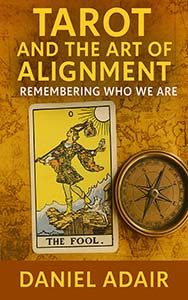
This is where my book, Tarot and the Art of Alignment, takes a different arapproach.
The central idea is surprisingly simple:
The wisdom we seek is not somewhere outside of us.
It is already within us.
The challenge is learning how to access it.
The Tarot provides a remarkably effective way to do exactly that.
Rather than telling us what to think, the cards help us listen.
Rather than asking us to surrender our authority to a teacher, they encourage us to develop trust in our own inner knowing.
Rather than offering one answer for everyone, they reveal the unique lessons, challenges, and opportunities present in each individual’s life.
In this model, the Tarot is not a fortune-telling device.
It is a mirror.
A guide.
A conversation with the deeper parts of ourselves.
Your Own Inner Teacher
One of the things I appreciate most about the Tarot is its simplicity.
A Tarot deck costs roughly twenty-five to thirty bucks.
Once you have it, the conversation can begin.
There are no monthly subscription fees. No expensive retreats. No advanced certification programs. No endless upselling.
Just you, the cards, and the wisdom waiting beneath the noise of everyday life.
The goal is not to find another guru.
The goal is to discover the teacher that has been quietly waiting within you all along.
And in my experience, the Tarot is one of the most powerful keys to that door.

