Was the Good Luck Fairy taking a bathroom break on the day you were born?
When your ship came in, were you at the airport?
Did your four-leaf clover turn out to be poison ivy?
If you’re one of the many people who feel like you came into this world under a cloud of bad luck, then The Wheel of Fortune may have an important lesson to teach.
The Archetype of Luck
The Wheel of Fortune is the Tarot’s great symbol of luck.
Every culture throughout history has recognized the existence of fortune, fate, chance, or providence—even if no one has ever managed to define exactly what luck is.
What we do know is that it seems wildly uneven.
Some people appear to be born under a lucky star. Opportunities seem to fall into their laps. They meet the right people at the right time. Doors mysteriously open.
Others spend their lives feeling like every door they approach has a “Closed” sign hanging on it.
Most of us live somewhere in between.
Luck is a remarkable force when you stop and think about it.
A successful investor can lose everything in a market crash through no fault of their own. Someone who has struggled financially for decades buys a lottery ticket on a whim and wakes up wealthy.
When Lady Luck smiles on us, everything seems to flow.
When she decides to leave, it can feel like nothing goes right.
The Wheel of Fortune represents that mysterious current moving beneath the surface of our lives.
The Old Interpretation
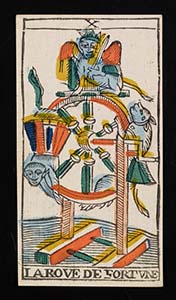
The older Tarot decks presented a fairly blunt message.
In the Tarot de Marseille, the wheel looks almost like a giant hamster wheel. Strange creatures ride its rim. One is climbing upward while another is tumbling down. At the top sits a stern ruler holding a sword, reminding us that fortune constantly changes.
The message is simple:
Up.
Down.
Up again.
Good luck.
Bad luck.
No one stays at the top forever, and no one remains at the bottom forever.
Waite’s New Interpretation
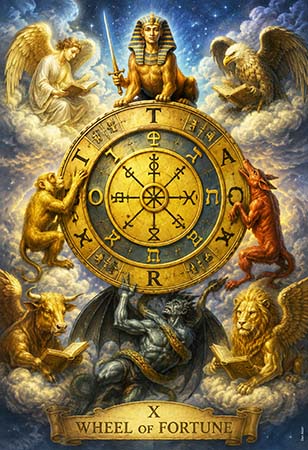
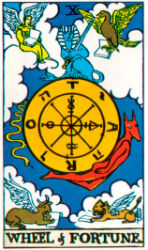
Arthur Edward Waite and Pamela Colman Smith transformed the image into something much more mysterious.
The crude wheel became a beautiful circular symbol filled with esoteric imagery. Around its rim are symbols drawn from alchemy, Hebrew mysticism, and ancient tradition. The dark figure that once ruled the wheel has been pushed to the bottom.
Now the highest point belongs to the Sphinx.
That change is significant.
The Sphinx represents wisdom, mystery, and understanding. Rather than brute force ruling our fate, wisdom now sits above the turning of fortune.
And then there are those wonderfully puzzling creatures in the four corners.
They’re the fixed signs of the zodiac—Taurus, Leo, Scorpio, and Aquarius.
For some reason…
…they’re all reading books.
It’s one of those delightful details that makes the Waite-Smith deck so fascinating.
So What Does It Mean?
The Victorian occultists didn’t deny the existence of luck.
Quite the opposite.
They believed that cycles of fortune were simply one of the natural laws of life.
Just as the tides rise and fall…
Just as the moon waxes and wanes…
Just as the seasons endlessly change…
Human beings move through cycles of prosperity and hardship.
The wheel turns.
It always has.
It always will.
The real question isn’t whether we can stop the wheel.
We can’t.
The question is whether we have to ride every revolution with it.
The four fixed signs may be offering an answer.
Unlike the creatures clinging to the wheel itself, they remain calm, steady, and detached. They aren’t fighting the motion below them. They’re quietly studying. Learning. Watching.
In other words, they’ve found a place that doesn’t move.
That’s the deeper lesson of the card.
We may not be able to control the cycles of fortune, but we can learn not to be controlled by them.
When life enters one of those stretches where everything seems to go wrong, we can remember:
This, too, shall pass.
Oddly enough, the more fiercely we struggle against a season of bad luck, the more we become entangled in it.
Acceptance isn’t surrender.
It’s stability.
The Wheel of Fortune reminds us that while the wheel keeps turning, we don’t always have to spin with it.
Perhaps that’s the greatest stroke of luck of all.