Doing Inner Child Work With the Tarot

Can Tarot help us understand the childhood we’ve forgotten? This Inner Child Tarot spread uses ten cards to explore the emotional world of your younger self—your home, caregivers, fears, needs, coping strategies, and the beliefs you carried into adulthood. Most importantly, it asks not only what your Inner Child needs from you, but what gifts your Inner Child may still be waiting to give you.

I like to think of the Six of Cups as the Inner Child card. It evokes nostalgia, childhood joy, innocence and the memory of a safe, comforting place.

But what if our childhood wasn’t safe and sweet?

One of the most interesting things about the Tarot is that we can use it to read the past as well as the future. That may sound a little paradoxical. After all, we KNOW our past already, don’t we? We lived it, so surely we ought to remember it.

Frequently, though, we don’t.

Doing Inner Child work can be frustrating because there may be whole stretches of childhood that we remember only vaguely—or seemingly not at all. Sometimes difficult or traumatic experiences leave memories that are fragmented, confused or difficult to access. A child may also have been too young to understand what was happening or to put it into words.

And sometimes we’re dealing with experiences that occurred before we had the language or conceptual ability to make sense of them. The child experienced the fear, loneliness, confusion or joy, but couldn’t create the coherent story that the adult mind expects to find later.

So our past can sometimes seem almost as blank and mysterious as our future.

And that’s where the Tarot can become interesting. Rather than using the cards to establish exactly what happened, we can use their symbolic language to explore the emotional landscape of the child we once were.
THE INNER CHILD READING

This simple ten-card reading can be used to explore a period of childhood that feels distant, unclear or emotionally significant. For this example, let’s imagine that we’re trying to understand ourselves at the age of eight.

1. The Child

Who was I at eight? Begin with the child herself, before considering everything that was happening around her. Don’t assume that the eight-year-old you was simply a smaller version of the person you are today. The intervening years may have made you remarkably strong, while the eight-year-old was frightened and vulnerable.

Or perhaps the opposite is true. Maybe the eight-year-old was a fearless little artist, explorer or dreamer whose creativity was gradually pushed underground.

Who was that child before the world finished teaching her who she was supposed to be?

2. The Home

What was the emotional atmosphere of my home? Was home a refuge or a place of anxiety? Was it warm and affectionate, emotionally distant, chaotic or unpredictable?

Did you feel free to relax and simply be a child, or did you need to remain alert to the moods and reactions of the people around you?

3. The Parents or Caregivers

How did I experience the adults responsible for me?

Notice that the question isn’t whether your caregivers were objectively “good” or “bad.” We’re interested in how the child experienced them.

You may have had genuinely loving parents who were nevertheless exhausted, overwhelmed or stretched too thin. Their intentions may have been loving while the child still experienced loneliness or neglect.

The Tarot card describes the child’s world.

4. School and the Outside World

How did I experience teachers, classmates, rules, achievement and the larger social world?

Was school exciting or frightening? Were you accepted by other children, or did you feel different from them? Were you encouraged by teachers, bullied by classmates, praised for achievement or made to feel that you could never quite measure up?

For many children, school is the first sustained encounter with a world beyond the family. What did that world teach you about yourself?

5. What I Needed

What emotional or psychological need was strongest at that age?

Perhaps you needed recognition, affection, protection or encouragement. Maybe you needed someone to listen to you. Or perhaps what you desperately needed was simply peace and quiet.

Try not to judge the need. Ask instead whether the child received enough of it.

6. What I Feared 

What made the eight-year-old feel unsafe, ashamed, rejected, powerless or uncertain?

Did you feel secure at home? Were the adults around you supportive or critical? Did you fear failure, punishment, abandonment or humiliation? Sometimes childhood fears seem trivial to the adult mind. They weren’t trivial to the child experiencing them.
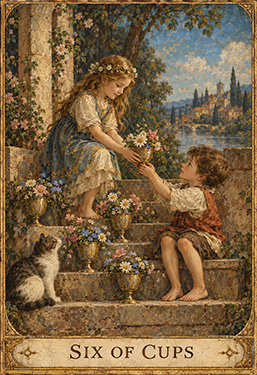
Six of Cups Poster – Available on Etsy

7. How I Adapted

What strategy did I develop to navigate that world?

This may be one of the most revealing cards in the reading. Perhaps you learned to become invisible. Maybe you became the good child, the funny child, the successful child, the rebellious child or the child who took care of everybody else.

Perhaps you escaped into books, art, fantasy or imagination.

What did the “little you” learn to do in order to function in the world?

8. What I Believed About Myself

What conclusion did the child draw from all of this?

This may be the heart of the reading.

Children naturally try to make sense of their experiences, but they don’t have an adult’s perspective. A child who isn’t receiving enough attention may not conclude, “My mother is exhausted and overwhelmed.” The child may conclude, “I’m not important.”

Those childhood conclusions can quietly become the beliefs through which we interpret our adult lives.

9. What I Carried Forward

What belief, behavior or emotional pattern formed then that the adult still carries?

Perhaps you learned to please everyone else while putting your own needs last. Maybe you learned never to ask for help, never to appear vulnerable or always to prove your worth through achievement.

The important question is whether the strategy that helped the child is still serving the adult.

10. What the Child Still Has to Give Me

What survived intact?

This card isn’t about what needs fixing. It’s about imagination, courage, sensitivity, humor, curiosity, independence, creativity, playfulness and wonder.

That’s another side of the Six of Cups that we sometimes overlook. Your Inner Child isn’t merely carrying wounds. Your Inner Child is carrying gifts.

What did that child possess that you need to reclaim?

TAROT IS NOT A MEMORY-RECOVERY DEVICE

There’s an important caution to all of this.

Tarot speaks through symbols, associations, emotions and intuition. A card may unexpectedly trigger an image, feeling or apparent memory, but that doesn’t establish that the event literally happened in the way we imagine it.

We’re exploring our experience of the past, not conducting a historical investigation.

Memory itself is reconstructive and imperfect, and attempts to recover supposedly hidden memories can sometimes produce sincere but inaccurate conclusions. That’s particularly important when a reading seems to suggest abuse or another serious event that you don’t independently remember.

The feeling may be real and worth exploring. The interpretation of its cause may or may not be.

If you’re dealing with a particularly traumatic childhood or powerful memories begin emerging during this kind of work, consider exploring them with a qualified mental-health professional rather than relying upon the Tarot to determine what happened.

And don’t be shy about it. Take your Tarot cards to your next therapy session.
RECEIVING THE GIFT FROM YOUR INNER CHILD

Too often, Inner Child work focuses entirely on what went wrong.

Sometimes that’s necessary. If we were mistreated, frightened, ignored or neglected as children, understanding those experiences can help us stop interpreting their consequences as evidence that something was inherently wrong with us.

But eventually another question becomes possible.

Instead of asking only: What went wrong? We can begin asking: What can I understand now that I couldn’t understand then?

And finally: What does that child still have to give me?

Perhaps that’s the deeper message of the Six of Cups. The child we once were isn’t simply waiting somewhere in the past to be rescued. She may also be waiting there with something we left behind.
The Tower Card – Anatomy of a Nervous Breakdown

Exploring the healing side of The Tower card through a Jungian perspective.

As Above, So Below.

As Within, So Without.

— The Kybalion

Most discussions of The Tower card in the Tarot focus almost entirely on what is happening in a person’s outer world.

And that’s understandable. It’s a dramatic card.

When The Tower appears, we think of events like divorce, losing a job, bankruptcy, foreclosure, the collapse of a relationship, or some other sudden upheaval. The outer destruction can be breathtaking.

But as the old Hermetic principle suggests, whatever is happening in our outer lives is also reflected in our inner lives.

When the structure of our exterior world collapses, something often collapses inside us as well.

That inner destruction is what we used to call a nervous breakdown.

Everything we believed to be true is suddenly called into question. Relationships with people we trusted crumble into dust. Beliefs we held dear for most of our lives are revealed to be false. The future we thought we understood disappears.

We find ourselves psychologically adrift. We have lost our place in the world, and we cannot seem to figure out how to get back to normal.

In Jungian terms, The Tower can be understood as the sudden and sometimes catastrophic dismantling of a rigid psychological structure. An outgrown persona, a false framework, or a collection of deeply held illusions can no longer withstand reality.

Something has to give.

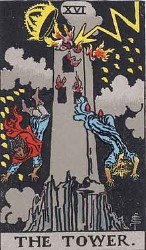
And the symbols contained in The Tower provide a remarkably clear roadmap of that process.

THE CROWN

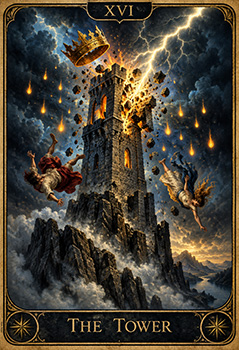
At the top of the tower is a crown, blasted away by the lightning strike.

Psychologically, the crown can represent the sovereignty of the conscious ego—the part of us that believes it understands what is happening and has things under control.

To put that more plainly, we all have to believe in ourselves.

When we get up in the morning, we need to believe that we are sane, that the world is reasonably predictable, and that what we do during the day will make sense and help keep us safe.

That is the everyday ego.

It goes to work. It pays the bills. It buys the groceries. It makes appointments. It solves problems. It deals with all those other human beings who are out there trying to do exactly the same thing.

Most of the time, it does a pretty good job.

But what happens when our predictable, manageable world completely falls apart?

What happens when we discover that our partner has been cheating on us? What happens when we lose the job we thought was secure? What happens when our finances collapse, our health fails, or something else occurs that simply cannot be fitted into the story we have been telling ourselves?

That wonderful daily wizard—the ego—suddenly doesn’t look so powerful.

The part of us that we believed would always keep us safe, solve the problem, and keep the car between the white lines suddenly has no idea what to do.

There is an old expression heard in twelve-step programs:

“My best thinking got me here.”

That is the crown being blown off the tower.

The Tower Poster – 13 X 19 Inches – Available on etsy

THE LIGHTNING STRIKE

And the moment we finally realize that we have really and truly lost control can feel like being struck by lightning.

It comes as a sudden flash of recognition—a crisis of the mind.

We may have spent months or even years denying that anything was seriously wrong.

“No,” we tell ourselves, “my partner couldn’t possibly be cheating on me. Those secretive phone calls and motel receipts don’t necessarily mean anything.”

Or perhaps we keep telling ourselves that we are just a little short financially this month.

Yes, we were short last month too. And the month before that. But things will turn around. We just need to tighten the budget a little more.

Until suddenly the truth becomes impossible to avoid.

We realize that we have been lying to ourselves.

And we are in real trouble.

That is the lightning strike.

The illusion doesn’t gradually fade away. For one terrible instant, we see through it.

And once we have seen the truth, we cannot completely unsee it.

THE FALLING FIGURES

The two figures blasted from the tower can represent the parts of ourselves that can no longer remain protected inside the old psychological structure.

We cannot hide in our intellectualizations and rationalizations anymore.

We built this magnificent structure called “my life.”

It protected us. It gave us an identity. It told us who we were, what mattered, whom we could trust, and what tomorrow was supposed to look like.

Now we have been thrown out of that safe little nest.

We are in psychological free fall.

There is nothing to hold on to because the things we once held on to are precisely the things that are collapsing.

But there is another way to look at those falling figures.

They are being grounded.

Literally.

They are falling out of an artificial structure and back toward the earth.

Toward reality.

The experience may hurt like hell. It may scare us half to death. But if we survive the fall, we have something we did not have while we were safely locked inside the tower:

The possibility of starting over.

Because now we have to.

THE GOLDEN SPARKS

Look carefully at the Waite-Smith Tower and something else is falling alongside the two figures.

Twenty-two golden drops or sparks surround the tower.

There are several ways of interpreting them. From a Jungian perspective, we might see them as psychic energy released when an old structure breaks apart. Spiritually, they can suggest something even more intriguing: illumination arriving in the middle of catastrophe.

The card is not simply about destruction.

It is about the destruction of a structure that can no longer contain who we are becoming.

At the very moment our old world is falling apart, new possibilities are appearing.

That doesn’t make the destruction pleasant.

It doesn’t mean we should pretend that loss isn’t loss, or pain isn’t pain.

But it suggests that destruction and creation may sometimes be two parts of the same process.

We cannot discover who we really are while clinging desperately to an identity built from fear, illusion, habit, or other people’s expectations.

The curse of The Tower is that everything we believed in may be falling apart.

The blessing is that we are finally free to discover what remains when it does.

And from there, we can begin again.

INDIVIDUATION

Perhaps the greatest difficulty with The Tower is that it feels like an ending.

Our world has been blown apart.

But psychologically, the ending may only be one stage in the process Carl Jung called individuation—the lifelong process of becoming a more whole and authentic individual.

As I said at the beginning, we all need a coherent story about ourselves in order to function.

But when that story becomes increasingly dependent upon denial, rationalization, self-deception, or an identity we have outgrown, maintaining it requires more and more energy.

Eventually reality catches up with us.

Eventually the false edifice comes tumbling down.

Jung used another wonderfully complicated word that is particularly appropriate to The Tower: enantiodromia.

Put very simply, it describes the tendency of something pushed too far in one direction to produce movement toward its opposite.

Psychologically, what we refuse to acknowledge does not simply disappear. The more rigidly we cling to one side of ourselves or one version of reality, the more pressure can accumulate in what has been excluded.

Eventually something breaks through.

In the language of Tarot, lightning strikes the tower.

When we become stuck in our own falsehoods—in the stories we tell ourselves and sometimes everyone around us—life has an uncomfortable way of getting us unstuck.

One way or another.

The false structure is burned down to its foundations so that something more authentic can eventually be built in its place.

And that may be the most important thing to understand about The Tower.

We naturally stare at the lightning.

We stare at the flames.

We stare at the people falling through the darkness.

But the destruction is not the entire story.

The Tower is also the clearing of ground.

Something false has ended.

Something real can now begin.

Yes, the burning tower is what catches our attention. But the deeper message of The Tower may be the healing that becomes possible after the destruction.

The High Priestess and the Art of Being an Empath

Surviving as an empath in a world of mixed signals.

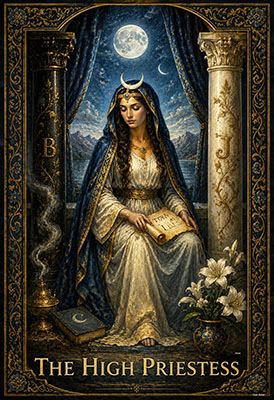
The High Priestess – 13 X 19 – Available on Etsy

Are You an Empath?

Have you ever walked into a room, greeted someone you’ve never met, and instantly known they were angry, grieving, anxious, or quietly celebrating something wonderful?

If so, here’s a piece of advice.

Don’t say anything.

Seriously. Don’t.

Most people don’t enjoy discovering that someone can see behind the mask they’re presenting to the world.

The High Priestess

In an earlier post, I described the High Priestess as the Tarot’s archetype of intuition.

She sits between two pillars—one black and one white—representing the meeting of opposites. I like to think of her as standing where logic and intuition meet, where analytical thought gives way to sudden flashes of knowing.

That’s how intuition often feels.

It doesn’t arrive through careful reasoning.

It simply appears.

The answer is just…there.

The Empath’s Antenna

Being an empath can feel like walking through life with an extra antenna attached to your nervous system.

You notice things that other people miss.

Not because you’re reading minds, but because you’re reading people.

A slight hesitation.

A forced smile.

A shift in someone’s tone.

The energy in the room changes, and somehow you already know why.

For many empaths, this isn’t something they consciously do. It feels as natural as seeing colors or hearing music. They aren’t sitting there analyzing people.

They simply know.

Why It Makes People Uncomfortable

Here’s the problem.

Most people carefully manage what they reveal to the world.

Carl Jung called this the persona—the social mask we wear. It’s the version of ourselves we’re comfortable showing other people.

We’re happy for people to know our hobbies, our opinions, or what we do for a living.

We’re far less comfortable with them seeing our fears, our grief, our insecurities, or the parts of ourselves we’re trying to hide.

When an empath quietly senses those hidden emotions, people often feel exposed—even if the empath never intended to pry.

That can make them uncomfortable.

Sometimes it even makes them defensive.

Can We Turn It Off?

Many books about empathy focus on building stronger boundaries.

That’s good advice.

If empaths absorbed every emotional signal around them all day long, they’d quickly become overwhelmed.

But completely shutting down our intuition isn’t really the answer either.

Empathy is a gift, much like sight or hearing.

We don’t solve the problem by pretending we can’t see.

The Real Secret

The real skill isn’t becoming less intuitive.

It’s becoming more discreet.

Just because you know something doesn’t mean it needs to be spoken.

Sometimes people aren’t ready.

Sometimes they aren’t asking.

Sometimes the kindest thing you can do is quietly understand without announcing that you understand.

That’s the High Priestess at her best.

She knows.

But she doesn’t feel compelled to prove that she knows.

She observes.

She waits.

And when the moment is right, she speaks.

Until then, she simply smiles—and keeps the mystery alive.

Recovery, Shame, and The World Card

In therapy or recovery but still haunted by your past? This post explores how The World card can help transform shame and regret into growth. By embracing even painful histories, we can find “closure without a bow” — turning painful memories into guides instead of burdens.

Are you in recovery from alcoholism or addiction but still feel really deep shame about your past?

Are you in therapy but just can’t seem to shake off the depression and anxiety that springs from old beliefs and the ghosts of trauma?

Believe me – you’re not alone.  Many of us can stay sober or work our asses off in counseling, but still feel like we’re going through it with a cinder block chained around our necks.  Guilt, shame, and memories of what we were can weigh us down to a point where we’re almost paralyzed.

The World card from the Tarot can offer a powerful lens for looking at this struggle and finding a way forward.

A SYMBOL OF COMPLETION

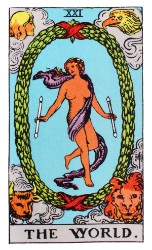
In its traditional meaning, The World card celebrates the completion of one cycle and moving onto the next one.  It’s the, “and they lived happily ever after,” card for, “normal,” people

For instance, a person might leave their job after many successful years and move on to another one that presents new challenges.

Or perhaps a parent has spent 18 years raising a child and when the kid goes off to college, the parent finally has time for her own dreams.

Or maybe a writer has spent 2 years putting a book together, it’s finally been published, and now they’re moving on to a new project.

The common theme there is that all of these people can look back and honestly say, “Well done.”

But what happens when we look back at our past and all we can say is, “Oh, christ, what a freaking mess.”

WHEN SATISFACTION ISN’T POSSIBLE

For many of us, the past doesn’t exactly sparkle with bright and cheery accomplishments.  Instead, it can feel like an extended disaster zone.

Maybe we worked at the same job for years and got fired because of poor performance.

Perhaps we wasted many years in a toxic, codependent relationship.

Or we might have been so drunk or drugged up that we destroyed everything and everyone we touched.

Trying to get into a sustained recovery can seem almost impossible under the weight of regret.  The question is:  How do we process all of this and move on to a new life?

WHAT DOES AA SAY ABOUT IT?

When I was trying to help a relative get into recovery, I sat through literally hundreds of Alcoholics Anonymous meetings with her.

Let me hasten to say, I’m not trying to push an AA agenda or wave a Big Book in your face.  It works for some people, it doesn’t work for others, and it’s not everyone’s cup of tea.

What really struck me in those meetings, though, was that some of their members had figured out a way to do this.  They’d sit there and calmly tell the most horrific stories imaginable about their drinking careers and then talk about how happy they were now.

The phrase that was always repeated was, “We will not regret the past nor wish to shut the door on it.”  There are two powerful statements in that:

1 – Even if we totally screwed up, we can CHOOSE not to regret it.

2 – We don’t slam the door on it or pretend that it never happened.

It’s not about denying the past.  It’s about reclaiming it.

FACING THE PAST WITH COURAGE

Facing what we’d rather forget requires a lot of courage, and we need to give ourselves credit for that struggle.  It can also mean that we can mine a few diamonds out of the sewage and become better human beings.

The heartbreak of being totally broken can teach us greater compassion for those who are still struggling.

The mistakes that we made can teach us humility.  It’s mighty hard to look down on someone else when you’re lying in a gutter.

The chaos that we endured can teach us resilience and we can realize how strong we truly are to have survived it.

True courage isn’t erasing our story but owning it without shame.

LESSONS FROM NOT SHUTTING THE DOOR

When we keep our past in view – without wallowing in it – we transform it into guidance.  Painful memories can evolve into teachers, showing us what to avoid and what truly matters.

Even more, our honesty can become a gift.  By sharing our experiences, we offer others a road map through their own dark terrain.

We can look at a friend, a lover, or a neighbor and honestly say, “Oh, man, I know what you’re going through.”  Because we do.

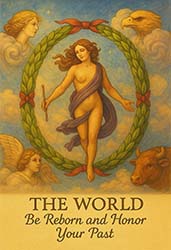
The World Affirmation Poster available on my etsy site

CLOSURE WITHOUT TAKING A BOW

I guess that there are, “normal,” people who live more or less all of the time in Happy Land.  They move from one wonderful accomplishment to the next and life comes at them with ease and grace.  That’s what The World card is all about.

For the rest of us, closure means accepting the whole mess that we may have made of things and integrating it, rather than forgetting it.  We accept the fact that we’ve had a lot heavier karma to deal with than most people.  

And we remind ourselves that wholeness isn’t about perfection.  It’s about embracing all that we are as human beings – our triumphs, our failures, and the courage it takes to live through them.

Impostor Syndrome and The King of Wands Reversed

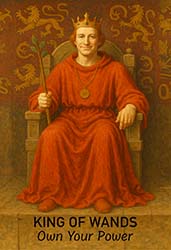
The King of Wands reversed shines a light on impostor syndrome — that nagging sense of never being “good enough.” Learn how this Tarot archetype mirrors self-doubt and discover practical steps to reclaim authentic confidence, reverse the distortion, and own your rightful place at the table.

Do you never feel “good enough?”

Do you feel like, no matter how hard you try, no matter how much you do, you’re still falling short?

Does it seem as if everyone around you somehow has more talent, more luck, and is more deserving than you are?

That’s called, “Impostor Syndrome,” and it can destroy our lives.

WHAT IS IMPOSTOR SYNDROME?

Put very simply, it’s the persistent feeling that we’re a fraud, even when the evidence in our life says otherwise.

Self-doubt becomes a constant companion and we dismiss our achievements as, “a fluke,” or, “just good timing.”  Even worse, there’s a chronic fear that someday we’ll be found out, that everyone else will realize that we’ve just been bullshitting our way through life and we don’t have any real substance.

It’s quite common among people who grew up in abusive households because that’s one of the primary messages that they got as kids:  “you’re not good enough.” No matter what you do, you’re still not good enough.

It’s especially common among creatives, leaders, and anyone who’s stepping into a new role in life.  Exactly the people who are already stretching themselves into growth and success.

THE KING ON A SHAKY THRONE

In the Tarot, the King of Wands represents the exact opposite of impostor syndrome.  He radiates confident leadership.  He’s the charismatic leader who can stand firmly in his own power and inspire the people around him.

But reversed?  His fire dims and he hesitates.  His self-belief falters and instead of leading with boldness he spirals into self-doubt.

That’s where Impostor Syndrome rears its ugly head:

Self-doubt in leadership.

Fear of being, “Found Out’ and huge anxiety that others will see through the facade.

Inconsistent Confidence and swinging between moments of brilliance and moments of total collapse.

Avoidance of responsibility and shrinking back from visibility and opportunity.

Overcompensation and burnout where we work WAY too hard to prove our worth until exhaustion sets in.

The King of Wands reversed is the perfect representation of Impostor Syndrome at work.

King of Wands Affirmation Poster available on my etsy site.

HOW TO OVERCOME IT

There’s an old joke that says that if you feel the need to ask your therapist if you’re a narcissist, you’re not one.  The same thing applies to Impostor Syndrome.  If you’re constantly full of self-doubt, you probably shouldn’t be.

The gift of the Tarot is that no card is fixed.  The King of Wands can always be turned upright again and so can our confidence.  Here are a few simple practices that can reverse Impostor Syndrome:

1 – Keep a, “proof journal.”  Write down ALL of our wins, big and small, to create a counter-narrative to the voice that’s telling us that we’re, “not good enough.”  And if that feels uncomfortable, it’s just proof that we really need to do it.

2 – Normalize mistakes.  People with Impostor Syndrome don’t just regret it when they screw up – they beat themselves into a bloody pulp over it.  Every artist, every writer, every visionary stumbles.  That’s part of the growth curve.  As Julia Cameron said, “In order to become a good artist, you have to first give yourself permission to be a bad artist.”

3 – Talk it out.  When we share our doubts with a trusted friend or therapist we get the realistic feedback we need.  When we tell someone we love that we feel like a total fuck-up they will frequently be amazed and even appalled that we could perceive ourselves that way.  Basically, that’s just, “borrowing someone else’s eyes” and they may see our brilliance and talent far more clearly than we can.

THE ONLY IMPOSTOR IS OUR SELF-DOUBT

The King of Wands reversed reminds us that Impostor Syndrome isn’t the truth.  It’s a distortion, an illusion that doesn’t need to define our reality.

Turn the card upright and loosen the chains of self-criticism.  Step into the fiery confidence that we should have and that we deserve.

We’ve already earned our places at the table. Now own it.