Temperance: Finding the Right Proportion

The Temperance card as a personal balancing act.

Temperance is usually defined as moderation, balance, and avoiding extremes. But the imagery of the Tarot suggests something more precise. Temperance is not simply about having less of something—it is about discovering the right proportion between different forces in our lives.

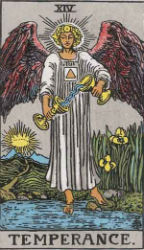
At first glance, Temperance can seem like one of the simpler cards in the Major Arcana. An angel stands quietly, pouring liquid from one cup into another. One foot rests on the earth while the other stands in water. Behind the angel, a path winds toward distant mountains and a brilliant golden light.

Nothing particularly dramatic is happening.

But perhaps that’s the point.

Temperance is about the delicate process of bringing different parts of ourselves—and different parts of our lives—into the proper relationship with one another.

Temperance as a Cardinal Virtue

Temperance is one of the traditional cardinal virtues, along with Justice, Fortitude and Prudence. Three of these virtues survive quite recognizably in the standard Tarot: Justice, Strength (Fortitude), and Temperance. Prudence is conspicuously absent. (For more on the missing Prudence card, see my previous post Dear Prudence – The Mysterious Case of the Missing Tarot Card.)

In older Tarot decks such as the Tarot de Marseille, the imagery of Temperance is considerably simpler than that of the Waite-Smith card. We generally see an angelic figure pouring liquid between two vessels.
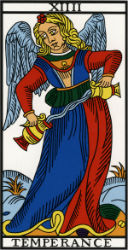
To modern eyes, pouring something from one cup to another may not immediately suggest moderation. Historically, however, the connection was much more obvious.

The older meaning of temperance was not merely abstaining from excess. The Latin root temperare carries the sense of regulating, combining or mixing things in the correct proportions. Water and wine, for example, could be mixed so that the strength of the wine was tempered.

This gives us the fundamental symbolism of the two cups.

Temperance is creating the right mixture.

And importantly, the right mixture does not necessarily mean equal amounts.
Balance Doesn’t Always Mean 50/50

We often visualize balance as equality. Put the same amount on both sides of a scale and equilibrium is achieved.

Temperance offers a different model.

Suppose you’re making soup. Equal quantities of salt and water would certainly represent equality, but they wouldn’t produce anything you’d want to eat.

The ingredients have to be present in the proper proportions.

The same principle applies to life.

We need work and rest, but that doesn’t mean twelve hours of each every day. We need independence and connection, reason and emotion, discipline and spontaneity. What constitutes the right balance changes according to circumstances.

Temperance therefore represents something more sophisticated than simply avoiding extremes. It asks:

What does this particular mixture require?

That is a dynamic form of balance. The liquid in the card is moving because maintaining equilibrium often requires continual adjustment.
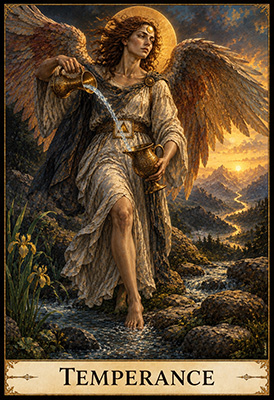
Temperance Poster – 13 X 19 – Available on Etsy

One Foot in the Water, One on the Land

A. E. Waite and Pamela Colman Smith greatly expanded the symbolism of the older Tarot image.

One of their most famous additions is the angel’s peculiar stance: one foot rests on dry land while the other is immersed in water.

Water traditionally represents emotion, intuition, imagination and the unconscious. Solid ground suggests physical reality, stability, practicality and the tangible world.

The angel doesn’t choose between them.

It participates in both.

We could read this very simply as advice to feel deeply without losing our grounding.

Someone who lives entirely through emotion may be swept along by every changing feeling. Someone who insists upon remaining completely rational and controlled may become disconnected from intuition and emotional reality.

Temperance asks for neither extreme.

It asks us to discover the useful proportion between them.

Head and Heart

Something similar appears in the symbols placed upon the angel’s forehead and chest.

It’s entirely possible that these were meant to represent the influences of the heart and brow chakras. And their placement naturally suggests another important polarity.

Head and heart.

Thought and feeling.

Reason and intuition.

Again, the card does not tell us which should win.

Imagine someone deciding whether to remain in a difficult relationship. Their emotions may say one thing while the observable facts say another.

Temperance doesn’t necessarily say, “Ignore your feelings and be rational.”

Nor does it say, “Follow your heart regardless of the evidence.”

Instead it asks the person to bring both sources of information into the same vessel.

What do I feel?

What do I know?

And what conclusion emerges when both are given their proper weight?

That’s Temperance at work.

Justice Weighs; Temperance Blends

This also gives us an interesting distinction between two of the cardinal virtue cards.

Both Justice and Temperance concern balance, but they achieve it differently.

Justice balances by weighing.

Temperance balances by blending.

Justice holds a scale. Separate things are compared against one another until equilibrium is established.

Temperance pours one thing into another. The elements aren’t merely compared—they become part of a new mixture.

That makes Temperance particularly useful when apparently contradictory needs are both legitimate.

Perhaps someone is pursuing an important creative project but becoming exhausted.

The answer isn’t necessarily to abandon the project. Nor is it necessarily to push harder.

Temperance asks a different question:

What proportion of work and restoration will allow the work to continue?

Perhaps the problem isn’t the goal at all.

The mixture is wrong.

The Path Toward the Light

Behind the angel is another important feature: a winding path disappearing into the distance.

It eventually reaches mountains beneath a brilliant golden light, within which appears something resembling a crown.

This introduces movement into an otherwise remarkably still card.

The angel isn’t walking along the road. The angel stands quietly performing the work of integration.

The road comes afterward.

That suggests a beautiful practical interpretation of Temperance. Sometimes we cannot see how to move forward because something within our present situation is badly out of proportion.

We may be working too much and recovering too little.

Thinking endlessly and feeling too little.

Giving constantly and receiving nothing.

Dreaming without acting—or acting without considering where we’re going.

When those elements are brought back into a workable relationship, the next step may become much easier to see.

The balance isn’t the destination.

The balance makes the journey possible.

Temperance in a Tarot Reading

When Temperance appears in a reading, the familiar advice to practice moderation is perfectly valid—but we can make it considerably more useful.

Temperance may be saying:

Something here needs to be brought into better proportion.

That might mean less of something, but it could equally mean more of something that has been neglected.

Too much work may require rest. Too much caution may require a little risk. Excessive emotional involvement may need perspective. Excessive intellectualization may need feeling. Constant giving may need to be balanced by receiving.

The card can also suggest that two things we’ve been treating as opposites don’t actually require an either/or decision. Perhaps they can be combined.

And that brings us back to those two cups.

The angel continually pours between them, adjusting the mixture.

Temperance isn’t asking us to eliminate one part of ourselves in favor of another. It asks us to discover how the different parts belong together.

Find the right proportion. Integrate the opposites. And when the mixture is right, continue along the path.
The Angels of the Tarot

Exploring the various types of angels that are depicted in the Waite Tarot Deck.


There are ALOT of angels flying around in the Major Arcana of the Tarot.

the-lovers

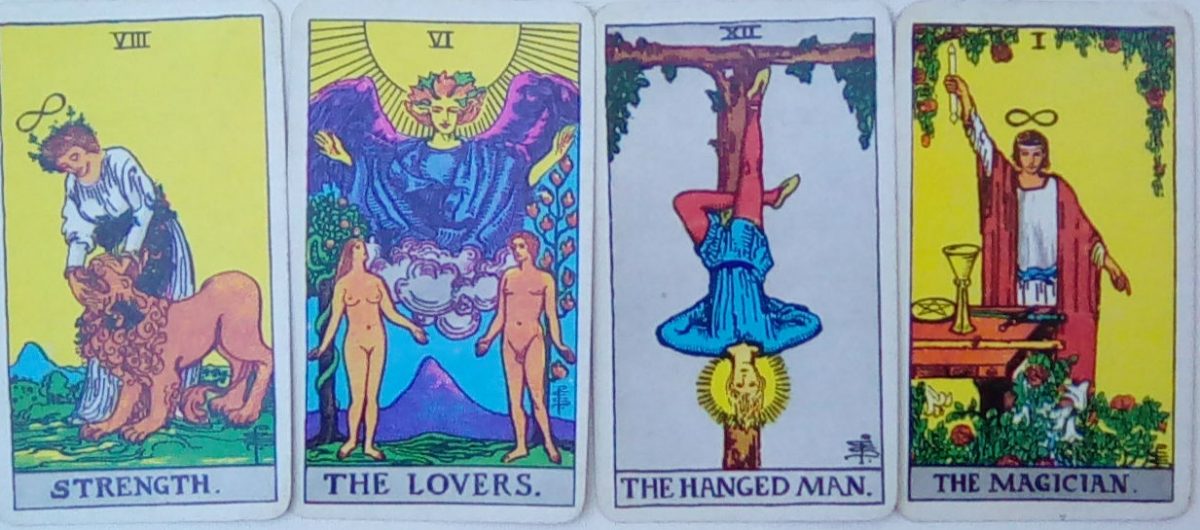
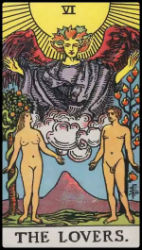
The first one to appear is in The Lovers, hovering over Adam and Eve, arms outstretched, while the crafty snake twines around an apple tree.  One assumes that this snapshot was taken BEFORE Uppity Eve decided that she just had to have a goddamned apple for breakfast, because the angel seems to be protecting or blessing them as they stand there.  After her snack, of course, god went into a major psychotic rage and the angel drove them out of the garden with a flaming sword. (“She ate AN APPLE! That bitch ate one of my apples! How dare she? They’re MY apples. I’ll show her!  I’ll throw her skinny ass right OUT of Paradise. I’ll get you, my pretty, and your little dog, too!”)

Jewish tradition holds that the angel who tossed them out was Jophiel, which is odd because she seems like a pretty nice angel.  She’s known as, “the angel of beauty,” and she’s shines beautiful thoughts into people’s hearts and helps addicts and artists.

wheel

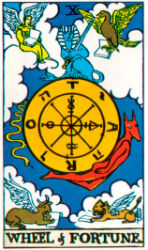
The next angels to appear are the Cherubim and we see them in both The Wheel of Fortune and The World.  Cherubim have four faces, one of an ox, a man, and eagle, and a lion. The human face fits on the front and the lion face goes on the right and ox goes on the left and the eagle face goes . . . somewhere else.  Must be on the top or the back, right?

What else?  They have two sets of wings that join together.  The top set is to fly around with and the bottom set they use to cover themselves up.  For why, I don’t know. (Ezekial 1:6)

So, as near as I can tell, they look sort of like giant dragonflies only they have four faces which are placed right, left, middle, and somewhere else.  And to think they didn’t even have LSD when they wrote this . . .

We should note that cherubim are NOT cherubs as we know them on Valentines Day cards.  The cute, cuddly little guys who shoot arrows into your heart are actually putti.  That’s right, they’re putti.  Cutey puttis. Look it up.

Also, apparently the Cherubim guard the gates of the Garden of Paradise so Uppity Eve can’t sneak back in for another apple, though it’s not clear if Jophiel (remember Jophiel?  Nice angel? About 5 foot 4, blonde hair?) is a Cherub.

Also, Satan was a Cherub.  Who knew, right?

temperance

The next angel, who is pictured in the Temperance card, is . . . well . . . the Temperance angel.  I’ve done a lot of research on him/her and no one seems to know who she/he is, although they all agree that he/she is either of both sexes or no sex, which would make he/she an it, rather than she/he. We know that Temperance is one of the christian cardinal virtues so perhaps the angel is merely supposed to be an allegorical reference to our better self.

devil (1)

The next to the last angel is The Devil.  And perhaps I’m taking a leap here that isn’t justified.  There are so many christian symbols in the Tarot that it seems logical that if they’re referring to The Devil they probably mean Satan who, as noted above, is a Cherub and NOT a putti.  NOT A PUTTI!

On the other hand, he could be Beelza Bubba, or whole bunch of other fallen angels.  Or the idea of evil itself. Still, it seemed better to err on the side of caution and include him.

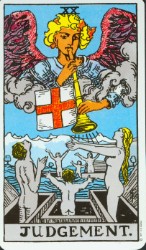
judgement

And the last angel is the angel blowing the horn on the Judgement card to summon the dead out of their graves.  We can probably go out on a limb and say that this is Gabriel the Archangel. Anal retentive biblical scholars will point out to you that the bible doesn’t say it was Gabriel and, in fact, the bible doesn’t even mention Gabriel and in fact the only archangel that the bible even mentions is Michael.

But we all know it’s Gabriel.  Gabriel’s the one with the horn.  Everyone knows that.

Angels.  What a trip!  If you want to take a deep dive into angelology (yes, there IS such a word) Wikipedia has an extremely detailed article here.

If you’re interested in exploring your personal relationship with angels and spirit guides  DailyOm has several good courses with guided visualizations here.


“Just the Tarot,” by Dan Adair – available on Amazon

Temperance in the Tarot

The meaning of the Temperance card in the Tarot, including definitions for both the upright and reverse positions.

temperance

An angel stands on the edge of a placid body of water, one foot on the ground and one foot in the water.  She holds a chalice in each hand and is pouring water from one into the other. A shining solar disk is on her forehead and a triangle is emblazoned upon her chest.  A road runs off into the distance where a crown glows like the sun just beyond a range of mountains.

Upright: This is one of those cards that’s always sweet to find in your reading.  It basically means nothing’s wrong and everything’s right. You’re in the flow and life is good.

This card often appears after the questioner has gone through a difficult phase in life and has earned a period of peace through his or her hard work.  It may indicate tranquility in life in general or in specific areas of life such as relationships, work, or home. Look at the surrounding cards for clues.

Above all else, this card talks about balance and peace.  Psychologists interpret water as representing emotions in dreams.  The angel has one foot in the water and one foot on land, indicating that she can fully indulge in emotions while staying well grounded.

This is not a card of gain, per se.  The water being poured from one cup to the other is not increasing, it stays the same.  The message is that the questioner has enough just as it is.

Reversed – This may indicate a period of intemperance of some sort.  It could be drinking too much, partying too much, working too much, even worrying too much.  The key here is to carve out a little time for peaceful reflection and rest. Do some yoga or tai chi.  Curl up with a book. Take a bubble bath. Chill.

If you have questions about this card or its meaning in one of your readings, please don’t hesitate to leave a comment.  I’ll get back to you as soon as I can.

A Few Extra Thoughts About Temperance

Temperance is one of the most under-defined cards in the Major Arcana, so it can be kind of fun to look at.  The standard quickie definition is that it stands for moderation which is probably true on a certain level since the card was, indeed, originally named, “Moderation.”

So, if a questioner draws the Temperance card you can just say, “Well, it looks like this is a period of moderation and balance in your life.”  If it’s reversed you can just say, “You’re really drinking like a swine, you sot.”

Just kidding.  

“You may be overdoing your recreational libations a tiny bit.”  There, that’s better.

Aleister Crowley named this card, “Art,” in his Thoth Tarot deck.  A trifle puzzling until you realize that he was referring to the art of alchemy.  And there is strong symbolism in the card showing the mixing of two different elements in the two chalices just as the alchemists did in their rituals and experiments.

Arthur E. Waite flipped off into some weird place with his definition, stating:  “All of the conventional symbols are renounced herein . . . So also are the conventional meanings.”

Okay . . .  I’m guessing they didn’t know that the hell to make of it, either.

This particular image – a woman pouring water from one jug to another – was actually all over Europe prior to the first recorded publication of the Tarot.

temperance2

That might be expected since Temperance is one of the four cardinal virtues of the catholic church.  The usual take on it is that the woman is mixing water with wine, thus diluting the effects of alcohol and showing temperance.

But then the Tarot – as usual – does something a little weird with the image.  The woman is converted into an angel, even in the very early decks. Why?

temperance3

My theory – and it’s only a theory – is that the card may refer to another meaning of the word, “temperance.”  As in, “to temper.”

If you want to make a metal harder or more flexible you add other metals to it when it’s in a molten state to change the composition of the material.  You take it’s basic nature and you add something that changes it but builds on that basic nature without destroying it.

This card might very well refer to the adding of a, “divine element,” to basic human nature.

We’ve all seen the, “ancient aliens,” shows where they expound on the fact that something radical happened at one point in our species history.  We share so many of the characteristics of our simian cousins that the link between us and the apes is undeniable. Yet, somehow, sometime, somewhere, something happened that caused us to be entirely different is so many ways.  We developed agriculture, art, philosophy, science, religions, etc., etc., etc.

The ancient aliens take on it is that some higher species flew down in their space gizmos and fiddled around with our basic DNA to manipulate us into a more advanced  species. Just exactly WHY they did that isn’t quite clear. Maybe they were on a picnic and they were bored.

An equally unprovable theory (which I happen to like better) is that human souls began incarnating in simian bodies and that the DNA changed over time to match the souls.  Thus the angel mixing up a fresh brew of whatever is in those two chalices, literally adding a, “divine spark,” to the body of an ape.

Dr. Candace Perk demonstrated that our brains manufacture neuropeptides that match our emotional states and that these bond with receptor cells throughout the body.  Without going into too many boring details our emotions literally manufacture our bodies cells and that recurs about every 2 months.

So why couldn’t a Higher Soul in a simian body literally remanufacture it?

It’s an intriguing question.  I’d always looked at the road in the background of this card as leading AWAY from the angel and the distant crown as a goal to be achieved through the practice of moderation.  But maybe that’s the road that the angel just walked down, from the divine . . . to us.

Sound too weird to be true?  Hey . . . Donald Trump is the President of the United States.  All weirdness is now on the table.

Just the Tarot by Dan Adair, a kindle ebook available on Amazon