The Emperor and the Empress: Two Very Different Ways of Living

The Emperor seeks control, structure, and achievement. The Empress finds abundance through harmony, receptivity, and enjoyment of life. Discover what these two Tarot archetypes reveal about Western culture—and how balancing their energies can lead to a happier, more fulfilling life.

The Emperor and the Empress are obviously two of the paired cards in the Tarot, but they represent two very different kinds of energy.

In fact, I would maintain that they represent two fundamentally different ways of being in the world.

They aren’t simply personality traits or psychological tendencies. They represent two different philosophies about how life works, how we should approach it, and what we need to do to find happiness and abundance.

The Emperor believes that we create a good life by taking control of it. The Empress believes that we create a good life by learning to live in harmony with it.

And here’s where things get interesting: Western civilization has largely embraced the Emperor’s approach to life, while treating the Empress’s philosophy as something vaguely impractical.

But is the Emperor’s way necessarily the better one?

Forget the Genders

We probably shouldn’t even have to say this anymore, but when we talk about Empress energy and Emperor energy, we’re not talking about males versus females.

The Empress isn’t simply the feminine side of the Emperor, and the Emperor isn’t the Empress without breasts.

Every human being contains masculine and feminine qualities, yin and yang, testosterone and estrogen. If the Empress turns up in our Tarot reading, she may well represent a woman in our lives. Or she may represent a man with a great deal of yin energy.

And the Emperor can just as easily represent a woman who approaches life through discipline, structure, and control.

What we’re really talking about are two different orientations toward existence.

And whichever one predominates in our personality can profoundly influence how we experience the world.
Empress Energy: Living in Harmony With Life
As I wrote in my free ebook:

“The Empress wants abundance. She wants you to embrace the richness of life, nurture what you love, and allow your creativity to flourish.”

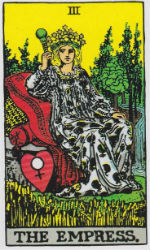
Take a good look at the Empress in the Rider-Waite-Smith Tarot.

She’s reclining comfortably on something resembling a luxurious settee rather than a formal throne. She holds a scepter of power, but she grips it loosely, almost as an afterthought.

She’s surrounded by lush vegetation, ripening wheat, and flowing water. Her shield bears the symbol of Venus, the planet traditionally associated with love, beauty, and pleasure.

There’s no palace, no fortress, and no indication that she’s particularly concerned about defending her territory.

She seems to be telling us, “I exist in the natural world, and the natural world is my palace and my riches.”

The Empress doesn’t need to conquer the world to enjoy its abundance.

She already belongs to it.

And that distinction is enormously important.

Emperor Energy: Creating Order From Chaos

Now let’s look at the Emperor.

As I wrote in that same ebook:

“The Emperor wants order. He wants you to take command of your life, establish a solid foundation, and create the structures necessary to achieve your goals.”

The Emperor presents a very different picture.

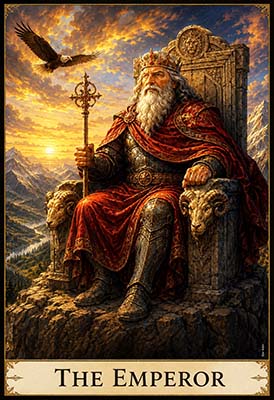
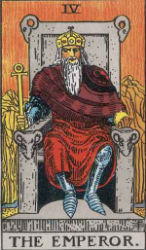
He’s an older man, dressed in armor, sitting on a massive stone throne. One assumes he has a rigid spine and a terrible case of hemorrhoids from sitting on that thing, but he’s definitely in command.

And look at his surroundings.

There are no lush gardens, no ripening fields, and no flowing streams. Behind him are barren mountains, hard and unyielding.

Where the Empress inhabits a living landscape, the Emperor occupies a landscape of stone.

His throne is decorated with rams’ heads, symbols of Aries, the astrological sign associated with Mars, initiative, and assertive action.

Everything about the card suggests strength, authority, discipline, and control.

The Emperor doesn’t simply accept the world as he finds it. He intends to shape it according to his will.

And that brings us to the essential difference between these two archetypes.

The Empress works with life. The Emperor works upon life.

Neither approach is inherently wrong, but they can produce radically different experiences of existence.

The Empress’s Way of Living

I don’t think it’s entirely coincidental that the Empress precedes the Emperor in the Tarot’s sequence of Major Arcana.

We might interpret her position as representing something more fundamental than the structures of civilization: our original relationship with the natural world.

Before we build cities, establish governments, create schedules, and invent five-year plans, we’re living creatures participating in a living universe.

And that’s the world of the Empress.

A person with a predominance of Empress energy tends to approach life with openness, receptivity, and trust.

Such a person may find abundance in a beautiful sunset, an affectionate friendship, a garden full of flowers, or the simple pleasure of sitting quietly with a cup of coffee.

Abundance isn’t necessarily measured in dollars and possessions. It’s measured in the richness of experience.

In many respects, this resembles the Taoist concept of wu wei, often translated as effortless action or non-forcing. Wu wei doesn’t mean sitting around doing nothing. It means acting in harmony with the natural movement of things rather than constantly struggling against them.

Think of a gardener.

The gardener doesn’t create the mysterious force that makes a seed germinate. He prepares the soil, plants the seed, provides water, and allows nature to do what nature does. He participates in the process without trying to dominate it.

That’s Empress energy.

She nurtures, encourages, and cultivates. And she trusts that life has its own creative intelligence.

The Emperor’s Way of Living

The Emperor, on the other hand, is what we’d call a take-charge sort of person.

He wants to organize, construct, regulate, and improve his environment.

He’d take one look at the Empress’s beautiful garden and immediately start drawing up plans.

“Okay, we obviously need a sprinkler system in here. I think the planter boxes should go over there, and the grass is getting a little overgrown. I’ll start weed-whacking right away.”

And before you know it, the Empress’s garden has become a landscaping project with a budget, a timetable, and a quarterly performance review.

Now, there’s nothing inherently wrong with any of that.

Without Emperor energy, we’d have a difficult time building houses, organizing communities, or accomplishing anything that requires sustained effort and planning.

The Emperor gives us structure. He establishes boundaries, creates systems, and provides the discipline necessary to turn ideas into practical realities.

But there’s a fundamental assumption underlying his approach to life. The world is something that needs to be managed.

Where the Empress sees a natural order in which she participates, the Emperor sees an environment that can be improved through deliberate intervention.

The Empress asks, “How can I live in harmony with what is?”

The Emperor asks, “How can I change what is into what I want it to be?”

And that distinction becomes particularly interesting when we look at the culture in which we live.

Western Civilization: The Emperor’s Kingdom

If you want to understand how thoroughly Emperor energy dominates Western culture, just listen to the language we use.

We’re constantly being told to take control of our lives, master our emotions, conquer our fears, overcome obstacles, and achieve our goals.

We talk about winning the battle against disease, fighting poverty, conquering nature, and dominating the competition.

Even our relationship with ourselves is frequently described in terms of struggle.

We need more self-discipline. More willpower. Better time management. Greater productivity. And if we’re not accomplishing enough, we’re probably not trying hard enough.

In other words, we need to become better Emperors.

From childhood onward, we’re encouraged to compete, achieve, accumulate, and demonstrate measurable success. Our schools reward performance. Our workplaces reward productivity. Our economic system rewards growth.

We even turn relaxation into something that needs to be scheduled and optimized.

There’s a certain absurdity in being told that we should practice mindfulness for twenty minutes every morning because scientific studies suggest it will make us more productive at work. Apparently, even inner peace needs to justify itself with a favorable return on investment.

Now, I’m not suggesting that Western civilization has produced nothing worthwhile.

Quite the contrary.

The Emperor’s capacity for planning, organization, and disciplined action has given us extraordinary achievements in science, medicine, engineering, and technology.

But every philosophy has its limitations. And when one particular approach to life becomes so dominant that we scarcely recognize the alternatives, we can lose something important.

We can forget how to simply be.

We can become so preoccupied with improving our lives that we forget to enjoy them. And we can become so determined to control our circumstances that we experience anything beyond our control as a personal failure.

Perhaps most importantly, we can begin to believe that abundance is something we must constantly struggle to obtain rather than something we can also discover in the world around us.

That’s where the Empress has something important to teach us.
The Problem With Too Much Empress Energy

Now, I have to admit that Empress energy appeals to me more than Emperor energy. Probably because I’m fairly lazy.

But the Empress has her shadow side, too.

Taken to an extreme, her receptivity can become passivity.

Her trust in the natural flow of life can become an excuse for avoiding responsibility. And her appreciation of the present moment can turn into a reluctance to make necessary changes.

We see this occasionally in the New Age movement.

Someone spends hours visualizing a beautiful new life, repeating affirmations, and attempting to raise their vibrations. And then they sit back and wait for the UPS driver to magically deliver whatever they’ve been manifesting.

Unfortunately, the universe doesn’t always operate on a home-delivery schedule.

Even the most beautiful garden needs someone to pull the weeds occasionally. The Empress’s wisdom lies in cooperating with life, not withdrawing from it.

And that’s where a healthy dose of Emperor energy becomes useful.

The Problem With Too Much Emperor Energy

The Emperor’s shadow is considerably more familiar to most of us.

When his desire for order becomes excessive, he turns controlling, rigid, and authoritarian.

Everything must happen according to his plan. Every problem must have a solution. Every situation must be managed.

And every person in his immediate environment is expected to cooperate.

His motto becomes “My way or the highway.” And sooner or later, his friends and family take the highway.

But there’s another, more subtle problem with excessive Emperor energy.

It creates the illusion that we can control far more of life than we actually can. We can make plans, establish goals, and work diligently toward achieving them.

But we can’t control the economy, the weather, other people’s decisions, or the countless unpredictable events that shape our lives.

And the more tightly we cling to the illusion of control, the more anxious and frustrated we become when reality refuses to cooperate.

The Emperor’s greatest strength—his ability to impose order—can become his greatest weakness when he forgets that not everything needs to be controlled.

Sometimes the most intelligent thing we can do is stop pushing.

Finding the Balance

As usual, the answer seems to lie somewhere between the two extremes.

We need the Emperor’s ability to plan, organize, and act decisively. But we also need the Empress’s ability to relax, appreciate, nurture, and trust.

The Emperor can help us plant a garden.

The Empress reminds us to sit in it occasionally and enjoy the flowers.

And perhaps that’s the real secret to balancing these two archetypes.

Use the Emperor to create the conditions for a good life. Use the Empress to actually experience that life.

Make your plans, but don’t keep a daily organizer under your pillow. Work toward your goals, but don’t become so obsessed with the future that you overlook the present.

And recognize that sometimes the most productive thing you can do is absolutely nothing.

There’s an interesting principle frequently encountered in visualization and manifestation practices: the more we appreciate what we already have, the more receptive we become to experiencing abundance.

Whether we interpret that metaphysically or psychologically, there’s something valuable in the idea. Gratitude shifts our attention away from what is missing and toward what is already present.

And that shift can profoundly change our experience of life.

To put it in very simple terms, if the Universe gives you a gift and you don’t say thank you, don’t expect to get more presents.

Perhaps We Need a Little More Empress

I suspect that one of the great challenges of modern Western life is that we’ve become so thoroughly conditioned by Emperor energy that we scarcely recognize how much of our behavior it governs.

We measure our worth by what we accomplish. We measure success by what we accumulate. And we measure the quality of our lives by how closely reality conforms to our expectations.

But the Empress offers a radically different possibility.

What if life isn’t primarily a problem to be solved?

What if the natural world isn’t simply a collection of resources to be managed?

And what if happiness isn’t something waiting for us at the end of a long series of accomplishments? What if it’s something we can experience right now?

The Emperor will always have an important place in our lives. We need his discipline, his courage, and his capacity to turn dreams into reality.

But perhaps we’ve allowed him to occupy the throne for a little too long. Perhaps it’s time to invite the Empress back into the kingdom.

After all, the Emperor may know how to build a magnificent palace.

But the Empress knows how to make it a place worth living in.
The Emperor and Ruling a Kingdom of Socks and Dishes

The role of The Emperor’s energy in our daily lives.

How are you ruling over your kingdom right now?

No, I don’t mean your imaginary kingdom where you’re a titan of industry or maybe a pirate.

I don’t mean the video game kingdom where you’re the greatest slayer of orcs of all time.

I mean your kingdom.

The one with socks on the floor.

Laundry that’s piling up.

Bills that still need to be paid.

Dishes waiting in the sink.

You know…

The kingdom you actually have control over.

The Emperor and The Empress

The Empress and the Emperor are the only true matched pair in the Major Arcana. In a previous post, I suggested that the Empress represents our ability to receive abundance. The Emperor represents our ability to organize it.

The Empress is how we receive the world.

The Emperor is how the world receives us.

The Empress is the generative principle.

The Emperor Poster – 13 X 19 Inches – Available on Etsy

The Emperor is the organizing principle.

Both of these energies live within every one of us. They aren’t male and female so much as complementary ways of being. Like the Emperor and the Empress themselves, they’re opposite ends of the same spectrum.

The Empress is relaxed, open, and completely at ease.

The Emperor is covered in armor from head to toe.

The Empress is soft and receptive.

The Emperor is firm and projective.

The Emperor is Our Place in the World

Sooner or later, every one of us has to leave the safety of the family nest and make our way in the world. We have to earn a living, work with other people, find a place to live, pay the bills, keep the house in order, and somehow hold it all together.

Yes…it’s that dreaded stage of life we call . . . adulting.

The Empress is the part of us that nurtures our identity as it grows.

The Emperor is the part that carries that identity into the world and quietly says:

“This is who I am. I have a right to be here.”

If The Empress is the Universal Garden, The Emperor is the guy who built the garden beds, carried in the sacks of manure to fertilize it and remembers to water it all every morning.

So How Do We Claim the Emperor’s Energy?

By developing self-control without becoming controlling.

By cultivating quiet confidence instead of arrogance.

By becoming competent at what we do.

By keeping our promises to ourselves.

The Emperor doesn’t ask us to dominate other people. He asks us to govern ourselves.

Not as a tyrant.

As a wise ruler.

Not with harsh self-criticism.

With gentle but strong guidance.

Despite his throne, his crown, and his armor, the Emperor’s work isn’t really about kingdoms at all.

It’s about picking up those socks.

Paying the bills.

Keeping your word.

Creating healthy boundaries.

Standing up for yourself without trampling someone else.

Every small act of self-government strengthens the Emperor within us.

And perhaps that’s the real lesson of this card.

Before we can rule a kingdom, we have to learn to rule ourselves.

Tarot and the Art of Alignment – Available of Amazon

The Emperor: Sacred Structure and the Protection of Creativity

A look at the roles of Yin and Yang energies in the process of creativity.

The Emperor and the Empress are obviously paired cards—one female and the other male. But if we stop at gender, we miss their deeper meaning entirely.

On a more profound level, they represent the Yin and Yang energies that exist within every human being.

Every woman has testosterone in her body. Every man has estrogen. Wholeness comes not from exaggerating one pole and suppressing the other, but from integrating both. Strength and compassion. Power and vulnerability. Fierceness and tenderness.

This is what the ancient Yin–Yang symbol illustrates so elegantly: Yin contains Yang, and Yang contains Yin.

When these energies are balanced, they produce whole, grounded human beings. When they are separated and exaggerated, they produce caricatures.

That’s where we find emotionally stunted men obsessed with dominance and control. That’s where we find people who abdicate their agency entirely and wait for someone else to take care of their lives.

Me Tarzan. You Jane.

Man strong. Woman weak.

This is not balance. This is Yang attempting to overwhelm Yin. But Yin and Yang are not enemies. They are partners.

Creation requires both.

The Peculiar Paradox of Yin Energy

Modern culture often assumes that Yang energy—the active, assertive, masculine principle—is the true creative force, while Yin energy is passive or secondary.

Nature shows us exactly the opposite.

Consider procreation. A man’s biological contribution to the creation of a child may take minutes. But the woman’s body then undertakes nine months of continuous creation—growing, forming, and sustaining new life from her own substance.

She gives birth. She nourishes the infant. She does the creating.

THE YIN ENERGY DOES 99% OF THE WORK OF CREATION.

This pattern appears everywhere.

The receptive, Yin principle is not inert. It is generative. It is the matrix from which life emerges.

The Kybalion expresses this clearly: the feminine principle does the creative work. The masculine principle directs and structures it.

Without Yin, nothing would exist.

⸻

The Artist and the Subconscious

We see this same pattern in the creative process.

When we imagine an artist, we picture someone standing at an easel, brush in hand, actively painting.

But the visible act of painting is only the final stage.

Long before the brush touches the canvas, the image has already been forming in the artist’s subconscious mind. It grows invisibly. It gestates. It organizes itself.

We call this “inspiration,” as if it appeared suddenly.

But inspiration is the flowering of something that has been developing quietly within.

The conscious mind—the Yang principle—provides skill, technique, discipline, and execution. But the image itself emerges from the Yin subconscious.

Again, the receptive principle does the creative work.

⸻

The Function of the Emperor

Does this mean the Emperor—the Yang principle—is unnecessary?

Not at all.

The Emperor is essential.

The Empress creates. The Emperor protects and stabilizes what she creates.

Consider the garden.

The Empress is the lush, living growth. She is the fertile soil, the green leaves, the flowing water. She is life itself.

But without structure, the garden cannot reach its full potential.

The Emperor builds the raised beds. He enriches the soil. He installs irrigation. He builds the fence to keep the deer out.

He does not create the life. He ensures its survival. The Emperor provides continuity. He creates the conditions under which life can flourish and endure.

⸻

The Emperor Is Always Grounded in the Empress

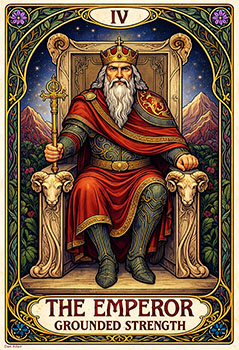
In my own Emperor affirmation card, I made a subtle but important change. The Emperor still sits on his stone throne, armored and immovable.

But I surrounded him with life.

Emperor Affirmation Poster – available on Etsy

Because the Emperor does not exist independently of the Empress. He exists to protect her. He exists to serve creation. Within each of us, the Emperor is the part that creates structure for our creative and emotional lives.

If you are an artist, your Emperor sets up your studio, organizes your materials, and protects your time.

If you are a writer, your Emperor establishes the discipline to write regularly and brings your work into the world.

If you are in a relationship, your Emperor establishes boundaries that protect emotional safety and mutual respect.

The Emperor does not suppress the Empress.

He protects her so she can fully express herself.

When the Emperor Is Separated from the Empress

When the Emperor loses his connection to the Empress, he becomes distorted.

His structure serves nothing. His authority protects nothing.

He becomes the petty tyrant. The rigid bureaucrat. The hollow authoritarian. His armor is empty. He enforces rules not to protect life, but to compensate for his own inner disconnection.

True authority does not arise from domination. It arises from service to life.

The Emperor’s true purpose is not control. It is protection. He is the guardian of the garden. He is the structure that allows creativity to endure.

He is sovereignty in service of life itself.

When we see beyond the illusion of gender, the deeper purpose of these archetypes becomes clear. The Empress and the Emperor are not separate beings, but complementary forces within each of us. One creates. The other protects what has been created. One generates life from the invisible depths. The other builds the structure that allows that life to endure. 

Our true purpose is not to choose between them, but to embody both—to allow our inner Empress to bring forth creativity, love, and vision, and to allow our inner Emperor to establish the boundaries, discipline, and stability that allow those creations to survive and flourish in the world. When these two forces work in harmony, we cease to live reactively and begin to live sovereignly, shaping a life that is both fertile and enduring.

Putin, Ukraine, Toxic Males, and The Emperor Card

Toxic-Male psychopathology in the invasion of Ukraine.

We’re at about the three week mark in the Russian invasion of Ukraine.  Anyone who’s a decent person has been shocked, appalled, and nauseated by what we’ve seen.  A quiet, peaceful country primarily known for its wheat and decorated Easter eggs is being bombed into dust.

For no apparent reason.

The horror of what we’re seeing on the news everyday is hard to grasp, but equally hard to grasp in the, “why,” of it.  Why would Russia suddenly launch a brutal military campaign – the likes of which we haven’t seen since the Nazis – against a neighbor who was absolutely no threat to its security?

I saw a talking head on one of the news shows tonight who asked, “Just how much of a psychopath is Vladimir Putin?”  It’s a revealing question because it points to the fact that we already knew Putin was a psychopath, we just didn’t know (and still don’t) how truly crazy he may be.

That truth points to another truth, which is that we’ve developed a remarkably high tolerance for psychopathology.  We put up with it.  We accept it.  It isn’t as if Putin hasn’t been doing dreadful things for decades.  He almost single handedly destroyed whatever small hope the Russian people had for freedom and democracy.  His political opponents end up poisoned, dead, or in prison.  He employed chemical warfare in Syria.

He’s a bad guy.  A crook.  A thug.  A criminal.  And he has been all of those things all of the time that he’s been in power.  Still, the world leaders kept inviting him to the dinner table.  Kept trading with Russia, inviting their teams to the Olympics, welcoming their tourists and investors, just as if Putin was somehow a normal, civilized leader.  It wasn’t until he decided to obliterate a modern society for no particular reason that we began to treat him like the psychopath that he is.

Just to define our terms before we go any further, what exactly do we mean when we say that someone is a psychopath?  According to Wikipedia, psychopathology is:

“characterized by persistent antisocial behavior, impaired empathy and remorse, and bold, disinhibited and egotistical traits.”

Put another way, a psychopath is a cold blooded, egotistical prick who causes a lot of suffering and really doesn’t give a shit about how many people he hurts.

I have argued previously in this blog that psychopathology is an inherent part of the Toxic-Male paradigm which our society too often embraces.  We see some of that exemplified in the Tarot card, The Emperor.  We can tell from his throne, scepter and title that he’s a powerful leader, a king of kings.  When we look a little more closely at the card, though, we see that he’s completely alone, armored, rigid, and surrounded by a blighted, sterile landscape.  His power is so toxic that not a tree or a flower can grow in his poisonous energy field. Still,  we focus on the power and not the devastation.  

Power that destroys everything around it for the sake of power is psychopathic.

Many of us actually admire and reward psychopathic behavior.  Consider this article from Forbes magazine in which they estimate that up to 12% of corporate CEOs may be psychopaths.  They are in those positions precisely because they are ruthless, have a total lack of empathy and will place corporate profit above the human suffering of their employees every time.

Remember when the CEO of the mortgage company Better.com fired over 900 employees at a goddamned Zoom meeting just before Christmas?  People across the country were shocked at the totally heartless, callous way that he’d behaved, but he wasn’t fired.  He took a month-long hiatus (translate:  he took Christmas vacation) and was back at work within a month.  He issued a tepid apology which was much more of an, “I’m sorry I got caught,” than it was an, “I’m sorry.”  He kept his job because the board of directors at Better.com wanted someone with psychopathic traits running their company.

We may shake our heads at the horrible behavior of Vladimir Putin but while we’re doing that we should take a very careful look at the behavior of Donald Trump. Persistent antisocial behavior?  Check.  Impaired empathy?  Check.  Total lack of remorse?  Check.  Bold, disinhibited and egotistical traits?  Check.  Can we really doubt that the primary difference between Putin and Trump is one of power?  Can we really doubt that Trump would have happily shut down a free press and had his opponents imprisoned if he could have gotten away with it?  Trump is a classic CEO psychopath.

And just about half of the population of the United States voted for him.  If you need any evidence that we have an increasing tolerance for psychopathic behavior, there it is.

When we look at written history, legends, and myths, it’s a safe bet that psychopaths have always been scattered throughout the human race.  Wherever we find suffering, cruelty, torture, war and rape, there we find psychopaths.  Is it fair, though, to tag this trait as a part of Toxic-Males?  After all, there are female psychopaths, too.

The answer to that question is a resounding, “yes.”  Psychopathology is toxic and it is very much a male behavior.  The ratio of male to female psychopaths may be as high as 20:1.  Virtually all serial killers have been males.  Mass shootings are overwhelmingly committed by males.  The prison population of violent offenders is heavily weighted toward males.

We can see the same evidence in human history.  Leonard Shlain, author of “The Alphabet Versus the Goddess: The Conflict Between Word and Image,” hypothesizes that most of the earliest human cultures were matriarchal, goddess based and peaceful.  It wasn’t until the emergence of patriarchal society that we began to see psychopath kings and leaders.  There is no historical record of females leading hordes of barbarians to murder, rape, and pillage.  Virtually all of the monsters in human form – Ghengis Khan, Hitler, Napolean, Pol Pot, to name just a few – have been males.

It might be tempting for us to simply shrug our shoulders and say, “Oh, well . . . they’ve always been a part of the human race.  What can we do about that?”  Unfortunately – or perhaps fortunately – the human race is at a crossroads and, as Eckhart Tolle has pointed out, we are in imminent danger of extinction if we don’t begin to evolve out of our current ways of thinking.  We now have weapons capable of destroying life on earth.  Millions – not thousands – of people were killed in wars and other armed conflicts during the 20th century and it’s not looking a hell of a lot better in this century.

To put it mildly, “Houston, we have a problem.”  A major component in that problem is Toxic-Male psychopathology.  By far and away, the majority of human beings – male and female – are NOT out there killing people and spreading terror.  It’s this tiny, tiny minority that’s threatening our very existence.  

So we must be rid of them.  One way or another, we MUST be rid of them.  We start that process with our own minds.  We start that process by recognizing that they are sick, depraved, deeply flawed human beings.  We stop, “admiring,” their so-called toughness and ruthlessness and realize that it’s really nothing more than a thin veneer over a sadistic personality.  We stop describing them as, “geniuses,” when they put their brutality on full display.  We stop voting for them when they run for office.  We stop promoting them to positions of leadership in businesses.  We stop acting as if it’s somehow okay or inevitable that mass shootings continue in our society or that our leaders are braggadocious bullies.

Above all else, we need to start holding up and supporting the model of emotionally healthy, nurturing, caring males.  Most men are not like these psychopaths – we know that.  Most men love their partners and their families and just want to live their lives in peace and harmony.  At the same time, though, as males we are constantly confronted with the stereotypes of what, “real,” men are like.  And those stereotypes look an awful lot like the psychopaths:  ruthless, emotionless, physically dominant, violent, and lacking in empathy.  That ideation of the, “alpha male,” is buried WAY deep down inside the collective psyches of both males and females.  We have to start digging it out, holding it up to the light of day, and rejecting it.

It really is a matter of our survival.

The Emperor in the Tarot

The meaning of The Emperor card in the Tarot, including definitions for the upright and reversed positions.

Emperor

There is a tendency among Tarot readers to associate the Emperor with the Empress.  If the Empress is the ultimate Feminine Energy then the the Emperor must be the ultimate Masculine Energy.  It makes sense, both because of the names of the cards and their proximity to each other in the deck. They seem to be two sides of the same coin, yin and yang.

It’s just not so, however.  The Empress is wild, unbridled, sensual, ready for a good roll in the hay at a moments notice.  The Emperor, on the other hand, looks like he’s had a bad case of constipation for twenty years and would probably need a double dose of viagra to even think about a roll in the hay.  And let’s face it: who wants to go to bed with someone who’s dressed in armor?

Another very common misconception is that he’s associated with the astrological sign Aries the Ram.  It makes sense on the face of it because there are ram’s heads all over the card. That’s about the only way it make sense.  Aries is associated with the number one, not the Emperor’s number four. Additionally, Aries is the child of the zodiac, fresh, impulsive, trusting, headstrong.  The Emperor is obviously a very old man and there’s nothing ram like about his demeanor or his posture. The rams, like the barren mountains in the background, are meant to suggest that the Emperor dwells in isolation high above the common folk of the world.

So, yes, the Emperor represents male energy but only a very narrow spectrum of it.  If this archetype is blowing through your life you may be about to encounter someone who is rock solid, a very strong individual who is fully capable of taking charge and does so.  He probably won’t be a barrel of laughs – if fact, he may not have any sense of humor at all – but he will be experienced and totally dependable.

If the card represents the questioner it may show that he or she is in a position to take charge and reach their goals.  They are well suited to the task at hand and there is an emphasis upon using the intellect rather than emotions. There is a warning to not come across as too authoritarian.  “My way or the highway,” is an approach that will cause some people to head for the highway.

Reversed:  This warns that someone you are relying may not be all they’re cracked up to be, that they may be pretending to be more capable than they are and that you are in for a disappointment.  If the card represents the questioner it suggests that there is a lack of focus and concentration.

If you have questions about this card or its meaning in one of your readings, please don’t hesitate to leave a comment.  I’ll get back to you as soon as I can.

A Few Extra Thoughts:

When you pull The Emperor in a reading it may be a good time to think about positions of power in general and male power in particular.

We live in a society where the dominant model for power is that it flows from the top down.  Whether you’re talking about the president in our political structure or CEOs in the corporate world there is one person – usually male – who wields the overwhelming majority of power.  He makes the decisions, he gives the orders, he expects those orders to be followed. If they aren’t he crushes anyone who was, “insubordinate.”

Basically that’s a pretty medieval structure.  It’s no mistake that we still use the phrase, “they seized power,” when we’re talking about one political party or the other winning an election.  It goes back to the era when power literally WAS seized at the point of a sword by one tyrant or the other who then got to live in luxury while the rest of the people worked to support his lifestyle.  As Mel Brookes said, “It’s good to be the king.”

Unfortunately, it’s not a very good model for the rest of us.  If you’re a boss or a supervisor and you pull this card try to imagine some different ways of using power rather than just being a my way or the highway person.  How can you share the power? How can you get your employees more involved in the decision making? How can you make your workplace more of a democracy and less of a kingdom?

And any male who gets The Emperor in a reading should take a little time to think about, “male power.”  What does it mean to you to be a powerful male? Is it located in your body? Do you think of it as being able to dominate other people physically and, “kick some ass?”  Is it in your intellect and you seek to dominate other people on that level?

Does it have to involve dominance at all?  

Can you be strong in your ability to nurture, to comfort, to care and show up day after day after day to do the things that need to be done?  I’ve known some men who did home caregiving for sick wives or children who were far, far stronger than the bullies in the workplace thumping their chests.

What does it mean to be, “a powerful male?”  The jury is still out on that one.

“Just the Tarot,” by Dan Adair – a kindle ebook available on Amazon