The Strength Card and Fearlessness

Exploring quiet fidelity to our values as the greatest form of strength.

Are you living fearlessly in the midst of chaos?

In the past, I’ve written about how the Strength card beautifully illustrates the Hindu principle of Ahimsa—the practice of harmlessness. (See The Strength Card, Ahimsa, and Your Magical Anti Shit-Head Cloak.)

In its simplest form, Ahimsa teaches that when our own hearts are truly peaceful, we cease moving through the world as agents of violence. The remarkable claim of the tradition is that this inner harmlessness also becomes a kind of protection. Peace itself becomes a shield.

Today, though, I’d like to explore another aspect of the Strength card.

Fearlessness.

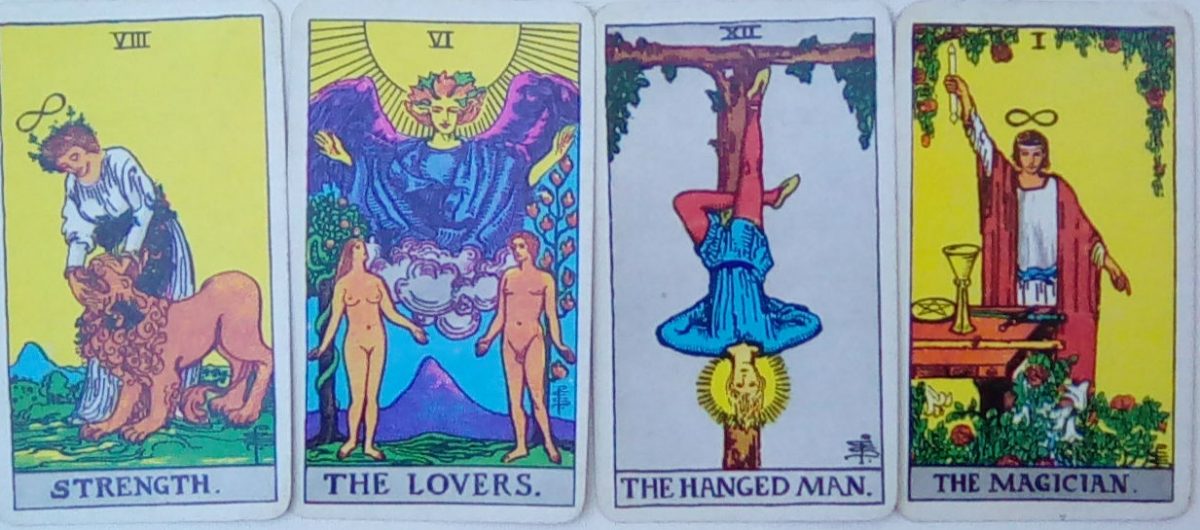
Look carefully at Pamela Colman Smith’s illustration. The woman doesn’t overpower the lion. She doesn’t wrestle it into submission. She approaches it with gentleness, compassion…and with a complete absence of panic.

The great lion becomes, almost unbelievably, a house cat waiting to have its ears scratched. She’s fearless and so the lion is fearless.
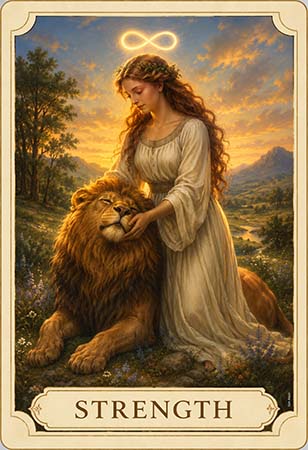
Strength Tarot Poster by Dan Adair – available on Etsy

What Is Fear?

Fear is not a character flaw.

It’s part of being human.

Deep within the brain are networks whose job is to constantly scan our surroundings for danger. When they detect a threat, our limbic system responds instantly. Our heart rate rises. Adrenaline and cortisol flood our bloodstream. Muscles tighten. Attention narrows.

Fight.

Flight.

Survive.

It’s a marvelous system. Our ancestors lived because of it.

Thank you, nervous system – good job!

The problem isn’t fear itself.

The problem is when we never leave that state.

Modern life has a remarkable ability to keep the alarm bells ringing. Financial worries. Health concerns. Relationships. Politics. Endless news feeds. Before long we’re swimming in stress hormones that were designed for emergencies, not for everyday living.

Eventually the body grows exhausted.

And so does the spirit.

The Western Idea of Fearlessness

Our culture loves fearless heroes.

Movies are filled with square-jawed action stars who stare down impossible odds without breaking a sweat. They defeat violence by becoming even better at violence.

It’s entertaining.

But it’s also a fantasy.

That kind of fearlessness isn’t based on peace.

It’s based on becoming more dangerous than whatever threatens us.

The mystic quietly disappears and the sociopath takes center stage.

The message becomes: “You don’t have to be afraid if everyone else is afraid of you.”

That’s a strange definition of courage.

Nothing has actually become peaceful.

We’ve simply dumped more adrenaline into the system and called it victory.

A Peaceful Heart

Whenever we declare war on fear, something curious happens.

We activate the limbic system that we’re trying to quiet.  When we use phrases like, “battling our fear,” we immediately wake up our fear center. Battle? Did someone say battle?

Why do we battle something?

Because we’re afraid of it.

So we create a strange paradox.

We try to conquer fear…with fear.

The Strength card offers another path.

It doesn’t ask us to destroy fear.

It asks us to stop feeding it.

That doesn’t mean we ignore danger. It doesn’t mean we stop listening when our instincts warn us that something is genuinely wrong. We don’t need to take up nude skydiving just to prove we’re fearless.

We notice fear.

We thank it for trying to protect us.

And then we continue walking with a peaceful heart.

The lion is still a lion.

But we are no longer terrified by its roar.

Quiet Fidelity

When I think about genuine fearlessness, I don’t think about action heroes.

I think about the husband who spends years caring for his wife through cancer, quietly getting the wheelchair ready every morning.

I think about the single mother working two jobs so her children have food on the table and shoes on their feet.

I think about the husband or wife who continues showing kindness and faithfulness long after romance has faded into ordinary life.

Henry David Thoreau famously wrote that “Most men lead lives of quiet desperation.”

Perhaps.

But I think he overlooked something.

Most people live lives of quiet fidelity.

They get up every morning.

They show up.

Even when hope seems unreasonable, they continue hoping.

Even when depression whispers that nothing matters, they keep looking for beauty.

Even when illness or grief comes to visit, they continue choosing life.

That, to me, is what the Strength card is really about.

For most of us, fearlessness doesn’t mean living without fear. Perhaps the rare saint—or the rare sociopath—can make that claim.

The rest of us simply learn not to let fear become the author of our lives.

We acknowledge it.

We thank it.

We refuse to let it drive.

And little by little, we discover that the lion was never conquered.

Only our relationship to it changed.

As Joseph Campbell so beautifully observed:

“The cave you fear to enter holds the treasure you seek.”

Perhaps the greatest treasure isn’t on the other side of fear.

Perhaps it is the peaceful heart we discover while walking through it.
Tarot and the Art of Alignment – Available on Amazon

The Strength Card in the Tarot

The meaning of the Strength card in the Tarot, including definitions for the upright and reversed positions.

Strength

This is, obviously, first and foremost a card denoting strength.  It is, however, a quiet, gentle, enduring strength rather than a blustering, muscle flexing type of strength.  Note how gently the woman is closing the lion’s mouth. She almost appears to be petting it, rather than subduing it.

The lemniscate hovering above her head indicates that she is channeling the Higher Power and the realm of spirit.  This is very much the strength of the Goddess, loving and nurturing to all of her creatures and conquering with enduring love rather than brute force.

This card shows that the questioner will overcome challenges and be successful in the long term.  The key to this is quiet perseverance rather than an all out frontal assault on the problems. The urge to fight – represented by the lion – is overcome and supplanted by the loving strength of her higher nature.  So, too, the questioner should approach problems with loving kindness rather than aggression and will win out in the end.

On a simple physical level this card may show an individual who has been ill for some time but is slowly recovering and gaining strength.

REVERSED – A lack of strength and resolve.  The questioner may be overcome by foes and enemies because he or she isn’t strong enough to stand up to them.  If conflicts arise try to delay and retreat.

This may also show a person who is chronically ill or fatigued and is failing to get better.  A long term, serious illness.

If you have questions about this card or its meaning in one of your readings, please don’t hesitate to leave a comment.  I’ll get back to you as soon as I can.

A FEW MORE THOUGHTS ABOUT STRENGTH:

Strength has some of the most cliched definitions attached to it of any card in the Major Arcana.  It’s a woman closing a lion’s mouth. So the lion is an animal, right? And the woman is, well, a woman.  And, hey, she’s got the symbol for eternity floating over her head! So . . . um . . . it must be about using our higher nature to control our animal instincts, right?

And, of course, the second someone mentions, “animal instincts,” being the good little puritans we are, we immediately think of . . . you know . . . S-E-X.  And somehow this rather interesting portrayal of a woman quietly closing the mouth of a lion morphs into a morality play about being more spiritual and less sexual because, of course, sex and spirituality are opposites.  

It’s my belief that Strength is actually about a state of being called, “Ahimsa.”  For those of you who aren’t familiar with it Ahimsa is a phrase which basically means, “being harmless,”  or, “doing no harm.” It’s practiced in Hinduism, Buddhism, and Jainism and is mentioned prominently in the Yoga Sutras of Patanjali.  And, yes, it’s usually described as a practice but it’s also a state of being. It’s a state of projecting absolutely no harmful or aggressive vibrations at all.

Let me give you an example.  My life partner Carol had an old Persian cat who liked to lie out in the sunshine during the summer.  I glanced out the kitchen window one day and was astonished to see this large, white cat stretched out on the ground and completely surrounded by birds.  They were strolling around, pecking at the ground, grooming themselves, and literally within inches of one of their worst predators, a cat.

They had absolutely no fear of the cat because they somehow knew that the cat had absolutely no interest in harming them.  The cat was practicing kitty-ahimsa and the birds were responding in kind.

You find similar scenarios in the tales from India.  Ferocious tigers and snakes who become completely docile in the presence of a master practicing ahimsa.

Here’s what Swami Kriyananda said about it:  “Ahimsa, rightly understood, becomes the ultimate weapon;  it turns one’s enemy into one’s friend, thereby banishing the possibility of further conflict.”

You could call it the ultimate weapon, as he did, or the ultimate STRENGTH.

I told the story about the cat and the birds to a conservative friend of mine.  He sneered and said, “Well, it’s a good thing that cat has someone to feed it or it would starve to death.”

He didn’t get it.  The cat was fully capable of killing those birds in seconds but the cat chose not to.  Instead of spreading blood and gore all over the back yard the cat chose to enjoy the sunny day and, perhaps, the songs of the birds.  He projected peace and peace is what was projected back at him.

Violence, aggression, anger, fear, those are all ultimately choices that we make.  If we put out those vibrations the beings around us respond on the same vibrational level.  If we put out peace and harmlessness the beings around us respond with peace and harmlessness.

Ahimsa can be a difficult concept for Westerners to grasp.  We tend to think of strength as something we’re doing, some positive action, or at least the ability to endure something unpleasant.  Ahimsa, on the other hand, is not-doing. It’s a deliberate withdrawing from any actions that might cause harm, anger, or fear.  It seems totally paradoxical:  you are ARMING yourself with peace.  And thus you overcome violence.

This card calls for taking a good, deep look at what we mean when we use the word, “Strength.”  Is it aggression? Dominance? Walking over people who disagree with you? Or is it quite the opposite?

“Just the Tarot,” by Dan Adair – a kindle ebook available on Amazon