The Emperor and the Empress are obviously two of the paired cards in the Tarot, but they represent two very different kinds of energy.
In fact, I would maintain that they represent two fundamentally different ways of being in the world.
They aren’t simply personality traits or psychological tendencies. They represent two different philosophies about how life works, how we should approach it, and what we need to do to find happiness and abundance.
The Emperor believes that we create a good life by taking control of it. The Empress believes that we create a good life by learning to live in harmony with it.
And here’s where things get interesting: Western civilization has largely embraced the Emperor’s approach to life, while treating the Empress’s philosophy as something vaguely impractical.
But is the Emperor’s way necessarily the better one?
Forget the Genders
We probably shouldn’t even have to say this anymore, but when we talk about Empress energy and Emperor energy, we’re not talking about males versus females.
The Empress isn’t simply the feminine side of the Emperor, and the Emperor isn’t the Empress without breasts.
Every human being contains masculine and feminine qualities, yin and yang, testosterone and estrogen. If the Empress turns up in our Tarot reading, she may well represent a woman in our lives. Or she may represent a man with a great deal of yin energy.
And the Emperor can just as easily represent a woman who approaches life through discipline, structure, and control.
What we’re really talking about are two different orientations toward existence.
And whichever one predominates in our personality can profoundly influence how we experience the world.
Empress Energy: Living in Harmony With Life
As I wrote in my free ebook:
“The Empress wants abundance. She wants you to embrace the richness of life, nurture what you love, and allow your creativity to flourish.”
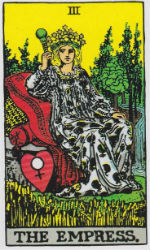
Take a good look at the Empress in the Rider-Waite-Smith Tarot.
She’s reclining comfortably on something resembling a luxurious settee rather than a formal throne. She holds a scepter of power, but she grips it loosely, almost as an afterthought.
She’s surrounded by lush vegetation, ripening wheat, and flowing water. Her shield bears the symbol of Venus, the planet traditionally associated with love, beauty, and pleasure.
There’s no palace, no fortress, and no indication that she’s particularly concerned about defending her territory.
She seems to be telling us, “I exist in the natural world, and the natural world is my palace and my riches.”
The Empress doesn’t need to conquer the world to enjoy its abundance.
She already belongs to it.
And that distinction is enormously important.
Emperor Energy: Creating Order From Chaos

Now let’s look at the Emperor.
As I wrote in that same ebook:
“The Emperor wants order. He wants you to take command of your life, establish a solid foundation, and create the structures necessary to achieve your goals.”
The Emperor presents a very different picture.
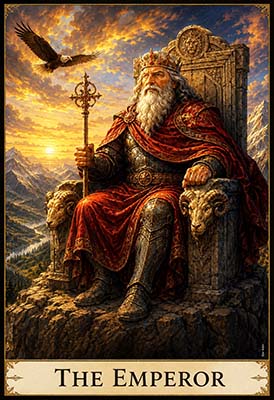
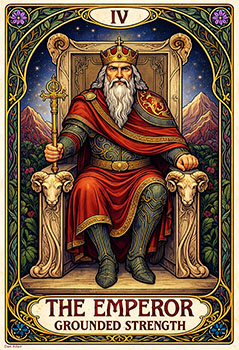
He’s an older man, dressed in armor, sitting on a massive stone throne. One assumes he has a rigid spine and a terrible case of hemorrhoids from sitting on that thing, but he’s definitely in command.
And look at his surroundings.
There are no lush gardens, no ripening fields, and no flowing streams. Behind him are barren mountains, hard and unyielding.
Where the Empress inhabits a living landscape, the Emperor occupies a landscape of stone.
His throne is decorated with rams’ heads, symbols of Aries, the astrological sign associated with Mars, initiative, and assertive action.
Everything about the card suggests strength, authority, discipline, and control.
The Emperor doesn’t simply accept the world as he finds it. He intends to shape it according to his will.
And that brings us to the essential difference between these two archetypes.
The Empress works with life. The Emperor works upon life.
Neither approach is inherently wrong, but they can produce radically different experiences of existence.
The Empress’s Way of Living
I don’t think it’s entirely coincidental that the Empress precedes the Emperor in the Tarot’s sequence of Major Arcana.
We might interpret her position as representing something more fundamental than the structures of civilization: our original relationship with the natural world.
Before we build cities, establish governments, create schedules, and invent five-year plans, we’re living creatures participating in a living universe.
And that’s the world of the Empress.
A person with a predominance of Empress energy tends to approach life with openness, receptivity, and trust.
Such a person may find abundance in a beautiful sunset, an affectionate friendship, a garden full of flowers, or the simple pleasure of sitting quietly with a cup of coffee.
Abundance isn’t necessarily measured in dollars and possessions. It’s measured in the richness of experience.
In many respects, this resembles the Taoist concept of wu wei, often translated as effortless action or non-forcing. Wu wei doesn’t mean sitting around doing nothing. It means acting in harmony with the natural movement of things rather than constantly struggling against them.
Think of a gardener.
The gardener doesn’t create the mysterious force that makes a seed germinate. He prepares the soil, plants the seed, provides water, and allows nature to do what nature does. He participates in the process without trying to dominate it.
That’s Empress energy.
She nurtures, encourages, and cultivates. And she trusts that life has its own creative intelligence.
The Emperor’s Way of Living
The Emperor, on the other hand, is what we’d call a take-charge sort of person.
He wants to organize, construct, regulate, and improve his environment.
He’d take one look at the Empress’s beautiful garden and immediately start drawing up plans.
“Okay, we obviously need a sprinkler system in here. I think the planter boxes should go over there, and the grass is getting a little overgrown. I’ll start weed-whacking right away.”
And before you know it, the Empress’s garden has become a landscaping project with a budget, a timetable, and a quarterly performance review.
Now, there’s nothing inherently wrong with any of that.
Without Emperor energy, we’d have a difficult time building houses, organizing communities, or accomplishing anything that requires sustained effort and planning.
The Emperor gives us structure. He establishes boundaries, creates systems, and provides the discipline necessary to turn ideas into practical realities.
But there’s a fundamental assumption underlying his approach to life. The world is something that needs to be managed.
Where the Empress sees a natural order in which she participates, the Emperor sees an environment that can be improved through deliberate intervention.
The Empress asks, “How can I live in harmony with what is?”
The Emperor asks, “How can I change what is into what I want it to be?”
And that distinction becomes particularly interesting when we look at the culture in which we live.
Western Civilization: The Emperor’s Kingdom
If you want to understand how thoroughly Emperor energy dominates Western culture, just listen to the language we use.
We’re constantly being told to take control of our lives, master our emotions, conquer our fears, overcome obstacles, and achieve our goals.
We talk about winning the battle against disease, fighting poverty, conquering nature, and dominating the competition.
Even our relationship with ourselves is frequently described in terms of struggle.
We need more self-discipline. More willpower. Better time management. Greater productivity. And if we’re not accomplishing enough, we’re probably not trying hard enough.
In other words, we need to become better Emperors.
From childhood onward, we’re encouraged to compete, achieve, accumulate, and demonstrate measurable success. Our schools reward performance. Our workplaces reward productivity. Our economic system rewards growth.
We even turn relaxation into something that needs to be scheduled and optimized.
There’s a certain absurdity in being told that we should practice mindfulness for twenty minutes every morning because scientific studies suggest it will make us more productive at work. Apparently, even inner peace needs to justify itself with a favorable return on investment.
Now, I’m not suggesting that Western civilization has produced nothing worthwhile.
Quite the contrary.
The Emperor’s capacity for planning, organization, and disciplined action has given us extraordinary achievements in science, medicine, engineering, and technology.
But every philosophy has its limitations. And when one particular approach to life becomes so dominant that we scarcely recognize the alternatives, we can lose something important.
We can forget how to simply be.
We can become so preoccupied with improving our lives that we forget to enjoy them. And we can become so determined to control our circumstances that we experience anything beyond our control as a personal failure.
Perhaps most importantly, we can begin to believe that abundance is something we must constantly struggle to obtain rather than something we can also discover in the world around us.
That’s where the Empress has something important to teach us.
The Problem With Too Much Empress Energy
Now, I have to admit that Empress energy appeals to me more than Emperor energy. Probably because I’m fairly lazy.
But the Empress has her shadow side, too.
Taken to an extreme, her receptivity can become passivity.
Her trust in the natural flow of life can become an excuse for avoiding responsibility. And her appreciation of the present moment can turn into a reluctance to make necessary changes.
We see this occasionally in the New Age movement.
Someone spends hours visualizing a beautiful new life, repeating affirmations, and attempting to raise their vibrations. And then they sit back and wait for the UPS driver to magically deliver whatever they’ve been manifesting.
Unfortunately, the universe doesn’t always operate on a home-delivery schedule.
Even the most beautiful garden needs someone to pull the weeds occasionally. The Empress’s wisdom lies in cooperating with life, not withdrawing from it.
And that’s where a healthy dose of Emperor energy becomes useful.
The Problem With Too Much Emperor Energy
The Emperor’s shadow is considerably more familiar to most of us.
When his desire for order becomes excessive, he turns controlling, rigid, and authoritarian.
Everything must happen according to his plan. Every problem must have a solution. Every situation must be managed.
And every person in his immediate environment is expected to cooperate.
His motto becomes “My way or the highway.” And sooner or later, his friends and family take the highway.
But there’s another, more subtle problem with excessive Emperor energy.
It creates the illusion that we can control far more of life than we actually can. We can make plans, establish goals, and work diligently toward achieving them.
But we can’t control the economy, the weather, other people’s decisions, or the countless unpredictable events that shape our lives.
And the more tightly we cling to the illusion of control, the more anxious and frustrated we become when reality refuses to cooperate.
The Emperor’s greatest strength—his ability to impose order—can become his greatest weakness when he forgets that not everything needs to be controlled.
Sometimes the most intelligent thing we can do is stop pushing.
Finding the Balance
As usual, the answer seems to lie somewhere between the two extremes.
We need the Emperor’s ability to plan, organize, and act decisively. But we also need the Empress’s ability to relax, appreciate, nurture, and trust.
The Emperor can help us plant a garden.
The Empress reminds us to sit in it occasionally and enjoy the flowers.
And perhaps that’s the real secret to balancing these two archetypes.
Use the Emperor to create the conditions for a good life. Use the Empress to actually experience that life.
Make your plans, but don’t keep a daily organizer under your pillow. Work toward your goals, but don’t become so obsessed with the future that you overlook the present.
And recognize that sometimes the most productive thing you can do is absolutely nothing.
There’s an interesting principle frequently encountered in visualization and manifestation practices: the more we appreciate what we already have, the more receptive we become to experiencing abundance.
Whether we interpret that metaphysically or psychologically, there’s something valuable in the idea. Gratitude shifts our attention away from what is missing and toward what is already present.
And that shift can profoundly change our experience of life.
To put it in very simple terms, if the Universe gives you a gift and you don’t say thank you, don’t expect to get more presents.
Perhaps We Need a Little More Empress
I suspect that one of the great challenges of modern Western life is that we’ve become so thoroughly conditioned by Emperor energy that we scarcely recognize how much of our behavior it governs.
We measure our worth by what we accomplish. We measure success by what we accumulate. And we measure the quality of our lives by how closely reality conforms to our expectations.
But the Empress offers a radically different possibility.
What if life isn’t primarily a problem to be solved?
What if the natural world isn’t simply a collection of resources to be managed?
And what if happiness isn’t something waiting for us at the end of a long series of accomplishments? What if it’s something we can experience right now?
The Emperor will always have an important place in our lives. We need his discipline, his courage, and his capacity to turn dreams into reality.
But perhaps we’ve allowed him to occupy the throne for a little too long. Perhaps it’s time to invite the Empress back into the kingdom.
After all, the Emperor may know how to build a magnificent palace.
But the Empress knows how to make it a place worth living in.