
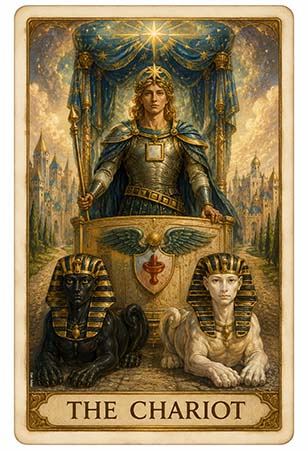
The Chariot may be the strangest card in the Tarot.
It is supposed to represent victory, yet no battle has begun.
It represents movement, yet nothing is moving.
It depicts a chariot, yet there are no horses—only two sphinxes.
There are no reins.
There is no whip.
There is no enemy.
Nothing appears to be happening at all.
Was It Intentional?
And that may be exactly what Pamela Colman Smith, the illustrator of the Waite Tarot Deck, wanted us to notice.
For generations, The Chariot has been interpreted as a card of willpower, determination, and conquering obstacles. Yet when we actually look at the picture, those obstacles are nowhere to be found. There is no battlefield, no rough road, no charging army. The charioteer isn’t straining. He isn’t shouting commands. He simply stands, perfectly still.
It’s almost as though the card is asking us to question our assumptions.
Perhaps the real battle isn’t out there.
Perhaps it’s in here.
The black and white sphinxes seem to embody opposing forces: reason and emotion, courage and fear, planning and intuition, the conscious and unconscious mind. Left to themselves, they would almost certainly pull in different directions. Yet the charioteer doesn’t force them into submission.
In fact, he has no reins.
That omission is astonishing.
If this card were really about domination, the reins would be the most important object in the entire picture. Pamela could easily have painted magnificent golden harnesses stretching from the driver’s hands.
Instead, she paints…nothing.
The message seems surprisingly modern.
You don’t move forward by pulling harder.
You move forward by becoming aligned.
The Chariot and Wu Wei
There’s an old idea in Taoism called wu wei, often translated as “effortless action.” It doesn’t mean laziness or passivity. It means acting without inner conflict. The master doesn’t appear powerful because he exerts more force than everyone else. He appears powerful because nothing inside him is working against itself.
The same principle appears in the martial arts. Beginners rely on muscular effort. Masters move with astonishing economy because every part of the body is working together.
The Chariot seems to celebrate that same kind of mastery.
Not force.
Alignment.
The Years that Lead to a Moment
Think about the biggest moments of your own life.
Writing the book.
Leaving the job.
Starting the business.
Falling in love.
The visible action often takes only a single day.
The invisible preparation may take years.
Long before the wheels begin to turn, something inside us has to come into harmony. One part of us can no longer be saying, “Go,” while another whispers, “Stay safe.”
Most of us believe we’re stuck because life is difficult.
Sometimes that’s true.
But just as often, we’re stuck because different parts of ourselves are pulling toward different destinations.
“I want to follow my dream.”
“I don’t want anyone to criticize me.”
“I want intimacy.”
“I’m terrified of being vulnerable.”
That’s a motionless chariot.
Not because there isn’t a road.
Because the driver hasn’t yet become whole.
Seen this way, The Chariot isn’t asking, “How strong is your will?”
It’s asking a far more interesting question:
How divided is your mind?
When those inner divisions begin to dissolve, movement becomes almost effortless. The struggle isn’t eliminated because the world suddenly becomes easy. It’s eliminated because we’ve stopped fighting ourselves.
Perhaps that’s why Pamela painted a motionless chariot.
She wasn’t showing us the moment of victory.
She was showing us the battle before the battle.
The quiet, invisible work of bringing ourselves into alignment.
Because once that work is complete, the journey has already begun.