The Empress and Remembering Creativity

We’re all born creative—but somewhere along the way, we forget. This post explores how to reconnect with your natural creative spark by nurturing it gently, playfully, and without judgment. Centered around the Empress Tarot card and the affirmation “Nurture Creativity,” this is a soulful guide to reclaiming your artistic joy, silencing your inner critics, and remembering who you really are.

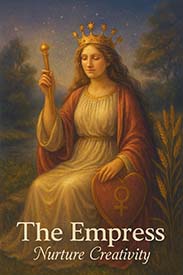
A tarot affirmation poster available at Synergy Studio

 Nurture Creativity: A Message from The Empress

We are born creative. That’s not poetry—it’s biology. The moment a child is given space, they draw in the dirt, sing nonsense songs, build forts out of chairs and blankets. As Picasso once said, “Every child is an artist. The problem is how to remain an artist once he grows up.”

Substitute the word artist with creative and the truth holds. It’s not just painters or poets or musicians who are creative—it’s gardeners and cooks and problem-solvers and dreamers. Creativity is our birthright. The trouble is, somewhere along the way, we forget that.

That’s why when I created the affirmation poster for The Empress, I chose the words: “Nurture Creativity.” She’s not just a symbol of beauty or abundance—she is the Earth Mother of inspiration itself. Her power doesn’t lie in striving or perfection. It lies in growing, tending, and trusting.

 So What Happened?

If we’re born creative, why do we have to learn how to nurture it?

Because somewhere along the line, that light was dimmed.

It happens early—often by people who love us. Well-meaning parents may tell their children, “You can’t make a living as an artist,” or “You should do something more practical.” The message is subtle but clear: creativity is fine for hobbies, but not for life.

Teachers, too, can unwittingly squash that spark. A child who colors outside the lines, who doesn’t draw a tree the “right” way, or who writes odd little poems that don’t rhyme may be corrected, redirected, or even shamed. In the name of order, achievement, and conformity, imagination is often sacrificed.

Then there’s the school system itself, which tends to reward left-brain thinking—math, logic, memorization—while cutting funding for art, music, poetry, and play. Creative expression is often treated as an “extra” instead of a core part of human development.

Add to that a culture that idolizes productivity over process, perfection over exploration, and we end up with generations of adults who believe they are not creative simply because they were never given the space—or the encouragement—to grow.

But that creativity didn’t vanish. It just went quiet.

The First Step Back

The first step in being creative is remembering that you already are.

You were born that way. Creativity isn’t something you have to earn, or prove, or qualify for—it’s part of your wiring. Despite all the conditioning you received growing up, despite what teachers, parents, or critics may have said, your creativity never left you.

It’s not gone. It’s just… misplaced.

Think of it like losing your car keys. You don’t panic because they’ve stopped existing—you just start retracing your steps. You check your pockets, your coat, the kitchen counter, under the couch cushion. And eventually, you find them right where you left them. Creativity is like that: it’s tucked into your daydreams, your doodles, your half-finished journal entries and quiet longings. It’s waiting for you to remember.

You’re not starting from scratch. You’re simply coming home.  Here are some simple steps to get you there.

Remember It’s Play

One of the most important things to remember as you reconnect with your creativity is this: it’s supposed to be fun.

You’re not going to get a work evaluation. You’re not going to be graded. There’s no report card, no gold star, and no panel of judges waiting to declare whether what you made is “good enough.” There’s no wrong way to write a poem or paint a picture or design your garden. If it feels good to your spirit, you’re doing it right.

If you catch yourself getting tense, self-critical, or frozen with perfectionism, think back to finger painting as a kid. You weren’t trying to master composition or worry about the light source. You were just joyfully smearing color across a page—ooey, gooey, and gloriously free. You didn’t second-guess whether it was “real art.” You just made it.

That’s the energy you want to invite back. Not pressure. Not performance. Just play.

Get rid of the critics in your head.

Those voices telling you you’re not good enough? They’re not the voice of truth. They’re the echo of someone you met along the way—probably in childhood. Maybe it’s creepy Mrs. Finglestermer, your second-grade teacher who chewed with her mouth open and told you you weren’t “doing it right.” Or maybe it’s your perfectionist father who criticized how you made your bed—so of course now you think your sketch isn’t good enough either.

Whatever form they take, those voices don’t belong in your creative space. Tell them to sit down and shut up.

Second: protect your creativity from external critics too.

Don’t ask people what they think of your poem, or your painting, or your dream, unless they’ve earned the right to hold it gently. If someone mocks or dismisses your work, they never get to see it again. Your creativity is like a small child—it deserves to feel safe, encouraged, and loved. You wouldn’t leave your kid with someone who belittles them. Don’t do that to your art either.

Create in sacred space. Share it only with the people who nurture, not the ones who nitpick. The Empress doesn’t seek approval—she creates because it is her nature.

Return to the Garden

The Empress reminds us that creativity doesn’t thrive under pressure—it blossoms in safety, in slowness, in love. When we nurture our creativity, we’re not just making art—we’re healing the part of ourselves that was told to be quiet, to be small, to be practical. We’re reclaiming the joy of making for its own sake. So whether it’s through paint or words or music or movement, give yourself the grace to grow. You don’t need permission. You only need space. And a little bit of faith.

You are already creative. You always have been. All that’s left is to remember.

“Just the Tarot,” by Dan Adair.  A kindle ebook at available at Amazon.

Learning to Live Without Joy

Many people feel disconnected, numb, or unable to access joy—especially after childhood trauma. This post explores emotional flatness, toxic positivity, and why realness may matter more than happiness.

Did you get ACED when you were a kid?

ACE stands for Adverse Childhood Experience, and the odds are fairly high that you experienced one. ACEs include things like emotional abuse, neglect, parental mental illness, substance abuse, and divorce or separation of the parents.

We tend to think of those kinds of negative experiences as relatively rare. Maybe we got the hell beaten out of us by a crazed, drunk parent—but most people didn’t, right?

After all, just look at how happy everyone else seems.

But according to the CDC-Kaiser ACEs Study, 61% of adults across 25 states reported experiencing at least one ACE. And nearly 1 in 6 (16.7%) reported four or more.

The truth is, a sizable portion of the population is living with the long-term effects of unresolved trauma—including dissociation, emotional blunting, chronic anxiety, and difficulty accessing joy.

The Cultural Pressure to Be Happy

One of the strongest side effects of long-term trauma is the belief that, “Man, I must really be fucked up, because I’m just not happy. Everyone else is happy, but I’m a train wreck. In fact, I’m not even a train wreck, I’m completely off of the tracks.”

That belief is especially potent if you’re American.

American culture—especially through media and marketing—places enormous value on positivity, confidence, and personal success. Like the figures in the Three of Cups, we’re all supposed to be dancing with joy, smiling through life, bubbling over with gratitude. The message is:

“You should be happy, empowered, and in control of your life at all times.”

And if you’re not?

Then something must be seriously wrong with you.

This pressure to appear happy, even when we’re not, creates:

Emotional dissonance: A split between what we feel and what we think we should feel.

Shame about feeling bad: A second layer of suffering on top of the original pain.

Social masking: We say we’re “fine” or “happy” because it’s expected—and we believe others are genuinely feeling that way (even when they aren’t).

Antidepressants and the Emotional Economy

A recent Gallup poll reported that a whopping 78% of Americans say they feel satisfied or very satisfied with their lives. The poll even bemoaned the fact that the “happiness index” was down by two points.

Meanwhile, the U.S. is among the highest consumers of antidepressants in the world.

Some people take them for serious clinical issues—but many of us take them simply to cope with lives that feel emotionally flat or chronically overwhelming.

Years ago, psychologists discovered that one of the most useless surveys in the world was asking teenage boys if they’d had sex. The overwhelming majority said, “yes, of course I have,” —even though many of them didn’t have the slightest clue how to unfasten a bra, let alone what to do next. They thought they were supposed to be having sex, because they assumed all the other boys were doing it—even though they weren’t.

In much the same way, Americans seem to be lying to pollsters about how happy we are, because we think we’re supposed to be happy.

After all, everyone else is smiling.

Even if they’re not.

We’re taking pills to create artificial happiness because we think we should be happy, even when we’re not.

Living With “Flat” Emotions

What if, instead of constantly trying to fix our feelings, we first learned to live with them?

Assuming there’s no organic brain issue involved, there’s always a reason that we’re not happy.

As Gabor Maté points out, when we suffer trauma that we can neither fight nor flee from, we dissociate. We leave our bodies. We stop feeling.

Not feeling becomes a survival mechanism—a way of coping with pain that would otherwise overwhelm and break us.

If you’re among the 61% who’ve had at least one ACE, you’ve probably experienced dissociation and emotional flatness.

If you’re in the 16% who had four or more ACEs, emotional flatness may be how you live most of the time. It’s not that we don’t want to be happy—we just don’t know how.

And that, in itself, can be traumatic, because we’ve been programmed to believe that we should be happy—even when we can’t feel it.

But we can reframe that.

Rather than chasing a happiness ideal that may not be accessible—especially after trauma—it’s possible to:

• Honor emotional flatness as a survival adaptation.

• Shift the goal from happiness to authenticity.

• Value calmness, neutrality, or quiet presence as valid emotional states.

• Find meaning not in chasing joy, but in living gently and truthfully with what is.

This doesn’t mean giving up on healing, but healing might not look like “feeling great all the time.”

It might look more like “being okay with feeling whatever I feel.”

A New Emotional Ethic: Realness Over Happiness

Ideally, we need a massive cultural shift—from:

“I must feel good in order to be okay”

to:

“I’m okay because I’m allowing myself to feel what’s true for me.”

But… yeah. Don’t hold your breath on that one.

What is possible—what’s powerful—is to make that shift within ourselves.

If you’ve had the hell beaten out of you, either physically or emotionally, as a child or as an adult, it’s okay to feel sad.

It’s okay to feel numb.

It’s not just okay—it’s rational.

That doesn’t mean we want to live there forever.

That doesn’t mean we resign ourselves to an existence without joy. But maybe healing begins when we stop pretending. When we stop performing. When we let ourselves feel—or not feel—exactly where we are.

In this new ethic:

• Sadness is not a problem.

• Numbness is a messenger.

• Joy, when it comes, is a gift—not a requirement.

Back in the 1960s the Transactional Psychology movement came up with the catch phrase:  “I’m Okay, You’re Okay.”

To which Elisabeth Kubler-Ross replied:  “I’m Not Okay, You’re Not Okay.  And That’s Okay.”

The first step in the path seems to be honestly saying, “This is who I am.  This is where I’m at. I hurt when I feel and so I try not to feel. And for right now, that’s okay.”

The Alchemy of the Mind: Transforming Your Life With the Seven Principles of the Kybalion

Empath Ethics 101: Don’t Help?

Why respecting emotional boundaries is essential for empaths—and how not helping can sometimes be the most loving choice.

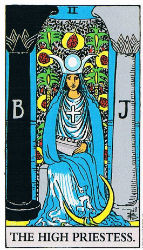
The High Priestess – Intuition

If you’re an empath, you’ve probably been in this situation: you’re having a perfectly normal conversation with someone, but your intuition is screaming that something’s wrong. You sense they’re deeply hurting. Their emotional shields are up, their energy has pulled inward — but underneath it all, you can feel the pain.

The first instinct of an empath is to say, “Hey, what’s wrong? What can I do to help?” Especially if it’s someone we love, we want to reach out and offer comfort.

But sometimes, that’s exactly the wrong thing to do.

It’s Not Intrusive… to Us

The first thing to understand is: we’re not being deliberately intrusive. We channel other people’s emotions as naturally as breathing. When we’re in a one-on-one conversation with someone we care about, we pick up on their energetic patterns — even if they’re trying to hide them. It’s not something we try to do. We just do.

But to someone who isn’t an empath, that does feel intrusive. It can feel like we’re reading their private diary without permission.

Expecting an empath not to process someone else’s energy is like telling someone not to notice faces or colors. It’s simply how we experience the world. But we have to remember: “normal” people don’t operate this way, and many feel invaded or exposed when we reflect their hidden emotions back to them.

Language as a Boundary

For most people, language functions as an energetic boundary. Let’s say we’re sitting with someone and sense something is wrong. The conversation might go like this:

“How are you today?”

“I’m fine, thank you.”

“So everything’s good with you?”

“Yes, it is.”

That’s the moment we need to stop. We’ve given them a verbal cue that we’re open to listening. They’ve responded by clearly saying they don’t want to talk about it.

That doesn’t mean our intuition is wrong. We can trust what we’re sensing. But they’ve drawn a boundary with language — and emotionally healthy people honor boundaries.

Don’t Get Loopy

For empaths — especially intuitive types like INFJs and INFPs — this can trigger a kind of informational loop. Our intuition says something’s wrong, but the person says everything’s fine. It feels disorienting — like being told the sky is green and the grass is blue.

This can easily lead to obsessive thinking. We replay conversations, analyze patterns, try to intuit what they won’t say. When we can’t resolve it, we go over it again and again.

It becomes a loop — rearranging the same puzzle pieces, but still not seeing the picture. It’s a huge drain on time and energy.

The truth is: if they want to tell us what’s wrong, they will. If they don’t, it’s not our business.

Give Them the Gift of Space

Sometimes, the greatest gift we can offer someone we love is space.

Yes, we may know — deeply, clearly — that they’re hurting. And we want to help. But we must also respect the context of our relationship.

If you’re a therapist and they’ve asked for support — of course, help them.

If you’re giving a Tarot or psychic reading and they’re open — of course, help.

But outside those contexts, no matter how close we feel to someone, it’s always up to them to invite us in. If they don’t, we honor that. We don’t push. We don’t intrude.

Yes, It’s Confusing

Yes — this can feel confusing as hell to empaths.

In many ways, we’re always intimate with those we love. We feel their emotions. We know how they’re doing even when they’re not physically present. Sometimes it feels like their pain is our pain.

But we must remember: feeling something doesn’t mean we need to act on it.

If someone we care about is struggling, and they don’t ask for help, we let them be. We can still support them energetically — by holding space, sending love, offering healing from a distance.

But anything more? That’s up to them.

The Two of Pentacles, Multipotentialites, and Specializing in Being a Non-Specialist

How to distinguish creativity from attention deficit disorder.

Did you ever walk into a room and then have absolutely NO clue why you did it?  We stand there for a couple of seconds, asking ourselves, “What in the hell am I doing in here?  What did I want in this room?”  Blank. And then we remember that we were looking for our car keys or we wanted to make the bed or maybe there’s a book that we left somewhere and we need to find it.

That happens to everyone, of course, and older people even joke about it.  “I wouldn’t remember where my head was if it wasn’t screwed on.  Maybe I’m getting the OldTimers Disease.”

If it KEEPS happening, though, we may start to hear a little voice inside our mind that’s sounding an alarm.  “Hey, dude, maybe you are getting Alzheimer’s.  Or maybe you shouldn’t have taken all of those recreational drugs when you were a kid.  Or – oh, my god – maybe you’ve got a brain tumor!  Or maybe you’ve got ADHD!”

ADHD-ISH

The truth of the matter is that a lot of us are feeling ADHD-ish these days.  After all, attention deficits can also spring straight out of anxiety and depression and these aren’t the most tranquil of times, are they?  Even if we don’t have personal problems, the news networks and the internet are constantly blasting out the message that the sky is falling and we’re all going to die.  Climate change, pandemics, wildfires, dead celebrities, crazy politicians, oh, my!

Huge numbers of people are feeling distracted, nervous, upset, and having trouble concentrating.  There’s an epidemic of lost car keys and many of us aren’t just keeping to-do lists, we’re keeping lists of our to-do lists.  Try an internet search on, “how to get organized,” and you’ll see how very many us are bewildered, befuddled and befucked.  

AN ALTERNATE VIEW

Now, WAY BACK in the 2010s, Emilie Wapnick noticed that there were many, many people feeling this way.  It wasn’t just that they were having trouble with their attention spans or with getting organized.  Their entire lives felt unfocussed, as if they simply couldn’t decide what they should do next.  

She gave an incredibly influential TED talk called, “Why Some of Us Don’t Have One True Calling,”  and she introduced a radical idea.  Maybe, she suggested, we’re not really ding bats who keep getting distracted by shiny objects.  Maybe we’re actually just incredibly creative people who can’t and won’t be satisfied by a single pursuit. 

The term that she uses to describe people like that is, “multipotentialite.” As she outlines in her wonderful book, “How to Be Everything: A Guide for Those Who (Still) Don’t Know What They Want to Be When They Grow Up,” there are some of us who simply aren’t wired to be single-pursuit human beings.  We may be simultaneously (and passionately) pursuing vocations in art, writing, and auto repair, all the while researching a half a dozen other fields that we’re interested in.  In the past, such a person might have been admired and even lauded for their intellectual curiosity.  Today, they’re frequently labeled as being dysfunctional or misdiagnosed as having attention deficit disorder.

HENRY FORD’S DEMON BABY

Almost from its inception, the Industrial Revolution attempted to turn human beings into mere slaves who operated the machines in the factories.  The model wasn’t really perfected, though, until Henry Ford introduced his, “rolling assembly line,” in December of 1913.  Using that model, workers stand in one place as the product rolls by on a conveyor belt.  Each worker performs one job in assembling the product, and they do that one job over and over, hundreds of times a day. This ushered in the age of specialists.

There is no question that Henry Ford was a thoroughly evil man.  He was such a rotten person that Adolph Hitler mentioned him admiringly in Mein Kampf and kept a large portrait of Ford behind his desk.  Perhaps the worst thing that he did, though, was to champion the idea that a person should specialize in only one thing and do it over and over until his soul dies from sheer boredom.

NOT BELONGING IN THE AGE OF SPECIALIZATION

That idea of specializing in only one thing has it’s advantages, of course.  For instance, if we’re having a heart valve replaced it’s comforting to know that the surgeon has performed the same operation hundreds of time before.  Still, it can have devastating effects if it’s presented as the ONLY model of functioning in our society.

To be clear, multipotentialites don’t just like to pursue multiple interests at once:  it’s what they do.  It’s wired into their brains.  Telling a multipotentialite to specialize in just one area is like telling an introvert to go to more parties or telling a cat to fetch a stick and bark.

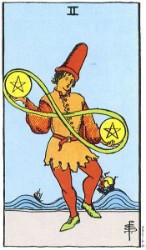
When we take that natural behavior, though – that need to pursue many different interests at once – and drop it into our linear, specialized society, it looks a lot like . . . guess what?  ADHD.  In a culture where concentrating on one task at a time is the behavior that’s rewarded and reinforced, the multipotentialite is frequently perceived as being highly dysfunctional.   Why can’t you concentrate?  Why don’t you ever get anything finished?  Why do you keep jumping from one thing to the next?  Those are questions that the multipotentialite will hear her entire life and it can leave her feeling inadequate, guilty, and shamed.  Like the figure in the Two of the Pentacles, life seems like a constant balancing act, rather than a fulfilling adventure.

STRATEGIZING FOR A HAPPY LIFE

If all of this is striking a chord with you, if you feel that you may be a multipotentialite, then rest assured, there are still ways to find happiness.  There are a few simple strategies that can make you feel like you’ve got super-powers instead of constantly feeling less than.

1. Embrace Your Identity and Fix Your Self-Image: Recognize that being a multipotentialite is a strength, not a flaw. Celebrate your curiosity and versatility instead of forcing yourself into a specialist mold.

2. Consciously Design a Portfolio Career: Instead of choosing one path, build a career that allows you to explore multiple interests. This could mean freelancing, consulting, or combining part-time roles.  If you’re an artist and a writer, for instance, you could do illustrations set off with poetry.

3. Set “Seasons” for Your Passions: Focus on specific interests for a set period, then rotate to another. This prevents burnout and keeps things fresh. This allows you to hyper-focus on a particular avocation, but use boredom as a signal for when it’s time to switch to another.

4. Create a “Renaissance Schedule”: Dedicate blocks of time to different pursuits. For example, Mondays for art, Tuesdays for coding, and so on. Structure helps manage your many passions without feeling scattered.

5. Prioritize Projects: Not every interest needs to become a lifelong commitment. Learn to distinguish between short-term fascinations and long-term passions.

6. Find Overlaps: Look for ways to combine your interests into unique projects. A multipotentialite superpower is the ability to innovate by connecting ideas from different fields.

If you’re interested in exploring more multipotentialite options for living, I’d really encourage you to visit Emilie’s website, “puttylike.   Creativity and curiosity are options that many people seem to have missed out on, so let’s take them to the max.

The Eight of Pentacles, Bras Burning Bright, and the Importance of Social Deviance

A look at the importance of personal and social deviance as illustrated by the war over brassieres.

Imagine a culture that was SO rigid that the people in it actually dictated what kind of underwear you had to put on in the morning.  Sounds pretty crazy, doesn’t it?

Still, that was exactly the situation that we had right here in the United States just 50 short years ago.  It’s a short tale and well worth looking at.

The modern brassiere was invented by Mary Phelps Jacob in 1910.  From that point on it was declared that, “decent,” women would wear bras and breasts would henceforth be encased in cotton cups when they were transported out in public view.

Now, in the late 1960’s, a growing group of women said, “I don’t wanna.”  It wasn’t that they were rigidly opposed to brassieres because, as any woman will tell you, bras can be comfy cosy in winter months and in cold climates.  Rather, they were making the radical assertion that any human being should have the right to decide whether they want to wear underwear on any given day.

Many people in our culture were shocked and appalled at the notion of unfettered breasts.  Women who went braless were actually arrested for, “public indecency,” in some Southern states.  “Decent,” women sneered at them and, “god-fearing,” men leered at them.

Still, the revolutionary bra warriors persisted and even went so far as to hold public bra burning to make their point.

By today, of course, no one cares if a woman wears a bra or not.  Generally speaking, bras go on in the winter time and come off in the summer time, which is perfectly sensible and the way it should have been all along.

The Great Bra Culture War is a perfect illustration of what sociologists refer to as, “tolerated social deviance.”  They actually have a very precise definition of deviance, which goes like this:

Deviance is a behavior, trait, or belief that departs from a social norm and generates a negative reaction in a particular group. In other words, it is behavior that does not conform to the norms of a particular culture or society.

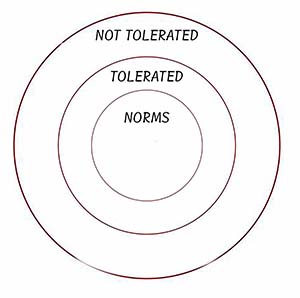
Tolerated social deviance is behavior that’s outside of the social norm, but not so far outside of it that it warrants severe punishment.  We can think of it as a series of concentric circles where the inner circle is the norm, the second circle is outside of the norm but it’s tolerated, and the outer circle is SO far outside of the norm that it will get you arrested.

In that model, during the first half of the 20th century not wearing a bra in public was in the outer circle and would result in a woman being shunned, slut-shamed, or arrested.  After the 1960s, not wearing a bra moved into the second circle of being outside the norm, but tolerated.  And by now, it’s moved into the inner circle of perfectly acceptable behavior, except in Mississippi.

The point of all of this is that freedom and creativity exist OUTSIDE of the norm.  That inner circle of social norms consists of people behaving in exactly the same way as everyone else.  The behavior is, “acceptable,” precisely because everyone else is doing it.

The world of the social norm is what Stuart Wilde was talking about when he referred to the Tick-Tock world.  As he pointed out in his book, “Affirmations: How to Expand Your Personal Power and Take Back Control of Your Life,” the Tick-Tock world involves getting up every day and doing the same things over and over and over because that’s what society expects of us and we don’t want anyone to think we’re being weird or unusual.  “I have to wear a bra because everyone else wears a bra and what would the neighbors think if I didn’t?”

To put it in terms of energy, it’s a closed system.  There’s nothing new or different flowing into it, because everyone is acting and thinking exactly the same way.  It’s like the guy in the Eight of Pentacles who’s just making the same product over and over again, but not creating anything new.

Deviance is thinking outside of that closed box.  Deviance is what allows fresh, different energy into the system.  Deviance is what makes us evolve.

We see this in cultures all across the world.  The most creative, vibrant cultures are the ones that tolerate the highest levels of diversity.  China and Russia, for instance, have extremely low tolerance for diversity and social deviance.  Are they producing any great literature?  Any amazing art?  Fabulous music?  Is anyone desperately trying to get into their countries?  Nope.

Put very simply, the best cultures are the cultures that maximize freedom and diversity.  Those are the cultures that are the most alive and evolving the fastest.

I’ve lived in both California and Texas.  I CHOOSE to live in California because California maximizes my opportunity to be just as different, weird, and unusual as I want to be.  California values social deviance and so I have a much greater opportunity to be my authentic self, to the best of my abilities.

It’s important to ponder all of this as we move into the new era of the Trump administration.  Are we going to continue to be a society that values  and encourages diversity or are we going to become a closed, intolerant  and stagnant energy system?

Make no mistake:  there ARE people out there who are so crazy that they want to tell us what kind of underwear we should put on in the morning.  They want to shrink those two outside circles into one boring inner circle where everyone looks and acts precisely like everyone else.  

Don’t let them do it.

Empaths, Elections, and Staying True to Our Own Energy

Building effective boundaries for empaths.

If you’re an empath and you’ve been feeling kind of sick to your stomach lately, believe me – you’re not alone.  Many of us have experienced the recent election in the United States as something that makes us want to curl up in a ball under a blanket for the next four years.

It’s important for us to explore how this is affecting us from a bioenergetic perspective, though, and not just from a political or emotional perspective.  What is all of this DOING to our energy and our energy fields?

What’s one of the first words that come to mind when we contemplate being an empath?  Boundaries, right?  Boundaries, boundaries, BOUNDARIES!  

Empaths have extremely porous personal boundaries and very leaky energetic boundaries.  In a way, that’s what makes us empaths.  “Normal,” people have fairly strong boundaries and a strong sense of, “I’m over here and you’re over there and we’re two separate beings.”  For a normie, what another person is feeling stays inside of the other person, unless the other person decides to share it.  For an empath, other people’s feelings are constantly flooding into us. It’s very easy for us to merge with those feelings and mistake them for our own.

That’s one of the reasons that many empaths become codependent.  We merge so totally (and so easily) with other people’s emotions that we mistake them for our own.  If someone we’re close to is having emotional or mental problems, we think that we have to manage their drama because it feels like it’s our own. We end up taking care of their lives instead of our own.

So one of the first steps to becoming a healthy empath is to learn to identify our own energy and separate it out from other people’s energies.  We learn this at an early age and many of us become socially avoidant as a result.  We realize that if we’re around people who are angry, depressed, or violent, that we just soak all of that in and it fucks us up.  One strategy we use to deal with that is to just avoid people in general: many empaths become radical introverts.  Which works, but it’s not the BEST strategy, right?  We really can’t cover our heads with the blankets for the next four years.

Can we?  Um . . . no.  I guess not.

We have to learn to separate our energy fields in better ways.

The human energy system is really quite simple to visualize.  As Alla Svirinskaya says in her book, “Own Your Energy – Develop Immunity to Toxic Energy and Preserve Your Authentic Life Force,”  we can think of it as the physical body or core, which is surrounded by a couple of other energetic layers or bodies which are the emotional body and the mental body.  Those other bodies are usually seen as egg shaped, so we end up with a picture of it that looks like this:

For a normie, those extra layers act as a wall to keep out other people’s energy. They filter out negative energies so that they never reach the core of the physical body. For an empath, though, they act as a bridge.  Instead of blocking us off from the emotional identity of people who aren’t us, they allow it to flow right into our personal energy fields which frequently overwhelms us, leaving us confused and injured.

Most empaths are dealing with those dynamics on a daily basis.  What we forget, though, is that our personal energy fields exist inside of larger energy fields.  Any time that you put a group of people together, their personal energy fields are going to merge to some extent and generate a group energy field that’s composed of the collective emotions of all of those people. And we live within those other energy fields.

In a very real sense, we could talk about the vibrations of a particular town or a county or a state.  Those vibrations are the collective energies of the people who live in those places.  Texas, for instance, has a very different vibration than California. And, yes, countries have a collective energy field, too, which is brings us back to the topic at hand:  dealing with this election.

About 72 million Americans got together and voted for a candidate who oozes hatred and anger out of every pore of his orange skin.  THAT is the collective energy that we’re dealing with right now and THAT is what’s making us feel sick.  Put simply, there’s a whole lot of hatred and anger out there in the collective energy field and it’s seeping in to our personal energy fields.  As empaths, we are especially vulnerable to this.

So what can we do about it? Well, we need to remember that the key to being a healthy empath is to be able to distinguish OUR energy from OTHER’S energy.  We need strong boundaries and we need that sense of, “this energy belongs to me and that energy doesn’t.”

Empaths are (for the most part) kind, loving, compassionate people.  That just goes with the territory.  When you really and truly understand another human being on the deepest level, it’s very difficult to stay angry with them.  Or to hate them.  Or to judge them too harshly.

Hatred, anger and judgements are NOT our energies and that’s why they make us sick.

A good strategy for us, then, is to be very conscious of those energies existing inside our personal fields. If we start to feel really, really, REALLY pissed off at the Trumpsters, we can stop and say, “This is NOT my energy.  This is their energy.  I won’t own it.”

Another strategy is to do what Chagdud Tulku called, “antidoting.”  The antidote for hatred is love and the antidote for anger is compassion.  I’m not suggesting that we turn ourselves into human doormats for the Trumpsters.  Rather, we’re just embracing our own nature.  By embracing our own nature, by being as compassionate, kind, and caring as we can, we automatically separate OUR energy from THEIR energy and – surprise, surprise! – we’ve got boundaries.  Suddenly, they’re over there and we’re over here and we don’t have to live in their hatred or let it blend into our energy.

Shazam!

The Moon, Processing the Election, and Summoning a New Reality

Processing the craziness of the U.S. election and waiting for a new world to manifest.

MORE THAN JUST THE BLUES

So how are you doing out there after this crazy election?  If you’re a liberal, an empath, or an intuitive, you’re probably feeling puzzled, sad, angry, depressed, and – to a certain extent – scared.

And, unless you’ve just sworn off rationality (like the other half of the country) you’re probably trying to figure this out.  What in the HELL just happened?  It’s more than just a normal case of post-election blues.  It’s a need to restore some sense of sanity to our daily lives.

YES, THEY REALLY ARE CRAZY

The first thing to acknowledge is that, yes, the Trumpsters really ARE crazy.  There’s an old argument that says, “A million people can’t be wrong.”  But they can be and frequently are.  Millions of people supported Hitler and Stalin.  Millions of people supported the Catholic church raping and burning and murdering it’s way across several centuries.  Not only is there not truth in numbers, there’s frequently collective insanity.

DEFINING CRAZY

If you joyously embrace something that’s going to fuck you up, you’re crazy.  We recognize that fact with addicts who stick the needle in their arms one more time or alcoholics who pick up a bottle again.  Bi-polars who quit taking their meds.  Abused spouses who go back to their abusers.  If we choose self-destruction, we’ve left the realm of sanity.

In my lifetime, there has never been an election where more people voted against their own self-interest.  Women voted for a man who wants to end their control over their own bodies.  Latinos voted for a candidate who calls them murderers and rapists.  So-called Christians voted for a serial adulterer who’s violated nearly everything that Jesus ever taught.  And on and on.  They’ve chosen someone who is going to destroy their lives, therefore they’re crazy.

TRYING TO RESTORE BALANCE

One of the first things that we do when we’re confronted with a whole lot of crazy is to try to restore a sense of balance and sanity.  There must be some reason why they acted so crazy, right?

That’s our rational, left-brain, linear thinking trying to understand why they acted as they did.  A sense of sanity is very important to human beings.  It makes our environments predictable, it makes our lives orderly and meaningful.  More than anything else, it gives us a sense of safety and we need a sense of safety to function.

This is why we’re seeing all of the post-election analysis.  “What is it that women really wanted?  What issues are really important to minorities?  What message was rural America really trying to send?”

PROCESSING CRAZY

The sad truth, though, is that if we try to process non-rational behavior from a rational perspective, it just makes us crazy.  There are million reasons out there for why different people voted for Trump.

I couldn’t bring myself to vote for a woman.

I didn’t like her laugh.

I’m paying too much for groceries.

I’m worried about immigrants.

I’ve always voted for Republicans.

I hate liberals.

He didn’t REALLY mean all of those things he said.

Any and all of those reasons pale in comparison to the reality of voting for a senile, hateful, con artist who announced that he intends to be a dictator and end democracy as we know it.  When we put the reasons next to the results, they’re all crazy.

THE MOON CARD AND CRAZY

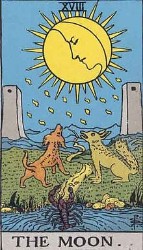
The Tarot card, The Moon, is all about crazy.  It shows a dog and a wolf baying at the Moon, while a crustacean crawls out of a dark pool.  It illustrates that even our domesticated dogs still contain the genes of the wild wolf and our brains still contain the primitive, crocodile brain that motivates hatred and fear.  The light of the Moon illuminates but doesn’t delineate.  We see a shape on the ground and we don’t know if it’s a snake or a rope.

What happened in our last election was all about illusions, delusions, and trickery.  It was the wolf snapping it’s ravenous jaws at our doors and the crocodile gnashing it’s teeth.  It was a cultural and spiritual disaster.  It was crazy to the max.

CREATING ALTERNATIVE REALITIES

So if we can’t use our rational minds to really understand what just happened, what do we do?  Well, we ask for answers and wait for alternative realities to emerge.

We need to give our subconscious minds – which are also our links to our higher selves – time to process all of this craziness.  What we just got was the equivalent of a massive data dump.  We just now found out that over half the country supports a very evil (yep, I’m going to use that word) agenda.  It contains racism, sexism, homophobia, xenophobia, and fascism.  We simply can’t assimilate all of that data at once.

What we CAN do is to actively engage with our subconscious minds (and thus our higher selves), ask for answers, and wait for them to emerge.  That means doubling down on meditating, prayer, lucid dreaming, reading Tarot cards – whatever our particular means is of creating a dialogue with our subconscious and higher selves.  That means actively asking for answers.

IT TAKES A LITTLE WHILE

As we know, the subconscious mind doesn’t have a drive-through window.  We can’t just cruise up and order an answer to all of this with a side of onion rings or fries.

We also know, though, that our subconscious minds, our higher selves, and our guides and helpers are infinitely creative.  Right now, at this very moment, they are weaving together a tapestry that will contain the answers we need.  As spiritual seekers we don’t drive out the darkness – we bring in the light.  The light will start to emerge over the next couple of months and it will emerge through us.

The Five of Wands, Louise Hay, and Becoming the Grown Up Who Lives in Our Heads.

A look at childhood programming and using affirmations.

If I were to say, “Your thoughts are total bullshit,” you’d probably feel highly insulted.  On the other hand, if I were to say, “My thoughts are total bullshit,”  you might agree with me or you might tell me that’s not true and wonder where I got such a terrible self-image.

But if I were to say, “A lot of OUR thoughts, as human beings, are total bullshit,” that’s a more fertile ground for discussion simply because it depersonalizes it and takes us out of a fight-or-flight reaction.  We don’t have to defend anything or run away from being criticized.

In, “You Can Heal Your Life,” Louise Hay made the point that, at their base, our thoughts really mean nothing at all.  They’re just words that we string together and they don’t take on any meaning by themselves.  We have to ASSIGN meaning to them.  We have to say, “I believe these thoughts are true.”

And, oddly, our beliefs are nothing more than thoughts that we’ve repeated over and over and over until we believe that they’re true.  When we take a little closer look at those thoughts we can understand exactly why so many of them really are bullshit.

First of all, a lot of our thoughts were, “installed,” in our little brains when we were far, far too young to make any rational judgements about their validity.  By the time that we reach late adolescence most of us have been thoroughly programmed with unexamined thoughts that we believe to be true.  The richest source of the programming is our families, of course, but we get a hefty dose of it from our teachers and peers, as well.  Some of those thoughts might be things like:

I’m no good at math.

I can’t dance.

I’m a terrible athlete.

I’m not very good looking.

I’m too fat or too skinny or too tall or too short.

I don’t fit in.

Nobody likes me.

Or the thoughts might be something like:

Democrats are communists.

Republicans are fascists.

Rich people are heartless.

People who don’t practice my religion are evil.

Black people are scary or white people are arrogant honkies.

Immigrants are too lazy to work AND they’re going to steal my job.

These are all just words, strung together to make thoughts, which were repeated over and over when we were young until we came to believe that they must be true.

The truth of these beliefs were totally unexamined when we were kids because we didn’t have the mental capacity to evaluate them.  If our parents or teachers told us they were true, well then – hey –  they must be true because that’s what the grownups said. For the most part, though, they remain unexamined when we’re adults, which is the second reason that many or our thoughts are total bullshit.

Most of our thoughts are subliminal, which literally means, “below the light.”  In this case, we mean, “below the light of consciousness.”  We just think them, without even being aware of the fact that we’re thinking them.  That’s the infamous, “stream of consciousness,” or, “monkey mind,” that engages about 20 seconds after we wake up in the morning.  It’s just a ceaseless chatter that runs along by itself and contains – buried in its content – all of that programming that we got as kids.  It sounds like this:

Gotta get the coffee going, godamn it’s cold, I wonder if I have enough gas in the car, should have balanced the checkbook but I’m no good at math, gotta get the kids up and make breakfast, can’t believe the price of eggs, it’s the rich Republicans driving the prices up, nobody cares about working people, if only I had a better job but I’m not smart enough to get a better job, where are my socks . . .”

The unexamined thoughts that were programmed into us when we were kids are running over and over again, all the time, and remain unexamined.  And, yes, thoughts that are repeated over and over become beliefs and, like the people in the Five of Wands, we’ll fight to the death to defend our beliefs.

Which is the third reason that most of our thoughts are bullshit.  We’re totally ego involved with them.  Most of us, most of the time, completely identify with that subliminal thought stream.  We experience it as, “These are MY thoughts in MY mind, therefore, they’re a part of me.”  It never occurs to us that they’re not really our thoughts.  They’re our parent’s thoughts and our teacher’s thoughts and maybe even the thoughts of that bully who tortured us at recess in the third grade.

Affirmations, as Louise Hay points out, are a simple way to step out of that thought stream and start changing our beliefs by changing our thoughts.  Let’s face it:  most of don’t have the time to just sit there all day and watch our thoughts.  “Ah HA!  There’s another negative thought from my childhood programming!  Take THAT, negative thought!”

What we can do, though, is to become a little more conscious of our thought streams.  Even when we’re working or driving to the store or taking a shower, we can watch the mind chattering away and consciously think, “Okay, that’s a pretty negative thought,  And it’s probably not MY thought; it’s just something my mind was taught when I was a kid.”

When we begin to dis-identify with that constant stream of thoughts, we immediately lose the need to defend them.  After all, they’re not really my thoughts, so why should I care about them?  And then we can begin to replace all of that subliminal programming with programming that we consciously choose.

Just pick a positive thought – any positive thought – and repeat it 3 or 400 times a day.  Does that seem like a lot?  Well, how many times a day do we say something negative to ourselves with that childhood programming?  Hundreds of times, right?

If that sounds like a sort of a forced, Pollyanna Positivity it’s because it is. We are quite literally pushing our thoughts in a new direction and it can feel completely unnatural to begin with.  But that’s the whole point:  there’s nothing, “natural,” about our unhappy beliefs, either.  They were just thoughts that were repeated again and again, often by the miserably unhappy adults who raised us.  That’s all that happy beliefs are, too – thoughts that are repeated again and again until they become beliefs.  And we get to be the adults who are repeating them, which is pretty cool.

The Emperor, Psilocybin, and Butterfly Warriors

A look at the role of psilocybin in erasing toxic masculinity.

And then there’s the amazing case of Mark Matzeldelaflor.

Mark was a Navy Seal.  In case you’re not familiar with that, the Seals and the Green Berets are the ultimate warriors.  Incredible athletes, highly disciplined and impeccably trained, they are considered the finest combat soldiers in the world.  

Mark was also a professional sniper in the Seals.  His job was to kill other human beings by shooting them with high powered rifles, as rapidly and effectively as possible, and he was very good at it.

After serving two tours in Iraq, he left the military and returned to the West Coast, where he became an emotional and spiritual shipwreck.  He drifted from one meaningless job to another, drank too much, suffered from horrible PTSD and sank into depression and suicidal ideation.

Then one day a buddy of his said, “Hey, man, why don’t you take some Magic Mushrooms with me”. And it all went away.  All of the trauma, all of the depression, the alcoholism, the PTSD – it vanished from his heart and brain like . . . well . . . magic.

Mark immediately started trying to use his new world view to help other veterans and started an organization called Guardian Grange.  The idea is to use the discipline and talents that they’ve acquired in the military but channel that into helping to save the earth.  And their first project is . . . a refuge for monarch butterflies.

Now, I’ve written quite a bit here about toxic male role models and I find this story so amazing from that perspective.  When we think of the classic toxic male, we tend to envision a guy who’s taken a few too many steroids, muscular, swaggering, fairly devoid of emotions, unable to admit any vulnerabilities, and a bully.

That kind of a guy becomes a sort of a silly cartoon when you put him up against the reality of a Navy Seal.  These are men who can run or swim for hours with no rest, survive in a jungle or desert with no food, and kill with no mercy or compunction.

So how does someone who is literally a stone cold killer suddenly become a Butterfly Warrior?  It’s fascinating to think about, isn’t it?

The normal cultural model for male/female behavior is based on hormones.  To put it in a nutshell, men are chock full of testosterone and that makes us aggressive, dominant, and violent.  Women are flooded with estrogen, and that makes them passive, nurturing, and weak.  That model was given a huge boost by Sigmund Freud, a man who wanted to fuck his own mother and thought the clitoris was utterly unimportant in female sexuality.

Despite it’s rather shaky logic and dubious proponents, that remains the model that most people operate out of:  we’re simply predetermined products of our hormones.  But what if we’re not?

Scientists are just now beginning to really dig into what psilocybin does to the human brain.  They know, for instance, that it has some sort of a strong interaction with serotonin and pleasure receptors, meaning that it makes us happier.  They know that it vastly increases the connectivity between different parts of the brain, so that parts of our brain that don’t usually, “talk to each other,” are suddenly communicating.  They know that it suppresses activity in other parts of the brain, such as the portion that maintains our sense of self and ego.

Still, there’s much more that we DON’T know about how Magic Mushrooms affect our brains than what we DO know.  Somehow it erases depression, anxiety, PTSD, and suicidal ideation.  And – I suspect – it may also erase toxic male role modeling.

My symbol for the Male Archetype in our culture is The Emperor.  He’s strong, he’s heavily armored, he’s living in a barren environment, and he’s very much alone.  He rules, but he’s paid a heavy price for his crown.  He is, above all else, disconnected.

One of the best descriptions I’ve read of what psilocybin does to the human brain is that it’s just like a snow globe.  It picks up our brains, gives them a good shake, and a lot of our normal neural pathways are disrupted and fly off in totally new directions.  If you’re more into mechanistic models, it seems to instantly rewire our brain patterns.

Dig what Mark said in that interview:  “I just reconnected to nature and my past, where I was like a kid in the woods.”  That description is what we hear from many other people who have taken psilocybin:  an instant sense of reconnection with the earth and with meaning.

Now, there’s no suggestion that psilocybin caused a huge drop in Mark’s testosterone levels or that he suddenly became a eunuch and that’s what took away his aggression or his toxic male role modeling.  He simply instantly learned how to be a male in an entirely different way than what WE ARE TAUGHT that it means to be a male.

All of this is strongly indicative that, “manhood,” is much more in our heads than it is in our testicles.  Toxic masculinity may very well consist of a series of enculturated neural pathways that are so deeply burned into our brain tissue that they’re nearly impossible to overcome.  Unless someone picks up that snow globe and gives it a good shake.

We can’t expect that taking psilocybin will turn our culture around anytime soon.  For one thing, we’re taught from the cradle that some form or another of toxic masculinity is good, that this is the way that a real man behaves.  For another, there’s no money to be made by the pharma industries where psilocybin in concerned.  It’s out there and it’s relatively cheap, so why manufacture it?

Still, it’s a start.  If a man who was the most efficient killing machine the military can manufacture can suddenly turn into a warrior for butterflies that’s . . . a miracle.  

There’s hope.

Another way to almost instantly expand your consciousness is to buy my ebook, Just the Tarot, available dirt cheap on Amazon.

The Fool, Flowing into Fun, and Making Wu Wei Our Woo Hoo

A look at Flow State as a spiritual practice.

Most people know about being, “in the Flow,” also known as being, “in the Zone.”  It’s that feeling of engaging in an activity with such concentration and perfection that it’s as if we somehow become the activity and the activity becomes us.

Dancers and athletes talk about being in the Flow when they turn in a performance that’s absolutely flawless and they somehow go far beyond what they’ve ever been able to do before.  Artists and writers have the same sort of an experience when they plunge so deeply into their work that it’s almost as if the painting is painting itself, or the page is filling itself with beautiful images.

One of the fascinating things about Flow state is that the world seems to disappear for a while.  There’s nothing in our consciousness except the activity that we’re engaging in.  It’s like a trance. Painters will frequently start a painting and then, “wake up,” six hours later, having lost all track of time, their environment, and anything else but the surface of the canvas.

Oddly, we see very much the same phenomenon with people who are plagued by ADHD.  They may spend most of their lives jumping from one activity to another, unable to focus or stay on task for more than a few minutes.  When we take those same people, though, and sit them down in front of a video game, it’s a very different story.  They go into a state of hyper-focus and will frequently become so immersed in the game, so ultra-concentrated, that they may not leave it for hours.  They’re in a trance and the world has disappeared.  They’re in the Flow.

Hungarian psychologist Mihal Csikszentmihalyi first noted the Flow state in 1975, but Taoism pegged it centuries ago and calls it, “Wu Wei.”  Wu Wei can be translated as, “inaction,” or, “doing nothing,”  but a closer definition is, “effortless action.” Which is exactly how we feel when we’re in the Flow.  We feel that we’re completely in synch, in the groove, in harmony with whatever activity we’re engaged in and it becomes totally effortless.

Now, a lot of Westerners have had trouble with the idea of Wu Wei, because they glom onto the idea of just doing nothing, rather than doing something effortlessly. As lovely as it can be, sitting on a beach dangling our toes in the water is NOT Wu Wei.  

We are in the Flow state when we are involved in an activity for which we have some skill.  When we’re doing something completely. Somehow in that process our ego disappears, our environment disappears, and our sense of time disappears, which is pretty much the definition of a transcendent spiritual experience.

To put it another way, we’re co-creating with the Universe.

Mike Dooley hints at that process when he’s talking about the art of visualizing and manifestation.  He says that the Universe acts as a sort of a GPS system that guides us to our goals, constantly popping up directions and resources to get us where we want to go.  BUT . . . we have to actually start the car before the GPS system starts to work.  We have to get our asses in gear and move before the Flow state happens.

The closest that the Tarot gets to portraying that state is The Fool.  The Fool is dancing along at the edge of a cliff, so absorbed in his joy that he really doesn’t even see the precipice.  The message of the card is that even if he dances off of the edge he’ll just go on dancing on air.  He’s in the Flow.

The neat thing about all of this is that, when we look at being in the Flow AS an act of co-creating with the Universe, then it becomes a spiritual practice.  It becomes a way of communing with our higher powers or spirit guides or angels or whatever we want to call them.

All we have to do is to figure out what gets us into that state of Flow and DO IT.  It can be almost anything.  It can be painting or writing or dancing or gardening or cooking or having incredible, mind-blowing sex.  It’s just a matter of thinking about what activities come the closest to putting us into that trance state.  What is it that, when we do it, the world disappears for a while, time stops, and we completely forget our egos?

Once we identify the activity – and we all have at least one – then we build it into our lives more and more.  Every time that we engage in our particular Flow activity, we form a stronger and stronger bond with our higher powers and our higher selves.

And it’s fun.  It’s lots and lots of fun.