Devils And Angels: Why We Choose Our Chains

The Lovers and the Devil represent two of humanity’s most fundamental choices: love or hatred, compassion or cruelty. But why do we so often choose the very things that make us suffer? Discover how the loose chains in the Devil Tarot card reveal a profound spiritual truth about free will, the power of love, and our ability to liberate ourselves from the bondage of hatred and fear.

The Lovers card makes the bold proclamation that love is our birthright and that it flows from a divine source.

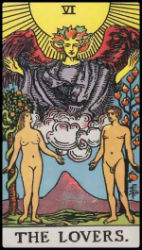
It’s right there in the card. The couple—presumably Adam and Eve—stand naked in the Garden of Eden. Eve looks upward to the angel as the source of their love, and Adam looks at Eve as the channel of that love.
OH, NO YOU DON’T!

As soon as we declare that love is our birthright and the natural order of our being, the “realists” will arrive to laugh at us.

“Look around you,” they’ll admonish us. “Do you see a lot of love happening? What about the bombings and the shootings and the genocide and the casual cruelty? How can you possibly say that love is our birthright?”

And they have a powerful point, of course. All of that IS happening in our world and has been happening for many centuries.

But coincident with that, there has been much more love than there has been horror. There is a powerful love that flows from every mother of every species to her children. There is a constant urge in the human soul to aid those who are hungry or sick or wounded. There is compassion and caring and nurturing.

Still, there’s that dichotomy in human experience. There has been great love, and there has been great cruelty.

Which do we choose? Which one do we want to live with? Which one do we want to change?

THE LOVERS AND THE DEVIL

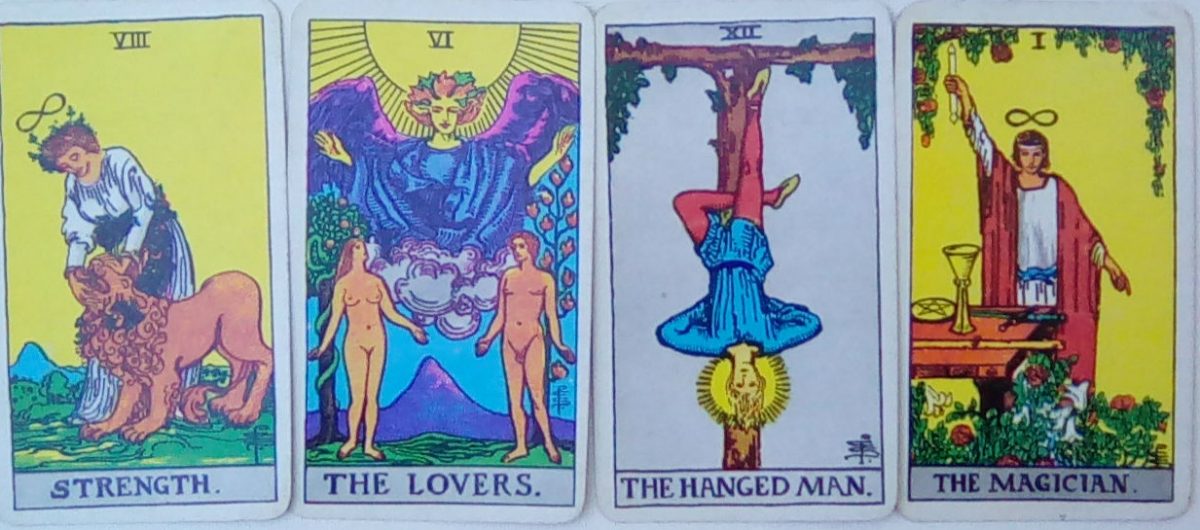
The Devil card is inextricably linked to the Lovers. It’s the same couple. They both have a supernatural being hovering over them. They both stand naked and unprotected. But one couple is living in paradise, and the other is living in chains.

And the difference, I would argue, is one of choice: choosing to live in love rather than cruelty.

The Devil card is contained WITHIN the Lovers card. It’s the snake in the tree, right? The snake is supposed to be the Devil tempting Eve, but what is he tempting her with? He’s tempting her with choice.

The Devil is saying, “You don’t HAVE to live like this. You can CHOOSE to NOT love if that’s what you want.”

We can choose to live in love, or we can choose to live in hatred and cruelty. We are the only species on the planet that can choose to live in opposition to our basic nature.
THE CHAINS ARE LOOSE

When we look at the Devil card, one of the first things we notice is that their hands are unbound and the chains around their necks are very loose. They could, at any moment, CHOOSE to lift the chains over their heads and walk away.

But they don’t.

Now, you can flip that coin one of two ways. You can say that they’ve chosen to live in hatred and evil. Or you can say that they’ve chosen to NOT live in love.

Because the two energies can’t coexist.

You cannot be loving and compassionate AND be cruel and hateful at the same time. One energy drives out the other. Period.

This is the source of the old Buddhist adage that we don’t drive out the darkness; we bring in the light. Hatred cannot exist in the energy of love, and love cannot exist in the energy of hatred.

IS IT LOVING OR IS IT NOT?

That’s not a complicated question. With the exception of a few sociopaths and malignant narcissists, we all KNOW when we’re being kind and loving, and we KNOW when we’re being shitheads.

Put another way, for normal human beings, love makes us feel good and hatred makes us feel bad. That’s wired into us. It’s natural. It’s our birthright.

But it’s also our choice.

We can—and do—invent a million reasons for choosing to NOT be loving.

He hurt my feelings.

She looked at me wrong.

They talked about me behind my back.

Nobody understands me.

Even—Goddess help us—his skin is the wrong color.

And when we make those choices, we KNOW that they’re wrong. We know because they make us suffer, and they make other people suffer. It’s not rocket science—we know it in our hearts.

THE ANTIDOTE

Buddhism puts it in very simple terms: hatred and anger are the poison, and love is the antidote.

If you were out taking a stroll in nature and a rattlesnake bit you, would you argue with the doctor about taking the antivenin?

“Well, gosh, doc, I just don’t really know. I mean, it’s my choice, isn’t it? I’ll have to think about it and figure out what my best course of action is here.”

Meanwhile, the poison is rushing through your system, you’re getting sicker and sicker, and you may lose your leg.

We need to approach the choice between love and hatred with that same urgency.

Because the hatred is killing us.

The Devil is the poison, and the Lovers is the antidote.

Choose.
Judgement: The Tarot Card of Recovery, Rebirth, and Spiritual Awakening

The Judgement card represents more than resurrection and spiritual awakening—it is also the Tarot card of recovery and rebirth. From the sudden spiritual transformations of Eckhart Tolle and Byron Katie to the gradual journey of overcoming addiction or emotional suffering, Judgement symbolizes the possibility of leaving an old life behind and beginning anew. Discover how this powerful Tarot card can also represent a call to awakening through spiritual teachers, recovery programs, or unexpected opportunities for personal transformation.

When the old life ends and a new one begins.

Of all the cards in the Tarot, few capture the experience of profound personal transformation as powerfully as Judgement.

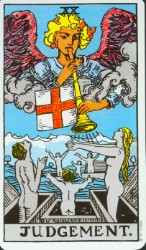
In the Rider-Waite-Smith Tarot, the Judgement card depicts an angel sounding a trumpet over a landscape of open graves. Men, women, and children rise from their coffins, their arms extended toward the heavens. They are responding to a call that summons them out of death and into a new existence.

Traditionally, the card is associated with resurrection, spiritual awakening, and the final judgement of the soul. But there is another interpretation that makes Judgement particularly relevant to modern life.

Judgement is the Tarot card of recovery.

It represents those extraordinary moments when a person emerges from years of alcoholism, addiction, depression, or emotional suffering and discovers that life can be entirely different from anything they have previously experienced.

Sometimes that transformation happens almost instantaneously. Sometimes it unfolds over months or years. But in either case, the person who emerges may be profoundly different from the person who began the journey.

In a very real sense, they have been born again.

The Experience of Sudden Awakening

Throughout history, people have described extraordinary experiences in which their entire understanding of themselves and the world suddenly changes.

The spiritual teacher Eckhart Tolle provides a particularly striking example.

In his account of his awakening, Tolle describes years of intense depression, anxiety, and emotional suffering. One night, during a period of overwhelming despair, he experienced a sudden realization that transformed his relationship with his own thoughts.

When he awoke the following morning, the familiar burden of psychological suffering had disappeared. He experienced a profound sense of peace and presence that became the foundation of his subsequent spiritual teachings.

Byron Katie describes a remarkably similar transformation.

After years of depression, anger, and emotional turmoil, Katie experienced an unexpected awakening while staying at a halfway house for women with eating disorders.

She describes suddenly recognizing that her suffering was connected to believing her own thoughts. With that realization came an extraordinary sense of freedom.

Both accounts share a remarkable characteristic. There was a life before the awakening and an entirely different life afterward.

The external circumstances of their lives did not necessarily change overnight. What changed was their fundamental relationship with themselves and the world.

This is the essence of the Judgement card.

The figures rising from their coffins are not simply recovering something they have lost. They are entering a new state of existence.

Recovery as a Form of Resurrection

Although sudden spiritual awakenings are dramatic, the same fundamental transformation can occur through the slower process of recovery.

Consider someone who has spent decades struggling with alcoholism. Over time, drinking may have become the organizing principle of that person’s existence. Relationships deteriorate, opportunities disappear, and life gradually contracts around the addiction.

Eventually, something happens.

Perhaps there is a personal crisis. Perhaps a friend intervenes. Perhaps the individual simply reaches a point where continuing the old life becomes unbearable.

And then comes the possibility of recovery.

For some people, entering a program such as Alcoholics Anonymous marks the beginning of a transformation that extends far beyond giving up alcohol. They begin to examine their beliefs, their behavior, their relationships, and their understanding of themselves. They develop new habits, new friendships, and sometimes an entirely new spiritual outlook.

The process may take years, and recovery does not always follow a straight line. But eventually, some people look back at their former lives and barely recognize the person they once were.

They have not simply stopped drinking. They have become someone new.

The same kind of transformation can occur when someone emerges from a long period of depression or another deeply entrenched pattern of suffering. Recovery may involve treatment, support, changes in circumstances, and considerable personal effort. It need not involve a dramatic spiritual revelation to represent a genuine rebirth.

This is why Judgement can be understood as the card of recovery. It represents the possibility that the old life, with all its suffering and limitations, does not have to determine the future.

The Trumpet Call: An Invitation to Awaken

There is another fascinating aspect of the Judgement card that deserves attention.

The angel does not descend into the graves and physically pull the people out. Instead, the angel sounds a trumpet. The people rise in response.

This suggests that Judgement represents not only the experience of awakening but also the call that invites us to awaken. And that distinction can be particularly important when the card appears in a Tarot reading.

Sometimes the call comes through another person. It might be a friend who encourages someone to attend an AA meeting, a therapist who introduces a new way of understanding emotional suffering, or a spiritual teacher whose words suddenly make sense of years of confusion.

Sometimes the call comes through an organization or spiritual tradition. A recovery program, a Buddhist meditation retreat, a spiritual community, or a course in personal development might provide the environment in which a profound transformation becomes possible.

Sometimes the call comes through a book. A person might encounter the writings of Eckhart Tolle, Byron Katie, or another spiritual teacher and recognize something that speaks directly to their own experience.

And sometimes the call comes through a crisis. The collapse of a relationship, the loss of a job, or the recognition that an old way of living has become intolerable may create an opportunity for change.

None of these experiences guarantees an awakening.

But each can represent the sounding of the trumpet. The invitation has arrived. What happens next depends, at least in part, on how we respond.

What Judgement Means in a Tarot Reading

When Judgement appears in a reading, it may indicate that the querent is approaching a significant turning point.

Unlike Death, which often represents endings and the necessity of letting go, Judgement emphasizes what becomes possible after the old life has been left behind.

It is the moment of awakening, recognition, and rebirth.

For someone struggling with an addiction or destructive pattern, Judgement may suggest that an opportunity for recovery or meaningful change deserves attention.

For someone who has experienced years of emotional suffering, it may symbolize the possibility of discovering a different relationship with their thoughts, feelings, and personal history.

For someone exploring spirituality, it may represent an invitation to investigate a teacher, practice, philosophy, or community that could deepen their understanding of life.

And for someone who has already undergone a major transformation, Judgement may simply acknowledge what has happened.

The old life is over. A new one has begun.

Of course, a Tarot card cannot promise recovery, predict a sudden awakening, or replace professional treatment when it is needed. But it can provide a powerful symbolic framework for recognizing opportunities for transformation.

Answering the Call

Perhaps the most encouraging message of the Judgement card is that awakening does not necessarily require years of preparation or extraordinary spiritual abilities.

Sometimes it arrives unexpectedly, as it reportedly did for Eckhart Tolle and Byron Katie.

Sometimes it develops gradually through recovery, meditation, therapy, spiritual practice, or the ordinary work of changing one’s life.

And sometimes the transformation begins with something as simple as accepting an invitation. Attending a meeting. Reading a book. Asking for help. Trying a different way of living.

The figures in the Judgement card have spent an unknown length of time in their graves. Yet when the trumpet sounds, the possibility of a new life appears.

Perhaps that is the card’s most profound message.

No matter how long we have lived within the limitations of our old lives, the possibility of awakening may still exist.

The trumpet is sounding.

The question is whether we are ready to rise.

Healing Our Week with the Tarot: Using “Antidotes” for Negative Energy

Weekly Tarot as mindfulness: forecast your reactions, apply the antidote (compassion, joy, courage), and make your inner world a peaceful place

There’s an internet meme I really love that says, “Maybe the day had a shitty you.”  It’s a good reminder that our own energy creates a lot of what we experience as being, “outside of us.”  Let’s talk about a very simple mental hygiene routine with the Tarot that we can use to keep our energy clean and positive.

The Buddhist Practice of Antidoting

Buddhism has long recognized that positive emotions are good for us and negative emotions are bad for us.  There’s nothing revolutionary about that simple fact.  Happiness makes us happy and sadness makes us depressed.  What a concept!

Buddhism gets even more radical than that, though, and refers to negative emotions as, “poisons.”  Constantly feeling the negative emotions – anger, hatred, jealousy, depression – is like drinking poison.  It makes us physically, emotionally, and spiritually sick.

And, if we drink poison, we obviously need an antidote, right?  So, in the Buddhist practice, if we’re angry about something we meditate on loving/compassion.  If we’re jealous of someone, we meditate on feeling good for them.  If we’re afraid, we meditate on courage.  Any negative emotion has a corresponding antidote.

We can easily tie that thinking into a Tarot practice that helps us to stay balanced and stress free.

A Simple Weekly Tarot Practice

At the start of each week, try doing a short four-card predictive spread:

1. Current Conditions

2. What Needs to Be Done

3. Factors Working Against Me

4. Probable Outcome

For example, imagine the reading comes up like this:

• Current Conditions – Five of Cups (reversed) – recovering from sadness

• What Needs to Be Done – Seven of Wands (reversed) – exhausted after a battle and feeling defensive

• Factors Working Against – Five of Swords – conflict, tension, disagreements

• Probable Outcome – Five of Wands – ego struggles for dominance; hollow victories.

Without diving too deeply into analysis, we can see this describes a week of emotional recovery mixed with potential conflict.

The energy of the week feels charged—lots of fives, lots of challenges.

But remember: nothing the Tarot predicts is ever set in stone. It simply points to the energetic weather we’re about to walk into.

Finding the Antidote

So, how do we antidote this kind of energy?

By becoming as peaceful and non-reactive as possible.

If the cards forewarn us that conflict is likely, we can consciously generate its opposite: serenity, patience, and groundedness.  When we carry that peaceful energy into the week, we DON’T blow up at the rude cashier at the grocery store.  We DON’T indulge in road rage when someone cuts us off in traffic.  We DON’T snap at a co-worker when they say something sarcastic to us.

When we carry those antidoting energies, we rise above the fray.

We stop feeding the poison and instead create harmony wherever we go.

In the same way, if our reading predicts sadness or depression, we can consciously seek out things that will make us happy.  If it predicts that we’re going to be scattered, we can do a little extra mindfulness practice.

Turning “Negative” Cards Into Meditation

This is one of the most powerful ways to meditate with the Tarot.

When we pull a card that seems negative, rather than dreading it, we can pause and ask: What’s the opposite of this energy? If this card represents a poison, what’s its antidote?

If the cards suggest sadness or loss, how can we actively cultivate joy?

If they hint at arrogance, how can we practice humility?

If they predict anger or tension, how can we embody calm?

Each “negative” card becomes a mindfulness bell—an invitation to rebalance our inner world.

Empowerment Through Awareness

Instead of thinking, “This is going to be a rough week,” we can say,“This reading is giving me insight into the energies ahead—and tools to shift them.”

This approach gives us agency.

It empowers us to stay in the flow, improve our own energy, and choose how we’ll respond to life’s ups and downs.

No matter what’s happening around us, we’re the ones who have to live in our own minds—and Tarot can help us make that a bright, peaceful place to be.

“Just the Tarot,” by Dan Adair – a kindle ebook of Tarot definitions available on Amazon