The Lovers and Falling in Love with Love

The archetypal power of love in the human heart.

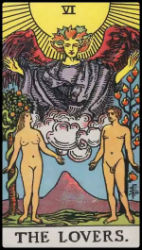
When most people look at The Lovers card, their attention goes immediately to the man and woman.

But perhaps they’re not the real subject of the card.

Perhaps the real story is the angel.

Are You in Love with Your Lover… or in Love with Love?

It’s a curious question.

When we fall in love, what is it that actually transforms us? Is it another human being? Or is it the mysterious experience that awakens within us?

We’ve all known that feeling.

You meet someone. Conversation becomes effortless. Ordinary days suddenly seem enchanted. Music sounds richer. Food tastes better. Even standing in line at the grocery store doesn’t seem quite so terrible.

The world hasn’t changed.

You have.

Love has reorganized your perception.

And what’s fascinating is that this transformation often begins long before we really know the other person.
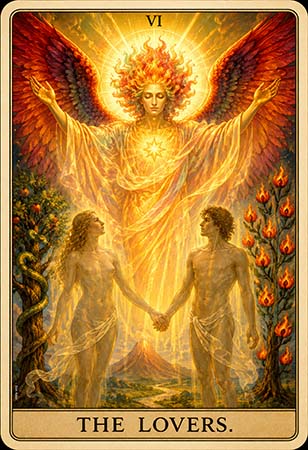
The Lovers Tarot Poster by Dan Adair – 13 X 19 – Available on Etsy

 The Golden Aura

Relationships don’t always last.

Some become lifelong partnerships. Others end in disappointment, heartbreak, or betrayal.

Yet even after the relationship is over—even after anger has replaced affection—we often remember those first weeks or months with remarkable clarity.

We remember the golden feeling.

The sense that life itself had become brighter.

Which raises an interesting possibility.

Perhaps what we miss isn’t only the person.

Perhaps we miss the state of consciousness that love awakened within us.

The Angel in the Card

This is why I find the angel in this illustration so compelling.

The two human figures occupy the foreground, but towering above them is a radiant angel, pouring light over the entire scene.

The humans may tell the personal story.

The angel tells the archetypal one.

In Jungian psychology, an archetype is a universal pattern that lives within the human psyche. Love is certainly one of those patterns. Whenever it awakens, it changes the way we see ourselves and the world around us.

Suddenly, things that once seemed important lose their urgency.

Small gestures—a smile, a touch, a glance across a room—become deeply meaningful.

Love rearranges our priorities almost overnight.

 The Human as the Vehicle

Ram Dass once spoke about grief in a way that has stayed with me.

He suggested that when someone we love dies, leaves us, or simply disappears from our lives, it feels as though our heart has been torn out.

Why?

Because we mistake the person for the love.

His suggestion was that the beloved is the vehicle through which we experience that profound state of love. When the vehicle disappears, it feels as though love itself has vanished.

Whether or not you agree with his spiritual conclusions, the psychological insight is worth considering.

Perhaps another person doesn’t create love inside us.

Perhaps they awaken something that was already there.

 Which Comes First?

It’s impossible to know.

Does falling in love activate the archetype of love?

Or does the archetype become active first, allowing us to fall in love with someone we might otherwise never have noticed?

Most of us have looked back at an old relationship and wondered:

“What in the world did I ever see in that person?”

Perhaps the answer isn’t that we were blind.

Perhaps, for a brief time, we were seeing through the eyes of love itself.

 Bringing the Angel Home

The Lovers card offers a beautiful challenge.

Instead of waiting for another person to bring love into our lives, what if we learned to cultivate that quality ourselves?

Not necessarily romantic love.

Simply love.

Loving your home.

Loving your work.

Loving the people you meet.

Being a little slower to judge and a little quicker to help.

Offering compassion to strangers—and to yourself.

Whether you see love as divine energy, a psychological archetype, or simply one of humanity’s greatest capacities, the effect is remarkably similar.

Life becomes brighter.

And perhaps that is the true lesson of The Lovers.

The couple may come and go.

But when love itself finds a permanent home in your heart, no one can take it away.
Tarot and the Art of Alignment – Available on Amazon

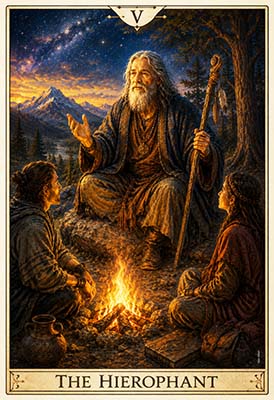
The Hierophant and Choosing Your Teachers

Who were your greatest teachers?

Who has earned the right to teach you?

That may sound like a strange question, but it’s really the heart of The Hierophant.

Human beings inherit an astonishing amount of knowledge from those who came before us. Language. Music. Art. Meditation. Psychology. Even Tarot itself. Every generation stands on the shoulders of countless teachers.

If each generation had to reinvent the wheel, civilization wouldn’t have gotten very far.

That’s the gift of The Hierophant.

At its heart, The Hierophant represents wisdom that has been tested, preserved, and passed from one generation to the next. He is the archetype of the teacher.

The Hierophant Poster – 13 X 19 – Available on Etsy

Who Changed Your Life?

Think for a moment about the people who genuinely changed the direction of your life.

Maybe it was Ram Dass.

Carl Jung.

Joseph Campbell.

Alan Watts.

A beloved grandmother.

An art teacher.

A therapist.

A meditation instructor.

None of these people simply possessed information. They embodied something. They had walked a path, learned from it, and then offered what they had discovered to others.

That act of passing wisdom forward is the true essence of The Hierophant.

The Shadow Hierophant

Every archetype has its shadow.

The shadow of The Hierophant is the false teacher.

History is full of them.

Some seek money, power, admiration, or control while wearing the robes of spirituality. Others may be sincere but become trapped inside rigid beliefs, insisting that their truth is the only truth and everyone else is wrong.

The ancient Sufi saying captures it perfectly:

“A donkey laden with holy books is still a donkey.”

Knowledge alone doesn’t make someone wise.

Available as a downloadable PDF book on Etsy

Choosing Your Teachers

We live in an age overflowing with gurus.

Scroll through YouTube for a few minutes and you’ll find hundreds of people promising enlightenment, wealth, healing, awakening, or secret knowledge.

So how do we choose?

A genuine teacher doesn’t ask you to surrender your mind.

They don’t demand blind obedience.

They don’t make themselves the destination.

Instead, they point beyond themselves.

They encourage you to test what they teach against your own experience.

The healthiest teachers aren’t interested in creating followers.

They’re interested in creating independent human beings.

The best Hierophants quietly say:

“I’ve walked this road before.”

“Let me save you a few unnecessary mistakes.”

“Test everything I tell you.”

“And someday, I hope you’ll surpass me.”

That’s Ram Dass.

That’s Joseph Campbell.

That’s Mr. Rogers.

That’s the Zen master who smiles when the student finally understands.

Becoming the Hierophant

Eventually, life invites each of us into the role of teacher.

Not because we’ve collected enough books or memorized enough quotations.

But because we’ve suffered.

We’ve loved.

We’ve failed.

We’ve learned.

We’ve become just a little wiser than we were before.

The real question isn’t whether people listen to us.

It’s whether we’ve earned the right to speak.

The Buddhists have long emphasized the practice of Right Speech. Among its many teachings is a warning against pretending to possess spiritual wisdom we haven’t actually attained.

That is the Shadow Hierophant.

Claiming authority before we’ve earned it.

Perhaps that’s why this old saying has endured for centuries:

Before you speak, let your words pass through three gates:

Is it true?

Is it necessary?

Is it kind?

The Hierophant reminds us that wisdom is more than knowledge.

It is knowledge tempered by humility.

And perhaps the greatest teachers are those who quietly invite us to become teachers ourselves—not by repeating their words, but by discovering our own.

The Emperor and Ruling a Kingdom of Socks and Dishes

The role of The Emperor’s energy in our daily lives.

How are you ruling over your kingdom right now?

No, I don’t mean your imaginary kingdom where you’re a titan of industry or maybe a pirate.

I don’t mean the video game kingdom where you’re the greatest slayer of orcs of all time.

I mean your kingdom.

The one with socks on the floor.

Laundry that’s piling up.

Bills that still need to be paid.

Dishes waiting in the sink.

You know…

The kingdom you actually have control over.

The Emperor and The Empress

The Empress and the Emperor are the only true matched pair in the Major Arcana. In a previous post, I suggested that the Empress represents our ability to receive abundance. The Emperor represents our ability to organize it.

The Empress is how we receive the world.

The Emperor is how the world receives us.

The Empress is the generative principle.

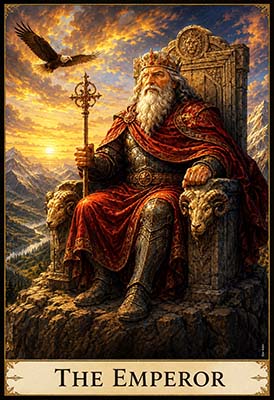
The Emperor Poster – 13 X 19 Inches – Available on Etsy

The Emperor is the organizing principle.

Both of these energies live within every one of us. They aren’t male and female so much as complementary ways of being. Like the Emperor and the Empress themselves, they’re opposite ends of the same spectrum.

The Empress is relaxed, open, and completely at ease.

The Emperor is covered in armor from head to toe.

The Empress is soft and receptive.

The Emperor is firm and projective.

The Emperor is Our Place in the World

Sooner or later, every one of us has to leave the safety of the family nest and make our way in the world. We have to earn a living, work with other people, find a place to live, pay the bills, keep the house in order, and somehow hold it all together.

Yes…it’s that dreaded stage of life we call . . . adulting.

The Empress is the part of us that nurtures our identity as it grows.

The Emperor is the part that carries that identity into the world and quietly says:

“This is who I am. I have a right to be here.”

If The Empress is the Universal Garden, The Emperor is the guy who built the garden beds, carried in the sacks of manure to fertilize it and remembers to water it all every morning.

So How Do We Claim the Emperor’s Energy?

By developing self-control without becoming controlling.

By cultivating quiet confidence instead of arrogance.

By becoming competent at what we do.

By keeping our promises to ourselves.

The Emperor doesn’t ask us to dominate other people. He asks us to govern ourselves.

Not as a tyrant.

As a wise ruler.

Not with harsh self-criticism.

With gentle but strong guidance.

Despite his throne, his crown, and his armor, the Emperor’s work isn’t really about kingdoms at all.

It’s about picking up those socks.

Paying the bills.

Keeping your word.

Creating healthy boundaries.

Standing up for yourself without trampling someone else.

Every small act of self-government strengthens the Emperor within us.

And perhaps that’s the real lesson of this card.

Before we can rule a kingdom, we have to learn to rule ourselves.

Tarot and the Art of Alignment – Available of Amazon

The Empress and the Abundance of the Heart

The Empress and the abundance of love.

Would you like to be an Empress?

You might read that sentence and think:

“Who, me? The muffler’s about to fall off my car. I can barely pay the rent. The kids need new shoes that I can’t afford, and my apartment looks like a disaster area.

Do I want to be an Empress? Yeah… right.”

What Does an Empress Look Like?

Let’s take a minute to really look at the Empress card before you rule yourself out.

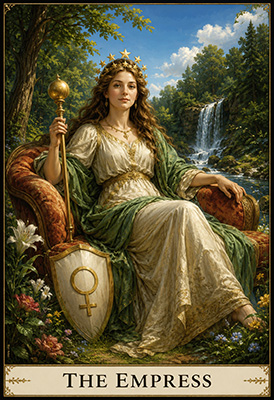
The Empress Poster – 13 X 19 Inches – Available on Etsy

What do we see?

A beautiful woman reclining comfortably on a simple couch. She’s wearing a flowing robe, and her head is crowned with stars. In one hand she loosely holds a scepter topped with a golden globe. Resting beside her is a shield bearing the symbol of Venus.

Behind her stretches a peaceful forest, with a waterfall flowing gently through it beneath a clear blue sky.

What else do you see?

If your answer is, “Nothing,” you got that one exactly right.

What’s Missing?

When we hear the word Empress, certain images immediately come to mind.

Royal courts.

Tables groaning beneath crystal goblets and golden dishes.

Ladies-in-waiting glittering with jewels.

Magnificent ivory thrones.

You know…

Money.

Power.

Status.

Truckloads of doe-ray-me.

Not This Empress

Yet none of those things appear in this card.

She’s reclining on a simple seat instead of an elaborate throne.

There are no servants.

No palace.

No symbols of worldly power.

Yes, she carries a scepter, but she holds it so casually that it almost feels like an afterthought. Her crown is made of stars rather than jewels. Even her shield bears not a lion or dragon, but the symbol of Venus—the emblem of love.

The forest, the waterfall, and the open sky are her royal hall.

What does that tell us?

The Empress and Abundance

The Empress is often described as the archetype of abundance.

But this is a very different kind of abundance.

It isn’t measured in bank accounts or luxury cars.

She doesn’t need possessions to convince herself she’s wealthy.

Her richness flows outward from her.

It doesn’t flow inward from the things she owns.

Her abundance is written upon her shield:

Love.

So how do we incorporate that Empress energy into our own lives?

The Empress and Filling the Well

Julia Cameron observed that creativity is not a bottomless well.

Eventually the well must be refilled.

Sooner or later, the creative life asks us to stop producing and simply receive.

The Empress understands this instinctively.

She would probably tell us that resting isn’t the opposite of creating.

Resting is creating.

When we step away from frantic schedules and consciously enjoy the beauty already surrounding us, we’re expressing Empress energy.

Reading.

Walking.

Listening to music.

Cooking.

Taking a bath.

Watching clouds drift across the sky.

Standing outside beneath the moon.

These aren’t interruptions to creativity.

They’re how creativity breathes.

They’re how we absorb the abundance that already exists simply because we’re alive.

The Empress as a Spiritual Practice

Perhaps the most important symbol in the entire card is the small shield bearing the sign of Venus.

It reminds us that love isn’t something we have to earn.

It isn’t something we have to chase.

And it isn’t something other people give us permission to experience.

Love is our birthright.

It already lives within us.

It flows from the heart rather than into it.

That means we can practice Empress energy every single day.

Making our homes beautiful.

Growing flowers.

Lighting a scented candle.

Preparing a meal with care.

Creating peaceful spaces.

Being fully present in our own lives.

These simple acts may seem ordinary.

The Empress would call them sacred.

Becoming the Empress

So…

Would you like to be an Empress?

Perhaps you already are.

The Empress doesn’t ask how much money is in your bank account, what kind of car you drive, or whether your furniture belongs in a palace.

She asks a much quieter question.

Can you recognize the abundance that’s already present in this moment?

Can you slow down long enough to appreciate beauty?

Can you create a little more peace?

Can you let love flow outward into the world through the smallest acts of everyday life?

If you can…

Then you’re already wearing the crown of stars.

Tarot and the Art of Alignment – Available on Amazon

The High Priestess and the Art of Being an Empath

Surviving as an empath in a world of mixed signals.

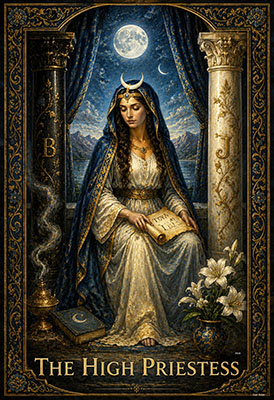
The High Priestess – 13 X 19 – Available on Etsy

Are You an Empath?

Have you ever walked into a room, greeted someone you’ve never met, and instantly known they were angry, grieving, anxious, or quietly celebrating something wonderful?

If so, here’s a piece of advice.

Don’t say anything.

Seriously. Don’t.

Most people don’t enjoy discovering that someone can see behind the mask they’re presenting to the world.

The High Priestess

In an earlier post, I described the High Priestess as the Tarot’s archetype of intuition.

She sits between two pillars—one black and one white—representing the meeting of opposites. I like to think of her as standing where logic and intuition meet, where analytical thought gives way to sudden flashes of knowing.

That’s how intuition often feels.

It doesn’t arrive through careful reasoning.

It simply appears.

The answer is just…there.

The Empath’s Antenna

Being an empath can feel like walking through life with an extra antenna attached to your nervous system.

You notice things that other people miss.

Not because you’re reading minds, but because you’re reading people.

A slight hesitation.

A forced smile.

A shift in someone’s tone.

The energy in the room changes, and somehow you already know why.

For many empaths, this isn’t something they consciously do. It feels as natural as seeing colors or hearing music. They aren’t sitting there analyzing people.

They simply know.

Why It Makes People Uncomfortable

Here’s the problem.

Most people carefully manage what they reveal to the world.

Carl Jung called this the persona—the social mask we wear. It’s the version of ourselves we’re comfortable showing other people.

We’re happy for people to know our hobbies, our opinions, or what we do for a living.

We’re far less comfortable with them seeing our fears, our grief, our insecurities, or the parts of ourselves we’re trying to hide.

When an empath quietly senses those hidden emotions, people often feel exposed—even if the empath never intended to pry.

That can make them uncomfortable.

Sometimes it even makes them defensive.

Can We Turn It Off?

Many books about empathy focus on building stronger boundaries.

That’s good advice.

If empaths absorbed every emotional signal around them all day long, they’d quickly become overwhelmed.

But completely shutting down our intuition isn’t really the answer either.

Empathy is a gift, much like sight or hearing.

We don’t solve the problem by pretending we can’t see.

The Real Secret

The real skill isn’t becoming less intuitive.

It’s becoming more discreet.

Just because you know something doesn’t mean it needs to be spoken.

Sometimes people aren’t ready.

Sometimes they aren’t asking.

Sometimes the kindest thing you can do is quietly understand without announcing that you understand.

That’s the High Priestess at her best.

She knows.

But she doesn’t feel compelled to prove that she knows.

She observes.

She waits.

And when the moment is right, she speaks.

Until then, she simply smiles—and keeps the mystery alive.

The Magician and Learning to Hide Your Magic

Magic might exist best in silence.

The internet has made the world’s spiritual traditions available to anyone with a curious mind. In the space of an afternoon you can watch videos on Tarot, meditation, astrology, Wicca, Hermetic philosophy, or ancient shamanic practices.

That kind of openness creates an illusion that every spiritual subject is now safe to discuss openly.

Unfortunately, that isn’t always true.

The Price of Being Different

The word eccentric simply means “off center.”

Imagine society as a great circle. Most people live comfortably near the middle, sharing many of the same assumptions about life, religion, and reality. They may disagree about politics, music, or sports, but the foundation of their worldview is remarkably similar.

A spiritual journey often carries us away from that center.

We begin asking unusual questions. We become interested in synchronicity, Tarot, meditation, dreams, symbols, or ancient traditions. We may even come to believe in things that many people dismiss without a second thought.

Naturally, we’re excited.

Whenever we discover something meaningful, our first instinct is to share it with the people we love.

And that can be a grave mistake.

The people listening may smile politely while privately wondering whether we’ve lost our grip on reality. Sometimes the judgment remains unspoken. 

Occasionally it comes back with surprising force from people we trusted completely and that can feel especially devastating.

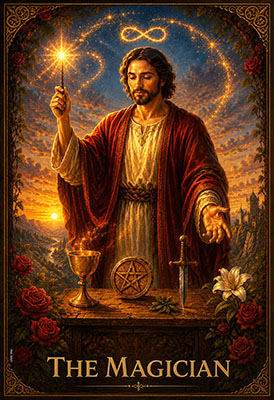
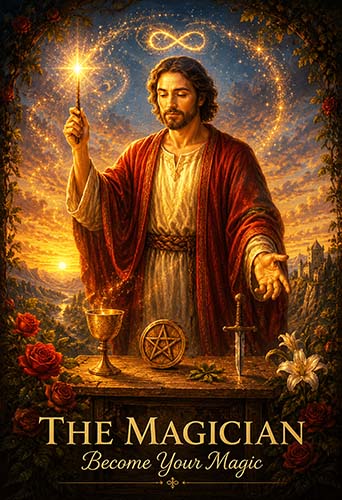
The Magician – 13 X 19 inch poster by Dan Adair – Available on Etsy

Protecting Young Beliefs

This is especially important when you’re just beginning your spiritual exploration.

New beliefs are like tender seedlings pushing through the soil. They aren’t yet strong enough to withstand harsh weather.

They need time.

They need experience.

Most of all, they need protection.

Sharing those fragile discoveries with someone who has already decided they’re nonsense is like inviting someone to stomp through your garden wearing heavy boots.

The damage isn’t necessarily that they change your mind.

The damage is that they plant seeds of doubt before your own understanding has had time to mature.

History Is Shorter Than You Think

It’s easy to assume that hostility toward unconventional spiritual practices belongs to the distant past.

We remember the witch trials and the Inquisition, when innocent people were imprisoned, tortured, or killed because they were suspected of practicing forbidden arts.

Yet fear of the occult has appeared much more recently.

During the Satanic Panic of the 1980s, innocent people were accused of bizarre crimes involving imagined occult rituals. The most famous example was the McMartin Preschool case in California, where extraordinary accusations dominated headlines despite the complete lack of supporting evidence. 

Witnesses testified that Virginia McMartin, who ran a day care center for preschoolers in Manhattan Beach was, “leading children into secret underground tunnels where they dressed up as witches and flew around in the air.  Other parents made similarly shocking allegations about McMartin Preschool, accusing the employees of cannibalism, blood-drinking and infant sacrifice.”

Only 40 years ago, right here in the United States, a county attorney indicted a woman for dressing up like a witch and flying around the air.

Let that sink in.

Why the Magician Keeps Silent

There is an interesting clue in the very word,  “occult.”

It simply means, “hidden.”

We usually think of hidden knowledge—teachings that are not widely known—but perhaps there is another lesson as well.

Some things are best kept private, even from people we thought we could trust.

There is quiet wisdom in that.

Not every insight needs to become a public discussion.

Not every ritual needs an audience.

Not every spiritual experience needs to be explained.

Sometimes the greatest magic grows best in silence.

The greatest secrets of Western Occultism were passed down from adept to student, always hidden from the prying eyes of the crowds, the priests, and the judges.  That’s how they survived through the many years of the Dark Ages.  Perhaps that’s how they’ll survive again.

That is one of The Magician’s deepest lessons—not simply learning how to work with unseen forces, but learning when to keep them unseen.

Available on Etsy as a downloadable PDF book.

Four Paths to Becoming the Hermit

An exploration of being alone in the world.

The Hermit – 13 X 19 inch poster by Dan Adair – Available on Etsy

Of all the figures in the Tarot, none stands more completely alone than The Hermit.

Unlike the Fool, the Magician, or the Emperor, the Hermit has intentionally stepped away from the crowd. He has withdrawn from unnecessary human contact, choosing solitude over society.

That seems almost contrary to human nature.

Aristotle observed that anyone who has no need of society must be either a god or a beast. Yet the Hermit is neither. He is simply a human being who has walked a very unusual road.

So how does someone become the Hermit?

1. The Wounded Hermit

For many people, the journey begins with pain.

They reached out sincerely. They loved, trusted, and tried to belong. Again and again they were hurt, rejected, or misunderstood.

Eventually they withdraw—not because they hate people, but because they need to protect what remains of their heart.

For some, this is the first step toward becoming the Hermit.

2. The Disappointed Hermit

Others are not driven away by wounds but by disillusionment.

They have done everything society promised would bring fulfillment. They built careers, earned money, fell in love, married, raised families, or achieved success.

Yet something still feels empty.

Status, romance, wealth, and recognition eventually turn to dust, leaving them quietly asking:

“Is this really all there is?”

3. The Called Hermit

Sometimes the first two experiences awaken something deeper.

After enough disappointment, a person begins to long for truth rather than comfort. They become convinced that life must contain something more profound than endless striving.

This is where the spiritual search begins.

The Hermit is no longer running away from the world.

He is walking toward wisdom.

4. The Natural Hermit

Some people simply possess the temperament for solitude.

Introverts often discover that being alone restores rather than depletes them. What began as an escape from pain gradually becomes a place of peace.

They don’t merely tolerate solitude.

They flourish there.

For these people, being alone feels less like isolation and more like coming home.

The Hermit’s True Gift

For some, the Hermit is only a season of life—a place of healing before they return to the world.

For others, it becomes a lifelong calling.

They gradually realize they never truly fit the expectations of the culture around them. Solitude begins as medicine but eventually becomes as necessary as breathing.

The Hermit archetype doesn’t create that feeling of being different.

It simply shines a lantern on a truth that has always been there.

Sometimes the greatest journey isn’t learning how to belong to the crowd.

Sometimes it’s discovering who you become when the crowd is no longer needed.

Available on Etsy as a downloadable PDF book.

Saturn, The Tower, and Why I Meditate on The Fool

Saturn Transits and The Tower Card – How to NOT get run over.

As an Aries, I was recently dismayed to discover that Saturn has entered…

Gulp… Aries.

If you know anything about astrology, you probably understand why that made me nervous.

Saturn doesn’t exactly have the reputation of being the life of the party.

Saturn’s Bad Reputation

Saturn is often associated with:

* limitations

* delays

* responsibility

* endings

* hard lessons

* tearing down what no longer works

In other words…

Saturn has a way of rearranging your life whether you asked for it or not.

Sound Familiar?

If you’re a Tarot reader, that description probably reminds you of another archetype.

The Tower.

The Tower burns down the building.

It strips away certainty.

It leaves you standing in the ashes wondering,

“What just happened?”

A difficult Saturn transit can feel remarkably similar.

Sometimes it seems as though a cosmic steamroller has flattened your best-laid plans.

But They’re Not Exactly the Same

This is where I think people sometimes misunderstand Saturn.

The Tower is total collapse.

When the Tower appears, something fundamental is breaking apart.

It’s dramatic.

It’s shocking.

It’s often terrifying.

Saturn, however, is usually much more selective.

Saturn doesn’t destroy everything.

It destroys what isn’t solid.

That distinction makes all the difference.

Think of Saturn as a Strict Parent

I’ve always thought of Saturn as having a fatherly quality.

Not cruel.

Just uncompromising.

Imagine a parent walking into your room and saying,

“You haven’t used half this stuff in years. It’s time to clean it out.”

That’s Saturn.

Old habits.

Old beliefs.

Old ambitions.

Old identities.

If they’ve stopped serving your life, Saturn starts carrying them to the curb.

It may not feel pleasant.

But it isn’t random destruction.

Every Ending Makes Space for a Beginning

One thing that’s easy to overlook is that Saturn often marks the beginning of an entirely new chapter.

Yes, something is ending.

But something else is quietly making room to begin.

That’s why so many people look back on difficult Saturn periods years later and say,

“I wouldn’t want to go through it again…

…but I wouldn’t trade what came afterward.”

Why I Meditate on The Fool

When I’m going through Saturn energy, I don’t usually meditate on The Tower.

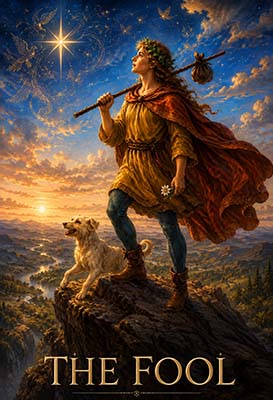
I meditate on The Fool.

That may sound strange at first.

The Fool is the card of beginnings.

Fresh energy.

New possibilities.

A journey that hasn’t been written yet.

The Fool steps into a completely unknown future with little more than hope, trust, and curiosity.

In many ways, that’s exactly what Saturn is asking us to do.

The Real Lesson

Here’s the conclusion I’ve gradually come to.

Saturn isn’t really asking us to suffer.

It’s asking us to let go.

Those are not the same thing.

The suffering often comes from trying to hold on to something that’s already finished.

When we resist Saturn…

the process feels brutal.

When we cooperate with Saturn…

the same energy becomes a tool for rebuilding.

You Can’t Stop Saturn…

…but you can work with it.

You can’t negotiate with it.

You can’t outrun it.

But you can decide whether you’ll spend your energy clinging to yesterday…

…or building tomorrow.

That’s why, during difficult Saturn transits, I keep coming back to The Fool.

Not because the journey is easy.

But because every meaningful journey begins the same way.

With one uncertain step into a brand-new world.

Tarot and the Art of Alignment – Available on Amazon

Fairies, Devas and Angels, Oh My . . .

Why our belief in nature spirits has diminished at the time that we need it the most.

Do you believe in fairies?

Gnomes?

Water sprites?

Undines, sylphs, elves, salamanders?

In a nutshell, nature spirits?

If you don’t believe in them, you’re right there with the great majority.  The few studies that have been done suggest that only about 10% of Americans believe that nature spirits exist.  Most of that 10% is composed of children, women, and people who research paranormal phenomena.

IT’S NOT NORMAL

If you tell other people that you believe in fairies, you’re going to get some serious side-eye, at the very least.  If you INSIST that you believe in fairies, you’ll be tagged as weird, eccentric, or seriously delusional.

After all, it’s just not NORMAL, is it?

Ironically, as Tim Wyatt points out in this video from the Theosophical Society, it absolutely IS “normal” to believe in nature spirits.  Every culture in human history has had frequent contacts with them.  Until now.

Our lack of belief in them is actually an aberration.  We’re the ones who aren’t normal.

So what happened?  Why did we lose contact with them?  Wyatt has some interesting suggestions.

URBANIZATION

The onset of the Industrial Revolution witnessed a huge migration of humans out of the country and into cities.  For the first time in human history, more people now live in cities than in towns and villages.

And the thing is, nature spirits love . . . guess what? . . . nature.  They reside in streams, rivers, lakes, forests, and beaches.  They are not present where there is a decided lack of nature, such as we find in the concrete monstrosities of our modern cities.

To put it another way, we’ve lost contact with nature spirits because we’ve lost contact with nature.  In our lust for constant construction, high-rises, and endless suburbs, we’ve driven the nature spirits out and they no longer speak with many of us.

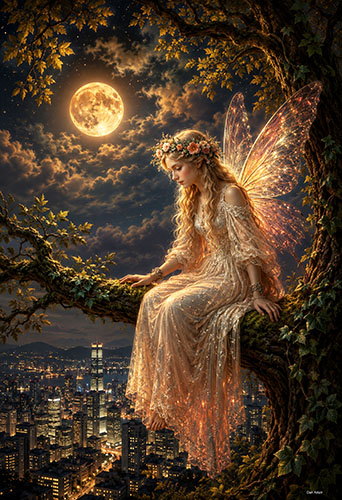
That’s what I was trying to portray with the image of the fairy looking down at the cityscape.  How sad it must be for them to witness us raping the lands where they once lived freely.

ORGANIZED RELIGION

The rise of Christian theology had a devastating effect on our relationship with nature and the spirits that inhabit it.  

It has traditionally taken a very binary approach to life and metaphysics.  On one side there’s good and on the other side there’s evil.  On one side there’s God and on the other side there’s Satan.

As Wyatt points out, angels were allowed into the Christian worldview, but only because they were messengers of God.  Nature spirits, on the other hand, were clearly pronounced to be servants of evil.  

Those who believed in nature spirits and communed with them were, in the Christian view, witches and sorcerers and were tortured and condemned to death.

Perhaps the clearest example of that approach was when the Catholic Church arrived in Ireland and cut down thousands of oak trees because the Druids worshiped in the sacred groves.  The church literally destroyed the very places where the nature spirits lived.

CYNICISM

What struck me most forcefully in Wyatt’s analysis was the effect that cynicism has had on our belief in nature spirits.

Cynicism is . . . fashionable.  We’ve only to scroll through the internet in order to find millions of people who don’t seem to believe in anything.  They mercilessly mock the belief systems of others and wear their pessimism like a badge of honor.

The news is fake.  Politicians are fake.  Liberals are fake.  Conservatives are fake.  Even viruses are fake.

What’s worse, we find many people who loudly proclaim their faith and simply ignore it in their day-to-day lives.  People who claim to believe in a Higher Power, yet spew hatred, vitriol, and distrust.

Which, of course, makes us . . . ahem . . . somewhat cynical about their faith.

In an age when people routinely dismiss what they see with their own eyes, why would we expect them to believe in something that they haven’t seen?  It’s far easier to dismiss nature spirits as superstitions of simple-minded people than to take them seriously, even if every other culture in human history has believed in them.

WHAT HAPPENS TO NATURE?

The Theosophists have a very interesting take on nature spirits, angels, and devas.  They don’t simply see them as amusing little creatures that frolic around the woods wearing pinecone crowns.

Rather, they view them as organizers of nature.  They are the underlying forces that make nature work.

For instance, we might think of a water sprite as living in a river.  From the Theosophist’s viewpoint, she’s actually making the river into what it is, overseeing the purity of the water and maintaining the lives of the various animals that live in it.

Orcas Island, off the coast of Washington, is said to have a magnificent deva or angel, who oversees all of the life of the island.  Lakes, rivers, streams, forests, mountains, all have nature spirits who nurture and sustain them.

Without the spirits, the earth begins to die and without the earth, we die.

MAKE LOVE, NOT WAR

As near as I can tell, the nature spirits don’t really give a flying fig whether we believe in them or not.  They’re not some Tinker Bell spirits who’ll curl up and die if we don’t clap for them.

In fact, they seem to avoid our company as much as possible, thank you very much.

What they DO want is for us to quit making war on them.

Stop cutting down those sacred groves of trees.  

Stop dumping tons of garbage into the oceans.

Stop paving over paradise and putting up parking lots.

Stop slaughtering millions of animals every year because it’s, “convenient,” for us.

I’m not asking anyone to share my beliefs.  But . . . you might go sit by a stream and think about it.  

Maybe ask the stream what it thinks.

The Happiness Compass: What If Joy Is Trying to Tell You Something?

Exploring the idea that happiness is a compass that points us in the right direction.

We’ve all heard the old saying from the 1960s:

“If it feels good, do it.”

Unfortunately, our culture often teaches the exact opposite.

Work a job you hate because it’s practical.

Stay in a relationship that’s gone stale because it’s your duty.

Ignore your dreams because they’re unrealistic.

Somewhere along the way, many of us begin wearing our unhappiness like a badge of honor, as though misery proves we’re responsible adults.

But what if we’ve misunderstood happiness?

What if it isn’t a luxury?

What if it’s a compass?

Happiness Isn’t Random

One of the central ideas in my book, Tarot and the Art of Alignment, is that happiness isn’t merely an emotion that comes and goes.

It’s directional.

It points.

When we’re moving toward the life we’re meant to live, something inside us quietly says:

“Yes…this is the way.”

Likewise, when we drift away from our authentic nature, life begins to feel heavy, flat, and strangely empty.

Our emotions aren’t simply fluctuations. They’re messages that point us in the right direction.

The Simplest Question

Perhaps the most radical question we can ask ourselves isn’t:

“How much money am I making?”

Or…

“What will other people think?”

It’s simply this:

Am I happy here?

If the honest answer is no, don’t treat it as a failure. Treat it as information.

Your inner compass is trying to get your attention.

Isn’t That Just Hedonism?

Whenever people talk about following happiness, someone inevitably objects:

“That sounds selfish.”

Or…

“Life isn’t supposed to be fun all the time.”

I agree. This isn’t about chasing pleasure.

There’s a profound difference between pleasure and fulfillment.

Pleasure asks:

“What feels good right now?”

Fulfillment asks:

“What kind of joy helps me become more fully myself?”

Real happiness isn’t the endless pursuit of dopamine. It’s the quiet satisfaction that comes from living in harmony with your deepest nature.

Happiness Is a Side Effect of Truth

One of the biggest misconceptions in our culture is that happiness comes from accumulating enough “stuff.”

More money.

A bigger house.

A nicer car.

More followers.

Those things may be enjoyable. But they’re not necessarily meaningful.

Real happiness comes from something much deeper.

It appears when we’re living with integrity.

When our actions reflect who we really are.

When we’re doing the work we came here to do—even if that work is difficult.

Happiness isn’t the goal.

It’s the glow that appears when we’re moving in the right direction.

Entering the Flow

Psychologists call it flow.

The Taoists simply speak of being in harmony with the Tao.

Athletes call it being in the zone.

Whatever name we give it, most of us have experienced those rare moments when intention and action become one.  When life seems to go perfectly.

Time disappears.

Energy rises.

Life feels strangely enchanted.

Synchronicities seem to increase.

Everything flows naturally.

To me, this is the Happiness Compass operating at full strength. The needle of the compass isn’t spinning in circles anymore – it’s pointing solidly in one direction.

Why We Lose Our Way

The tragedy is that most of us weren’t taught to trust this inner guidance.

We were taught to obey.

To fit in. To be practical. To put duty ahead of authenticity.

Eventually the compass is still there…

But it’s buried beneath expectations, obligations, financial worries, and the opinions of other people.

Eventually, we may not even remember what genuine happiness feels like, because we’ve forgotten who we truly are.

How the Tarot Can Help

This is one of the reasons I love working with the Tarot.

The cards don’t tell us who we’re supposed to become. They remind us who we already are. They gently reveal where we’ve ignored our intuition, overridden our happiness, or wandered away from our authentic path.

The cards are about helping us realign with ourselves and answer that basic question:  Am I happy? If the answer is no, they tell us why.

Perhaps happiness isn’t something we have to chase.  Perhaps it’s simply something that we need to remember.

⸻

Adapted from Chapter Six of my new book, Tarot and the Art of Alignment: Using the Cards to Remember Who You Are, which explores how the Tarot can become a practical compass for discovering your authentic path and living with greater joy, purpose, and synchronicity.


Now available – Tarot Meditation Kits