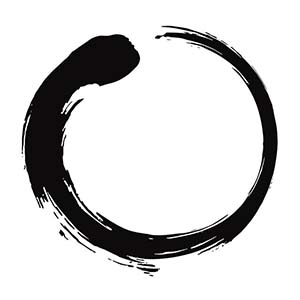


One of my favorite concepts in Taoist philosophy is something called Pu, usually translated as the Uncarved Block.
Imagine a block of wood sitting on a carpenter’s workbench. It hasn’t been cut, shaped, polished, or turned into anything. It might become a chair, a table, a beautiful sculpture, or a thousand other things. At the moment, however, it is none of those things.
And that’s precisely where its magic lies.
The uncarved block represents simplicity, wholeness, naturalness, and uncommitted potential. It hasn’t yet been shaped into a particular identity, and therefore hasn’t had its possibilities restricted by that identity.
Now, if you’ve spent much time studying the Tarot, you may already recognize where I’m going with this.
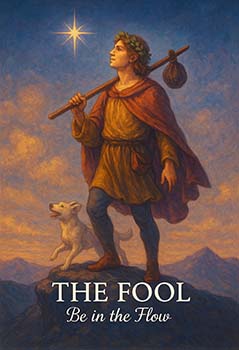
The Fool is the Tarot’s version of the uncarved block. Or, at the very least, he embodies much of the same philosophical energy.
The Fool Before the World Told Him Who to Be
Think about how we develop our identities. When we’re born, we don’t know whether we’re intelligent or stupid, attractive or unattractive, successful or unsuccessful. We don’t know whether we’re worthy of love, whether we’re talented, or whether we’re destined for greatness or mediocrity.
We simply exist. Then the world gets hold of us.
Our parents tell us what kind of people we should become. Our teachers tell us what we’re good at and what we’re not. Society tells us what constitutes success, what makes us desirable, and what we must accomplish to become worthwhile human beings.
Gradually, we begin collecting identities. I’m intelligent. I’m not good at mathematics. I’m artistic. I’m shy. I’m unsuccessful. I’m too old. I’m not good enough.
Some of these identities are flattering. Others are downright destructive. But even the flattering ones can become limitations.
If I define myself as an artist, for example, does that mean I can’t become a scientist? If I define myself as a failure, does that mean I can’t succeed? If I believe I’m untalented, how many possibilities will I never explore?
The Taoist concept of the uncarved block invites us to consider a fascinating possibility: What if personal growth isn’t always about becoming something more? What if sometimes it’s about letting go of everything we’ve been told we are?
That’s where the Fool enters the picture.
The Magic of Zero
In most modern Tarot decks, the Fool is numbered zero. And zero is a rather extraordinary number.
It isn’t positive or negative. It doesn’t represent a particular quantity of something. Yet it plays an essential role in a numerical system that can express an infinity of possibilities.
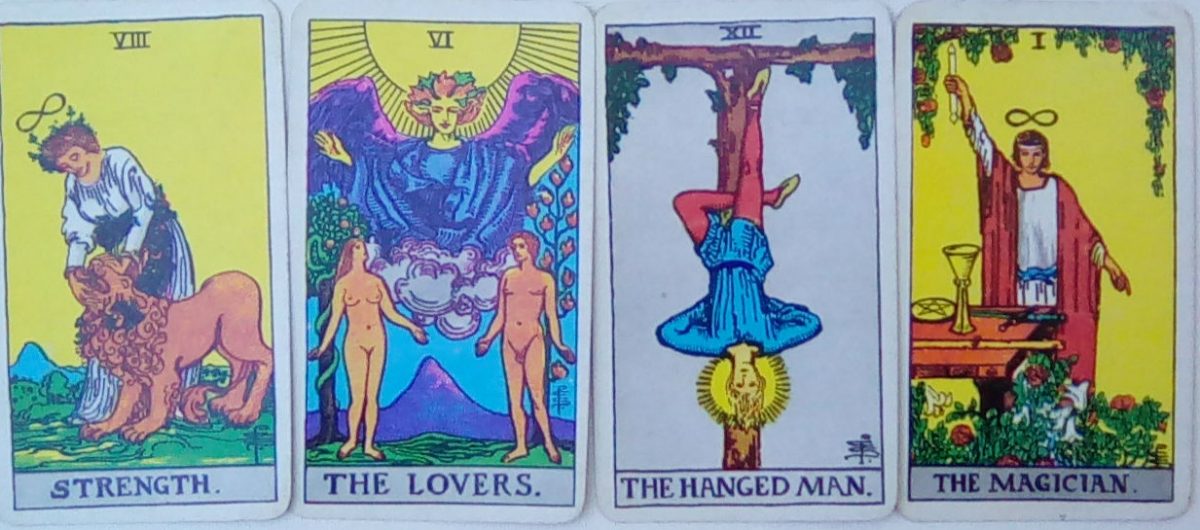
The Fool’s zero suggests a similar condition. He hasn’t committed himself to a particular identity. He isn’t the Emperor, with an empire to govern. He isn’t the Hierophant, with traditions to uphold. He isn’t the Hermit, with wisdom to dispense.
He is simply himself. And because he hasn’t defined himself too narrowly, he remains free to become almost anything.
We tend to think of our identities as descriptions of who we are. But quite often, they’re descriptions of who we’ve learned to believe we are. And there’s an enormous difference between the two.
The Fool invites us to loosen our grip on those definitions.
Perhaps we’re not failures. Perhaps we’ve simply experienced failure. Perhaps we’re not untalented. Perhaps we haven’t discovered our talents yet. Perhaps we’re not too old to begin something new. Perhaps we’ve simply accepted somebody else’s definition of what people our age are supposed to do.
The Fool doesn’t need to know who he’s going to become before he takes his first step.
The Fool and the Taoist Art of Wu Wei
There’s another Taoist concept that fits the Fool beautifully: wu wei.
Wu wei is often translated as “non-action,” although that translation can be misleading. It doesn’t mean sitting around doing nothing. It means acting naturally, without unnecessary struggle, resistance, or contrivance. It’s the art of moving with the flow of circumstances rather than constantly trying to force life into a predetermined shape.
Consider the Fool in the Rider-Waite-Smith Tarot. There he is, strolling along with his little bundle of possessions, his face turned toward the heavens, apparently unconcerned about the cliff immediately ahead of him.
Most traditional interpretations emphasize his recklessness. He’s so busy admiring the scenery that he doesn’t notice the danger. And that’s certainly one way to read the card.
But there’s another possibility. What if the Fool represents a way of moving through life without the constant burden of anxiety, calculation, and self-consciousness? What if his apparent foolishness is actually a kind of freedom?
He isn’t worrying about whether he’ll succeed. He isn’t comparing himself with other travelers. He isn’t agonizing over whether he’s qualified to undertake the journey. He’s simply experiencing the journey.
Of course, wu wei doesn’t mean ignoring cliffs or abandoning common sense. Taoist naturalness isn’t the same thing as carelessness. But it does suggest that we frequently make life more difficult than it needs to be by trying to control every possible outcome.
The Fool reminds us that sometimes the most natural thing in the world is simply to take the next step.
Recovering the Uncarved Self
There’s something particularly interesting about the Taoist ideal of the uncarved block. Most systems of personal development emphasize adding something to ourselves.
We need more knowledge, more discipline, more confidence, more skills, more accomplishments. We need to become better, stronger, wiser, and more successful. And certainly, there’s nothing wrong with developing our abilities.
But Taoism suggests that there’s another direction we can travel. Instead of continually adding new layers to our personalities, we can begin removing the artificial layers that prevent us from experiencing our natural selves.
We can question the beliefs we’ve inherited. We can release expectations that never really belonged to us. We can stop measuring our worth against standards that somebody else invented.
And perhaps, beneath all those accumulated definitions, we’ll discover something remarkably simple.
A person who doesn’t have to prove anything. A person who doesn’t have to become somebody else to be worthy of existence. A person who is free to explore life without constantly worrying about whether they’re doing it correctly.
In other words, we might rediscover the Fool.
Interestingly, this suggests that the Fool isn’t necessarily the least developed character in the Major Arcana. In some respects, he may represent a kind of wisdom that the other characters are still struggling to attain.
After all, it takes a certain amount of wisdom to recognize how little we really need to be ourselves.
Becoming the Fool Again
Perhaps the most interesting thing about the uncarved block is that it isn’t something we have to create. It’s something we have to uncover.
We don’t have to manufacture our natural selves. We simply have to recognize the beliefs, expectations, and artificial identities that have accumulated around them.
And that brings us back to the Fool. At first glance, he appears to be the most inexperienced character in the Tarot. He has no throne, no impressive credentials, no elaborate philosophy, and no apparent plan for the future.
But perhaps that’s precisely the point. The Fool doesn’t need to know everything before he begins. He doesn’t need to prove that he’s worthy of the journey. He doesn’t even need to know exactly where he’s going.
He’s willing to encounter life without demanding that it conform to everything he already believes.
And perhaps that’s why he’s numbered zero. Zero isn’t the absence of possibility. It’s the place where possibility begins.
The next time the Fool appears in a Tarot reading, consider asking yourself a slightly different question. Instead of asking, “What new adventure is beginning?” try asking:
“Who might I become if I stopped believing everything I’ve been told about who I am?”
You might be surprised by the answer.