As the final card of the Major Arcana, The World is both the end of a cycle and the beginning of a new one.
Yes, we’ve come to the end of the long journey through the archetypes. The lessons have been learned, the trials endured, and the pieces brought together. But Tarot doesn’t really have an ending. The moment one journey is completed, another begins.
The World isn’t a period.
It’s a doorway.
THE WREATH — COMPLETION AND REBIRTH
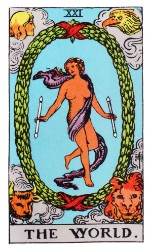
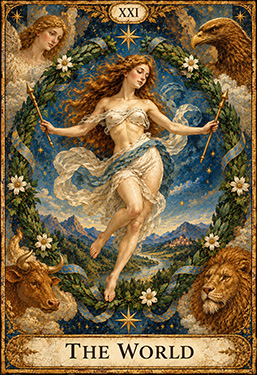
The most obvious symbol of completion is the enormous wreath surrounding the central figure.
But look at its peculiar shape. Rather than being perfectly circular, the wreath forms a long oval. It can easily suggest an opening, a portal—and perhaps even the shape of the birth canal.
Seen that way, the figure isn’t simply standing triumphantly inside a wreath celebrating what she has accomplished. She’s passing through it. She’s arriving at the destination and simultaneously being born into another world.
That’s one of the great paradoxes of The World: completion and beginning are the same event. Every genuine transformation eventually requires us to leave behind the person who began the journey.
THE FOOL, THE WORLD, AND THE DANCE OF LIFE

At the very beginning of the Tarot journey we encountered The Fool.
He’s filled with such exuberance that he practically dances toward the edge of a cliff. He doesn’t know where he’s going. He hasn’t experienced the Magician, the Lovers, Death, the Devil, the Tower, the Moon or any of the other archetypal encounters awaiting him.
He simply steps forward.
Now look at the figure in The World.
She’s dancing, too. But this is a very different dance. The Fool dances because he doesn’t yet know what lies ahead. The World dances because she does.
She has traveled through the entire cycle and somehow recovered the joyous freedom with which she began it.
This idea has a fascinating parallel in Hindu philosophy.
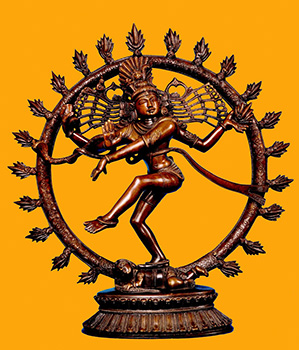
Shiva as Nataraja—the Lord of the Dance—is portrayed dancing within a great circle of flame. His dance represents the ceaseless movement of existence: creation, preservation, destruction and renewal.
The visual resemblance to The World is striking: a dancing figure surrounded by a circular boundary representing something vastly larger than the individual.
Hindu traditions also give us the wonderful concept of līlā, usually translated as “divine play.” Līlā suggests that creation doesn’t necessarily arise because the divine lacks something or needs to accomplish some desperately important objective. Creation can be understood as spontaneous expression—something closer to art, music, play or dance.
An artist paints. A musician plays. A dancer dances. Creation creates.
This doesn’t mean that suffering is unreal or that life should never be taken seriously. It suggests something subtler: beneath all our struggling, planning and attempts to control events, there may be another way of participating in existence.
We can dance with it.
The woman in The World is being born into something new, but she isn’t grimacing with effort. She’s having a hell of a lot of fun doing it.
THE MAGICIAN, THE WORLD, AND INTEGRATION

There’s another fascinating connection between The World and one of the earliest cards in the Major Arcana.
The woman holds two peculiar short, double-ended wands loosely in her hands. We’ve seen that wand before. The Magician holds one.
But notice the difference in how the two figures use them.
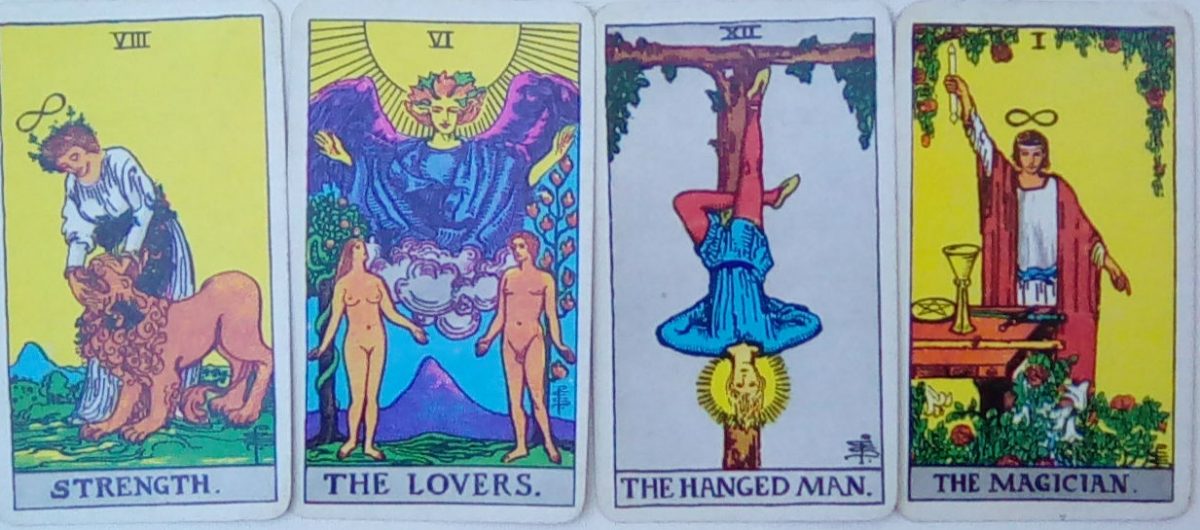
The Magician raises his wand deliberately toward heaven while pointing his other hand toward Earth. His entire posture communicates intention:
I will make something happen.
He channels divine power into manifestation. He gathers the four elemental tools before him and consciously directs his will.
The World no longer needs to do that. She holds two wands, perfectly balanced on either side of her body. She isn’t pointing them anywhere. She isn’t commanding anything. She almost seems to be playing with them.
They’ve become part of the dance.
The Magician uses magic. The World embodies it.
At the beginning of the journey, we have to learn that we possess creative power. We have to discover intention, will, concentration and the ability to shape our lives. But perhaps there comes a point when even that must be surrendered.
The Magician says: I am creating my world.
The World says: I am the creation.
THE MAGIC CIRCLE
Now notice the four mysterious figures occupying the corners of the card: the human or angel, eagle, bull and lion.
They have a long symbolic history extending far beyond Tarot, but within the Tarot’s esoteric correspondences they can be associated with the four fixed signs of the zodiac:
Aquarius — Air
Scorpio — Water
Taurus — Earth
Leo — Fire
Once again, all four elements are present. We encountered them on the Magician’s table at the beginning of the journey. Now they surround The World.
This gives the card an almost ritual quality. In Western ceremonial magic, the four directions and their elemental correspondences can be invoked around a ritual space. Symbolically, then, we can imagine the dancing woman standing within a great magic circle surrounded by the forces of creation.
But something has fundamentally changed.
The Magician stood before the elements and manipulated their symbols. The World dances among them.
Mind, emotion, body and spirit are no longer competing forces that need to be brought under control. They have become parts of a larger whole. That is integration.
And perhaps that’s what The World ultimately means by completion. Not perfection. Not reaching a place where nothing difficult will ever happen again.
Wholeness.
WHEN THE WORLD APPEARS IN YOUR READING
When The World appears in a reading, something has come full circle.
A long process may be reaching completion. You may finally understand something that once confused you, finish something you’ve worked toward for a long time, or realize that you’ve simply outgrown a particular chapter of your life.
But don’t mistake completion for stagnation. The World almost always contains the seed of what comes next.
You may be standing at exactly that strange threshold where you can look backward and say, “I’ve finished,” while simultaneously looking forward and realizing, “Now I begin again.”
The card can also indicate integration. Pieces of yourself that once seemed contradictory may finally be learning to coexist. The intellectual, emotional, physical and spiritual parts of your life may be finding their proper relationship with one another.
And sometimes The World offers an even simpler message:
Stop trying so hard to control the dance.
You’ve learned more than you realize. You have the tools. You’ve survived the journey.
Now loosen your grip on the wands.
Listen for the music.
And dance.