Just the Tarot Posts

THE MOON — DON’T MISTAKE MOONLIGHT FOR DAYLIGHT

The Moon is traditionally associated with illusion, uncertainty, and blurred reality—but why? By exploring the card’s dreaming face, open gateways, howling dog and wolf, and the strange creature rising from the water, we uncover a deeper meaning: The Moon represents those moments when subconscious fears, desires, memories, and intuitions begin coloring our perception of reality. The road is still there—we’re simply seeing it by moonlight.

The Moon is traditionally one of the more unsettling cards in the Tarot.

Illusion. Confusion. Deception. Uncertainty. Blurred reality. Things are not quite what they seem.

Those are perfectly good definitions, but they leave us with a question: Why? Why does the Tarot choose this particular collection of images to represent those ideas?

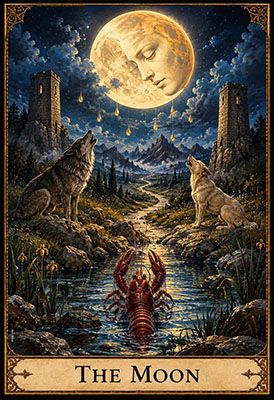
There is a pool of water with a strange crustacean crawling out of it. A dog and a wolf howl at the Moon. A road passes between two towers and winds away through an empty landscape. Strange drops of energy fall from the sky.

And above everything hangs an enormous Moon containing a human face.

Perhaps the key to understanding the entire card is right there.

The Moon’s eyes are closed.
THE DREAMING MOON

Look carefully at the Moon’s face. It isn’t screaming or displaying terror. It appears troubled, perhaps even melancholy, but its eyes remain firmly closed.

Nighttime. Moonlight. Closed eyes.

The Moon is dreaming. And perhaps it isn’t experiencing a nightmare so much as a troubled dream—the kind in which uncomfortable material from somewhere below consciousness begins working its way toward the surface.

That gives us a very different way of approaching the card.

During ordinary waking consciousness, we maintain a reasonably firm distinction between the world outside us and the world inside us. We distinguish memories from present events, imagination from observation, fears from facts.

Dreaming changes all of that.

The boundaries become porous. Memories mingle with fantasies. Fears become characters. Emotions become landscapes. People who died twenty years ago walk through the front door. Places we’ve never visited somehow feel completely familiar.

The subconscious speaks—but it speaks in its own peculiar language. And while we’re dreaming, we generally accept all of this as reality.
THE GATES ARE WIDE OPEN

The two towers in The Moon are usually interpreted as something we must pass through on our journey along the road.

But suppose we’ve been traveling in the wrong direction.

There is no obvious destination at the distant end of the road. The Tarot frequently used radiant light and other visual devices to suggest a glorious destination or spiritual attainment.

There is nothing like that here.

So what happens if we reverse direction?

Suppose we are traveling toward the pool rather than away from it.

Suddenly the towers become an entrance. And there’s something peculiar about that entrance: It’s wide open. The towers are separated by a broad expanse of land. There is no wall connecting them. No gate. No guardhouse. No barrier.

Nothing prevents us from entering.

That makes wonderful psychological sense if the landscape represents a dream—or, more broadly, a state in which the subconscious is becoming unusually active.

The gates between conscious and subconscious experience are open.

THE DOG AND THE WOLF

Just inside those gates we encounter two closely related animals: a dog and a wolf.

The wolf represents the primitive animal—the creature governed by instinct. The dog is essentially that same creature after thousands of years of domestication. It has learned the rules. It has adapted itself to human civilization.

Psychologically, the pairing is almost irresistible.

The wolf can represent our primal self: instinct, appetite, fear, aggression and everything else civilization has taught us to restrain. The dog can represent our conditioned self—perhaps even the ego attempting to maintain order.

And what does a guard dog do when something approaches the boundary?

It barks.

Both animals are howling at the Moon.  The intruder is the subconscious material and that’s what the wolf and dog are trying to keep out.

The ego may try to keep the contents of the subconscious at bay, but under the influence of The Moon, it cannot maintain complete control.

SOMETHING IS COMING OUT OF THE WATER

Then we reach the pool.

Water has long been associated with the subconscious and emotional realms, and the Tarot places it prominently at the bottom of the card.

And something is crawling out of it.

The strange crayfish or lobsterlike creature appears almost prehistoric. It belongs to a much older world than either the dog or wolf.

If the pool represents the subconscious, this creature can represent something equally ancient within ourselves: primitive psychological material that predates our carefully constructed conscious identity.

And it is rising.

The Moon, of course, controls the tides. The Tarot imagery therefore gives us a marvelous metaphor: the Moon is drawing something out of the depths.  Out of our depths.

Something normally submerged is coming to the surface.

That may be a forgotten memory. An instinct. A fear. A desire. An intuition. An old emotional wound. A creative image. Something we know without knowing how we know it.

The important point is that it has crossed—or is crossing—the boundary into consciousness.

WHAT IS A “MOON-LIKE” STATE?

This is where the symbolism becomes much broader than ordinary dreaming.

We might think of The Moon as depicting any Moon-like condition in which ordinary conscious control is weakened and subconscious material begins exerting an unusually powerful influence over our perception.

Dreaming is the most obvious example, but it isn’t the only one.

Intense anxiety can create a Moon-like state. So can grief, infatuation, obsession, fantasy, emotional overwhelm, trance, intense creativity and other experiences in which our interior world becomes unusually powerful.

And that’s when perception becomes tricky. Because we aren’t necessarily hallucinating something that doesn’t exist. More often, we’re interpreting something real through the light of our subconscious mind.

THE ROPE AND THE SNAKE

Imagine walking outside at night and seeing something long and curved lying across the path.

In daylight, you would immediately recognize it as a rope. But under uncertain moonlight, it looks remarkably like a snake. Your heart pounds. Your body tenses. You stop walking.

The rope is real.

The darkness is real.

Your fear is certainly real.

The snake isn’t.

Your subconscious has taken incomplete sensory information and supplied the rest.

That is The Moon.

And we do precisely the same thing psychologically.

An employer sends an email saying, “Could you come see me this afternoon?” If you’re already worried about losing your job, your subconscious may immediately finish the story. I’m getting fired.

Someone you love seems unusually quiet. They’re angry with me.

A new romantic interest doesn’t answer a message. They’re losing interest.

In each case, something actually happened. But subconscious fear, desire or expectation supplied information we didn’t possess.

The feeling may be real. The interpretation may not be.

BUT SOMETIMES THE SNAKE REALLY IS A SNAKE

And this is where The Moon becomes more interesting than a simple warning against illusion.

The subconscious isn’t necessarily wrong. Sometimes what we call intuition may be the subconscious assembling information the conscious mind hasn’t yet recognized.

Perhaps that quiet person really is angry. Perhaps something actually is wrong at work.

Perhaps some tiny combination of expression, tone of voice and behavior has registered below conscious awareness and produced the unmistakable feeling that something isn’t right.

That is why intuition belongs to The Moon just as surely as illusion does.

The problem is that under moonlight it can be extraordinarily difficult to distinguish between them.

Is this intuition—or fear? Am I perceiving something—or projecting something? Do I know this—or merely feel it very strongly?

The Moon doesn’t necessarily answer those questions.

It tells us that we need to ask them.

WHEN THE MOON APPEARS IN A READING

When The Moon appears, we don’t necessarily need to assume that somebody is lying to us or that everything around us is an illusion. Instead, the card may be telling us that subconscious material is strongly coloring our perception of the situation.

Something may be rising from the depths that deserves our attention. But this probably isn’t the moment to accept every fear, intuition, fantasy or suspicion as objective fact.

Ask yourself:

What do I actually know?

What am I assuming?

What am I afraid might be true?

What do I want to be true?

Is an old experience influencing how I interpret the present one?

Could my intuition be noticing something my conscious mind hasn’t recognized yet?

And perhaps most importantly:

Do I have enough light to see this clearly yet?

Sometimes we simply have to wait until we can see more clearly.

The lesson of The Moon may not be that we should distrust everything we experience in darkness. Dreams, emotions, instincts and intuitions can contain profound truths.

But they speak the symbolic language of the subconscious, and that language shouldn’t always be taken literally.

A rope may look like a snake.

A fear may masquerade as intuition.

And intuition may arrive disguised as an irrational fear.

The road is still there.

We simply have to remember that we’re seeing it by moonlight.

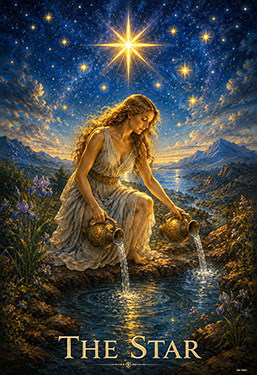
The Star and Shining Bright in Our Lives

The Star Card as the reborn self.

To paraphrase a wonderful movie:

“What does a star do? It shines.”

And that is precisely what The Star in the Tarot portrays: our ability to shine our light into the world around us.

Through a Jungian lens, the Tarot can be read as a visual map of individuation—the lifelong process of bringing the conscious and unconscious parts of ourselves into a more complete and integrated whole.

The Star represents an important moment in that journey. Something inside us has come together. Mind, spirit, emotion, and instinct are no longer fighting one another quite so fiercely. We have begun to understand who we are.

And now we’re ready to share it.

The Star isn’t searching for her light. She is the light.

THE STAR AND THE TOWER

The Star appears immediately after The Tower. There is no coincidence in that sequence.

As we recently discussed, The Tower can depict not merely the destruction of circumstances in our outer world, but the collapse of the psychological structures we have built around ourselves.

The Tower takes everything false, everything unsustainable, everything inauthentic—and burns it right to the ground.

But inherent in that destruction is the possibility of rebirth. When there is nothing left, we have to start over. And when we start over, we have the opportunity to rebuild our lives on something more authentic.

To quote the old Kris Kristofferson line made famous by Janis Joplin:

“Freedom’s just another word for nothing left to lose.”

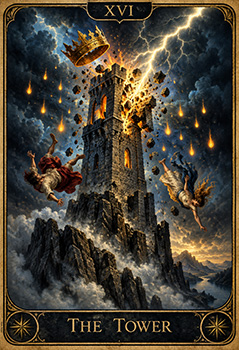
That is precisely where The Star enters the story. The Tower has stripped away the false structure. The crown has fallen. The walls have collapsed. The old identity has been shattered.

And yet—we’re still here.

Perhaps for the first time, we are free to become something closer to our authentic self.

The Tower says: This is what you are not. The Star answers: Then let me show you what you are.

THE STAR AND THE HERMIT

Another way to understand The Star is to compare her with The Hermit, because in some respects they represent almost opposite energies.

Psychologically, The Hermit represents deliberate introversion. He steps away from the collective noise of society to enter the inner world alone. He is searching for something that cannot be found amid the chatter and expectations of everyone around him.

Visually, his heavy gray cloak creates a boundary between himself and the world. He stands alone on his snowy mountain peak, carrying only his staff and lantern. The lantern represents consciousness illuminating the darkness—the small light with which he explores the unknown territories within himself.

The Hermit isn’t simply alone.

He wants to be alone.

He isn’t trying to share something. He’s trying to find something.

The Star is different.

She has emerged from that inward journey. She stands naked beneath the stars, without armor, cloak, crown, fortress, or disguise. There is nothing separating her from the world around her.

She isn’t searching for another source of energy. She has become a source.

She pours her water—her energy, creativity, compassion, wisdom, and essential self—back into the world.

Some goes into the pool, the realm of emotion and the unconscious. Some goes onto the earth, nourishing ordinary life.

She isn’t hiding. She’s nourishing. And perhaps most importantly, she isn’t diminished by giving. Her vessels don’t seem to run dry.

That is one of the profound lessons of The Star: when what we give comes from the authentic self rather than from obligation, fear, or the desperate need for approval, sharing ourselves does not necessarily empty us.

Sometimes it makes us more fully ourselves.

The Star Poster – 13 X 19 Inches – Available on Etsy

THE GUIDING STAR

Jung used the ancient term psychopomp for an archetypal figure that mediates between different realms of experience—particularly between consciousness and the unconscious.  The psychopomp is a guide who leads us from one realm into the next.

The Star can be understood as such a guide.  She is leading us from the destruction of The Tower into our own light.

But whatever psychological language we use, the message of The Star is remarkably simple.

We are meant to shine.

We are supposed to shine.

And for many people, that is much more difficult than it sounds.

Psychologist Brené Brown has described shame as the intensely painful experience of believing that we are flawed and therefore unworthy of love, belonging, and connection.

That belief can become one of the most powerful forces keeping us from fully participating in our own lives. We don’t show people what we’ve created because perhaps it isn’t good enough.

We don’t speak because perhaps what we have to say isn’t important.

We don’t pursue the thing we desperately want because perhaps we aren’t talented enough, attractive enough, intelligent enough, young enough, educated enough—or simply enough.

So we hide.

We become smaller. We cover ourselves in the Hermit’s cloak long after the period of solitude has served its purpose.

The Star has moved beyond that shame.

Look at her. She is completely exposed beneath an enormous night sky, yet there is nothing defensive about her.

She isn’t comparing herself with the other stars. She isn’t wondering whether Sirius is brighter. She isn’t asking whether someone else deserves to shine more than she does.

She simply shines.

And by doing so, she becomes a guide for everyone still standing in the darkness.

She seems to be saying: This is how you do it.

This is how you shine.

WHEN THE STAR SHOWS UP IN YOUR READING

When The Star appears in a reading, it often signals healing, renewal, authenticity, and the return of hope after a difficult period.

But I think its message goes considerably deeper than simply, “Things are going to get better.”

The Star asks you to stop hiding.

If you’ve recently experienced your own Tower—a loss, upheaval, disappointment, failure, or profound change—The Star suggests that the destruction may have cleared away something that was preventing you from becoming more completely yourself.

The question now is not simply: How do I get my old life back?

The better question may be: Who am I now that the old life is gone?

The Star can also appear when you have something that needs to be shared.

An idea. A talent. A piece of art. A book. A truth. A kindness.

A way of seeing the world that belongs uniquely to you.

You may still hear the old voice whispering that nobody wants it, that somebody else could do it better, or that you have no business putting yourself forward.

The Star says otherwise.

She doesn’t promise applause. She doesn’t promise success. She doesn’t even promise that everyone will understand what you have to offer.

She simply reminds you that your light cannot illuminate anything while you are hiding it.

So when The Star appears, ask yourself:

Where am I still making myself smaller than I need to be?

What part of myself am I finally ready to reveal?

What do I have that could nourish someone else?

And perhaps the most important question of all:

What would happen if I simply gave myself permission to shine?

Because what does a star do?

It shines.

The Tower Card – Anatomy of a Nervous Breakdown

Exploring the healing side of The Tower card through a Jungian perspective.

As Above, So Below.

As Within, So Without.

— The Kybalion

Most discussions of The Tower card in the Tarot focus almost entirely on what is happening in a person’s outer world.

And that’s understandable. It’s a dramatic card.

When The Tower appears, we think of events like divorce, losing a job, bankruptcy, foreclosure, the collapse of a relationship, or some other sudden upheaval. The outer destruction can be breathtaking.

But as the old Hermetic principle suggests, whatever is happening in our outer lives is also reflected in our inner lives.

When the structure of our exterior world collapses, something often collapses inside us as well.

That inner destruction is what we used to call a nervous breakdown.

Everything we believed to be true is suddenly called into question. Relationships with people we trusted crumble into dust. Beliefs we held dear for most of our lives are revealed to be false. The future we thought we understood disappears.

We find ourselves psychologically adrift. We have lost our place in the world, and we cannot seem to figure out how to get back to normal.

In Jungian terms, The Tower can be understood as the sudden and sometimes catastrophic dismantling of a rigid psychological structure. An outgrown persona, a false framework, or a collection of deeply held illusions can no longer withstand reality.

Something has to give.

And the symbols contained in The Tower provide a remarkably clear roadmap of that process.

THE CROWN

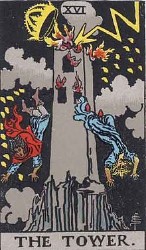
At the top of the tower is a crown, blasted away by the lightning strike.

Psychologically, the crown can represent the sovereignty of the conscious ego—the part of us that believes it understands what is happening and has things under control.

To put that more plainly, we all have to believe in ourselves.

When we get up in the morning, we need to believe that we are sane, that the world is reasonably predictable, and that what we do during the day will make sense and help keep us safe.

That is the everyday ego.

It goes to work. It pays the bills. It buys the groceries. It makes appointments. It solves problems. It deals with all those other human beings who are out there trying to do exactly the same thing.

Most of the time, it does a pretty good job.

But what happens when our predictable, manageable world completely falls apart?

What happens when we discover that our partner has been cheating on us? What happens when we lose the job we thought was secure? What happens when our finances collapse, our health fails, or something else occurs that simply cannot be fitted into the story we have been telling ourselves?

That wonderful daily wizard—the ego—suddenly doesn’t look so powerful.

The part of us that we believed would always keep us safe, solve the problem, and keep the car between the white lines suddenly has no idea what to do.

There is an old expression heard in twelve-step programs:

“My best thinking got me here.”

That is the crown being blown off the tower.

The Tower Poster – 13 X 19 Inches – Available on etsy

THE LIGHTNING STRIKE

And the moment we finally realize that we have really and truly lost control can feel like being struck by lightning.

It comes as a sudden flash of recognition—a crisis of the mind.

We may have spent months or even years denying that anything was seriously wrong.

“No,” we tell ourselves, “my partner couldn’t possibly be cheating on me. Those secretive phone calls and motel receipts don’t necessarily mean anything.”

Or perhaps we keep telling ourselves that we are just a little short financially this month.

Yes, we were short last month too. And the month before that. But things will turn around. We just need to tighten the budget a little more.

Until suddenly the truth becomes impossible to avoid.

We realize that we have been lying to ourselves.

And we are in real trouble.

That is the lightning strike.

The illusion doesn’t gradually fade away. For one terrible instant, we see through it.

And once we have seen the truth, we cannot completely unsee it.

THE FALLING FIGURES

The two figures blasted from the tower can represent the parts of ourselves that can no longer remain protected inside the old psychological structure.

We cannot hide in our intellectualizations and rationalizations anymore.

We built this magnificent structure called “my life.”

It protected us. It gave us an identity. It told us who we were, what mattered, whom we could trust, and what tomorrow was supposed to look like.

Now we have been thrown out of that safe little nest.

We are in psychological free fall.

There is nothing to hold on to because the things we once held on to are precisely the things that are collapsing.

But there is another way to look at those falling figures.

They are being grounded.

Literally.

They are falling out of an artificial structure and back toward the earth.

Toward reality.

The experience may hurt like hell. It may scare us half to death. But if we survive the fall, we have something we did not have while we were safely locked inside the tower:

The possibility of starting over.

Because now we have to.

THE GOLDEN SPARKS

Look carefully at the Waite-Smith Tower and something else is falling alongside the two figures.

Twenty-two golden drops or sparks surround the tower.

There are several ways of interpreting them. From a Jungian perspective, we might see them as psychic energy released when an old structure breaks apart. Spiritually, they can suggest something even more intriguing: illumination arriving in the middle of catastrophe.

The card is not simply about destruction.

It is about the destruction of a structure that can no longer contain who we are becoming.

At the very moment our old world is falling apart, new possibilities are appearing.

That doesn’t make the destruction pleasant.

It doesn’t mean we should pretend that loss isn’t loss, or pain isn’t pain.

But it suggests that destruction and creation may sometimes be two parts of the same process.

We cannot discover who we really are while clinging desperately to an identity built from fear, illusion, habit, or other people’s expectations.

The curse of The Tower is that everything we believed in may be falling apart.

The blessing is that we are finally free to discover what remains when it does.

And from there, we can begin again.

INDIVIDUATION

Perhaps the greatest difficulty with The Tower is that it feels like an ending.

Our world has been blown apart.

But psychologically, the ending may only be one stage in the process Carl Jung called individuation—the lifelong process of becoming a more whole and authentic individual.

As I said at the beginning, we all need a coherent story about ourselves in order to function.

But when that story becomes increasingly dependent upon denial, rationalization, self-deception, or an identity we have outgrown, maintaining it requires more and more energy.

Eventually reality catches up with us.

Eventually the false edifice comes tumbling down.

Jung used another wonderfully complicated word that is particularly appropriate to The Tower: enantiodromia.

Put very simply, it describes the tendency of something pushed too far in one direction to produce movement toward its opposite.

Psychologically, what we refuse to acknowledge does not simply disappear. The more rigidly we cling to one side of ourselves or one version of reality, the more pressure can accumulate in what has been excluded.

Eventually something breaks through.

In the language of Tarot, lightning strikes the tower.

When we become stuck in our own falsehoods—in the stories we tell ourselves and sometimes everyone around us—life has an uncomfortable way of getting us unstuck.

One way or another.

The false structure is burned down to its foundations so that something more authentic can eventually be built in its place.

And that may be the most important thing to understand about The Tower.

We naturally stare at the lightning.

We stare at the flames.

We stare at the people falling through the darkness.

But the destruction is not the entire story.

The Tower is also the clearing of ground.

Something false has ended.

Something real can now begin.

Yes, the burning tower is what catches our attention. But the deeper message of The Tower may be the healing that becomes possible after the destruction.

The Devil and the Problem of Unconscious Choice

The Devil Card and the need for choice before morality.

One of the most frequently discussed details in the Rider-Waite-Smith Devil card is the chains.

The naked man and woman stand chained to the black pedestal beneath the Devil, but a closer look reveals something peculiar. Their hands are completely free, and the chains around their necks are so loose that either figure could simply lift the loop over his or her head and walk away.

That gives us one of the standard interpretations of The Devil: we are often imprisoned by things that we can walk away from if we choose to do it.

It’s a powerful interpretation, and one I’ve discussed before. (See my previous post The Devil Card and Freedom.) But it raises another question that may take us deeper into the card.

What if the people don’t know that they can take the chains off?

Why Don’t They Take Off the Chains?

When we look at the picture, knowing that the chains are loose, their behavior seems completely puzzling.

Why don’t they simply leave?

One answer might be that they just don’t want to.  They might actually be enjoying whatever’s keeping them in chains.  Maybe they like getting drunk.  Maybe they’re having a really hot secret affair with their next door neighbor and it feels mighty fine.  Maybe they like being an addict.

But when we look carefully at the card, it doesn’t look like they’re making any kind of conscious decision at all.

Look at them.

They aren’t struggling against their chains.

They aren’t examining them.

They aren’t looking toward one another for help.

Most strikingly, neither of them is looking at the Devil.

There is an enormous, gigantic, scary, horny creature looming immediately behind them, and they seem almost completely unaware of his presence.

The man is even more remarkable. The Devil holds a flaming torch downward toward him, and the man’s tail has caught fire.

He doesn’t seem to notice.  Really?  Wouldn’t you notice it if your tail caught fire?  I know I would.

But maybe we’ve been asking the wrong question.

Instead of asking “Why don’t they choose to remove the chains?” perhaps we should be asking:

“Do they realize they’re wearing chains at all?”

Do they even realize that they’re slaves?

The Devil We Don’t See

This gives us a very different way of understanding the card.

The Devil represents something we haven’t yet seen.

We could make a serious case for the idea that most of us don’t make conscious choices about our lives.  Oh, we think we do and we like to brag about how well informed we are, but do we really?

There are, of course, marvelous exceptions but most of us are born in a particular rut and stay in that rut for most of our lives.  If we were born into a Christian family, we’ll probably stay Christians.  If our parents always voted Republican, we’ll probably vote Republican.  If we were born middle class, we’ll probably die middle class.  

We can say the same thing about our habitual ways of thinking.  If our parents were cynics and viewed the world skeptically, we will, too.  If our parents were depressive or angry, we’ll probably be depressed or angry, too.  If we were raised in a racist family, we’ll most likely be racist adults.

By the time we reach adolescence, we are thoroughly programmed little robots.  We may get a nose ring or a tattoo and call it rebellion, but soon enough we return to the rut we were born in.

And all the while, WE HAVE NO IDEA that we’re not making our own choices.  In fact, a part of the programming we receive is that we have freedom of choice when we really don’t.

It might be a belief inherited from our parents. It might be an assumption about money, sexuality, success, relationships, gender, class, religion or respectability. It might be a fear acquired in childhood. It might simply be a habit repeated for so many years that we’ve forgotten there was ever another way of behaving.

We don’t say, “I have chosen this.”

We say, “That’s just the way things are.”

And that may be one of the most powerful chains of all.

Morality Requires Choice

This brings us to perhaps the most provocative aspect of The Devil.

We traditionally associate the Devil with immorality. But what if the deeper problem depicted by the card is not immoral choice at all?

What if it is the absence of conscious choice?

In Jung and Tarot: An Archetypal Journey, Sallie Nichols writes:

“Without freedom to choose, there can be no true morality. The fact is that most of us today have more free choice than we realize; but many, still unconsciously imprisoned within cultural mores, refuse to accept the responsibility for moral choice.”

That distinction is crucial.

Morality isn’t simply obedience to a collection of rules. Genuine morality requires the ability to recognize alternatives, understand consequences, and then choose among them.

If I behave in a particular way merely because “that’s what people do,” I haven’t necessarily made a moral decision.

If I follow a religious commandment without ever examining it, I may be obedient—but obedience and morality aren’t the same thing.

If I repeat the prejudices of my culture because I’ve never recognized them as prejudices, I haven’t consciously decided that they are right.

And if I hurt another person while blindly acting out an unconscious fear or compulsion, the consequences remain real even though I may never have consciously intended them.

Consciousness creates the possibility of moral choice.

That’s where The Devil becomes considerably more complicated than a card about temptation or sin.

The people beneath him may not be wicked.

They may simply be asleep.

The First Act of Freedom Is Seeing the Chain

That brings us back to the apparent paradox at the center of the picture.

The couple are free. And they aren’t free.

Objectively, nothing prevents them from lifting those chains from their necks. Subjectively, however, they may have no idea that such a possibility exists.

Freedom therefore requires something before choice. It requires awareness.

We have to see the chain. We have to recognize the Devil standing behind us.

We may even have to notice that our tail is on fire.

Only then can we decide what we’re going to do about it.

Perhaps that is why The Devil occupies such an important place in the Major Arcana. He confronts us not simply with our appetites or our bad behavior, but with the uncomfortable possibility that forces we haven’t recognized may be making some of our choices for us.

The moment we see those forces clearly, something changes. We may still choose to remain exactly where we are.  But now it really is a choice.

What The Devil Means in a Reading

When The Devil appears in a reading, then, the question may not simply be “What has you trapped?”

A more useful question might be:

“What are you taking for granted that you have never consciously chosen?”

Look for the invisible assumption behind the situation. A relationship pattern, an inherited belief, a fear, a social expectation, a desire, an old family rule, or simply the conviction that “I don’t have any other choice.”

The card doesn’t necessarily tell you to break the chain.

It asks you first to see it.

Because once the chain becomes visible, you can finally decide whether to keep wearing it.

Temperance: Finding the Right Proportion

The Temperance card as a personal balancing act.

Temperance is usually defined as moderation, balance, and avoiding extremes. But the imagery of the Tarot suggests something more precise. Temperance is not simply about having less of something—it is about discovering the right proportion between different forces in our lives.

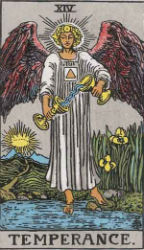
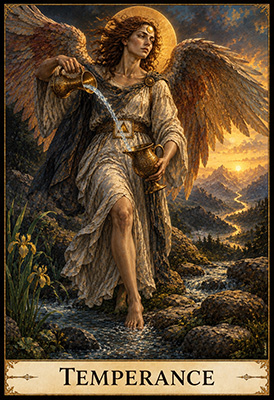
At first glance, Temperance can seem like one of the simpler cards in the Major Arcana. An angel stands quietly, pouring liquid from one cup into another. One foot rests on the earth while the other stands in water. Behind the angel, a path winds toward distant mountains and a brilliant golden light.

Nothing particularly dramatic is happening.

But perhaps that’s the point.

Temperance is about the delicate process of bringing different parts of ourselves—and different parts of our lives—into the proper relationship with one another.

Temperance as a Cardinal Virtue

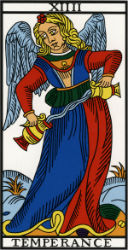
Temperance is one of the traditional cardinal virtues, along with Justice, Fortitude and Prudence. Three of these virtues survive quite recognizably in the standard Tarot: Justice, Strength (Fortitude), and Temperance. Prudence is conspicuously absent. (For more on the missing Prudence card, see my previous post Dear Prudence – The Mysterious Case of the Missing Tarot Card.)

In older Tarot decks such as the Tarot de Marseille, the imagery of Temperance is considerably simpler than that of the Waite-Smith card. We generally see an angelic figure pouring liquid between two vessels.

To modern eyes, pouring something from one cup to another may not immediately suggest moderation. Historically, however, the connection was much more obvious.

The older meaning of temperance was not merely abstaining from excess. The Latin root temperare carries the sense of regulating, combining or mixing things in the correct proportions. Water and wine, for example, could be mixed so that the strength of the wine was tempered.

This gives us the fundamental symbolism of the two cups.

Temperance is creating the right mixture.

And importantly, the right mixture does not necessarily mean equal amounts.

Balance Doesn’t Always Mean 50/50

We often visualize balance as equality. Put the same amount on both sides of a scale and equilibrium is achieved.

Temperance offers a different model.

Suppose you’re making soup. Equal quantities of salt and water would certainly represent equality, but they wouldn’t produce anything you’d want to eat.

The ingredients have to be present in the proper proportions.

The same principle applies to life.

We need work and rest, but that doesn’t mean twelve hours of each every day. We need independence and connection, reason and emotion, discipline and spontaneity. What constitutes the right balance changes according to circumstances.

Temperance therefore represents something more sophisticated than simply avoiding extremes. It asks:

What does this particular mixture require?

That is a dynamic form of balance. The liquid in the card is moving because maintaining equilibrium often requires continual adjustment.

Temperance Poster – 13 X 19 – Available on Etsy

One Foot in the Water, One on the Land

A. E. Waite and Pamela Colman Smith greatly expanded the symbolism of the older Tarot image.

One of their most famous additions is the angel’s peculiar stance: one foot rests on dry land while the other is immersed in water.

Water traditionally represents emotion, intuition, imagination and the unconscious. Solid ground suggests physical reality, stability, practicality and the tangible world.

The angel doesn’t choose between them.

It participates in both.

We could read this very simply as advice to feel deeply without losing our grounding.

Someone who lives entirely through emotion may be swept along by every changing feeling. Someone who insists upon remaining completely rational and controlled may become disconnected from intuition and emotional reality.

Temperance asks for neither extreme.

It asks us to discover the useful proportion between them.

Head and Heart

Something similar appears in the symbols placed upon the angel’s forehead and chest.

It’s entirely possible that these were meant to represent the influences of the heart and brow chakras. And their placement naturally suggests another important polarity.

Head and heart.

Thought and feeling.

Reason and intuition.

Again, the card does not tell us which should win.

Imagine someone deciding whether to remain in a difficult relationship. Their emotions may say one thing while the observable facts say another.

Temperance doesn’t necessarily say, “Ignore your feelings and be rational.”

Nor does it say, “Follow your heart regardless of the evidence.”

Instead it asks the person to bring both sources of information into the same vessel.

What do I feel?

What do I know?

And what conclusion emerges when both are given their proper weight?

That’s Temperance at work.

Justice Weighs; Temperance Blends

This also gives us an interesting distinction between two of the cardinal virtue cards.

Both Justice and Temperance concern balance, but they achieve it differently.

Justice balances by weighing.

Temperance balances by blending.

Justice holds a scale. Separate things are compared against one another until equilibrium is established.

Temperance pours one thing into another. The elements aren’t merely compared—they become part of a new mixture.

That makes Temperance particularly useful when apparently contradictory needs are both legitimate.

Perhaps someone is pursuing an important creative project but becoming exhausted.

The answer isn’t necessarily to abandon the project. Nor is it necessarily to push harder.

Temperance asks a different question:

What proportion of work and restoration will allow the work to continue?

Perhaps the problem isn’t the goal at all.

The mixture is wrong.

The Path Toward the Light

Behind the angel is another important feature: a winding path disappearing into the distance.

It eventually reaches mountains beneath a brilliant golden light, within which appears something resembling a crown.

This introduces movement into an otherwise remarkably still card.

The angel isn’t walking along the road. The angel stands quietly performing the work of integration.

The road comes afterward.

That suggests a beautiful practical interpretation of Temperance. Sometimes we cannot see how to move forward because something within our present situation is badly out of proportion.

We may be working too much and recovering too little.

Thinking endlessly and feeling too little.

Giving constantly and receiving nothing.

Dreaming without acting—or acting without considering where we’re going.

When those elements are brought back into a workable relationship, the next step may become much easier to see.

The balance isn’t the destination.

The balance makes the journey possible.

Temperance in a Tarot Reading

When Temperance appears in a reading, the familiar advice to practice moderation is perfectly valid—but we can make it considerably more useful.

Temperance may be saying:

Something here needs to be brought into better proportion.

That might mean less of something, but it could equally mean more of something that has been neglected.

Too much work may require rest. Too much caution may require a little risk. Excessive emotional involvement may need perspective. Excessive intellectualization may need feeling. Constant giving may need to be balanced by receiving.

The card can also suggest that two things we’ve been treating as opposites don’t actually require an either/or decision. Perhaps they can be combined.

And that brings us back to those two cups.

The angel continually pours between them, adjusting the mixture.

Temperance isn’t asking us to eliminate one part of ourselves in favor of another. It asks us to discover how the different parts belong together.

Find the right proportion. Integrate the opposites. And when the mixture is right, continue along the path.

The Death Card in Tarot: Death Is Only the Beginning

The three stages of the Death Tarot Card.

The Death card is one of the most misunderstood cards in Tarot. Far from simply representing physical death—or the rather vague modern idea of “transformation”—Pamela Colman Smith’s imagery appears to present death as the first stage of a much larger journey: death, passage through the unknown, and eventual return to the light.

Few Tarot cards have undergone as dramatic a transformation as Death.

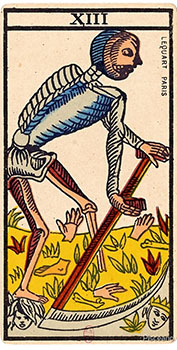
In many early Tarot decks, such as the Marseilles deck, Death is exactly what we would expect him to be: a skeletal figure wielding a scythe, mowing down human beings almost as though they were wheat. Kings, commoners, young and old all fall before him.

The symbolism isn’t particularly subtle.

Death comes for everyone.

But when Arthur Edward Waite and Pamela Colman Smith created the Rider-Waite-Smith deck, they radically reimagined the card.

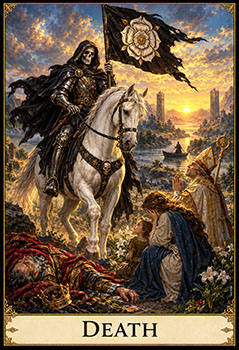
The scythe disappeared. Death climbed onto a white horse. And, perhaps most importantly, Smith created an entire landscape behind him.

That landscape may tell us what happens after Death passes.

From the Grim Reaper to the Rider

The mounted skeleton almost certainly draws upon one of the most famous images in the Book of Revelation: the Four Horsemen of the Apocalypse.

When the fourth seal is opened, Death appears riding a pale horse.

Waite and Smith borrow that terrifying image, but significantly change its character. Their Death carries no scythe and no sword. Instead, he carries a black banner bearing a white rose.

He isn’t simply killing people.

He is moving through the landscape.

And the landscape appears to be divided into three remarkably distinct regions.

Death Card Poster – 13 X 19 – Available on etsy

The First Realm: Death in the Clear Light of Day

The foreground is brightly and naturally illuminated.

Everything is clearly visible. We see the white horse, the skeletal rider, the fallen king, the bishop, the woman and the child. There is nothing particularly mysterious about this portion of the card.

Perhaps that is appropriate.

Whatever we may believe about an afterlife, reincarnation or resurrection, death itself is observable. Living things die. We may fear it, deny it or try not to think about it, but there is nothing metaphysically mysterious about the physical event itself.

Smith even gives us several different human responses to it.

The king has fallen before Death. His crown lies uselessly on the ground. Political power and worldly status provide no protection.

The woman turns away.

The child looks directly at Death, apparently without fear.

And the bishop remains standing, hands clasped before the approaching rider.

The bishop is particularly interesting. Unlike the king, he possesses no worldly means of resisting Death. But he does possess a spiritual framework through which death can be understood.

He doesn’t defeat Death.

He is able to face him.

The figures also recall the medieval Dance of Death tradition, in which Death comes for every rank of society. King, priest, woman and child ultimately share the same fate.

But then our eyes move beyond them.

And the card changes.

The Second Realm: The Liminal World

The middle distance is dramatically different from the foreground.

The clear light disappears. The landscape becomes gray and indistinct.

And separating the two regions is water.

On that water Smith has placed one of the smallest—and potentially most important—details in the entire card:

a boat.

The image immediately recalls the ancient story of Charon, the ferryman who transports the dead across the river separating the world of the living from the realm of the dead.

Whether Smith consciously intended Charon is impossible to establish simply from the picture. But the symbolic association is extraordinarily appropriate.

The river marks a boundary.

The boat crosses it.

And on the other side lies a strange, shadowy landscape.

In other words, Death itself may not be the mystery depicted by the card.

The mystery begins after Death.

Is the Moon Hidden Inside the Death Card?

At the far edge of this gray landscape stand two towers.

Anyone familiar with the Rider-Waite-Smith deck has seen them before.

They strongly resemble the two towers in The Moon.

In The Moon, a path leads between two towers and disappears into a strange nocturnal landscape. It is the territory of uncertainty, dreams, fears, illusions, instincts and the unconscious—the world in which the ordinary clarity of daylight has disappeared.

Smith appears to evoke remarkably similar visual territory in Death.

That gives us a fascinating possibility.

The middle portion of the Death card may function almost like a miniature version of The Moon: the liminal realm between one state of existence and another.

We have left the known world.

We haven’t reached the next one.

We are between states.

That is the essence of liminality:

I am no longer what I was, but I have not yet become what I will be.

The Third Realm: And Then the Sun Rises

Beyond the gray landscape and between the two towers, something entirely different appears.

The rising sun.

This is not a minor decorative feature. Waite himself called attention to it and associated it with immortality.

And visually, its placement is extraordinary.

If the towers recall The Moon, the brilliant sun appearing between them naturally anticipates The Sun.

The progression therefore becomes:

Death → the shadowy realm → the rising Sun.

Or, expressed through the Major Arcana:

Death → Moon → Sun.

And what follows The Sun in the Major Arcana?

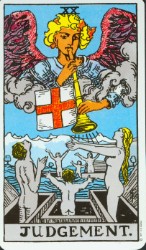
Judgment.

That is where the dead rise from their graves.

Suddenly, an extraordinary symbolic sequence becomes visible:

Death XIII → Moon XVIII → Sun XIX → Judgment XX

Death.

Passage through the unknown.

Return of the light.

Resurrection.

We cannot know whether Pamela Colman Smith consciously sat down and constructed that sequence. But we don’t need to know. The visual relationships are present in the cards themselves.

Death and Judgment

This also helps us understand why the Death card cannot be considered in isolation from Judgment.

The connection already exists within Christianity.

The Book of Revelation gives us Death riding his horse—and later gives us the resurrection of the dead and the Last Judgment.

The early Tarot’s scythe also contains an interesting implication. Death isn’t merely slaughtering people.

He is harvesting them.

And harvesting belongs to a cycle.

The crop grows. It is cut down. The field lies barren. Eventually new life appears.

Christian theology calls the eventual return of the dead resurrection, not reincarnation. They are very different doctrines.

Symbolically, however, both contain the same fundamental pattern:

Life → Death → Intermediate State → New Life

The Tarot journey appears to contain precisely that pattern.

The White Rose: Life Carried by Death

And this brings us back to Death’s strange banner.

Against the black background appears a white, five-petaled rose.

Waite explicitly tells us what it signifies. He calls it the “Mystic Rose” and says that it represents life.

Think about the paradox.

Death is carrying the symbol of Life.

The regenerative principle isn’t waiting somewhere beyond Death.

Death himself carries it.

There is also a beautiful visual echo elsewhere in the deck. The Fool carries a white rose as he begins his journey.

The Fool sets out carrying the rose.

Death carries the rose.

Bodies and identities disappear, but symbolically something essential continues.

The white rose may therefore give us the central message of the entire card:

The form dies. Life does not.

Death Is Only the First Third of the Picture

Perhaps the most remarkable thing about Smith’s Death card becomes apparent only after we stop staring at the skeleton.

Death occupies the foreground.

But the card continues far beyond him.

There is a river.

There is a crossing.

There is a mysterious intermediate landscape.

There is a gateway marked by two towers.

And beyond that gateway, the sun is rising.

Smith and Waite took an older image whose basic message was Death destroys everyone and expanded it into something much more complex.

Death became not simply an ending but the entrance to a process.

That is why describing XIII merely as the card of “transformation” doesn’t quite do it justice.

Transformation sounds almost painless.

Death is more radical.

Something has reached the end of its existing form. That form cannot accompany us farther. We must relinquish it before whatever comes next can emerge.

The card doesn’t promise that we will understand the passage while we’re traveling through it.

In fact, Smith seems to suggest exactly the opposite.

Between Death and the rising Sun lies the gray territory of uncertainty.

But the Sun is already rising.

What Death Means in a Tarot Reading

In a reading, Death usually indicates a genuine ending and an irreversible transition. Something has completed its natural life and cannot continue in its present form. This might be a relationship, job, belief, identity, habit, period of life or way of seeing ourselves.

The card’s advice is not simply “change.”

It is release.

Death says that we may temporarily enter a liminal period in which the old life is gone but the new one isn’t yet visible. That uncertainty is part of the process, not evidence that something has gone wrong.

The most important symbol may therefore be the smallest one on the horizon:

Beyond the ending, the Sun is already beginning to rise.

The Hanged Man Tarot Card: Finding Peace When You Can’t Move Forward

Explore The Hanged Man Tarot card as a symbol of suspension, powerlessness, reversed perspective and radical acceptance—and discover what it means when you cannot force life forward.

At first glance, The Hanged Man seems like a rather unpleasant Tarot card.

A man is hanging upside down by one foot. His hands are behind his back. He isn’t going anywhere, and there doesn’t appear to be anything he can do about it.

And yet there is something peculiar about him.

He doesn’t seem particularly bothered by the situation.

In the familiar Rider-Waite-Smith version, Arthur Edward Waite goes considerably further and gives the man a halo, transforming the image into something approaching spiritual illumination. But the essential image is much older than Waite’s deck. Earlier Tarot de Marseille versions already show the same strange figure hanging upside down with an unexpectedly composed expression.

So perhaps we don’t need the halo to understand him.

Instead, let’s look at what is actually happening to this man.

The Hanged Man Poster – 13 X 19 – Available on Etsy

What’s in the Card?

1. Suspension: Life Has Come to a Stop

The most obvious thing about The Hanged Man is that he is suspended.

He isn’t walking somewhere. He isn’t working on something. He isn’t fighting an enemy or pursuing a goal.

He’s literally going nowhere.

That’s very different from many of the other figures in the Major Arcana. The Charioteer is moving forward. The Hermit has deliberately withdrawn from the world. The Magician is actively manipulating the objects on his table.

The Hanged Man can do none of those things.

His normal activities have been interrupted.

We all encounter periods like this. A plan stalls. A relationship enters limbo. An illness interrupts our routines. We’re waiting for somebody else’s decision. Something we depended upon disappears. We simply don’t know what comes next.

Our natural response is usually:

“How do I get things moving again?”

But The Hanged Man raises a different possibility.

Perhaps, for the moment, we aren’t supposed to be moving.

Sometimes suspension is not an empty space between important events. The suspension itself is the experience.

2. Powerlessness: He Cannot Change His Circumstances

This brings us to the more uncomfortable aspect of the card.

The Hanged Man isn’t merely resting.

He’s powerless.

One foot is tied to the structure above him. His hands are behind his back. Whatever brought him into this situation, he cannot simply decide that he’s had enough, stand up and walk away.

That makes The Hanged Man a remarkably useful card for situations involving things outside our control.

We tend to associate personal power with the ability to change circumstances. If something is wrong, we fix it. If a door is closed, we find another door. If something isn’t working, we try harder.

Usually that’s excellent advice.

But sometimes there genuinely isn’t anything we can do.

And continuing to struggle against an unchangeable situation doesn’t necessarily give us more power. Sometimes it merely exhausts us.

The Hanged Man confronts us with one of life’s most difficult truths:

There are circumstances we cannot control.

The question then becomes not “How do I control this?” but:

“How am I going to live while this is true?”

Tarot and the Art of Alignment – Available on Amazon

3. Reversed Perspective: The World Looks Completely Different

Now something interesting happens.

Because the Hanged Man cannot go anywhere, his perspective changes instead.

Quite literally, his world has turned upside down.

The trees, the earth, the sky, other people—everything familiar is suddenly being seen from an unfamiliar angle.

Nothing necessarily changed in the outside world.

His position within it changed.

This may be the great gift hidden inside the card.

When our usual methods stop working, we may begin questioning assumptions we never previously thought to question.

What if success isn’t what I thought it was?

What if this relationship isn’t what I believed it was?

What if the thing I’ve been desperately pursuing isn’t actually what I need?

What if the situation I’ve been calling a disaster looks entirely different when viewed from another angle?

The Hanged Man doesn’t necessarily give us the answers.

He interrupts our habitual way of looking for them.

Sometimes we don’t acquire a new perspective because we’re wise enough to seek one.

Sometimes life turns us upside down until we have no choice.

4. Serenity: Acceptance Without Defeat

And finally we come to the strangest feature of the entire card.

The Hanged Man looks serene.

That’s remarkable.

If his face showed terror, the card would be about victimization.

If he were struggling against his restraints, it would be about imprisonment.

If he looked defeated, it would be about despair.

But he doesn’t.

Somehow, this man who cannot move, cannot escape and cannot control his circumstances has found peace within them.

That doesn’t necessarily mean he likes what has happened.

Acceptance isn’t approval.

Nor does acceptance mean that he will remain suspended forever.

It simply means that he has stopped fighting the reality of the present moment.

There is an enormous psychological difference between:

“This must not be happening.”

and:

“This is happening. What now?”

The first keeps us locked in combat with reality itself.

The second gives us somewhere to stand—even when, like The Hanged Man, we aren’t technically standing at all.

The Four Lessons of The Hanged Man

Taken together, the picture gives us four stages:

Suspension: My normal life has stopped.

Powerlessness: I cannot presently change this situation.

Reversed Perspective: Since I cannot change the situation, perhaps I can see it differently.

Serenity: I can stop fighting what I cannot presently change.

That’s considerably richer than simply defining The Hanged Man as “waiting” or “sacrifice.”

Sometimes the card may indeed indicate a sacrifice. Sometimes it may simply tell us to wait.

But at its deepest level, The Hanged Man seems to address one of the most difficult human experiences:

What do we do when there is nothing we can do?

His answer is extraordinary.

We stop.

We surrender the struggle—not necessarily forever, but for now.

We allow ourselves to see the situation from an entirely different perspective.

And perhaps we discover that peace does not always have to wait until the problem has been solved.

When The Hanged Man Appears in a Reading

When The Hanged Man appears, it may be useful to ask:

* Where has my life become suspended?

* What am I trying to control that I genuinely cannot control right now?

* What might this situation look like if I turned my assumptions upside down?

* What would acceptance look like if I stopped confusing acceptance with defeat?

The Hanged Man does not promise that someone is about to cut the rope.

He offers something stranger and perhaps more valuable:

the possibility of finding peace while we’re still hanging there.

Is Justice Really the Karma Card?

The Justice Card and an exploration of karma.

What if the Justice card isn’t really about getting what you deserve?

That familiar interpretation—“Justice means you’ll get what’s coming to you”—turns the card into a kind of cosmic courtroom. Somewhere in the universe, an invisible judge is apparently keeping score.

But there may be a much more interesting—and useful—way to understand Justice.

Karma Isn’t Cosmic Punishment

In popular Western culture, karma often gets reduced to cosmic revenge: do something bad and sooner or later the universe will smack you for it.

But karma is fundamentally about action and consequence. Actions create causes. Causes produce effects. Those effects create new circumstances from which further actions arise.

Seen this way, Justice becomes a remarkably good image of karma.

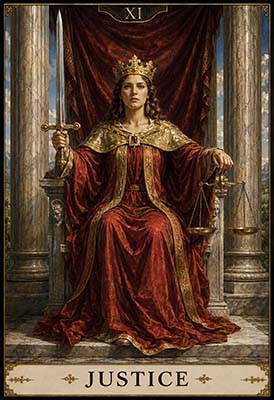
Justice poster – 13 X 19 – Available on Etsy

The Scales and the Sword

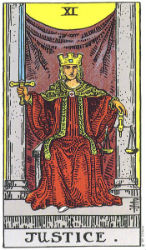
Look at the two objects Justice holds.

The scales represent cause and effect. Everything we think, choose and do enters the balance. Nothing happens entirely in isolation. Actions have consequences.

The sword represents those consequences becoming manifest. Eventually the abstract chain of causes produces an actual result.

The seed becomes the harvest.

And then notice Justice herself.

She isn’t angry. She isn’t pleased. She isn’t getting even.

She is impersonal.

Gravity doesn’t punish you for stepping off a roof. Fire doesn’t become angry because you put your hand into it. Cause and effect simply operate according to their nature.

That gives us a powerful metaphysical definition of the card:

Justice represents the law by which causes become consequences.

What Might Justice Mean in a Reading?

Suppose someone has spent years in a job they hate because they’re afraid to take a risk. Eventually they find themselves exhausted, resentful and wondering how their life became so small.

Justice doesn’t necessarily say, “You deserve this.”

Instead, it might say: Look at the chain of causes that brought you here.

Fear led to staying. Staying led to stagnation. Stagnation led to unhappiness.

That’s not punishment. It’s cause and effect.

And here’s the important part: the chain isn’t finished.

A different choice today creates a different cause—and potentially a different future.

Or imagine someone repeatedly entering relationships in which they ignore early warning signs. Justice appearing in a reading doesn’t have to mean that the universe has sentenced them to another disastrous relationship. It may be asking them to recognize the pattern itself.

What choice keeps setting the same sequence in motion?

Change that choice, and you begin changing what follows from it.

Justice Looks in Two Directions

This makes Justice both retrospective and prospective.

The scales look backward: What have I already set in motion?

The sword looks forward: What will follow from it?

And that gives the card considerably more agency than the old idea that Justice simply means “you’re going to get what you deserve.”

Justice isn’t necessarily announcing an unavoidable cosmic sentence.

It may be saying:

Look clearly at the causal chain. If you want a different consequence, this is where you change the cause.

And perhaps that is where Justice becomes not merely a card of karma, but a card of personal power.

Tarot and the Art of Alignment – Available on Amazon

The Wheel of Fortune: Why Does Luck Seem So Unfair?

The Wheel of Fortune and dealing with the archetype of luck.

Was the Good Luck Fairy taking a bathroom break on the day you were born?

When your ship came in, were you at the airport?

Did your four-leaf clover turn out to be poison ivy?

If you’re one of the many people who feel like you came into this world under a cloud of bad luck, then The Wheel of Fortune may have an important lesson to teach.

The Archetype of Luck

The Wheel of Fortune is the Tarot’s great symbol of luck.

Every culture throughout history has recognized the existence of fortune, fate, chance, or providence—even if no one has ever managed to define exactly what luck is.

What we do know is that it seems wildly uneven.

Some people appear to be born under a lucky star. Opportunities seem to fall into their laps. They meet the right people at the right time. Doors mysteriously open.

Others spend their lives feeling like every door they approach has a “Closed” sign hanging on it.

Most of us live somewhere in between.

Luck is a remarkable force when you stop and think about it.

A successful investor can lose everything in a market crash through no fault of their own. Someone who has struggled financially for decades buys a lottery ticket on a whim and wakes up wealthy.

When Lady Luck smiles on us, everything seems to flow.

When she decides to leave, it can feel like nothing goes right.

The Wheel of Fortune represents that mysterious current moving beneath the surface of our lives.

The Old Interpretation

The older Tarot decks presented a fairly blunt message.

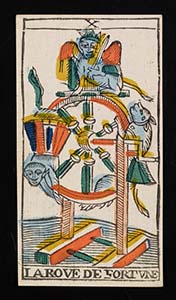
In the Tarot de Marseille, the wheel looks almost like a giant hamster wheel. Strange creatures ride its rim. One is climbing upward while another is tumbling down. At the top sits a stern ruler holding a sword, reminding us that fortune constantly changes.

The message is simple:

Up.

Down.

Up again.

Good luck.

Bad luck.

No one stays at the top forever, and no one remains at the bottom forever.

Waite’s New Interpretation

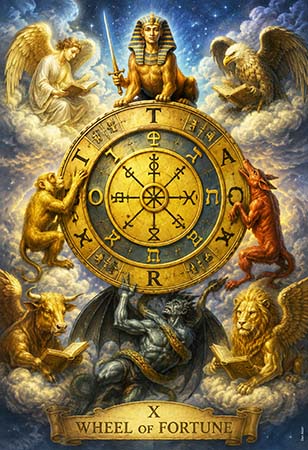
Wheel of Fortune Poster by Dan Adair – Available on Etsy

Arthur Edward Waite and Pamela Colman Smith transformed the image into something much more mysterious.

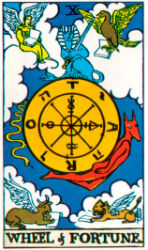
The crude wheel became a beautiful circular symbol filled with esoteric imagery. Around its rim are symbols drawn from alchemy, Hebrew mysticism, and ancient tradition. The dark figure that once ruled the wheel has been pushed to the bottom.

Now the highest point belongs to the Sphinx.

That change is significant.

The Sphinx represents wisdom, mystery, and understanding. Rather than brute force ruling our fate, wisdom now sits above the turning of fortune.

And then there are those wonderfully puzzling creatures in the four corners.

They’re the fixed signs of the zodiac—Taurus, Leo, Scorpio, and Aquarius.

For some reason…

…they’re all reading books.

It’s one of those delightful details that makes the Waite-Smith deck so fascinating.

So What Does It Mean?

The Victorian occultists didn’t deny the existence of luck.

Quite the opposite.

They believed that cycles of fortune were simply one of the natural laws of life.

Just as the tides rise and fall…

Just as the moon waxes and wanes…

Just as the seasons endlessly change…

Human beings move through cycles of prosperity and hardship.

The wheel turns.

It always has.

It always will.

The real question isn’t whether we can stop the wheel.

We can’t.

The question is whether we have to ride every revolution with it.

The four fixed signs may be offering an answer.

Unlike the creatures clinging to the wheel itself, they remain calm, steady, and detached. They aren’t fighting the motion below them. They’re quietly studying. Learning. Watching.

In other words, they’ve found a place that doesn’t move.

That’s the deeper lesson of the card.

We may not be able to control the cycles of fortune, but we can learn not to be controlled by them.

When life enters one of those stretches where everything seems to go wrong, we can remember:

This, too, shall pass.

Oddly enough, the more fiercely we struggle against a season of bad luck, the more we become entangled in it.

Acceptance isn’t surrender.

It’s stability.

The Wheel of Fortune reminds us that while the wheel keeps turning, we don’t always have to spin with it.

Perhaps that’s the greatest stroke of luck of all.

Tarot and the Art of Alignment – Available on Etsy as a Downloadable PDF

The Hermit and the Light No One Was Meant to See

Exploring the nature of solitude as exemplified in The Hermit card.

Why do we let our lights shine?

There’s an old country and western song that proclaims, “You can’t be a beacon if your light don’t shine.”

But suppose you don’t want to be a beacon? Should your light still shine?

The Hermit is one of the most interesting paradoxes of the Tarot.

We see an old man standing alone on a mountain peak, holding a lantern high above his head so that its light shines into the darkness.

Only…

There’s nobody there.

The number of people who are actually seeing his light appears to be exactly zero.

That tiny detail invites us to question one of the most common interpretations of the card.

Most Tarot books tell us that The Hermit has withdrawn from society, gained wisdom through solitude, and is now returning to share that wisdom with humanity.

It’s a beautiful story.

The problem is that the card itself never tells us that story.

There is no path leading back to civilization. There is no village waiting below. There are no followers gathering around him. The image simply shows a solitary man standing quietly on a mountain, holding up a lamp.

Perhaps another wanderer on a distant peak catches sight of it. Maybe a passing Yeti looked over and wondered, “I wonder what that old dude is up to?”

Perhaps no one sees it.

The picture doesn’t seem very concerned with the audience.

The Hermit – 13 X 19 inch poster by Dan Adair – Available on Etsy

The Hero’s Journey

The traditional interpretation may come from one of humanity’s oldest myths.

The hero enters the wilderness, gains wisdom, and returns transformed.

Jesus withdraws into the desert.

The Buddha leaves the palace before awakening beneath the Bodhi tree.

The knights search for the Holy Grail.

Frodo returns to the Shire.

We’re so accustomed to this pattern that we naturally assume The Hermit must be following it as well.

Surely no one would choose to live alone forever.

Surely solitude is only a temporary stage before returning to the world.

But is that really what we’re looking at?

The Nature of the Hermit

In an earlier post, I suggested that there are many expressions of the Hermit archetype.

Some people withdraw because life has wounded them. They need silence to heal. Eventually, they return.

Others retreat for a season to study, write, pray, or rediscover themselves.

But the true Hermit is something different.

Solitude isn’t a strategy.

It isn’t therapy.

It isn’t preparation for the next chapter.

It is simply his nature.

He isn’t hiding from humanity.

He isn’t waiting for humanity.

He’s exactly where he belongs.

If he retreats only so that he can eventually come back and teach everyone else, then he isn’t really a Hermit at all. He’s simply taking a very long vacation.

The Hermit in the Tarot doesn’t appear to be preparing for a return.

He simply stands on his mountain with his lamp.

The Lamp

So why hold the lantern aloft?

If it isn’t meant to illuminate the world, what is it illuminating?

Perhaps the answer is beautifully simple.

The Hermit is illuminating himself.

That is the real purpose of his solitude.

Away from the endless noise of civilization, he can finally hear his own thoughts.

He can meditate.

He can write.

He can ask the deepest questions without someone else’s voice rushing in to answer them.

He is discovering who he really is.

John Muir captured that spirit perfectly when he wrote:

“I’d rather be in the mountains thinking about God than in church thinking about the mountains.”

The Hermit’s mountain is not an escape from life.

It is the place where life finally becomes quiet enough to hear.

The Gift of the Hermit

Ironically, people who truly become themselves often end up helping others without ever intending to.

Someone may see the light from that distant mountain and find hope.

Someone may read the Hermit’s journal centuries later.

Someone may simply be inspired by knowing that another human being lived authentically.

But that isn’t why the Hermit holds the lamp.

Helping others is a beautiful consequence.

It is not the purpose.

The purpose is to live honestly.

To know yourself.

To become the person you were created to be, even if no one is watching.

Perhaps that’s the greatest lesson of The Hermit.

Not every light is meant to attract a crowd.

Some lights exist simply because they are true.

Available on Etsy as a downloadable PDF book