The Most Powerful Card in the Tarot – Getting Downright Foolish

An explanation of why The Fool is the most powerful card in the Tarot.

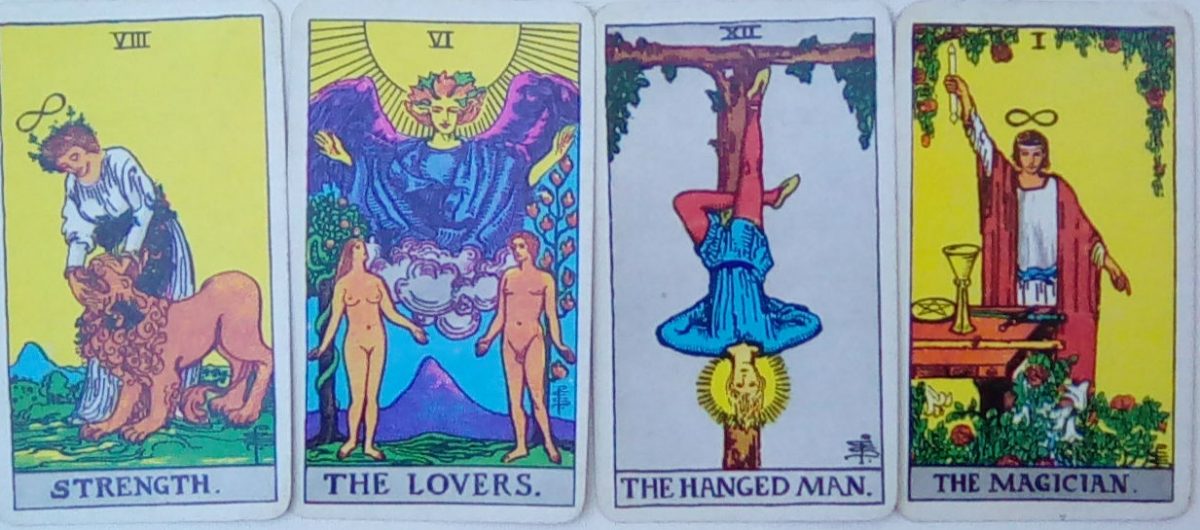
There’s an ongoing debate among Tarot aficionados about which card is THE strongest card in the deck.  The most prominent candidates are usually the first two cards of the Major Arcanum:  The Fool and The Magician.  I tend to lean toward The Fool, for reasons which I’ll explain, but the truth is that we need both of their energies in our personal and spiritual growth.  The Fool is pure potential, whereas The Magician is pure mastery.  Growth occurs when those two energies intersect.

LOOKING AT THE SYMBOLISM

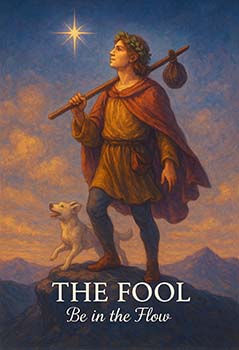
In The Fool, we see a young, ambisexual person dancing along at the edge of a cliff.  He lightly holds a rose in one hand, and his meager possessions are contained in a satchel hanging from a pole that he carries over his shoulder.  A small dog joyously cavorts at his feet, despite the fact that The Fool appears to be about to walk straight off of the cliff.

If we had to select a couple of words to describe the image, they would probably be, “happy,” and, “unfocused.”  The person in the card seems to not have a care in the world.  He’s to telling us to stop and smell the roses, to trust in the present moment. The message is that if he walks off of the cliff, he’ll just keep strolling along on thin air.

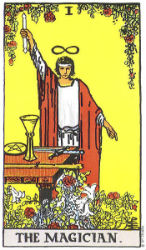
The Magician card, on the other hand, is an image of total concentration and focus.  He’s dressed in the formal robes of a ceremonial magician and looking very serious.  One hand, holding a wand with two points, is pointed toward the sky and the other is pointed at the ground.  His robe is belted with the ouroboros symbol of eternity, a snake eating it’s own tail, and that message is reinforced by the eternity symbol floating over his head.  The four symbols of earthly existence, the wand, pentacle, cup, and sword, lie on his altar.

“Just the Tarot” by Dan Adair – A complete set of definitions, layouts and instructions for reading Tarot cards.

The Magician is channeling the divine energy into the Earth Plane.  He’s using it to control the four elements and manifest his desires through the use of his will power.  If we had to select a couple of words to describe this image, they would be, “control,” and, “focus.”

THE MAGICIAN AS THE WESTERN PARADIGM OF POWER

The Magician is very much the Western paradigm of power.  We use phrases like, “He’s a take-charge sort of a guy,” or, “She’s always in control,” to describe this kind of power, and we tend to admire it.

The Magician is the type of a person who is very conscious of what she wants to accomplish, has a detailed plan for doing it, has the necessary skills to make it happen, and works the plan until she reaches her goals.

This is the type of linear, step-by-step thinking that Westerners have traditionally employed, and it can be very effective.  

It’s also very much an ego-based sort of a power.  It’s saying, “This is what I want and I’m going to use all of my abilities and will to make it manifest.”

THE FOOL AS THE EASTERN PARADIGM OF POWER

The Fool’s energy is much more in keeping with the Eastern paradigm of power.  It has more to do with aligning ourselves with a deeper, universal  power, rather than trying to run the whole show with our egos.

There’s a basic trust implicit in The Fool.  It’s a trust that, as the Desiderata put it, “whether or not it is clear to you, no doubt the universe is unfolding as it should.”  The idea is that there IS an underlying force in the Universe and that it’s a loving, compassionate force.  When we’re in alignment with that force, then we’re in The Flow, or the Tao, and our lives are much easier and happier because of it.  And, paradoxically, the more that we try to control that Flow, as the Magician does, the less in alignment we are and the harder life becomes.

VISUALIZING AND MANIFESTATION

We can see this sort of tension between The Magician energy and The Fool energy when we begin to delve into visualization and manifestation.  

Most of the books and seminars on the subject run pretty close to The Magician model of power. (A) We figure out what we want (the usual example being a million dollars.)  (B) We concentrate all of our will power on that goal by visualizing it, writing affirmations, and making vision boards.  (C) We cause that goal to manifest in our lives through repetition and the sheer power of our wills.  The Magician model is also very one-pointed and specific, as in, “I want a million bucks by September the first and I want it to be in unmarked hundred dollar bills.”

Of course, that frequently doesn’t work, as evidenced by the fact that most of us aren’t millionaires.  This is the point where many teachers will bring in the concept of The Fool energy.  The idea here is to relax, stay in the present moment, and quit telling the Universe how it’s supposed to behave.  Instead of setting a specific goal, right down to every detail, we set a general goal, but let the Universe work out the details.

Mike Dooley, in particular, works with this concept in many of his books like, “Manifesting Change.”  He refers to our trying to control all of the details (Magician energy) as, “the cursed hows.”  In other words, “I want a million bucks, Universe, and this is exactly HOW I want you to manifest it.”  The point that he’s making is that we may think we’re opening one door to financial abundance, but in reality we’re slamming shut a thousand other doors.  The Universe is infinite and it has an infinite number of ways of delivering what we want to manifest, unless we get too specific about how we want it done.

So, we bring in Fool energy.  We use a general statement like, “I’d like to manifest happiness and abundance in my life, Universe, and I’m sure you can work out the details.  After all, you make stars and solar systems, so this shouldn’t be much of a challenge for you.” And then we butt out and let it happen, while we stay happy and in the present moment.

CONSCIOUS AND SUBCONSCIOUS MINDS

The Kybalion – a discussion of Hermetic magic – talks about this dance between Magician energy and Fool energy in terms of the conscious and subconscious minds.

Our conscious mind is our everyday mind, which is the mind that we mostly identify with.  It’s ego based, logical, and linear and it’s very clever at performing mundane tasks.  It’s the mind that balances our budgets, pays the rent, buys groceries, and gets the kids to school on time.  We could call it Magician energy but it’s really just a tiny part of our larger mind.

The subconscious mind, on the other hand, comprises the majority of our minds.  Unlike the conscious mind, it never needs to sleep and it’s working 24/7, processing information, calculating what the future may look like and telling us when something’s wrong.

The most important thing about the subconscious mind, though, is that it’s our connection to the super-conscious mind, AKA the Universe.  Though that connection, it has almost infinite power to manifest anything that we truly desire.  That’s Fool energy.

Those two minds – conscious and subconscious – need to work together.  Although the subconscious mind is infinitely powerful, it just drifts without direction from the conscious mind.  Even worse, it can construct our reality based on the crap that flows through the internet, our televisions, our cultures and our religions, which may have very little to do with what we really want to manifest.

So we need to use that Magician energy – the conscious mind – to sort through our options and figure out where we want to actually go with our lives.  Do I want to be rich?  Do I want to be an artist?  Do I want more love in my life?  Once we determine what our overall goals and desires are, then we say, “Hey, subconscious mind/Universe – this is what I’d like to see happen.  Please get to work on that.”

THE FOOL DOES THE HEAVY LIFTING

Here’s the most important thing about all of that:  The Fool does the heavy lifting.  The SOLE PURPOSE of the conscious mind is to figure out where we want to go and turn it over to the subconscious mind/Universe.  

The conscious mind has a terrible time accepting that notion, because it’s ego based.  It wants to control every little detail of the manifestation process, and so it keeps snatching it back from the Universe and imposing more and more cursed hows on the process.  Every single time that we do that, we’re slamming doors shut instead of letting the subconscious mind open more doors.

And so, yes, in my opinion there can be no doubt that the most powerful card in the Tarot deck is The Fool.  It’s the primal energy that makes good things manifest in our lives.  The Magician can guide that energy but, by itself, it’s nothing but a control freak in a red robe.

Animal Companions, Heart Chakras, and Learning to Love

Our pets abilities to heal our Souls.

“I’ve known several Zen Masters and they were all cats.” – Eckhart Tolle

The image in The Fool tarot card shows a person dancing with joy at the edge of a cliff.  It’s meant to portray a Soul that’s so fully in the Flow that, even if she were to dance off of the cliff into thin air, she wouldn’t fall.  It’s a beautiful card, but we seldom take much note of the little dog that dances right along with The Fool.

In her book, “Animal Soul Contracts: Sacred Agreements for Shared Evolution”, Tammy Billups addresses the idea that animals come into our lives for specific reasons and they’re often instrumental in helping us to recover and evolve.  As she puts it, we have a Soul Contract with our animals.  We heal them and they heal us.

She tells the story of a man who was living alone when a stray dog suddenly showed up on his doorstep.  He took the dog in and they formed a strong, loving bond. The one problem was that the dog developed terrible separation anxiety and suffered greatly whenever his new owner had to leave the house.

He finally contacted Ms. Billups in the hope that she could work with the dog and help it to feel more secure.  In the course of treating the dog, though, the man had a sudden epiphany:  every relationship he’d ever had ended up with his lover walking away from him.  He had severe abandonment issues of his own and so he’d attracted an abandoned dog.  He started therapy and, as he learned to deal with his own fears of abandonment, the dog healed from its separation anxieties.

She posits that animals – and particularly that class of animals that we refer to as our, “pets,” – have a very deep and ancient Soul connection with human beings.  They not only mirror who we are, as the dog did with the young man, but they also point us toward a better way of existing in the world.

One thing that they provide to us abundantly is pure, unconditional love.  Getting that kind of love as an infant is vital to the development of a healthy, well adjusted human being.  Sadly, though, we have a lot of people in our world who were beaten more than they were hugged as children.  We emerge as adults who are convinced that (a) we can’t be loved; (b) somehow it’s our fault, rather than the fault of our crazy parents; and (c) it’s never safe to reach out to other people for love.

And then a puppy or a kitten shows up in our lives and loves us unconditionally.  The dog or the cat doesn’t give a flip about how smart we are or how we dress or how much money we have or any of the other parameters we may find in human relationships.  They just love us, totally and unconditionally, for who we are.  And, yeah, we learn that lesson on a deep Soul level:  it’s safe to love and to receive love.  They fill that hole in our hearts that’s been there since we were babies.

Another example that Ms. Billups gives is that highly empathetic people (and particularly empaths) will tend to attract highly empathetic animals.  We run into that sometimes with an animal that literally seems to be peering straight into our Souls when it looks at us.  There’s a sort of a tickle in our energy systems and a voice that says, “This dog somehow understands exactly who I am and what I’m feeling.”

The common bond is that both animals and empathetic people are primarily, “feelers,” rather than just thinkers.  We exist on that energy level of emotions and almost instantly perceive the hidden vibrations in another being.  And the, “training,” that we receive from that kind of an animal is to learn to keep our own vibrations as loving and kind as possible because they’re feeling them just as much as we are.

Which brings me to the part of Ms. Billups discussion that really blew me away, which is emotional support animals.

We’ve seen a fairly substantial increase in the presence of emotional support animals as a result of the wars in Iraq and Afghanistan.  Many of the troops were returning home with severe PTSD and social anxiety.  Psychologists found that pairing them with animals – usually dogs – helped to soothe their nervous systems and allowed them to interact more peacefully in social settings.

It makes sense, even on a superficial level.  If we’re feeling extreme anxiety, the presence of a calm, loving animal would obviously settle us down.  Ms. Billups takes that a step further, though.

She says that some animals, especially emotional support animals, are able to hold what she calls a, “transformational healing presence.”  In other words, it isn’t just their presence as a trusted companion that’s calming down the person’s nervous system.  Rather, these are animals that are SO evolved that they’re able radiate calmness, serenity and love out of their very core.

We can actually see that with our own eyes.  The next time that you encounter someone with a support dog in a store, stop and look at the people around you.  Most of them will suddenly slow down, smile, and begin to radiate calmness of their own.  It isn’t just because they think the dog is cute, either.  Rather, they’re walking into that energy field of a healing presence that the dog is holding and it transforms them.

There’s a lesson in there for humans, as well.  It takes work – sometimes a lot of work – but we can become that same sort of a transformational healing presence in the world.  Through therapy, affirmations, meditation, and working with our heart chakras, we can nurture a core energy that’s calm, loving, and compassionate.

We don’t need to develop a philosophy or a method around that.  We don’t need to become gurus or convince anyone that they should behave in this way or that way.  All that we need to do is to build the love in our hearts and radiate it out into the world.

One of the neat things about that is, like the support dog in the store, we can step out of all of that judgment about who’s going to receive the love.  The dog isn’t standing there thinking, “Oh, that one’s a Republican – no love for him.”  Or, “Uh, oh, it’s a liberal, shut down the love.”  It’s there for anyone who wants to receive it, no questions asked.  And if someone doesn’t want to receive it, the dog doesn’t get upset or neurotic about it – she just keeps shining that light.

So I’m going to start paying a lot more attention to the animals in my life and begin actively looking for the messages that they’re bringing me.  Perhaps I’ll put my cat in my lap the next time I meditate and see if she has anything she’d like to add.  I’m guessing she does.

The Fool, Flowing into Fun, and Making Wu Wei Our Woo Hoo

A look at Flow State as a spiritual practice.

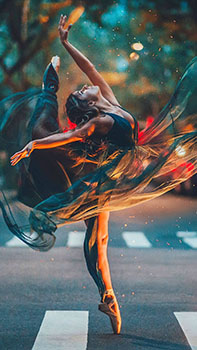
Most people know about being, “in the Flow,” also known as being, “in the Zone.”  It’s that feeling of engaging in an activity with such concentration and perfection that it’s as if we somehow become the activity and the activity becomes us.

Dancers and athletes talk about being in the Flow when they turn in a performance that’s absolutely flawless and they somehow go far beyond what they’ve ever been able to do before.  Artists and writers have the same sort of an experience when they plunge so deeply into their work that it’s almost as if the painting is painting itself, or the page is filling itself with beautiful images.

One of the fascinating things about Flow state is that the world seems to disappear for a while.  There’s nothing in our consciousness except the activity that we’re engaging in.  It’s like a trance. Painters will frequently start a painting and then, “wake up,” six hours later, having lost all track of time, their environment, and anything else but the surface of the canvas.

Oddly, we see very much the same phenomenon with people who are plagued by ADHD.  They may spend most of their lives jumping from one activity to another, unable to focus or stay on task for more than a few minutes.  When we take those same people, though, and sit them down in front of a video game, it’s a very different story.  They go into a state of hyper-focus and will frequently become so immersed in the game, so ultra-concentrated, that they may not leave it for hours.  They’re in a trance and the world has disappeared.  They’re in the Flow.

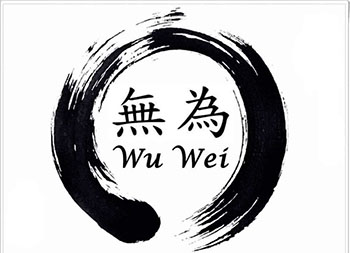
Hungarian psychologist Mihal Csikszentmihalyi first noted the Flow state in 1975, but Taoism pegged it centuries ago and calls it, “Wu Wei.”  Wu Wei can be translated as, “inaction,” or, “doing nothing,”  but a closer definition is, “effortless action.” Which is exactly how we feel when we’re in the Flow.  We feel that we’re completely in synch, in the groove, in harmony with whatever activity we’re engaged in and it becomes totally effortless.

Now, a lot of Westerners have had trouble with the idea of Wu Wei, because they glom onto the idea of just doing nothing, rather than doing something effortlessly. As lovely as it can be, sitting on a beach dangling our toes in the water is NOT Wu Wei.  

We are in the Flow state when we are involved in an activity for which we have some skill.  When we’re doing something completely. Somehow in that process our ego disappears, our environment disappears, and our sense of time disappears, which is pretty much the definition of a transcendent spiritual experience.

To put it another way, we’re co-creating with the Universe.

Mike Dooley hints at that process when he’s talking about the art of visualizing and manifestation.  He says that the Universe acts as a sort of a GPS system that guides us to our goals, constantly popping up directions and resources to get us where we want to go.  BUT . . . we have to actually start the car before the GPS system starts to work.  We have to get our asses in gear and move before the Flow state happens.

The closest that the Tarot gets to portraying that state is The Fool.  The Fool is dancing along at the edge of a cliff, so absorbed in his joy that he really doesn’t even see the precipice.  The message of the card is that even if he dances off of the edge he’ll just go on dancing on air.  He’s in the Flow.

The neat thing about all of this is that, when we look at being in the Flow AS an act of co-creating with the Universe, then it becomes a spiritual practice.  It becomes a way of communing with our higher powers or spirit guides or angels or whatever we want to call them.

All we have to do is to figure out what gets us into that state of Flow and DO IT.  It can be almost anything.  It can be painting or writing or dancing or gardening or cooking or having incredible, mind-blowing sex.  It’s just a matter of thinking about what activities come the closest to putting us into that trance state.  What is it that, when we do it, the world disappears for a while, time stops, and we completely forget our egos?

Once we identify the activity – and we all have at least one – then we build it into our lives more and more.  Every time that we engage in our particular Flow activity, we form a stronger and stronger bond with our higher powers and our higher selves.

And it’s fun.  It’s lots and lots of fun.

The Fool, Double Dorjes, and Saying Yippee to the Universe

A look at the underlying, happy energy of the Universe.

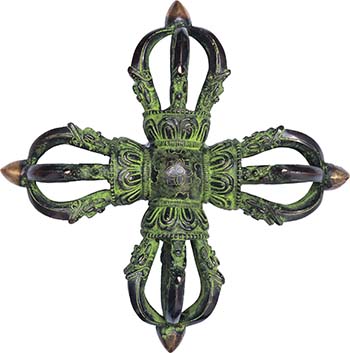
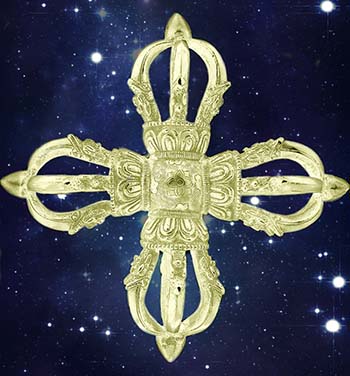
I’ve been playing around with making altar cards to sell on my Etsy shop (synergyfolkart.etsy.com) and trying to put together a line of them for Buddhists.   The other day I was looking at a picture of a double dorje – a very powerful symbol in Vajrayana Buddhism –  and I thought, “I wonder if I could make that gold, instead of bronze?”

Lo and behold, after several hours of research, clicking, layering, re-layering, and praying to the mighty goddess of Adobe Photoshop, I went from this:

to this:

Now, it hasn’t been that long since I had sex with someone – probably not more than 5 or 6 hundred years – but completing this transformation was very much like that feeling.  When I saw the final image there was a huge, internal, “YIPPEE!,” from my Inner Child and I got up and danced around my studio.  (And, yes, when I used to Get Lucky I would frequently shout, “YIPPEE!” and dance around the bedroom.)

There are probably about 30 million 10 year olds who are far more adept at Adobe Photoshop than I’ll ever be,  and I only get a few bucks for each card, so there was nothing earthshaking about this. But that’s not the point.

The point is that the Universe is doing something . . . somehow . . . for some reason. 

I don’t think I can put it any more clearly than that.

Scientists tell us that about 13 billion years ago there was a tiny dot of super-concentrated energy in the center of the Universe.  Well . . . it wasn’t the center of the Universe because there wasn’t any Universe, yet, but just for the sake of argument, pretend there was a Universe and there was this dot in the middle of it.  And then – KABLAMMM!!!!!!!!! – the tiny dot of energy suddenly exploded for no particular reason and started expanding outwards into . . . you know . . . nothing. 

The energy carried with it all of the . . . um . . . stuff . . . that would later form into solar systems and suns and planets and moons and Donald Trump’s hair.

That’s what they call the Big Bang Theory.

AND . . . according to the scientists, the Universe is STILL expanding.

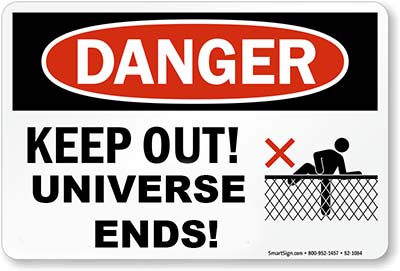
I’ve always had a little trouble with that part because I’ve never been able to figure out exactly what it’s expanding INTO.   I mean, if the Universe is everything and it’s expanding, then there must be a whole lot of nothing out there somewhere for it to expand into and I wonder if there’s some sort of a fence between the Universe and the Nothing.

But I digress.

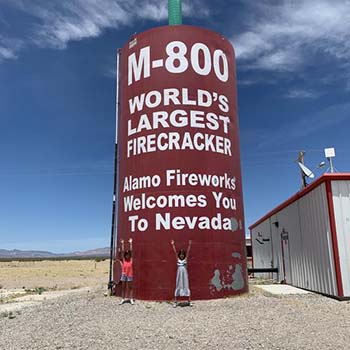
Modern science has pronounced that the Big Bang was sort of an incredibly powerful firecracker that blew up and scattered detritus all across the Universe.  And they’re very proud of that pronouncement because they feel it gets rid of all of the superstitious nonsense like gods and goddesses and creation myths and fables.  But just saying that there was a giant cherry bomb in the middle of the Universe before there was a Universe and it somehow blew up and somehow made the Universe, doesn’t really explain anything.  There are still those questions like, “Who made the cherry bomb?” And, “Who lit the fuse?”  And, “What’s the point?”

For centuries, Sages, Mystics, Philosophers and other people with far too much spare time on their hands have tried to figure out exactly what that primal energy that exploded outward from the Big Bang is composed of.  Is it alive?  Is it conscious?  Is it thinking?  Is it feeling?  Is it in a bad mood or does it have a sense of humor?

There are a few religions and philosophies out there – like Taoism and Vedanta – that assert that the primal energy is very much alive and conscious.  And, although our egos tend to make us forget it, we ARE that energy.  In many ways, we may actually be the spear tip of that energy because we’re one of the few species we know of who have evolved into thinking, self-reflective, beings.

It makes sense, then, that we feel at our best when we’re in alignment with that energy.  And we feel at our best when we’re loving, creative, and playful, much like the energy of The Fool, dancing along with his little doggie.

It’s not a HUGE leap, then, to extrapolate that the basic, primal energy of the Universe is loving, creative, and playful.  When we’re laughing, having great sex, or making Golden Double Dorjes. To me, at least, that’s a lot more logical than thinking that we’re the left over wrappings of some giant firecracker.

Yippee!!!!

My ebook, “Just the Tarot,” is now available for free for anyone who has a Kindle Unlimited membership. For those of you who don’t, it’s still DIRT CHEAP!

How to Lighten the Fuck Up by Fooling Around with Magic

A Quick Look at the Playful Nature of Magic.

Magic.  

What is it, anyway?  We talk about magic a fair amount.  We say that something, “felt really magical,”  or we, “feel a lot of magic,” when we’re with another person,”  or a solution to a problem appeared, “just like magic.”  But what, exactly, is it?  Is it just a feeling, or is it a real thing that exists in the world independent of our feelings?

In The Magician card, we see a person channeling magical energy from, “above,” into the material plane.  He’s using his concentration, his will power, and his skills to pull that energy into what he wants to manifest.

Which, of course, is a major clue.  Magic is an energy, just like light, sound, radio waves, or solar flares.  What’s more, it is it’s own energy, meaning that it’s distinct from other energies.

We tend to get it mixed up with other energies, because it appears coincident with them.  When we’re madly in love with someone, it feels magical, and so we tend to mix magical energy up with being in love.  When we’re joyous, it feels magical, and so we tend to mix magic up with great happiness.  But magic is it’s own energy that appears with joy and love, but isn’t just joy and love.

We can see an analog of this with emotions and brain chemicals.  When we have a lot of serotonin in our bodies, we feel happier.  When we have a lot of cortisol and adrenaline in our bodies, we feel more stressed and anxious.  But . . . happiness causes serotonin to appear and serotonin causes happiness to appear, so it’s a definite, “which came first, the chicken or the egg?” situation.  They’re not equivalent – they just appear at the same time.

Reductionists would have us believe that serotonin = happiness, but it’s not true.  Antidepressants, which increase serotonin levels, can be a very effective band aid for depression, but they pretty much have to go along with good therapy to deal with the underlying problems.  If we don’t build in the therapy, the happiness goes away when we stop taking the antidepressants because – guess what? – the things that were making us unhappy are still there.

In very much the same way, magic appears in our lives coincident with love and and joy, but the love and joy don’t cause the magic.  Nor does the magic cause the love and joy.  They just appear at the same time.

There are some other clues we can find that point to what magic actually is.  Two major markers that appear in our lives when we’ve got magical energy flowing through us are synchronicity and serendipity.  Synchronicity and serendipity are really just short hand for, “life is easy.”  Solutions to our problems appear out of nowhere.  People, places and things that feel like gifts from the universe manifest with no effort at all.  

And, “life is easy,” is really just short hand for, “life is light.  Life is playful. Life is fun.”

Which are some more major clues about what magical energy really is.  In the same way that magic tends to appear when we’re joyous or in love, magic tends to appear when we’re happy and playful.  It’s almost as if the universe is saying, “You know, you really need to lighten the fuck up if you want me to play with you.  I get that you’re all sad and dour, but it’s a drag and I can find someone else to hang out with.”

So magic is an energy that tends to appear in our lives when we’re loving, joyous, happy and playful.  It doesn’t cause them and they don’t cause magic, but they definitely appear at the same time.

Which brings us to another card, The Fool.

The Fool is FULL of magic.  He’s dancing along at the edge of a cliff and he really doesn’t give a fuck about the danger because he’ll just float right off into the air and keep dancing.  His little dog is picking up on his joy and dancing right along with him, in just the way that dogs always will.

Now, the interesting thing about The Fool is that he’s the Zero card in the Tarot deck.  Every other card has a number, but The Fool is Zero.  Which means that he doesn’t belong anywhere and he belongs everywhere.  We can literally take any card in the Tarot deck, drop The Fool on top of it and things will start to get better.  Even extremely bad cards like Death and The Tower start to improve the second that we bring in magical energy.  

There are people in the world who will tell us that life is insane, tragic, and brutal and that there’s very little to be optimistic about.  And, when we look at the daily news, it can be hard to argue with that view.  Believing in love, joy, playfulness, happiness and lightness can seem downright . . . Foolish.   

But that’s the point.  No matter how bad the situation may be, if we start to drop The Fool on it, if we start to increase the magic in our lives, it will get better.  

Magic brings love, joy, happiness, playfulness, easiness, and lightness with it.

Yes, please.  I’ll have some of that.

My e-book, Just the Tarot, is still available on Amazon at a price that’s SO reasonable that it would be downright Foolish not to buy a copy.

The Fool, The Magician, and Laughing With the Angels.

Playfulness as a major force in the universe.

I was watching a Sonia Choquette video recently that was about getting in touch with our spirit guides and angels.  She made the point that the first step in that is to get in touch with our own spirits, because spirit talks to spirit.  And she also said that sometimes our spirits are NOT hanging out in our bodies.  The basic idea is that, if we are constantly depressed, angry, and fearful, then our spirits don’t really WANT to be in our bodies because our bodies are so toxic.  Who wants to hang out in a room full of anger and sadness?  Who wants to hang out in a body full of anger and sadness?

Huh . . .

The cure for that is – surprise – to be happy.  Laugh, play, be light.  Make our bodies and minds into places where our spirits want to be.

It started me thinking about two Tarot cards, The Fool and The Magician.  Not the cards from the Waite Tarot deck, which was designed in the early 20th century, but the original, older portrayals from the 14th and 15th centuries.   The portrayals in the Waite deck are stunningly beautiful, but, in some ways, are not at all consistent with the original meanings of the cards.

Here, for instance, we have the Waite version of The Fool.  He/she is a beautiful, elegant, sexually indeterminate youth who is dancing along the edge of a chasm while a little dog dances beside him.  The basic meaning of the card is someone who is so high on cosmic energy, so in tune with universal energies that if he dances off of the cliff, he’ll just keep on dancing on thin air.

Now compare that to The Fool from the old Marseille Tarot deck.  This Fool is kind of a scruffy looking dude wearing the actual clothing of a Fool from the medieval royal courts.  The dog has torn a hole in his britches and he’s not even watching where he’s going.  He’s wearing a funny hat and he has jingle bells hanging off his cloak.

Not exactly elegant, is he?

But he does remind us of the original Fool who would entertain the royal courts.  He had a very, very special status in those courts because he was the only one who was actually allowed to laugh at and make fun of the King.  He was considered sort of a mad idiot, someone who had either been cursed or blessed by the gods with a somewhat insane, totally irreverent sense of humor.  His purpose was to mock the pompous and remind the all-too-serious that life can be seen as a joke.

The same point of view was taken of what we remember in our language as, “the village idiot.”  We might think of him as someone who was perhaps mentally deficient or brain damaged.  To the villagers, however, he was seen as someone who had been touched by the finger of god, someone who was viewed as a blessing to the village and so should be fed and cared for, for free.  He was a treasure in large part because he made people laugh and get in touch with their love.

Again, look at The Magician from the Waite deck.  Once more, we see a thoroughly elegant, physically beautiful individual who is very much in charge of his magic.  This is a master of the occult, a Wise Being who channels magic from the astral realm into the physical plane.  

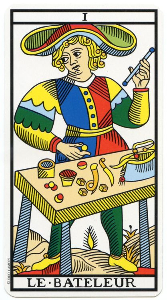
Contrast that with The Magician from the older decks.  This Magician looks a little clumsy.  He, too, is dressed in Fools clothing and isn’t paying attention to what he’s doing.  Displayed on the table before him is a cup and dice and coins, and other random items.  Far from being the magical symbols that we see in the Waite Magician card, these look like things he might have dug out of his pockets and we almost wonder if there might be a few balls of lint scattered in there.

The older Magician was not a master occultist.  The older magician was a street entertainer, much like the stage magicians that we see today.  He might not be sawing women in half or disappearing into a magical box, but he could still put on a hell of a show.  He could make the dice do what he wanted them to do and he probably wasn’t above taking a few pennies from people who couldn’t guess which cup the pea was under.

He was a flim-flam man.  An illusionist.  Someone who knew how to shuffle a deck of cards and astonish us by picking out the Ace of Spades every single time.

He was fun.

That’s what’s missing in the newer, Waite deck portrayals of these two cards.  The sense of fun.  The sense of goofiness.  The sense that life really isn’t supposed to be taken all that seriously and a lot of it is just plain silly. 

Here’s a radical proposition:  what if angels like to play?  What if angels actually have a rip roaring, hilarious sense of humor?  What if that’s the vibration that they actually exist on:  laughter and play?  So then think of the Western approach to prayer.  You know how we get all serious and somber and . . . church like . . . when we pray?  Prayer, after all, is a VERY SERIOUS business.  We all know that, because we’ve been in churches and people weren’t doing a hell of a lot of laughing.

But suppose . . . just suppose . . . that everytime we get all serious and somber, we automatically tune out our angels and guides?  Just like changing to a channel that they’re not broadcasting on.  They’re still there.  They’re still wanting to help us.  But we just tuned them out by completely losing our sense of humor.

It could be that laughter and play are underlying forces in the universe and when we’re playing, we’re in harmony with our true nature and our Higher Selves.  Think of little kids and puppies and kittens.  These are beings who have JUST transported in from the other side and what do they do all day?  They play.  They play and play and play until they fall over exhausted and then, when they wake up, they play some more.

Wouldn’t it be ironic if, by being SO serious about our spirituality, we were turning our backs on our spirituality?  Maybe we need to set up some playgrounds in our churches.  Maybe we need to find some pastors and priests and rabbis and mullahs who can tell a good joke.

Maybe we need to lighten the fuck up.

Laughter lights us up inside, sometimes like a warm, glowing candle and sometimes like fireworks, but it always brings light and lightness.  Laugh and get en-lightened.  Works for me.

Just the Tarot by Dan Adair, a kindle ebook available on Amazon

The Fool, Wu Wei, and Touching Your Woo Hoo

Exploring the concept of Wu Wei and the work ethic of drifting.

We all know how to be a success in life, right?  We set our alarms so that we can get up before the sun rises and we work our asses off all day.  We do twice as much as everyone else, put in lots of overtime, and keep working right up until we go to bed.  And some of us actually keep working in our dreams, mulling over the day while we sleep, running through scenarios for when we go back to work tomorrow.  We even have lots of inspirational sayings to reinforce our work-a-holic thinking.

“The early bird catches the worm.”

“Genius is one percent inspiration and ninety-nine percent perspiration.”

“Stay positive, work hard, and make it happen.”

Yay!  Let’s get out there and WORK!

But what if all of that is wrong?  In fact, what if most of it is bullshit?

The Taoists have an interesting concept called Wu Wei, which can be loosely translated as, “doing nothing,” and they say that it’s a major key to success.  A more accurate translation might be, “purposeful inaction,” and the basic idea is that the harder we work, the behinder we get. Taoists love to use rivers and lakes and water in general as metaphors, so we can do that to explain Wu Wei.

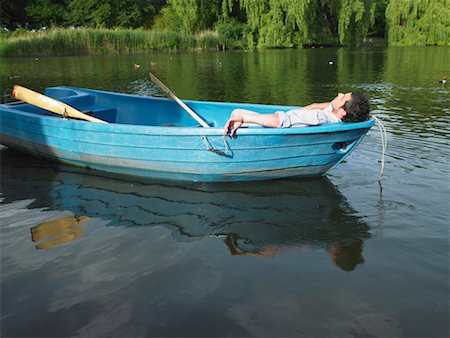
Suppose that you’re floating down a beautiful, green river in your little Rowboat of Life.  There’s a gentle current that’s carrying you along nicely and you’re making good forward progress.  It’s so quiet and peaceful and you can feel the sun warming your face and body.  Perhaps you let one hand trail behind you in the crystal clear water and for just a moment it feels like everything is absolutely perfect.  

BUT . . . you suddenly decide that you want to go faster, because faster must be better, so you grab your oars and you row like hell until you’re exhausted.  And you really haven’t gotten much further down the river.  All you’ve accomplished is to wear yourself out when you could have been just drifting along, enjoying the ride.

But WAIT!  You remind yourself that drifting is wrong!  Drifting is bad!  We need to be GOAL ORIENTED and MOVING FORWARD with MAXIMUM ENERGY AND MOTIVATION at all times.  By now, you know that rowing forward didn’t accomplish much, so you start paddling your Rowboat of Life from one side of the river to the other, just to be doing SOMETHING.  After all, you’re the Captain of your Rowboat!  YOU determine where you’re going and YOU’RE in charge of your destiny!  

 Eventually you realize that you’re making even less forward progress and after a while you get discouraged and put your paddles back in the boat.  You drift along thinking about it and beating yourself up for not making more effort.  Maybe a dragonfly lands on your nose while you’re cogitating.  “Am I lazy?” you ask the dragonfly.  “Do I just not have what it takes to be a winner?”

As you work it all out in your head, you realize that WINNERS KEEP GOING, no matter what the odds are against them.  Real winners are willing to work as hard as they can and then DIG DEEP to find that last reserve of energy to carry them across the finish line!  The harder you work, the more it proves that you’ve GOT WHAT IT TAKES, by god!

So just to prove how hard you work and how inspired you are, you turn your Rowboat of Life around and start paddling AGAINST the current.  You struggle and you strain and at a certain point you have a massive coronary and die, but at least you died a winner, right?

The whole point of this, of course, is that there are underlying currents of energy in the Universe.  They actually help us get to our goals if we just surrender to them and go with the flow.  Life isn’t an enemy.  Life isn’t something we have to fight.  Nature isn’t something we’re supposed to conquer.  We are meant to float as gently on the currents of life as a blossom drifting down a broad, quiet river.

Most of the New Thought writers and speakers have this concept as a central pillar of their philosophy.  In Choose Them Wisely: Thoughts Become Things! Mike Dooley talks about visualizing your goal in general terms and then moving toward it.  BUT he emphasizes very strongly that we don’t need to sweat the details about how we’re going to get there.  The Universe will provide the means and the ways and the paths once we get in harmony with the flow.

Louise Hay, in You Can Heal Your Life writes, “I believe in a power far greater than I am that flows through me every moment of every day . . . Out of this One Intelligence comes all the answers, all the solutions, all the healings, all the new creations.”

In Ask and It Is Given: Learning to Manifest Your Desires Esther Hicks/Abraham, says, “Well-Being is the basis of the Universe.  Well-Being is the basis of All-That-Is.  It flows to you and through you.  You have only to allow it.  Like the air you breathe, you have only to open, relax, and draw it into your being.”

In other words, there is a current of energy, of love, that underlies the entire Universe and our, “job,” our only true, “work,” is to align ourselves with that energy current and drift along on it, knowing that it will take us where we want to go.

The Fool Tarot card is the perfect illustration of this.  She dances along on the edge of a cliff, filled with the energy of love, totally unconcerned about where she’s going or how.  She’s in the flow.  She’s dancing with the energy and if she walks off of the cliff, she’ll just walk on air.

So . . . how do we get to the Flow and how do we know when we’re out of it?  How do we know when we’re paddling up the river, instead of riding the current?

According to Esther Hicks/Abraham, we actually have a compass in our little Rowboat of Life.  It’s called emotions.  And we can check that compass anytime that we want to.  HOW DO YOU FEEL?  If you feel crappy, angry, sad, or resentful, you’re paddling upstream.  If you feel happy, joyous, free, and content, then you’re floating down the river with a dragonfly perched on your nose.  If you’re not feeling anything at all, if you’re emotionally flat and apathetic, then your Rowboat is stuck on a freaking sandbar.  So the key is to get up every morning and say, “Woo Hoo!  I’m alive and I love it!”

We all need to stay in touch with our Woo Hoos a lot more than we are.  We can do that.

Of course, all of this is totally un-American.  Hard work and a lot of sweat are the answers.  Anyone who says different is plain Fool-ish.

Disclaimer: “As an Amazon Associate I earn from qualifying purchases.”

The Fool, The Buddha, and the Corona Virus

Some Tarot interpretations say that the bag or satchel that dangles from the end of the pole on The Fool card is his karma. That he is a new born soul dancing into life and the memories of his experiences and actions – both good and bad – are carried with him into his next incarnation in that little bag.

And that’s a good question for all of us as we face this very profound experience of a world wide pandemic: What will we carry with us when it’s finally over?

Shit happens. We all know that. A lot of the time we experience life less as the Captains of our Fates and more as the silver ball in an old fashioned pin ball machine. We aren’t thinking, we aren’t planning, we aren’t really conscious of what’s happening to us or why. We just keep hitting and being hit by those paddles, bouncing around from one place to the next until a bright, neon sign lights up and says, “GAME OVER.”

And then we’re dead.

Did it make any sense? Did our journey through all of the joys and pains, the triumphs and shit sandwiches actually MEAN anything? Or was it just a random series of events that left us bruised and battered and ultimately puzzled over why it all happened?

A large component in that equation is consciousness. Actually being aware of what’s happening to you right now, right this moment and actively SEEKING for meaning.

Let me give you an example from personal experience. My life partner, Carol, died a couple of years ago and eventually I joined a bereavement support group, also known as a Grief Group. Basically, it’s a small group of people who have lost a loved one and we sit down together once a week and talk about that experience. In other words, we’re trying to find some meaning, some understanding of what we’ve gone through and where we go from here.

One of the most positive things I’ve carried out of that group is the realization of how very much alike we all are in the face of something that is as monumentally dreadful as death. It doesn’t matter if you’re an 81 year old great grandmother or a 25 year old newly wed; death is experienced in much the same way. There are periods of shock, then numbing, then panic and horrible anxiety, overwhelming sadness, and the feeling of being totally lost in the world. There can be great nobility and growth in that process if you can somehow stay connected to your feelings and look for answers. What does it mean? Why did they die? Why am I still here? What am I supposed to do with my life now?

And, sadly, there are other people who experience very little growth and get no spiritual or emotional insights from the process. They throw themselves into a flurry of social activities right after the funeral and, when they have to be home, they turn the t.v. up as loud as it can go and stay on the phone as much as they can. They spend as little time as possible in that Sacred Silence that follows death and they think as little as possible about what it means. In a phrase, “they move on,” from the grieving period as fast as they can. If they’ve lost a husband or a wife, they remarry or re-partner within a year, as if their loved one was an interchangeable part rather than a precious human soul who intermingled with their life stream.

In other words, they don’t carry anything out of it.

Perhaps that’s a form of basic, animal wisdom. As the Buddha said, all sentient beings seek to be happy and to avoid suffering, so there’s nothing unusual about not wanting to hurt. But he also said that suffering is inevitable. No matter how much we might wish otherwise, we each have our portion of pain and how we deal with that suffering – IF we deal with that suffering – that moment in time is the anvil on which we forge our karma. It isn’t just what we go through – it’s how we consciously integrate what we go through. Did we learn anything from the experience? Did we grow and evolve as human beings? Did our compassion and ability to love others increase or diminish? Did we make what happened to us MEAN something in our lives?

So . . . here we sit in the midst of a major historical event. And none of want to be in it. I haven’t met one single person who has said, “Damn, this is exciting! I’m so glad I’m here to see this happen!” But, we’re still here, like it or not. A lot of people are going to die before this all over. Many more will lose people they love with all of their hearts and souls. There’s going to be suffering and we know that.

Right now, millions of us are locked away in our houses and apartments, waiting for the storm to blow through, hoping we won’t be one of the people who are swept out into eternity by this goddamned virus. I guarantee you that many of us are spending this time with the television turned up as loud as it will go, constantly on the phone, constantly on the internet, constantly trying to be too busy to think or feel. They can’t wait to, “move on,” and, “get back to normal.”

In other words, they won’t carry anything out of it.

Right now, we are ALL fools dancing on the edge of a cliff. We can take the time to sit down and meditate, to read, to journal, to REALLY talk with people we love, or . . . we can turn up the volume on the t.v. If there’s one thing we should all know right now it’s that life is precious, time is precious. We can fill that little bag The Fool carries with some new found wisdom, compassion, and meaning. We can actually ask what all of this means, why we’re here, and what we’re supposed to do next.

Or not.

The Three of Pentacles and the Creative Process

We know that humans essentially have two different brains in one skull.  The left hemisphere of the brain is involved in logical and linear processes such as math, writing, driving a car, and analyzing problems.  The right hemisphere is the, “creative brain,” and deals with dreams, symbols, intuition, inspiration, poetry and art.

While the right brain is more involved in the genesis of art, both sides of the brain are necessary to make it materialize.  Here’s an example: Janis is an artist and has a dream about a beautiful, glowing landscape. Upon awakening, she’s determined to paint the image she dreamed and share it with the world.  That’s right brain working.

She goes to her studio and has to select which paints will work best with the image, what size canvas she wants to paint it on, and which brushes she want to use.  That’s left brain working.

As she begins to paint she falls into a sort of a trance and hours go by without her being aware of anything but the painting.  Right brain is in charge again.

When she’s finished for the day she sits back and critiques what she’s done.  Did she get the lines right? Is the shading perfect? Did she capture the source of light?  That’s left brain engaging in the process.

So there’s this interesting back and forth between the two sides of the brain, each side contributing its’ own powers and skills to creating.  And that’s what we see in the Three of Pentacles.

The Three of Pentacles is unusual for a Minor Arcana card because it incorporates two figures from the Major Arcana.  A stonemason stands on a bench, mallet in hand, pausing between strokes to listen to two people who are conferring over a plan.  The two people are obviously The Fool and The Hierophant.

They are represented here, it seems, not so much as the formal individuals they are in the Major Arcana, but as the energies or vibrations associated with those two cards.

The Fool is wild, intuitive, intoxicated with divine energy but with no need to interpret or define what he’s doing.  The Hierophant is stodgy, stolid, conventional, not unkind but a stickler for the rules. The Fool is all about Right Brain energy and The Hierophant is all about Left Brain energy.

So we have this almost perfect representation of the creative process:  Left Brain and Right Brain working together while the craftsman waits to create their synthesis in the material world.

And one of the fun things about this card is that it’s not about art at all, according to its’ common definitions.  It’s about buying real estate and making improvements to your home, being enthusiastic about it but paying careful attention to details.  Which is a wonderful reminder that everything – everything – we do in life is a creative process. 

 Life is a canvas – use bright colors.

The Fool, The Magician, and Jesus Driving a Plymouth

Jesus is Watching – Original Painting by Dan Adair

There is a terrible country and western song called, “Jesus, Take the Wheel.”  I admit freely that every time I hear it I think, “Jesus, take a hike.” Too much church when I was a kid, no doubt.

At any rate, the heroine of the song is driving her car down an icy road when she suddenly hits a patch of black ice, the car starts to spin out of control, she takes her hands OFF of the steering wheel and cries out, “Jesus, take the wheel!”

Jesus, take the wheel

Take it from my hands

‘Cause I can’t do this on my own

I’m letting go

So give me one more chance

And save me from this road I’m on

Jesus, take the wheel

And apparently he does and the next thing she knows she’s sitting on the shoulder of the road in her car, which for some reason I’m thinking is an old Plymouth, and everything’s hunky dory.

Now, aside from making me intensely frightened of fundamentalist christians driving in snowstorms, it also brings up the distinction between spiritual surrender and spiritual co-creation.  I wrote in a recent post that I was practicing turning my most difficult problems over to my higher powers and this song is a perfect example of what I didn’t mean.

When we look at The Fool tarot card we see someone whom we might call, “god(dess) intoxicated.”  He is channeling that power from the Higher Realms, it’s flowing through every molecule of his being and he is HIGH with its’ energy.  He’s going to dance right off the edge of that cliff and just float away instead of plummeting to his death. In a very real sense he has surrendered his being and his body to that Higher Power.

But then we transition to the next card, The Magician, and we see something very different.  He’s in touch with that same energy, that same power, but he’s not just channeling it, he’s controlling it and directing it.

And that’s a major distinction, both philosophically and spiritually.  It’s the difference between spiritual surrender and spiritual co-creation.

In classic christian theology human beings are seen as essentially flawed, sinful creatures whose only hope for real salvation is to surrender their lives and their wills to Jesus.  Essentially, they want their independent, “selves,” to disappear as much as possible so they can be replaced by Jesus. It’s sort of like a cross between being possessed by a cuddly demon and The Stepford Wives.  You’re out, Jesus is in, everybody’s happy. Jesus take the wheel.

In Wiccan and Pagan theology, we aren’t flawed sinners, we are embodiments of the divine.  Yes, we may not remember that, we may be confused, disoriented, feel spiritually and emotionally lost, but in essence we ARE the divine on a journey to the earth plane.

When we,“turn our problems over,” to our angels, spirit guides, gods and goddesses, we aren’t asking them to take the wheel.  We’re asking them for wisdom and guidance to help us on our journeys. We’re asking them enter into our lives and act as co-creators with us.  

As an artist I can totally relate to that concept.  Instead of hogging the canvas and the paints and the brushes, I can paint for a little bit and then let my spirit guides paint for a little bit.  Or I can ask them for some advice about what colors to use and how I should blend the shadows and the light. But, ultimately, it’s my signature that goes on that canvas.  Ultimately my life is my creation, it’s not a surrender or a mistake. And I don’t think our Higher Powers would want it any other way.