Impostor Syndrome and The King of Wands Reversed

The King of Wands reversed shines a light on impostor syndrome — that nagging sense of never being “good enough.” Learn how this Tarot archetype mirrors self-doubt and discover practical steps to reclaim authentic confidence, reverse the distortion, and own your rightful place at the table.

Do you never feel “good enough?”

Do you feel like, no matter how hard you try, no matter how much you do, you’re still falling short?

Does it seem as if everyone around you somehow has more talent, more luck, and is more deserving than you are?

That’s called, “Impostor Syndrome,” and it can destroy our lives.

WHAT IS IMPOSTOR SYNDROME?

Put very simply, it’s the persistent feeling that we’re a fraud, even when the evidence in our life says otherwise.

Self-doubt becomes a constant companion and we dismiss our achievements as, “a fluke,” or, “just good timing.”  Even worse, there’s a chronic fear that someday we’ll be found out, that everyone else will realize that we’ve just been bullshitting our way through life and we don’t have any real substance.

It’s quite common among people who grew up in abusive households because that’s one of the primary messages that they got as kids:  “you’re not good enough.” No matter what you do, you’re still not good enough.

It’s especially common among creatives, leaders, and anyone who’s stepping into a new role in life.  Exactly the people who are already stretching themselves into growth and success.

THE KING ON A SHAKY THRONE

In the Tarot, the King of Wands represents the exact opposite of impostor syndrome.  He radiates confident leadership.  He’s the charismatic leader who can stand firmly in his own power and inspire the people around him.

But reversed?  His fire dims and he hesitates.  His self-belief falters and instead of leading with boldness he spirals into self-doubt.

That’s where Impostor Syndrome rears its ugly head:

Self-doubt in leadership.

Fear of being, “Found Out’ and huge anxiety that others will see through the facade.

Inconsistent Confidence and swinging between moments of brilliance and moments of total collapse.

Avoidance of responsibility and shrinking back from visibility and opportunity.

Overcompensation and burnout where we work WAY too hard to prove our worth until exhaustion sets in.

The King of Wands reversed is the perfect representation of Impostor Syndrome at work.

King of Wands Affirmation Poster available on my etsy site.

HOW TO OVERCOME IT

There’s an old joke that says that if you feel the need to ask your therapist if you’re a narcissist, you’re not one.  The same thing applies to Impostor Syndrome.  If you’re constantly full of self-doubt, you probably shouldn’t be.

The gift of the Tarot is that no card is fixed.  The King of Wands can always be turned upright again and so can our confidence.  Here are a few simple practices that can reverse Impostor Syndrome:

1 – Keep a, “proof journal.”  Write down ALL of our wins, big and small, to create a counter-narrative to the voice that’s telling us that we’re, “not good enough.”  And if that feels uncomfortable, it’s just proof that we really need to do it.

2 – Normalize mistakes.  People with Impostor Syndrome don’t just regret it when they screw up – they beat themselves into a bloody pulp over it.  Every artist, every writer, every visionary stumbles.  That’s part of the growth curve.  As Julia Cameron said, “In order to become a good artist, you have to first give yourself permission to be a bad artist.”

3 – Talk it out.  When we share our doubts with a trusted friend or therapist we get the realistic feedback we need.  When we tell someone we love that we feel like a total fuck-up they will frequently be amazed and even appalled that we could perceive ourselves that way.  Basically, that’s just, “borrowing someone else’s eyes” and they may see our brilliance and talent far more clearly than we can.

THE ONLY IMPOSTOR IS OUR SELF-DOUBT

The King of Wands reversed reminds us that Impostor Syndrome isn’t the truth.  It’s a distortion, an illusion that doesn’t need to define our reality.

Turn the card upright and loosen the chains of self-criticism.  Step into the fiery confidence that we should have and that we deserve.

We’ve already earned our places at the table. Now own it.

Dear Prudence – The Mysterious Case of the Missing Tarot Card

An examination of the mysterious Prudence Card that vanished from the original Tarot decks.

The Prudence Tarot Card

Did you know that there was a card that simply vanished out of the Tarot deck?  Poof!  Like it never existed, and its existence isn’t even known, except to a few historians and Tarot scholars.

THE PRUDENCE CARD

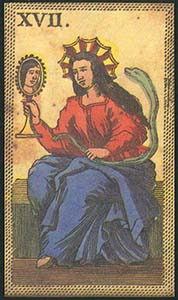
The card was known as, “Prudence,” and – as you can see – it depicted a woman looking into a mirror while a snake keeps her company.  A very strange image, indeed.

It appeared in one of the first known Tarot decks, known as the Visconti-Sforza deck.  This was about the year 1450 and, although the images were crude by today’s standards, for the most part they represent the same themes we see in our modern Tarot decks.  Except for Prudence.  What in the hell is SHE doing in there?

WHY PRUDENCE WAS INCLUDED

To understand why Prudence made her way into the Tarot, we really have to look at what was happening in Europe in the 1400s.

Can you say, “Inquisition?”  Sure you can.  

This was a time when the Catholic Inquisition was in full swing and even the hint of fortune telling could get you burned at the stake as a witch.  The Tarot is – quite obviously – a tool for divination and so they needed to disguise what it really was.

The first ploy was to say that it was just a simple card game.  You know . . . it’s just poker, only with archetypes.  Nothing to see here.

The second trick was to include so much Christian imagery that the priests and torturers would be thrown off of the scent.  In order to do that, they included the ‘four cardinal virtues’ of the Catholic Church.  They are:

JUSTICE

TEMPERANCE

FORTITUDE (AKA Strength)

PRUDENCE

Put quite simply, these cards are nothing but camouflage for the real, original Tarot deck.  

SO WHAT HAPPENED TO HER?

The obvious question here is, “Why did Prudence disappear?”  Why did the other, “virtue cards,” remain while she went away to wherever ex-Tarot-cards live?

Most scholars suggest that the messages she was meant to convey – reflection, wisdom, self-knowledge – were simply absorbed by other cards.   They feel that The Hermit card in particular had all of those qualities, so perhaps Prudence simply wasn’t necessary.  

In modern terms, we could say that her job description was eliminated.  Which sounds like bullshit, doesn’t it?

My personal theory is that Prudence may have been just a little too Pagan for their purposes.  It’s a very strange card. The image of a woman, a snake and a mirror conjure up memories of mythological creatures like Medusa or Hathor.  Perhaps the artist who created the Visconti-Sforza deck was tipping his hand a little too much with this depiction and they needed to hide her.

Whatever the reason, Prudence faded into obscurity, leaving the Tarot a little leaner, but much more mysterious.

PROBLEMS FOR THE OCCULTISTS

The presence of Prudence would have created a major problem for the Victorian occultists – who really brought the Tarot back to life – had they known about her.

They were bound and determined that there was some secret, ancient path hidden away in the Tarot cards and – by god – they were going to find it.  In the 19th century, Eliphas Levi had correlated the 22 cards of the Major Arcana with the 22 letters of the Hebrew alphabet.  He went on to create an elaborate system where he divided the 22 cards into three groups of 7, which echoed the Kabbalistic Tree of Life.

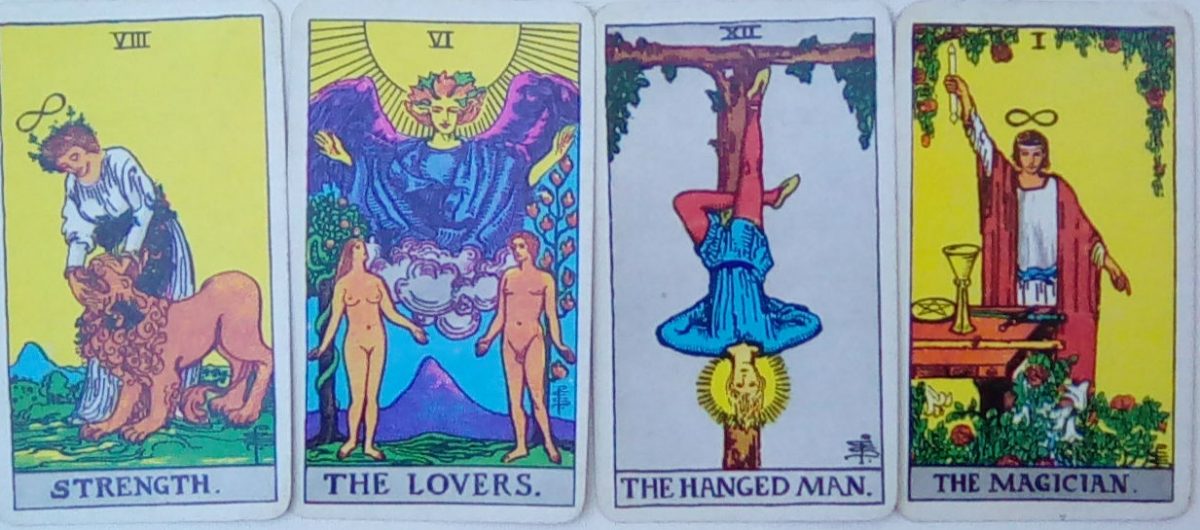
Arthur Edward Waite, who published the Waite deck that we’re all so familiar with, was so determined to make the deck fit into a numerology scheme that he actually changed the order of the cards.  He flipped the numbers so that Strength took the place of Justice and Justice became Strength.  Who cares about history, right?

And, after all of the many years they put into organizing the 22 cards of the Major Arcanum into tidy systems, it turns out there were actually 23 cards.

Well, hell.

CLOSING THOUGHTS

The disappearance of Prudence is more than just a historical footnote.  It reminds us that our knowledge of the Tarot is constantly evolving and it leaves some tantalizing questions.

Why did this ONE card disappear, and not the other virtue cards?

Was the Tarot truly designed as a mystical system disguised as a game?

Does it carry Egyptian or even Atlantean symbols that were concealed from the religious authorities?

The mystery endures and the Tarot invites us to keep looking.

“Just the Tarot,” by Daniel Adair – A kindle ebook available on Amazon

Shine Your Light: The Star Card, Shame, and the Courage to Be Seen

This post explores the deeper meaning of The Star card in the Tarot and reflects on why so many of us struggle to shine our light in the world. Drawing on the work of Brené Brown, Tibetan Buddhism, and real-life dynamics like shame and codependency, I look at the messages—both cultural and personal—that lead us to dim our brilliance. The Star invites us to pour our gifts into the world, not for recognition, but because it’s who we truly are. This is a reflection on healing, self-worth, and the sacred courage it takes to be seen.• shine your light

This image is from one of my new Tarot Affirmation posters, now available on my Etsy art site. I really love how it turned out—but even more than that, I love the message it carries: Shine Your Light.

And yet, for so many of us, that’s easier said than done.

Instead of shining, we hide. Instead of pouring ourselves out like starlight, we dim, shrink, withdraw. Why is it so hard to be radiant in a world that so desperately needs our brilliance?

The Culture of Shame and the Fear of Being Seen

In one of her powerful TED Talks, Brené Brown speaks about the culture of shame we all live in. Even if you didn’t grow up in a dysfunctional family (and statistically, about 60% of us did), we’re still marinated in a society that constantly criticizes, compares, and belittles.

Maybe you brought home a report card with a B, and your parent asked, “Why didn’t you get an A?”

Maybe you’re in a job where meeting your performance goals doesn’t bring a sense of completion—it just earns you a fresh, even more demanding set.

Maybe you’ve internalized the billions of dollars spent by the beauty industry telling you that your face, your body, your age, or your hair simply aren’t good enough.

On social media, the message is constant: unless you’re being validated with likes and followers, you’re invisible.

Advertising tells you your house isn’t elegant enough, your car’s too old, your wardrobe outdated.

Even spirituality isn’t immune. We whisper to ourselves: I should be better. I should care more. I should meditate more. Pray more. Try harder.

Let’s face it: in this world, it’s all too easy to believe that we should be ashamed of simply being ourselves.

As Brown puts it, shame drives two powerful tapes in our heads:

1. You’re never good enough, and

2. Who do you think you are?

And because those tapes run deep, we begin to engineer our own smallness. We shrink ourselves to stay invisible—because visibility feels like a threat. We dim our light so no one will see just how “inadequate” we believe we are. And in doing so, we fail to shine.

Codependency and Dimming Our Own Lights

Sometimes, the reason we hide isn’t culture—it’s relationships.

Too many of us are caught in dynamics where one partner shines while the other fades into the background. It might be dressed up in the language of care or sacrifice, but the effect is the same: one person takes center stage, while the other erases themselves.

It could be a relationship with a narcissist, where one partner is expected to provide constant praise, attention, and emotional caretaking.

It could be a more obvious kind of abuse, where failing to meet someone else’s needs results in punishment, blame, or even violence.

It might even look noble—like staying small to “support” someone who is ill, unstable, or in need. But the underlying belief is this: there isn’t enough light to go around.

And so, we dim ourselves to make the other person shine.

We play down our accomplishments. We pretend we’re not that talented. We take the backseat in our own story. And we tell ourselves it’s virtuous.

But it’s not noble to disappear. It’s not compassionate to go dark.

We were meant to shine.

The Star Card and the Sacred Act of Sharing

The Star card in the Tarot is a card of healing—but it’s not just personal healing. It’s about reconnecting with the world by letting your own light flow into it.

In Tibetan Buddhism, there’s a teaching that each of us carries a radiant jewel inside. It may be buried under layers of dust or encased in stone, but it’s there—glimmering with our true nature. And our task in life is to uncover that jewel and offer it to the world.

That’s what the woman in The Star card is doing. She kneels beside the stream and pours out her water—not hoarding, not holding back. She gives freely to the land and to the flow of life itself.

She’s not asking for praise. She’s not trying to be impressive.

She’s just being who she is: a vessel of light.

And so are you.

You don’t shine for applause.

You don’t shine to prove anything.

You shine because it’s your nature.

And this world is thirsty for that kind of offering.

A Final Thought

You are not just a person. You are a sacred gift.

You are a hidden jewel.

You are starlight in human form.

Let yourself shine.

“Just the Tarot,” by Dan Adair – a kindle ebook available on Amazon