New Moon in Sagittarius: Tarot-Friendly Rituals for Big Vision, Fresh Starts, and Better Luck

This New Moon in Sagittarius invites us to lift our eyes from daily worries and reconnect with a bigger sense of purpose. In this post, we explore how Sagittarius energy supports vision, belief, and fresh starts.

Tomorrow’s New Moon in Sagittarius is the kind of lunar reset that doesn’t whisper — it calls you forward. Sagittarius energy is optimistic, truth-seeking, and future-focused. It’s less about fixing what’s broken and more about asking:

“Where am I going next — and why does it matter?”

If you’ve been feeling stuck, uninspired, or a little too boxed in by routine, this is a beautiful New Moon to work with. Below are simple, Tarot-friendly practices (no complicated rituals required) that align with Sagittarius themes: expansion, belief, faith, and big-picture intention.

“Just the Tarot,” by Dan Adair – Available on Amazon

Why the Sagittarius New Moon Feels Different

Sagittarius is ruled by Jupiter, the planet of growth and opportunity. That’s why Sagittarius New Moons tend to feel like:

• a spark of hope returning

• a desire to try again (but smarter)

• an urge to explore new ideas, paths, or possibilities

• a hunger for meaning, not just productivity

This isn’t the New Moon for micromanaging.

This is the New Moon for choosing a direction.

7 Sagittarius New Moon Activities (That Pair Beautifully With Tarot)

1) Set “Big Horizon” Intentions

Sagittarius intentions work best when they’re directional rather than rigid.

Try writing intentions like:

• “I move toward a life that feels expansive and true.”

• “I welcome opportunities that widen my world.”

• “I allow myself to outgrow old limits.”

Think: vision, not logistics.

2) Do a One-Card Tarot Draw for the Next Chapter

Ask:

“What energy wants to grow in my life next?”

Pull one card and write three sentences:

1. What the card is inviting you to become

2. What it wants you to release

3. One small step you can take this week

Sagittarius loves simple, bold action.

3) Release One Limiting Belief

Sagittarius rules beliefs — the inner stories that shape your whole life.

Ask yourself:

• What belief has been quietly shrinking my world?

• Where have I been playing small because it felt safer?

Write the belief down. Then write:

“I no longer consent to this story.”

You don’t have to replace it with a perfect new belief yet.

Just loosen the grip.

4) Start a “Meaningful Study”

Sagittarius energy thrives on learning and perspective.

New Moon ideas:

• start a book that expands your worldview

• explore mythology, philosophy, or spiritual symbolism

• study one Tarot archetype more deeply this week

Even one chapter read with intention can shift your whole mood.

5) Go Outside and Ask One Big Question

Sagittarius is the open sky, the horizon, the road.

Take a walk and hold one question:

“If I trusted life more, what would I do next?”

Let the answer come slowly. Don’t force it.

6) Use a Mini Tarot Spread for Sagittarius Vision

Try this simple 3-card spread:

1. The Road I’m On

2. The Road That’s Calling

3. The First Step

This spread is perfect when you feel like you’re between chapters.

7) Create a “Jupiter List” (Luck & Expansion)

Write a list titled:

“What I’m Ready to Expand.”

Add anything that fits:

• creativity

• money

• confidence

• love

• freedom

• health

• visibility

• joy

Then circle the one that matters most. That’s your New Moon focus.

A Simple Sagittarius New Moon Ritual (5 Minutes)

If you like simple ritual, do this:

1. Light a candle

2. Write three big-picture intentions

3. Pull one Tarot card for guidance

4. Speak your intentions aloud

5. Close with:

“I trust the larger arc of my life.”

Sagittarius responds beautifully to spoken intention. It’s a “say it and claim it” kind of moon.

What to Avoid Under This New Moon

This is not the time for:

• micromanaging outcomes

• overthinking every emotion

• heavy, endless processing

• forcing certainty before you act

Sagittarius New Moons reward faith, courage, and forward motion — even if the path isn’t fully visible yet.

Closing Thought

The Sagittarius New Moon reminds us that life isn’t meant to be endured in a narrow hallway. It’s meant to be lived with curiosity and a sense of possibility.

Choose a direction that feels meaningful.

Then take one honest step toward it.

Happy New Moon.

The Art of Receiving: A Holiday Lesson from the Ace of Pentacles

Are you great at giving but secretly uncomfortable receiving? This holiday-inspired reflection on the Ace of Pentacles explores why receiving is the true key to abundance — and how learning to allow support, blessings, and prosperity can transform your life.

We hear it every year: “It’s the season of giving.”

And while generosity is beautiful, here’s a question we rarely ask:

How good are you at receiving?

Most of us are excellent givers.

We’ll show up for others, offer help, carry the emotional load, and give until we’re exhausted…

Yet when something is offered to us — kindness, support, a compliment, an opportunity, or even abundance — we freeze. We deflect. We downplay. We say, “Oh, you shouldn’t have…”

But in manifestation, and in the symbolic language of the Tarot, receiving is not an afterthought — it’s the core skill.

And the Ace of Pentacles, with its golden hand offering a gift from the sky, is the perfect reminder that abundance can’t enter your life until you’re willing to let it in.

Ace of Pentacles Affirmation Poster by Dan Adair – Available on Etsy.

Why Receiving Is the Real Skill in Manifestation

Genevieve Davis puts it beautifully in her book, “Doing Magic: A Course in Manifesting an Exceptional Life.”

“As soon as you have asked for anything, your next immediate job is to get out of the way. You need to get out of asking and into the receiving state as soon as you possibly can.”

Most people stay stuck in:

• asking

• wishing

• visualizing

• striving

• trying harder

But manifestation isn’t powered by effort.

It’s powered by allowing.

During the holidays we pour energy outward — buying gifts, doing favors, meeting expectations — but the universe doesn’t respond only to what we give. It responds to what we’re willing to accept.

 Receiving Requires Softening, Not Effort

In, “Ask and It Is Given: Learning to Manifest Your Desires” Abraham/Hicks calls this the Art of Allowing:

“Unless you are in the receiving mode, your desires will not be fulfilled.”

Receiving isn’t about deserving more or working harder.

It’s the opposite — a gentle softening.

Receiving happens when you:

• relax your shoulders

• loosen your defenses

• stop arguing with your blessings

• stop explaining your worth

• allow yourself to be supported

Winter energy itself teaches this.

The natural world slows, quiets, and becomes receptive.

There is no pushing — only opening.

The Holiday Block: Feeling Unworthy of Good Things

Here’s the core wound for many people — especially during the holidays:

We don’t believe we deserve good things.

Old stories rise up:

• “Other people need it more.”

• “I haven’t earned that.”

• “I don’t want to be a burden.”

• “I’m not enough.”

Many of us learned as children to receive less so others could have more.

So now, when life tries to hand us something beautiful, we reject it without even realizing we’re doing it.

But the Ace of Pentacles offers a different truth:

You are worthy of abundance.

You are worthy of support.

You are worthy of receiving joy, money, kindness, opportunity — just as you are.

The Ace of Pentacles: A Gift You Are Meant to Receive

TheAce of Pentacles  captures this moment perfectly:

• the hand offering a golden coin

• the floral archway

• the path leading into a new beginning

• the vibrant, fertile landscape

This is the universe extending a gift — potential, prosperity, a fresh start.

The affirmation, “Receive Abundance,” is not a command.

It’s an invitation.

A permission slip.

This holiday season, abundance may appear in quiet ways:

• someone offering help

• an unexpected opportunity

• a compliment

• money flowing in

• a door opening you didn’t expect

Your job?

Let yourself say yes.

A Simple Holiday Receiving Ritual (2 Minutes)

Try this before bed or during a quiet moment in the day:

1. Place your hand over your heart.

2. Take a slow breath.

3. Say gently:

“It is safe for me to receive.”

4. Picture the golden hand of the Ace of Pentacles offering you a gift.

5. Say:

“I allow good things to enter my life.”

Small practice, big shift.

This Season, Let Receiving Be Part of the Celebration

Giving is beautiful.

Generosity is sacred.

But so is allowing yourself to be blessed.

Let this be the season you stop deflecting your good.

Stop stepping aside.

Stop shrinking back.

Let this be the season you say, without apology:

“I am ready to receive abundance.”

Because the universe can only deliver what you’re willing to accept.

Seven Lessons the Tarot Can Teach About Surviving the Holidays

Feeling overwhelmed by the holiday season? The Tarot has a surprising amount of wisdom — and humor — to offer.From The Fool’s fresh start to The World’s end-of-year perspective, these cards remind us that the holidays don’t have to be perfect to be meaningful.

A little humor, a little magic, and just enough perspective will get you through the Holiday Haze.

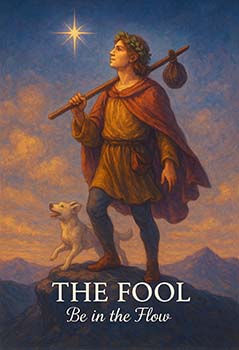
1. The Fool — You’re Allowed to Start Fresh

Every holiday season is a reset button.

Don’t carry last year’s stress into this year’s festivities.

Don’t walk off of emotional cliffs at family dinners.

Leap lightly… but maybe look down for gift-wrapping paper on the floor.

2. The Magician — Use the Tools You Actually Have

Trying to make a perfect holiday with imperfect resources?

The Magician whispers: Use what’s already on the table.

Don’t overspend now and stress later. 

Aim for gifts that are magical, not expensive.

3. The Lovers — Choose Peace, Not Drama

The holidays tend to bring opinions.

And relatives.

And opinions from relatives.

The Lovers reminds you: choose connection, not combat… or at least choose silence and pie.

If one of your loved ones says something absolutely outrageous, remember that you can just put a piece of pie in your mouth and smile.  Add whipped cream to make it an extra sweet conversation.

4. The Seven of Cups — Beware of Overcommitment

Shopping! Baking! Parties! Rituals! Volunteering! Travel!

The Seven of Cups says: You cannot say yes to all seven.

Pick the cup with the least glitter and the most sanity.

You don’t have to be all things to all people – just be the you that people love.

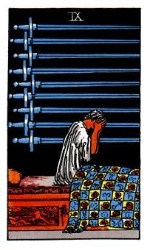
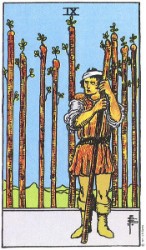
5. The Nine of Swords — Anxiety Lies

That nagging feeling that everything will go wrong?

It’s just the Nine of Swords doing its nightly stand-up routine.

Thank it for its service… and then ignore it.

Don’t just make it a holiday – make it a vacation from worry.

6. The King of Pentacles — Treat Yourself Like a Honored Guest

Warm food, soft blankets, comfortable socks —

This is not indulgence, this is holiday self-care strategy.

Just look at all the things you’ve done for other people!  Don’t you deserve a little pampering, too?

The King of Pentacles approves.

7. The World — You Made It Through Another Year

Pause. Breathe. Celebrate the cycle completing.

On the Winter Solstice, the solar year will end.  Take the time to reflect, to congratulate yourself for another trip around the sun. 

Give yourself credit for all the chapters you survived this year — and all of the growth that went along with that.

Bonus Holiday survival secret:

Lower expectations. Raise kindness. Wear stretchy pants.

Available on Amazon

GOOD GEMINI FULL MOON ACTIVITIES (For Everyone)

Activities of the Full Moon in Gemini.

1. Talk It Out

Gemini is ruled by Mercury, so this moon loves:

• good conversations

• honest check-ins

• clearing misunderstandings

• catching up with someone you care about

If something needs to be said, today is a great day to say it — with curiosity instead of judgment.

2. Write Something (Anything)

The Gemini moon is ideal for:

• journaling

• blogging

• brainstorming

• making lists

• outlining a project

• writing a letter you may or may not send

Gemini energy likes movement, not perfection.

Write badly! Write freely! That’s the point.

“Just the Tarot,” by Dan Adair – Available on Amazon

3. Learn Something New

A Gemini full moon is curiosity on steroids.

Great activities:

• watch a documentary

• read something weird

• take a short online class

• dive into a topic you’ve always wondered about

• explore a new tarot idea or card history

Your brain is extra “sparkable” today.

4. Mix Things Up

Gemini hates routines that feel stale.

Try:

• working in a different room

• rearranging something small

• taking a different route

• visiting a new café

• choosing a new deck to read with

Tiny disruptions = big inspiration under this moon.

5. Light Decluttering

Gemini rules mental clarity, and physical clutter can feel “noisy” today.

But keep it gentle:

• toss old papers

• clear a drawer

• tidy your desk

• delete apps you don’t use

This is not a “deep clean” moon — it’s an “open the windows and let air in” moon.

6. Play with Ideas (Without Committing to Anything Yet)

The full moon illuminates, but Gemini doesn’t demand decisions.

Today is perfect for:

• exploring multiple options

• casting wide nets

• letting possibilities bubble up

• following mental rabbit holes

• gathering puzzle pieces

Choose later — today is for variety.

7. Light, Airy Rituals (If you do them)

This moon works best with:

• incense or diffusing uplifting scents

• breathwork

• music or chanting

• tarot spreads focused on clarity or “What am I not seeing?”

• light meditation rather than deep shadow work

Keep it breezy.

 THE OVERALL THEME

A Gemini Full Moon is excellent for anything involving:

• clarity

• communication

• curiosity

• small changes

• flexible thinking

• opening mental windows

• connecting dots

It’s a mentally stimulating, slightly restless, very dynamic moon — great for creativity, experimentation, and fresh insight.

The Top Ten Tarot Cards Indicating Conflict

A quick, insightful guide to the ten Tarot cards that most often signal conflict—from chaotic energy and power struggles to hidden tension and emotional fallout. This post explains what each card means and how to navigate challenging situations with clarity and confidence.

There are days when Tarot feels like a warm hug…

…and days when it slides a little warning across the table and whispers,

“Brace yourself.”

Conflict is part of life, part of growth, and definitely part of the Tarot.

“Just the Tarot,” by Dan Adair – Available on Amazon

Whether it’s inner tension, relationship friction, or someone else’s chaos spilling into your lane, some cards show up to say:

“Something here needs attention.”

Here are the top ten Tarot cards that most strongly signal conflict — and what each one really means beneath the surface. If you’d like to download this list as a PDF file that you can add to your Tarot notebook, click here.

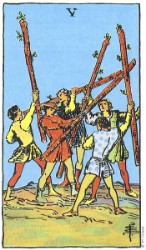
1. Five of Wands – The Classic Chaos Card

If conflict had a mascot, this would be it.

The Five of Wands shows:

– competition

– ego clashes

– mixed agendas

– flailing energy everywhere

It’s not necessarily destructive — but it is noisy.

Message: This isn’t war… it’s everyone talking at once. Calm the room.

2. Five of Swords – A Battle Nobody Really Wins

This is the energy of:

– arguing to be right

– unhealthy victories

– someone taking more than their share

– hurt feelings afterward

Message: Winning at all costs comes with a bill. Choose integrity.

3. Seven of Wands – Defend Your Ground

This is conflict from the outside:

– critics

– competition

– pressure

– feeling outnumbered

But the card says you can stand firm.

Message: Don’t fold. You’re stronger than the opposition.

4. The Tower – Major Disruption

This isn’t a small disagreement — it’s a smackdown from the universe.

Think:

– sudden revelations

– arguments that break things open

– emotional earthquakes

Message: The old structure needed to fall. Liberation follows.

5. The Five of Cups – Emotional Fallout

Not a conflict card on its face, but it often shows up after one:

– regret

– grief

– disappointment

– unresolved conversations

Message: You’re grieving what was lost. Healing begins when you turn around.

6. The Devil – Power Struggles

This card signals:

– manipulation

– obsession

– toxic dynamics

– control games

– addictive patterns in relationships

Message: This conflict has a hook. Break the chain, not each other.

7. The Knight of Swords – Rushing Into Battle

He is smart, fast, determined…

…and doesn’t always think things through.

Shows:

– heated arguments

– impulsive reactions

– someone charging ahead without listening

Message: Slow down before your mouth outruns your wisdom.

8. The Two of Swords – Silent Conflict

Not all conflict is loud.

This card is conflict frozen:

– denial

– avoidance

– stalemates

– tension beneath the surface

Message: Peace requires a decision. Open your eyes and choose.

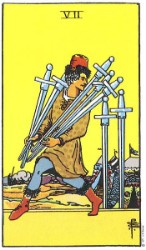
9. The Seven of Swords – Sneaky Energy

Not direct conflict — but conflict waiting to happen.

Signals:

– deception

– half-truths

– secret plans

– someone acting behind the scenes

Message: If something feels “off,” it probably is. Trust your intuition.

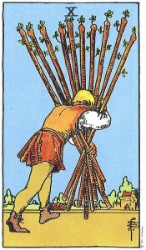
10. The Ten of Wands – Overwhelm and Burnout

This appears when conflict comes from:

– taking on too much

– carrying other people’s problems

– no boundaries

– pressure that builds until you snap

Message: Put down what isn’t yours. You’re not meant to carry it all.

Final Thoughts: Conflict Isn’t Always the Enemy

Conflict in Tarot isn’t punishment — it’s information.

The cards don’t show conflict to scare you…

They show it to help you:

– redirect

– set boundaries

– speak truth

– release what’s toxic

Because once conflict is acknowledged, transformation can finally begin.

THE EMPRESS AND THE ART OF FLUNKING OUT OF EARTH SCHOOL

A playful look at the New Age paradox of being “perfect souls” who still come to “Earth School” to learn lessons. The post explores both views and suggests that real growth comes not from suffering, but from joy, play, and becoming more fully ourselves.

There’s a rather large pothole in New Age philosophy that I keep tripping over. Let’s call it The Earth School Fallacy — the strange contradiction between “We are perfect divine beings” and “We’re here to learn lessons because… well, we’re NOT perfect divine beings.”

Somehow, we manage to carry both of those ideas around in our heads and not notice that they don’t quite fit together.

“Just the Tarot,” available on Amazon

THE EARTH SCHOOL MODEL

You’ve heard this one. If you’ve been on a spiritual path longer than a week, you’ve probably used this one.

Earth, we’re told, is a sort of cosmic classroom we incarnate into repeatedly. Each lifetime is a syllabus of Very Important Lessons, and with each incarnation we supposedly level up until we become Spiritually Perfect.

In this model, we actually choose our life challenges before we’re born.

Have a temper? Great! Let’s incarnate into a family whose daily activities include pushing all of your buttons like they’re competing for a prize. Assuming we don’t murder each other we eventually learn enough humility and patience and – SHAZAM –  we transform into Mahatma Gandhi.

Have an obsession with sex? Wonderful! Let’s incarnate into a world filled with gorgeous, eager, naked partners who—

Okay, that one never happens. But you get the drift.

Pass your lessons and you move up a grade.

Fail your lessons and you come back as a cockroach or a MAGA supporter and start over in Spiritual First Grade, eating glue and making macaroni art.

In Tarot Talk, Gaia’s classroom often looks like the Five of Wands — a bunch of souls flailing around wildly until one of us finally figures out what the sticks are for.

THE ANGEL WITHIN

Now we arrive at the second New Age idea — the one that directly contradicts the first.

This is the belief that we’re already spiritually perfect, but we’ve forgotten that fact. Our task isn’t to improve ourselves… it’s to remember that we don’t need improving.

Buddhists describe it as our original nature: a perfect jewel hidden under a crust of plain gray rock. Chip away the rock and — surprise! — you’ve been luminous the whole time.

Joni Mitchell phrased it better than all the gurus combined:

“We are stardust, we are golden,

and we’ve got to get back to the garden.”

In this view, we are pure, radiant beings from Source Energy who come to Earth, promptly forget who we are, and then spend the rest of our lives meditating, journaling, and buying inspirational calendars in an attempt to remember.

Put another way:

We’ve got a sleeping angel inside us, and the angel really needs to get its butt out of bed.

THE CONTRADICTION

Here’s the uncomfortable question no one asks:

If we’re already perfect, why would we CHOOSE to forget that and struggle?

It’s like becoming a master at algebra, then signing up for a lobotomy just so you can relearn quadratic equations from scratch.

Imagine your higher self sitting in another dimension saying,

“I’m a being of luminous perfection. You know what sounds fun? Forgetting everything and getting pissed off at the traffic while I drive to a boring, meaningless job that I hate.”

Something about that doesn’t quite compute.

EARTH SCHOOL AND THE WORK ETHIC PROBLEM

The Earth School model borrows heavily from Christian theology, a worldview in which:

• Humans are inherently sinful.

• Life is full of temptations that make us more sinful.

• If we behave ourselves and avoid having sex with the neighbor’s spouse, we get to go somewhere nice after we die.

In this model, Earth is basically the rough school on the dangerous side of town, with a curriculum of suffering, discipline, and fear.

Just keep your head down, work hard, and eventually—good news!—you’ll die.

THE VEDANTA SOLUTION (AKA: THE EMPRESS APPROACH)

Vedanta, from the Hindu tradition, on the other hand, leans toward Joni Mitchell’s interpretation. It suggests that:

• We are already perfect.

• Life is not meant to be hard.

• We’re not here to learn painful lessons.

• We’re here to experience, enjoy, and expand.

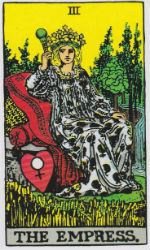
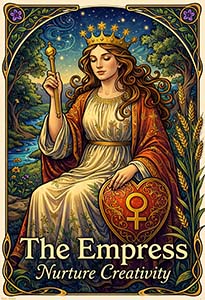
If the Vedanta version of Earth School has a model, it’s not the stern monk or stressed-out student — it’s The Empress.

Empress Poster available on Etsy

She’s not here to ace the test. She’s here to savor the banquet.

Play, creativity, pleasure, beauty — these are not distractions from the spiritual path.

They are the spiritual path.

That’s a really hard concept for Westerners to wrap our heads around.  We’re taught from the moment that we’re born that life is a series of assignments that we’re supposed to complete and that the next assignment will be better than the last.  That’s really the way that our whole society is set up.  We go to kindergarten so that we can go to grade school so that we can go to high school so that we can go to college or trade school so that we can get jobs so that we can get promotions so that we can retire comfortably and have enough money to pay for our funerals.

If we do all of that, we’ve been, “successful.”  If we don’t, our lives have been meaningless.

When someone tells us that the whole purpose of Earth School might actually be recess, it feels slightly insane.

LIVING SOMEWHERE IN THE MIDDLE

We can argue both sides.

If you lean toward Earth School, you can point to all the suffering and struggle that seem baked into our reality. As the English philosopher Thomas Hobbes famously put it, human life often appears “nasty, brutish, and short.”

But if you look again, you’ll also see breathtaking amounts of love, generosity, joy, and compassion.

So what’s the truth?

Probably something in the middle.

No, we’re not perfect angelic beings slumming on Earth…

but we can be.

Maybe life isn’t about learning painful lessons, and maybe it’s not about effortless perfection either.

Maybe it’s simply about becoming more yourself, more awake, more playful, more alive.

And oddly enough, the way we get there isn’t through suffering…

it’s through joy. It’s through learning how to play.

We don’t have to wait until we die to graduate.

We can do that right now — as soon as we remember that recess was always the point.

The Top Ten Tarot Cards That Indicate Healing

Discover the top ten Tarot cards that symbolize healing, recovery, and renewal. From The Star to The Hermit, explore how the cards reveal your path toward balance, peace, and wholeness.

When you’re working with the Tarot, certain cards appear as gentle messengers of recovery, renewal, and wholeness. Whether it’s physical, emotional, or spiritual healing, these ten cards remind us that balance and well-being are always within reach.

1. The Star

The ultimate card of healing and hope. It promises renewal after hardship and invites you to open your heart to divine light and self-trust.

2. Temperance

Balance, integration, and moderation — the alchemy of opposites. Healing flows when extremes are softened and peace returns.

3. The Sun

The warmth of vitality and joy. The Sun restores the life force, illuminating health, positivity, and the return of childlike energy.

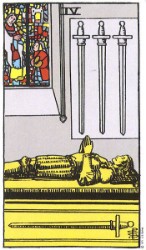
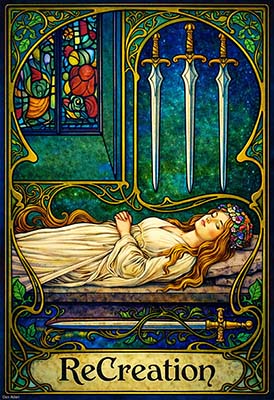
4. The Four of Swords

The body and mind’s call for rest. Recovery through stillness, meditation, and withdrawal from stress.

5. The Six of Swords

Moving away from turbulence toward calm waters. Healing through distance, clarity, and emotional peace.

6. The Ace of Cups

Renewal of the heart. Healing through love, forgiveness, and self-compassion; a cleansing flow of feeling.

7. The Queen of Pentacles

Earthy nurturing energy. Healing through care, nourishment, and connection to the body and natural rhythms.

8. The Three of Cups

Healing through friendship and community. Emotional recovery by rejoining the circle of support and joy.

9. The Ten of Pentacles

Long-term stability and health. Healing in the sense of “wholeness” — when life feels safe, abundant, and grounded again.

10. The Hermit

Healing through introspection and solitude. Finding the inner light that guides you back to your own wisdom.

 Using the Cards for Healing

When these cards appear in a spread, ask yourself: What part of me is ready to recover?

Healing doesn’t always mean fixing something broken — sometimes it means remembering you were whole all along.

“Just the Tarot,” by Dan Adair – a complete set of definitions for all of the cards, including layouts and instructions, available on Amazon.

The Magician: Symbols of Manifestation

The Magician shows how thought becomes form.
From roses and lilies to the infinity symbol, every detail reveals the art of manifestation — the meeting of spirit, will, and action.
Discover what each symbol means and how The Magician teaches conscious creation.

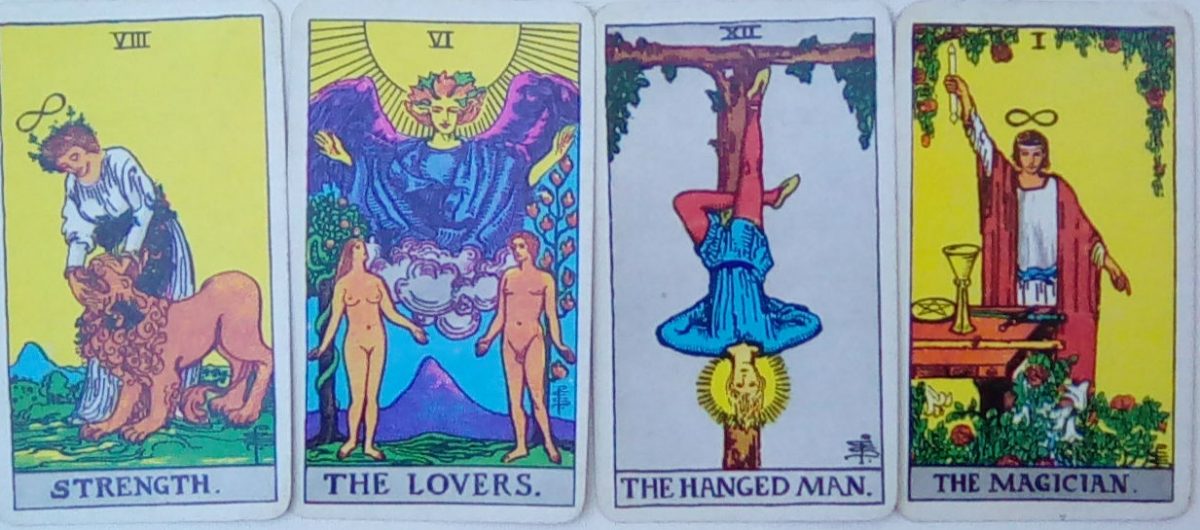
The Magician stands at the threshold between spirit and matter, reminding us that creation begins in consciousness. Every element in this card — from his roses to his raised wand — tells the story of how ideas become real.

Let’s look closely at the symbols that make the Magician such a powerful image of manifestation.

🌹 Roses and Lilies – Desire and Purity

At the Magician’s feet, red roses and white lilies intertwine. The roses symbolize passion and vitality — the raw energy of desire. The lilies represent purity, clarity, and spiritual truth.

Together they tell us: creation requires both — the fire of wanting and the innocence of trust.

The Raised Hand and Pointing Finger – “As Above, So Below”

With one hand holding a wand to the heavens and the other pointing to the earth, the Magician enacts the Hermetic axiom: “As above, so below.”

He channels divine inspiration downward into form, bridging worlds. It’s a reminder that every idea you manifest must be grounded in action.

⚡️ The Double-Ended Wand – Energy Flows Both Ways

The wand itself has two tips, showing that energy moves in a circuit. Inspiration doesn’t just descend — it also ascends, rising from the material back into the spiritual.

When you create something authentic, the universe responds in kind. Power flows in both directions.

🌀 The Infinity Symbol – Eternal Creative Flow

Above his head floats the lemniscate — the sideways figure eight of infinity — mirrored again in his serpentine belt, the ouroboros that eats its own tail.

These symbols whisper that creation is endless. There is no true beginning or ending, only perpetual transformation. Every manifestation becomes the seed of the next.

🎀 The Headband – Focused Intention

Around his brow, the Magician wears a simple white band. It signifies concentration — the mind harnessed and directed.

Magic without focus is daydreaming; focus without inspiration is drudgery. The headband marks the moment when clarity and will fuse.

❤️ The Red Robe – Passion in Action

Red is the color of vitality, courage, and physical energy. The robe says: ideas alone are not enough — they must be acted upon.

Beneath the robe, his inner tunic is white, showing that true power is driven by purity of motive, not ego.

🌞 The Yellow Background – Light of Consciousness

The entire scene glows in radiant yellow, representing illumination and awareness.

This is the color of intellect, clarity, and awakening — the mind fully alive. The Magician works in daylight because his magic is conscious, not hidden.

🧰 The Tools on the Table – Mastery of the Four Elements

Before him lie the wand, cup, sword, and pentacle — the emblems of fire, water, air, and earth.

They show that he commands all aspects of creation: spirit, emotion, thought, and matter.

Nothing is missing; he already holds everything needed to bring vision into being.

🔢 The Number One – The Point of Origin

As the first card of the Major Arcana, The Magician represents beginnings — the spark of individuality, the “I am” moment.

He’s the point where potential first becomes personal power. Every creative act starts here: the decision to say yes to your own ability.

🌟 Bringing It All Together

Every symbol in The Magician tells the same story: you are the conduit between heaven and earth.

Your thoughts, feelings, and actions are the instruments on his table.

When you align them with clarity and purpose, magic isn’t mysterious — it’s inevitable.

So the next time you draw The Magician, take a breath and remember:

You already have everything you need. All that remains is to raise your wand — and begin.

“Just the Tarot,” by Dan Adair – a guidebook for reading the cards with complete definitions and sample layouts, available as an ebook on Amazon.

The Top Ten “No” Cards for Taking a New Job

When the Tarot says no, it’s often saving you from a storm ahead. This article explores the ten cards that most often warn against taking a new job — from the Tower’s sudden collapse to the Devil’s golden handcuffs. Learn how to recognize when the energy around a position is toxic, unstable, or simply not aligned with your higher path. Sometimes walking away is the most empowered move you can make.

Sometimes a new opportunity looks great on paper, but the cards tell a different story. When these ten Tarot cards appear in a career reading — especially in key positions like Outcome, Challenge, or Advice — they often signal that the timing or energy around a new job just isn’t right.

1. The Tower

Sudden upheaval, chaos, or destruction. The Tower warns that this job could collapse unexpectedly — layoffs, toxic leadership, or a company shake-up that leaves you scrambling. Proceed only if you thrive on change and can land on your feet fast.

2. The Devil

Temptation disguised as opportunity. This card often signals golden handcuffs — a job that looks lucrative but erodes your freedom or values. Watch for manipulation, burnout, or a boss who wants control more than collaboration.

3. The Ten of Wands

Overload and exhaustion. The job might demand everything you’ve got — and then some. This card suggests taking on too much responsibility, often without the recognition or compensation that makes it worthwhile.

4. The Five of Swords

Office politics and power struggles. The Five of Swords points to a competitive or hostile environment where people win at your expense. If you sense drama or hidden agendas during the interview process, trust your instincts.

5. The Eight of Cups

Walking away. Even if you take the job, this card suggests you won’t stay long — your heart isn’t in it. The Eight of Cups reminds you that emotional fulfillment matters more than a paycheck.

6. The Seven of Swords

Deception or hidden motives. This could mean shady company practices or a job offer that isn’t what it seems. Get everything in writing and read the fine print — twice.

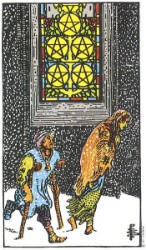
7. The Five of Pentacles

Financial instability or lack of support. This might be a company struggling to stay afloat or a position that doesn’t pay enough to sustain you. Be cautious about promises of “growth potential.”

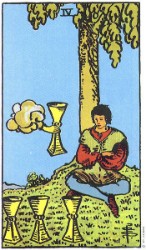
8. The Four of Cups

Apathy and disengagement. This job could leave you uninspired or emotionally flat. If you’re already feeling unmotivated, this may just be more of the same in a different package.

9. The Hanged Man

Stagnation. The Hanged Man suggests a lack of progress — your talents might be undervalued or your advancement delayed. If the job feels like waiting in limbo, it probably is.

10. The Ten of Swords

The painful ending. Whether it’s betrayal, burnout, or a layoff, this card says “enough.” The Ten of Swords is the Tarot’s final full stop — a clear “No” that urges you to let this opportunity pass and prepare for a fresh start elsewhere.

Closing Thoughts

A “No” from the Tarot isn’t always bad news — it’s often protection in disguise. These cards help you see beyond surface appeal and recognize when a job may drain your energy or steer you off your true path.

Sometimes the most powerful word you can say to the universe is no — because it creates space for the right yes to appear.

Feel free to leave questions in the comments section and I’ll get back to you as soon as I can.

“Just the Tarot,” by Dan Adair – A complete guide to Tarot readings available on Amazon.

Healing Our Week with the Tarot: Using “Antidotes” for Negative Energy

Weekly Tarot as mindfulness: forecast your reactions, apply the antidote (compassion, joy, courage), and make your inner world a peaceful place

There’s an internet meme I really love that says, “Maybe the day had a shitty you.”  It’s a good reminder that our own energy creates a lot of what we experience as being, “outside of us.”  Let’s talk about a very simple mental hygiene routine with the Tarot that we can use to keep our energy clean and positive.

The Buddhist Practice of Antidoting

Buddhism has long recognized that positive emotions are good for us and negative emotions are bad for us.  There’s nothing revolutionary about that simple fact.  Happiness makes us happy and sadness makes us depressed.  What a concept!

Buddhism gets even more radical than that, though, and refers to negative emotions as, “poisons.”  Constantly feeling the negative emotions – anger, hatred, jealousy, depression – is like drinking poison.  It makes us physically, emotionally, and spiritually sick.

And, if we drink poison, we obviously need an antidote, right?  So, in the Buddhist practice, if we’re angry about something we meditate on loving/compassion.  If we’re jealous of someone, we meditate on feeling good for them.  If we’re afraid, we meditate on courage.  Any negative emotion has a corresponding antidote.

We can easily tie that thinking into a Tarot practice that helps us to stay balanced and stress free.

A Simple Weekly Tarot Practice

At the start of each week, try doing a short four-card predictive spread:

1. Current Conditions

2. What Needs to Be Done

3. Factors Working Against Me

4. Probable Outcome

For example, imagine the reading comes up like this:

• Current Conditions – Five of Cups (reversed) – recovering from sadness

• What Needs to Be Done – Seven of Wands (reversed) – exhausted after a battle and feeling defensive

• Factors Working Against – Five of Swords – conflict, tension, disagreements

• Probable Outcome – Five of Wands – ego struggles for dominance; hollow victories.

Without diving too deeply into analysis, we can see this describes a week of emotional recovery mixed with potential conflict.

The energy of the week feels charged—lots of fives, lots of challenges.

But remember: nothing the Tarot predicts is ever set in stone. It simply points to the energetic weather we’re about to walk into.

Finding the Antidote

So, how do we antidote this kind of energy?

By becoming as peaceful and non-reactive as possible.

If the cards forewarn us that conflict is likely, we can consciously generate its opposite: serenity, patience, and groundedness.  When we carry that peaceful energy into the week, we DON’T blow up at the rude cashier at the grocery store.  We DON’T indulge in road rage when someone cuts us off in traffic.  We DON’T snap at a co-worker when they say something sarcastic to us.

When we carry those antidoting energies, we rise above the fray.

We stop feeding the poison and instead create harmony wherever we go.

In the same way, if our reading predicts sadness or depression, we can consciously seek out things that will make us happy.  If it predicts that we’re going to be scattered, we can do a little extra mindfulness practice.

Turning “Negative” Cards Into Meditation

This is one of the most powerful ways to meditate with the Tarot.

When we pull a card that seems negative, rather than dreading it, we can pause and ask: What’s the opposite of this energy? If this card represents a poison, what’s its antidote?

If the cards suggest sadness or loss, how can we actively cultivate joy?

If they hint at arrogance, how can we practice humility?

If they predict anger or tension, how can we embody calm?

Each “negative” card becomes a mindfulness bell—an invitation to rebalance our inner world.

Empowerment Through Awareness

Instead of thinking, “This is going to be a rough week,” we can say,“This reading is giving me insight into the energies ahead—and tools to shift them.”

This approach gives us agency.

It empowers us to stay in the flow, improve our own energy, and choose how we’ll respond to life’s ups and downs.

No matter what’s happening around us, we’re the ones who have to live in our own minds—and Tarot can help us make that a bright, peaceful place to be.

“Just the Tarot,” by Dan Adair – a kindle ebook of Tarot definitions available on Amazon