THE EMPRESS AND THE ART OF FLUNKING OUT OF EARTH SCHOOL

A playful look at the New Age paradox of being “perfect souls” who still come to “Earth School” to learn lessons. The post explores both views and suggests that real growth comes not from suffering, but from joy, play, and becoming more fully ourselves.

There’s a rather large pothole in New Age philosophy that I keep tripping over. Let’s call it The Earth School Fallacy — the strange contradiction between “We are perfect divine beings” and “We’re here to learn lessons because… well, we’re NOT perfect divine beings.”

Somehow, we manage to carry both of those ideas around in our heads and not notice that they don’t quite fit together.

“Just the Tarot,” available on Amazon

THE EARTH SCHOOL MODEL

You’ve heard this one. If you’ve been on a spiritual path longer than a week, you’ve probably used this one.

Earth, we’re told, is a sort of cosmic classroom we incarnate into repeatedly. Each lifetime is a syllabus of Very Important Lessons, and with each incarnation we supposedly level up until we become Spiritually Perfect.

In this model, we actually choose our life challenges before we’re born.

Have a temper? Great! Let’s incarnate into a family whose daily activities include pushing all of your buttons like they’re competing for a prize. Assuming we don’t murder each other we eventually learn enough humility and patience and – SHAZAM –  we transform into Mahatma Gandhi.

Have an obsession with sex? Wonderful! Let’s incarnate into a world filled with gorgeous, eager, naked partners who—

Okay, that one never happens. But you get the drift.

Pass your lessons and you move up a grade.

Fail your lessons and you come back as a cockroach or a MAGA supporter and start over in Spiritual First Grade, eating glue and making macaroni art.

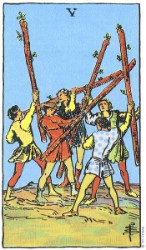
In Tarot Talk, Gaia’s classroom often looks like the Five of Wands — a bunch of souls flailing around wildly until one of us finally figures out what the sticks are for.
THE ANGEL WITHIN

Now we arrive at the second New Age idea — the one that directly contradicts the first.

This is the belief that we’re already spiritually perfect, but we’ve forgotten that fact. Our task isn’t to improve ourselves… it’s to remember that we don’t need improving.

Buddhists describe it as our original nature: a perfect jewel hidden under a crust of plain gray rock. Chip away the rock and — surprise! — you’ve been luminous the whole time.

Joni Mitchell phrased it better than all the gurus combined:

“We are stardust, we are golden,

and we’ve got to get back to the garden.”

In this view, we are pure, radiant beings from Source Energy who come to Earth, promptly forget who we are, and then spend the rest of our lives meditating, journaling, and buying inspirational calendars in an attempt to remember.

Put another way:

We’ve got a sleeping angel inside us, and the angel really needs to get its butt out of bed.

THE CONTRADICTION

Here’s the uncomfortable question no one asks:

If we’re already perfect, why would we CHOOSE to forget that and struggle?

It’s like becoming a master at algebra, then signing up for a lobotomy just so you can relearn quadratic equations from scratch.

Imagine your higher self sitting in another dimension saying,

“I’m a being of luminous perfection. You know what sounds fun? Forgetting everything and getting pissed off at the traffic while I drive to a boring, meaningless job that I hate.”

Something about that doesn’t quite compute.

EARTH SCHOOL AND THE WORK ETHIC PROBLEM

The Earth School model borrows heavily from Christian theology, a worldview in which:

• Humans are inherently sinful.

• Life is full of temptations that make us more sinful.

• If we behave ourselves and avoid having sex with the neighbor’s spouse, we get to go somewhere nice after we die.

In this model, Earth is basically the rough school on the dangerous side of town, with a curriculum of suffering, discipline, and fear.

Just keep your head down, work hard, and eventually—good news!—you’ll die.

THE VEDANTA SOLUTION (AKA: THE EMPRESS APPROACH)

Vedanta, from the Hindu tradition, on the other hand, leans toward Joni Mitchell’s interpretation. It suggests that:

• We are already perfect.

• Life is not meant to be hard.

• We’re not here to learn painful lessons.

• We’re here to experience, enjoy, and expand.

If the Vedanta version of Earth School has a model, it’s not the stern monk or stressed-out student — it’s The Empress.

Empress Poster available on Etsy

She’s not here to ace the test. She’s here to savor the banquet.

Play, creativity, pleasure, beauty — these are not distractions from the spiritual path.

They are the spiritual path.

That’s a really hard concept for Westerners to wrap our heads around.  We’re taught from the moment that we’re born that life is a series of assignments that we’re supposed to complete and that the next assignment will be better than the last.  That’s really the way that our whole society is set up.  We go to kindergarten so that we can go to grade school so that we can go to high school so that we can go to college or trade school so that we can get jobs so that we can get promotions so that we can retire comfortably and have enough money to pay for our funerals.

If we do all of that, we’ve been, “successful.”  If we don’t, our lives have been meaningless.

When someone tells us that the whole purpose of Earth School might actually be recess, it feels slightly insane.

LIVING SOMEWHERE IN THE MIDDLE

We can argue both sides.

If you lean toward Earth School, you can point to all the suffering and struggle that seem baked into our reality. As the English philosopher Thomas Hobbes famously put it, human life often appears “nasty, brutish, and short.”

But if you look again, you’ll also see breathtaking amounts of love, generosity, joy, and compassion.

So what’s the truth?

Probably something in the middle.

No, we’re not perfect angelic beings slumming on Earth…

but we can be.

Maybe life isn’t about learning painful lessons, and maybe it’s not about effortless perfection either.

Maybe it’s simply about becoming more yourself, more awake, more playful, more alive.

And oddly enough, the way we get there isn’t through suffering…

it’s through joy. It’s through learning how to play.

We don’t have to wait until we die to graduate.

We can do that right now — as soon as we remember that recess was always the point.

The Fool as Antidote: The Dictator Versus the Inflatable Frog

From inflatable frogs to the Tarot’s Sacred Jester, here’s why humor and play can puncture authoritarian posturing—and help renew our courage.

 Is it possible that what may save us from the political disaster we’re living through is pure Fool energy? Could it be that—more than protests and lawsuits—what ultimately rescues us is dancing, delight, and unapologetic Foolishness?

Portland, Expecting Doom… and Choosing Play

For months I dreaded a federal show of force in Portland, Oregon. My intuition said it was the logical target for a maximal authoritarian flex. Portland has all the necessary history.  It was the headquarters for the American Nazi movement prior to World War II.  And then there was a long, loud counter-history—artists, woo-woos, college kids, mystics, nude bike rides, and the endlessly invoked specter of “Antifa.” In short: the perfect symbol for the far right to try to crush.

When deployment was announced—National Guard plus a strong contingent of the ICE Orcs — I braced for the worst. Instead, Portlanders greeted it with protesters dressed as inflatable frogs and dancing bananas. Someone declared an “emergency nude bike ride,” and thousands of bare bodies on glittering bicycles poured into the streets.

The effect? Paralysis by absurdity. How does a macho, heavily armed ICE Orc “win” against a dancing banana? Left-brain force met right-brain play and simply short-circuited. The nation watched inflatable amphibians wiggle across our screens—and we laughed.

Remembering the Original Fool

We forget: in the oldest Tarot, The Fool wasn’t a tidy wanderer in tailored tights. He was a street entertainer—juggler, dancer, illusionist—utterly at home in an inflatable frog suit. In medieval courts, the Fool doubled as Sacred Jester, the one person allowed to lampoon the king and point out when the Emperor had no clothes.

That’s what Portland’s play did: it punctured the costume of power.

Why Laughter Works

Authoritarianism demands reverence. It thrives when we’re solemn and frightened. Laughter breaks the spell. It reveals the man behind the curtain, the baggy suit, the orange pancake makeup. Humor pulls us back into the Universal flow of playfulness and creativity, where life replenishes itself. Authoritarianism sits outside that flow; it eventually collapses under its own rigidity.

A Fool for Dark Times

We often gaze at the modern, elegant Fool and forget his deeper medicine. The original Fool brought giggles and belly-laughs during dark eras. That may be precisely what we need now.

Does this mean we abandon lawsuits, organizing, or policy? Of course not. It means we season courage with joy, protest with parody, pressure with play. When we add the Fool, we recover something essential: our sovereign refusal to be grim.

The Vanguard in Frog Suits

I didn’t expect the resistance to arrive on two wheels in nothing but body paint, but here we are—and it makes perfect sense. The antidote to the present darkness may well be to harness Fool energy and refuse to stop playing.

Let’s keep showing up with discipline and delight. March and mock. Organize and improvise. Because when we laugh together, power’s mask slips—and light gets in.

“Just the Tarot,” by Dan Adair – complete definitions and layouts for doing your own Tarot readings.

The Top Ten Tarot Cards That Indicate Healing

Discover the top ten Tarot cards that symbolize healing, recovery, and renewal. From The Star to The Hermit, explore how the cards reveal your path toward balance, peace, and wholeness.

When you’re working with the Tarot, certain cards appear as gentle messengers of recovery, renewal, and wholeness. Whether it’s physical, emotional, or spiritual healing, these ten cards remind us that balance and well-being are always within reach.

1. The Star

The ultimate card of healing and hope. It promises renewal after hardship and invites you to open your heart to divine light and self-trust.

2. Temperance

Balance, integration, and moderation — the alchemy of opposites. Healing flows when extremes are softened and peace returns.

3. The Sun

The warmth of vitality and joy. The Sun restores the life force, illuminating health, positivity, and the return of childlike energy.

4. The Four of Swords

The body and mind’s call for rest. Recovery through stillness, meditation, and withdrawal from stress.

5. The Six of Swords

Moving away from turbulence toward calm waters. Healing through distance, clarity, and emotional peace.

6. The Ace of Cups

Renewal of the heart. Healing through love, forgiveness, and self-compassion; a cleansing flow of feeling.

7. The Queen of Pentacles

Earthy nurturing energy. Healing through care, nourishment, and connection to the body and natural rhythms.

8. The Three of Cups

Healing through friendship and community. Emotional recovery by rejoining the circle of support and joy.

9. The Ten of Pentacles

Long-term stability and health. Healing in the sense of “wholeness” — when life feels safe, abundant, and grounded again.

10. The Hermit

Healing through introspection and solitude. Finding the inner light that guides you back to your own wisdom.

 Using the Cards for Healing

When these cards appear in a spread, ask yourself: What part of me is ready to recover?

Healing doesn’t always mean fixing something broken — sometimes it means remembering you were whole all along.

“Just the Tarot,” by Dan Adair – a complete set of definitions for all of the cards, including layouts and instructions, available on Amazon.

The Magician: Symbols of Manifestation

The Magician shows how thought becomes form.
From roses and lilies to the infinity symbol, every detail reveals the art of manifestation — the meeting of spirit, will, and action.
Discover what each symbol means and how The Magician teaches conscious creation.

The Magician stands at the threshold between spirit and matter, reminding us that creation begins in consciousness. Every element in this card — from his roses to his raised wand — tells the story of how ideas become real.

Let’s look closely at the symbols that make the Magician such a powerful image of manifestation.

🌹 Roses and Lilies – Desire and Purity

At the Magician’s feet, red roses and white lilies intertwine. The roses symbolize passion and vitality — the raw energy of desire. The lilies represent purity, clarity, and spiritual truth.

Together they tell us: creation requires both — the fire of wanting and the innocence of trust.

✋ The Raised Hand and Pointing Finger – “As Above, So Below”

With one hand holding a wand to the heavens and the other pointing to the earth, the Magician enacts the Hermetic axiom: “As above, so below.”

He channels divine inspiration downward into form, bridging worlds. It’s a reminder that every idea you manifest must be grounded in action.

⚡️ The Double-Ended Wand – Energy Flows Both Ways

The wand itself has two tips, showing that energy moves in a circuit. Inspiration doesn’t just descend — it also ascends, rising from the material back into the spiritual.

When you create something authentic, the universe responds in kind. Power flows in both directions.

🌀 The Infinity Symbol – Eternal Creative Flow

Above his head floats the lemniscate — the sideways figure eight of infinity — mirrored again in his serpentine belt, the ouroboros that eats its own tail.

These symbols whisper that creation is endless. There is no true beginning or ending, only perpetual transformation. Every manifestation becomes the seed of the next.

🎀 The Headband – Focused Intention

Around his brow, the Magician wears a simple white band. It signifies concentration — the mind harnessed and directed.

Magic without focus is daydreaming; focus without inspiration is drudgery. The headband marks the moment when clarity and will fuse.

❤️ The Red Robe – Passion in Action

Red is the color of vitality, courage, and physical energy. The robe says: ideas alone are not enough — they must be acted upon.

Beneath the robe, his inner tunic is white, showing that true power is driven by purity of motive, not ego.

🌞 The Yellow Background – Light of Consciousness

The entire scene glows in radiant yellow, representing illumination and awareness.

This is the color of intellect, clarity, and awakening — the mind fully alive. The Magician works in daylight because his magic is conscious, not hidden.

🧰 The Tools on the Table – Mastery of the Four Elements

Before him lie the wand, cup, sword, and pentacle — the emblems of fire, water, air, and earth.

They show that he commands all aspects of creation: spirit, emotion, thought, and matter.

Nothing is missing; he already holds everything needed to bring vision into being.

🔢 The Number One – The Point of Origin

As the first card of the Major Arcana, The Magician represents beginnings — the spark of individuality, the “I am” moment.

He’s the point where potential first becomes personal power. Every creative act starts here: the decision to say yes to your own ability.

🌟 Bringing It All Together

Every symbol in The Magician tells the same story: you are the conduit between heaven and earth.

Your thoughts, feelings, and actions are the instruments on his table.

When you align them with clarity and purpose, magic isn’t mysterious — it’s inevitable.

So the next time you draw The Magician, take a breath and remember:

You already have everything you need. All that remains is to raise your wand — and begin.

“Just the Tarot,” by Dan Adair – a guidebook for reading the cards with complete definitions and sample layouts, available as an ebook on Amazon.

Healing Our Week with the Tarot: Using “Antidotes” for Negative Energy

Weekly Tarot as mindfulness: forecast your reactions, apply the antidote (compassion, joy, courage), and make your inner world a peaceful place

There’s an internet meme I really love that says, “Maybe the day had a shitty you.”  It’s a good reminder that our own energy creates a lot of what we experience as being, “outside of us.”  Let’s talk about a very simple mental hygiene routine with the Tarot that we can use to keep our energy clean and positive.

The Buddhist Practice of Antidoting

Buddhism has long recognized that positive emotions are good for us and negative emotions are bad for us.  There’s nothing revolutionary about that simple fact.  Happiness makes us happy and sadness makes us depressed.  What a concept!

Buddhism gets even more radical than that, though, and refers to negative emotions as, “poisons.”  Constantly feeling the negative emotions – anger, hatred, jealousy, depression – is like drinking poison.  It makes us physically, emotionally, and spiritually sick.

And, if we drink poison, we obviously need an antidote, right?  So, in the Buddhist practice, if we’re angry about something we meditate on loving/compassion.  If we’re jealous of someone, we meditate on feeling good for them.  If we’re afraid, we meditate on courage.  Any negative emotion has a corresponding antidote.

We can easily tie that thinking into a Tarot practice that helps us to stay balanced and stress free.

A Simple Weekly Tarot Practice

At the start of each week, try doing a short four-card predictive spread:

1. Current Conditions

2. What Needs to Be Done

3. Factors Working Against Me

4. Probable Outcome

For example, imagine the reading comes up like this:

• Current Conditions – Five of Cups (reversed) – recovering from sadness

• What Needs to Be Done – Seven of Wands (reversed) – exhausted after a battle and feeling defensive

• Factors Working Against – Five of Swords – conflict, tension, disagreements

• Probable Outcome – Five of Wands – ego struggles for dominance; hollow victories.

Without diving too deeply into analysis, we can see this describes a week of emotional recovery mixed with potential conflict.

The energy of the week feels charged—lots of fives, lots of challenges.

But remember: nothing the Tarot predicts is ever set in stone. It simply points to the energetic weather we’re about to walk into.

Finding the Antidote

So, how do we antidote this kind of energy?

By becoming as peaceful and non-reactive as possible.

If the cards forewarn us that conflict is likely, we can consciously generate its opposite: serenity, patience, and groundedness.  When we carry that peaceful energy into the week, we DON’T blow up at the rude cashier at the grocery store.  We DON’T indulge in road rage when someone cuts us off in traffic.  We DON’T snap at a co-worker when they say something sarcastic to us.

When we carry those antidoting energies, we rise above the fray.

We stop feeding the poison and instead create harmony wherever we go.

In the same way, if our reading predicts sadness or depression, we can consciously seek out things that will make us happy.  If it predicts that we’re going to be scattered, we can do a little extra mindfulness practice.

Turning “Negative” Cards Into Meditation

This is one of the most powerful ways to meditate with the Tarot.

When we pull a card that seems negative, rather than dreading it, we can pause and ask: What’s the opposite of this energy? If this card represents a poison, what’s its antidote?

If the cards suggest sadness or loss, how can we actively cultivate joy?

If they hint at arrogance, how can we practice humility?

If they predict anger or tension, how can we embody calm?

Each “negative” card becomes a mindfulness bell—an invitation to rebalance our inner world.

Empowerment Through Awareness

Instead of thinking, “This is going to be a rough week,” we can say,“This reading is giving me insight into the energies ahead—and tools to shift them.”

This approach gives us agency.

It empowers us to stay in the flow, improve our own energy, and choose how we’ll respond to life’s ups and downs.

No matter what’s happening around us, we’re the ones who have to live in our own minds—and Tarot can help us make that a bright, peaceful place to be.

“Just the Tarot,” by Dan Adair – a kindle ebook of Tarot definitions available on Amazon

The Karma Cards of the Tarot: Lessons, Consequences, and Course Corrections

Some Tarot cards seem to carry more spiritual gravity than others — the ones that reveal how actions return, lessons repeat, and growth becomes inevitable. These are the “karma cards,” reflecting the Kybalion’s Principle of Cause and Effect. Each shows us where the soul confronts the consequences of its choices — and how to rise into a new level of awareness.

What We Mean by “Karma”

Karma isn’t punishment or reward — it’s simply the universal law of cause and effect. Every thought, every word, every choice sends ripples into the field of consciousness, and those ripples eventually return to their source. When we see a “karma card” in a reading, it doesn’t mean the universe is judging us. It means the universe is teaching us.

In The Kybalion, this is expressed as “Every Cause has its Effect; every Effect has its Cause.”

In the Tarot, that principle unfolds symbolically through specific archetypes that reveal how energy cycles back around, how old patterns resolve, and how the soul grows through awareness.

The Major Arcana Karma Cards

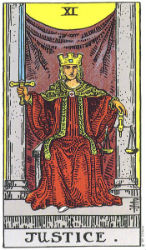
Justice (XI) — Karma in its purest form

Justice is the balancing of the scales — the moment when truth emerges and consequences unfold. It represents the return of equilibrium after imbalance, reminding us that integrity, fairness, and honesty always realign the cosmic order. When Justice appears, something in your life is finding its balance again.

Judgment (XX) — The higher reckoning

This is karma’s spiritual octave — the point of awakening. Judgment calls us to review the past with clarity and compassion, to rise from the old self, and to claim renewal. It shows that karmic patterns are completing because understanding has dawned.

The Wheel of Fortune (X) — The turning of cycles

The Wheel reveals how karma is always in motion. Life rises and falls, fortunes shift, and every chapter becomes another turn in the spiral of growth. This card reminds us that luck isn’t random — it’s the natural consequence of the energy we’ve set in motion.

The Hanged Man (XII) — Seeing karma differently

When we find ourselves “stuck,” suspended between worlds, it’s often because the universe is asking us to pause and see things from another perspective. The Hanged Man teaches surrender, acceptance, and the wisdom that comes only when we release control. Sometimes, karma simply says: Wait. See. Understand.

Death (XIII) — Karmic transformation

Death ends what has outlived its purpose. It’s the natural completion of a karmic story — the moment when the past dissolves so new life can begin. In karmic terms, Death is liberation, not loss.

The Devil (XV) — Karma we create ourselves

The Devil shows entanglement — the cycles of desire, addiction, and illusion that keep us bound. It’s the reminder that we forge our own chains, and the key to freedom lies within. Whenever this card appears, it invites us to stop creating new karma and start unbinding the old.

The Tower (XVI) — Karma as course correction

When we resist growth, the universe sometimes intervenes dramatically. The Tower represents those moments of sudden change that dismantle illusion and force renewal. It’s not cosmic punishment — it’s divine intervention, clearing away what can no longer stand.

The World (XXI) — Karma fulfilled

Here, the cycle completes. The lessons have been learned, the soul has integrated its experiences, and balance has been restored. The World is the joy of completion — the karmic graduation that makes space for a new beginning.

Karmic Echoes in the Minor Arcana

While the Major Arcana show the grand architecture of karmic movement, echoes of those same lessons appear in the Minor cards.

• Ten of Swords — the final reckoning of a mental or verbal pattern.

• Ten of Wands — karmic burdens carried too long.

• Six of Pentacles — the law of giving and receiving, the return of generosity.

• Eight of Cups — walking away from a karmic cycle that has served its purpose.

Each of these cards shows a microcosm of cause and effect — personal moments of realization that mirror the larger soul journey.

The Deeper Message

The Tarot doesn’t show karma as destiny written in stone — it shows movement, opportunity, and awareness. Every card offers a chance to respond consciously, to change course, to balance energy, and to evolve.

When we recognize a “karma card,” we’re not seeing a sentence. We’re seeing a mirror.

And in that mirror, we find both the story of what has been — and the power to write what comes next.

Please feel free to leave questions in the comments section and I’ll get back to you as soon as I can.

The Top Ten Tarot Cards Indicating Something Is About to Change

Feeling stuck in life, like the gears just won’t move? Tarot can reveal when change is on the horizon. Here are the top ten cards that signal transformation, progress, and fresh starts are just ahead.

Are you feeling like your gears are stuck in park and you just can’t make any progress?

Life has those frustrating phases when nothing seems to move forward, and it feels like the universe hit “pause.” But in Tarot, there are clear signs that the stillness is temporary — that something is about to shift. When these cards appear in your spread, they often signal that change is on the horizon.

Here are the top ten Tarot cards that whisper, “Get ready — things are about to give.”

If you’d like to download this list as a PDF file to use in your reference library, please click here.

1. The Tower

The most dramatic of them all. The Tower represents sudden upheaval, breakdown of old structures, and unexpected change. While often unsettling, it clears space for new growth that couldn’t happen otherwise.

2. Death

Not about physical death, but transformation. The Death card announces the end of one cycle and the beginning of another. Something old must be released so something new can be born.

3. The Wheel of Fortune

The cosmic gears are turning again. The Wheel reminds us that nothing stays the same forever — what goes down must rise again. Big shifts in luck, fate, or perspective are coming.

4. Judgement

This card calls for awakening and renewal. Judgement often signals that a chapter is closing, and you’re being invited to step into a new version of yourself.

5. The Fool

When The Fool appears, it’s time to leap. New journeys, fresh starts, and adventures are right around the corner. Change is already waiting at the door.

6. The Hanged Man

At first glance, this card seems like being stuck — but it’s the pause before release. The Hanged Man invites you to surrender, gain a new perspective, and prepare for the shift that follows.

7. The World

Completion is at hand. The World marks the end of a major cycle and the transition into the next. It’s change with a sense of wholeness and accomplishment.

8. Eight of Wands

Fast movement! When the Eight of Wands shows up, delays are ending, and events will soon speed up. It’s the card of sudden progress, news, or opportunities arriving quickly.

9. Ace of Wands

The spark of something new. This card often signals a breakthrough — fresh energy, creative drive, or passion ready to ignite. It marks the turning point from stagnation into action.

10. Five of Pentacles (Reversed)

In upright form, this card shows hardship, but reversed it often signals recovery and things turning around. Change is coming to lift you out of difficulty and into support, healing, or new resources.

Final Thoughts

If you’ve been in one of those liminal phases where nothing seems to move, these cards are reminders that stagnation never lasts forever. Whether the change comes suddenly like lightning (The Tower) or slowly like the seasons (Death, The World), the Tarot assures us: movement is inevitable.

So if your spread shows one of these cards, take heart — the gears are about to shift, and your story is moving forward again.

“Just the Tarot,” by Dan Adair – A kindle ebook available on Amazon

What To Do When Our Lives Turn Into Crap – Wheel of Fortune Reversed

How to deal with it when you hit a period of bad luck

I recently got The Wheel of Fortune reversed in one of my personal readings and we all know where that’s at:  a period of bad luck coming.  Get ready, because things are NOT going to go the way that you want them to, at least not for a while.

And, since I’m an intuitive, I started thinking about exactly what, “luck,” is.  When we say we’re lucky or we’re unlucky, just what exactly are we talking about?

KARMA

Some of it can be karma, of course.  We’ve all met those people who seem to be blessed with nothing but good fortune.  They were born into families that loved and nurtured them, they were the beauty queens and football heroes in their high schools, and they went on to have wonderful careers, lots of money, and 2.5 semi-perfect children.  Into every life a little rain must fall, but they seem to live under giant umbrellas.

And then there are people who just can’t buy a fucking break.  No matter how hard they try, no matter how they struggle and strive, nothing goes right for them.  They’re always at the right place at the wrong time and money and love evade them like a bunny rabbit on speed.

Many of the people who are blessed with Hallmark Card lives have done little to deserve those lives, and many of the people who are cursed with disastrous existences have done little to deserve THAT fate.  

So all we can do is to shake our heads and say, “Well, it must be karma.  They must have been very, very good or very, very bad in a previous incarnation and now they’re getting what they deserve.”

Because if we DON’T say that, there’s no real justice or balance in it. Then life becomes this sort of an insane lottery where it’s all just a matter of . . . luck.

TIME AND TIDE

Another approach to dealing with bad luck is the Principle of Rhythm that’s discussed in books like The Kybalion.  The idea here is that there’s a natural rhythm to life where sometimes everything’s coming up rainbows and sometimes it all turns to shit.  

The way that the Kybalion explains it is that life is very much like the pendulum of a clock.  It swings first in one direction and then in the opposite direction and each swing is equal to the other.  We may have a period of great good fortune but it will be followed by a period of bad luck and vice versa.  

They reinforced that idea by looking at nature.  The moon waxes and then wanes.  The tides rise and then fall.  People are born, spring into maturity and then die.  Our emotions may be ecstatic one day and really depressed the next.  

There seems to be a natural rhythm where we swing from one extreme to the next on a regular basis but spend most of our time somewhere in the middle.

Of course, the problem with that theory is that it ends up being one-step-forward and one-step-back.  If our bad luck is always equal to our good luck, then we ain’t got no luck at all, brothers and sisters.

The way that they solved it was to say that life TENDS toward the positive.  That even if we have swings between good and bad luck, we have a little more good luck than bad.  So we’re actually making progress even if it feels like our feet are stuck in concrete.

And, yes, they turned to reincarnation to explain why some people have nothing but good luck and some people have nothing but bad luck.  Even if it seems like the clock’’s pendulum got permanently stuck on one side, it’s really just swinging very slowly because we can’t remember our past lives.

Okay . . .

WHO THE HELL KNOWS?

Humans have been trying to explain luck since the beginning of time.  There are a million different theories and formulas about it and they really just boil down to, “How do I get me some of that GOOD luck?”  Or, “How do I avoid that BAD ju-ju?”

A lot of the advice has involved figuring out ways to bribe the crazy gods that we’ve invented.  The Old Testament tells us to burn a fatted calf, because god likes a good barbecue.  The Taoist religions burn fake money because apparently that’s a way of making a deposit in their god’s bank accounts (yes, even gods need a little pocket change.). And, of course, many modern day Christians go to church every Sunday to sort of hedge their bets.  “Hey, Lord, I just put a twenty in the collection plate, and I could use a really lucky week.”

All we really know is that there seems to be something out there that we call, “luck.”  It’s some sort of a force or energy that brings good fortunes into the lives of some people. Its absence brings bad fortunes into the lives of others.  No matter how much we may want to, we can’t buy it or cajole it into our lives or pay a priest or pastor to make it go away when it turns bad.

SO WHAT DO WE DO?

So what do we do when we’re going through a patch of really bad luck?  When we flip over the card and it’s The Wheel of Fortune reversed?  

One solution is to just hunker down and ride it out.  Bad luck can feel like a huge storm that’s raging through our lives and we just need to get into the tornado shelter.  Try to turn off our emotions, grit our teeth, and wait for it to pass.

The Kybalion suggests trying to, “rise above it.”  In other words, there’s not a goddamned thing we can do about that clock pendulum swinging, but we can try to raise our vibrations to a point where it affects us less than it would otherwise.  Eventually the pendulum will swing back in the other direction.  If we stay calm, try to stay positive, and remember that this too shall pass, it will lessen the effects.

BEEN DOWN SO LONG IT LOOKS LIKE UP TO ME

Of course, if we ARE one of those people who seem to have been born under a bad moon, that’s a different kettle of fish.  If there’s been nothing but bad luck for a very long time, then we need to learn to adjust to that, too.

And the only solutions I can come up with there are to try a little harder than the Hallmark Card people and build in the fact that we’re not luck magnets.  We actually need to take the time to write the affirmations, do the visualizations, make the vision boards, and feng shui our houses until they shine like newly minted dimes.  Because it’s NOT going to come naturally to us.  

Maybe we were terrible people in a past life.  Maybe our clock pendulums broke when we were born.  Who knows?  What we do know is that we’ve got to put in a little more effort.  

Ultimately, good luck or bad luck, we make our own lives.

“Just the Tarot,” by Dan Adair – a kindle ebook available on Amazon

How to Shine Your Star and NOT Be a Good Codependent

Do you ever feel invisible, like you’ve disappeared into someone else’s needs? The Star reversed shows how codependency drains us — and how to take back your light.

Of all of the forms of codependency, perhaps the most insidious is the, “good,” kind.  The kind where we’re actually making ourselves less, because it’s the right thing to do.  

Or so we think.  

Our personal light, our Spirit becomes dimmed because we’re trying to make someone else’s shine a little brighter.  If it goes on for too long, we can even forget who we really are.

WHAT CODEPENDENCY REALLY MEANS

When we hear the word, “codependency,” most of us think of the classic scenario involving an alcoholic/addict and the person taking care of him.  In that sort of a relationship, the alcoholic may have the money, but he’s too screwed up to really take care of himself.  The codependent takes care of him – sees that the bills are paid on time, buys the groceries, cleans the house, defends him from criticism, but doesn’t have any personal funds.  

The result, of course, is that neither party is able to survive on their own.  They are mutually dependent on the other for survival and they may hate each other but they also need each other.

At its root, though, codependency is any relationship where we chronically subordinate our own needs and desires to someone else’s.  

That can actually take the form of a noble pursuit.  In a very real sense, good parents subordinate their own needs and desires to rearing their children until the children can fly on their own.  We can also see it in home healthcare situations, where one partner in the relationship is literally too ill to care for herself and the other partner becomes a full-time caretaker.

These are the, “good,” forms of codependency where we’re basically just doing what’s right and what’s loving.  But they can still destroy us over the long haul.

MAKING OURSELVES SMALLER

One of the hallmarks of codependency is shrinking ourselves while inflating someone else.

In the home healthcare situation that I just mentioned, the partner who is healthy may be devoting her entire life to taking care of the partner who is ill, yet insisting that, “it’s no big deal.”  She may sacrifice her social life, her hobbies, her time for herself to an endless round of cooking, cleaning, medications, and taking her partner to medical appointments.  She may have completely given up her own life in order to preserve his.

Because the other person’s light is so dimmed, we do everything we can to make it shine a little brighter.  We praise them, we prop them up, we take care of their every need and we never, ever, let them feel that they are, “less than,” because of their illness.

Over time, this creates an energy imbalance that leaves us feeling like invisible ghosts, like we never had the chance to live as our fullest, most authentic selves because we’ve disappeared into someone else’s needs.

The real tragedy of codependency isn’t just exhaustion – it’s the slow erosion of Self.

THE STAR REVERSED

In the Tarot, the exemplar of codependency is The Star reversed.  When it’s upright, The Star is a beacon of hope, inspiration, and healing.  It’s someone who is fully shining his light into the world.

When it’s reversed, it can point directly to codependent patterns such as:

• Outsourcing your self-worth to another person.

• Over-giving and self-sacrifice until your own cup is bone dry.

• Healing others while neglecting your own healing.

• Depending on someone’s approval to feel hopeful.

• Pretending everything’s fine just to keep the relationship intact.

The Star reversed doesn’t mean you’ve lost your light, though. It means you’ve been dimming it.

THE ANTIDOTE IS RECLAIMING YOUR OWN LIGHT

The medicine for The Star reversed is to consciously reclaim your own radiance:

• Affirm your intrinsic value through affirmations, creative expression, and celebrating small achievements.  That can be as easy as taking a few moments to journal every morning and write about what YOUR dreams are.

• Set boundaries and practice saying “no” without guilt. That can be as simple as saying, “No, I don’t watch that television show,” or, “I’d rather listen to MY music.”

• Shift your focus from “I’ll fix them” to “I’ll care for myself first.” You DO have a right to savor your morning coffee before you make their breakfast.

• Anchor hope internally by nurturing personal goals, spiritual practices, or creative outlets.  Do you love to paint or write or garden?  Insist on taking some time for that every week.  No excuses and no interruptions.  Even if it’s only an hour, that’s your sacred space.

• Practice radical honesty — with yourself and others.  If you hate what you’re doing, you’ve got a right to express that.  If you think you deserve some extra praise and kindness instead of being taken for granted, you’ve got a right to that, too.

• Cultivate interdependence, where two whole people choose connection rather than two halves clinging to each other.  Especially if there’s an imbalance in money, remind your partner frequently of all of the things that you do and how much he’d have to pay to have someone other than you do them.  

Each of these steps helps you pour back into your own cup — and when you shine, you inspire others to shine too.

THE PARADOX OF HEALING

The paradox of this type of codependency is that we usually take it on precisely because we ARE good, loving, kind people. If we see someone who needs help, we help them.  If our child is troubled, we’re there for them 200%.  If our partners are ill, of COURSE we’re going to move heaven and earth to take care of them.

But as it goes on . . . and on . . . and on . . . that good, loving person who is our core being begins to erode.  It isn’t that we become bad people or quit caring – it’s that we simply begin to disappear.  We become nothing but appendages to the needs of the people that we’re caring for.

The lesson of The Star is to let our light shine again.  That core of ourselves that we’re losing through the codependency is what was healing the other person to begin with.  When we lose it, we lose our ability to heal, not just them, but ourselves.

We have to let our lights shine.

“The Star,” a personal affirmation poster available on my etsy site

Will This Love Really Last? 10 Tarot Cards That Say “Yes”

Wondering if your love will really last? Tarot offers powerful clues. Here are the top 10 “yes” cards for romance — symbols of harmony, joy, and lasting connection.

While the Tarot doesn’t hand out guarantees, it does shine a light on the energies present in a relationship. And some cards are so clear, so affirming, that when they appear in a spread, they almost shout “yes!”

Why Tarot for Love Questions?

Love and relationships are the number one category of Tarot inquiries. People turn to the cards when they’re uncertain about where things stand, or when they’re weighing the long-term potential of a relationship.

Tarot won’t say, “This relationship is guaranteed to last forever.” But what it will do is highlight the dynamics at play — the emotional energy, the strengths, and the challenges that shape a partnership. And when certain cards appear, they point strongly toward harmony, mutual growth, and a lasting bond.

The Top 10 Tarot “Yes” Cards for Romance

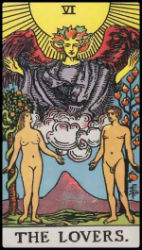
1. The Lovers

This is the archetypal card of love, union, and attraction. It represents shared values and choices that strengthen the bond. When The Lovers appear, the message is clear: the relationship is rooted in deep connection.

2. Two of Cups

The quintessential partnership card. It reflects mutual attraction, balance, and reciprocity. The Two of Cups points to a genuine soul connection where both people bring equal energy to the table.

3. Ten of Cups

This is the “happily ever after” card. It symbolizes long-term happiness, emotional fulfillment, and family harmony. If you’re asking about lasting love, the Ten of Cups is a resounding yes.

4. Four of Wands

A card of celebration, milestones, and commitment. It often shows up around engagements, weddings, or moving in together. It’s a sign that the relationship is not only joyful but ready to move into the next chapter.

5. The Empress

Abundance, nurturing, and fertility flow through this card. The Empress speaks of love that supports growth — creative partnership, deep affection, and the potential to build something lasting together.

6. The Star

The Star brings healing, inspiration, and spiritual alignment. In love, it suggests that the relationship is not only joyful but also restorative, giving both partners hope and a sense of divine timing.

7. Six of Cups

Sweetness, comfort, and sincerity. This card speaks to simple pleasures and genuine affection. Whether it’s new love or a rekindled flame, the Six of Cups highlights warmth and emotional honesty.

8. The Sun

Few cards are as positive as The Sun. It represents joy, openness, and vitality. In romance, it signals a relationship where both people feel seen, supported, and energized.

9. Ace of Cups

The overflowing chalice of love. This card signals the beginning of a new relationship or the renewal of affection in an existing one. It’s pure emotional abundance and a beautiful green light for love.

10. Two of Wands

While not strictly a “romance card,” the Two of Wands points to planning a shared future. It suggests vision, growth, and expansion — a partnership where both people are willing to build together.


What These Cards Have in Common

Look at these ten cards together, and a pattern emerges:

  • Union & Commitment: Lovers, Two of Cups, Four of Wands, Ten of Cups.
  • Emotional Fulfillment: Ace of Cups, Six of Cups, Empress.
  • Joy & Inspiration: Sun, Star, Two of Wands.

The common theme? Relationships that thrive on balance, mutual support, and a shared vision for the future.

A Note of Realism

Of course, not every card in the Tarot is a “yes.” Sometimes the spread brings red flags — lessons that need to be learned before love can grow strong. That doesn’t mean the relationship is doomed, but it does mean awareness and patience are needed.

Stay tuned: in a future post, we’ll explore the Top 10 “No” Cards for Love Questions.

Conclusion

Deciding if a love will last is never easy. But the Tarot provides more than predictions — it offers symbolic guidance about the energy flowing through your relationship.

When the “yes” cards appear, they suggest love that’s harmonious, joyful, and ready to grow into the future. If you see these cards in your spread, take it as the Universe’s way of saying: love is worth the leap.

“Just the Tarot,” by Dan Adair – A kindle ebook available on Amazon