Is Justice Really the Karma Card?

The Justice Card and an exploration of karma.

What if the Justice card isn’t really about getting what you deserve?

That familiar interpretation—“Justice means you’ll get what’s coming to you”—turns the card into a kind of cosmic courtroom. Somewhere in the universe, an invisible judge is apparently keeping score.

But there may be a much more interesting—and useful—way to understand Justice.

Karma Isn’t Cosmic Punishment

In popular Western culture, karma often gets reduced to cosmic revenge: do something bad and sooner or later the universe will smack you for it.

But karma is fundamentally about action and consequence. Actions create causes. Causes produce effects. Those effects create new circumstances from which further actions arise.

Seen this way, Justice becomes a remarkably good image of karma.
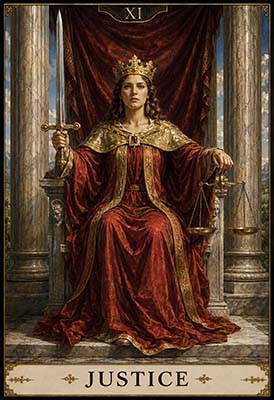
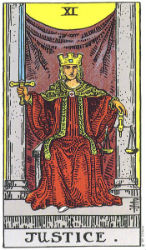
Justice poster – 13 X 19 – Available on Etsy

The Scales and the Sword

Look at the two objects Justice holds.

The scales represent cause and effect. Everything we think, choose and do enters the balance. Nothing happens entirely in isolation. Actions have consequences.

The sword represents those consequences becoming manifest. Eventually the abstract chain of causes produces an actual result.

The seed becomes the harvest.

And then notice Justice herself.

She isn’t angry. She isn’t pleased. She isn’t getting even.

She is impersonal.

Gravity doesn’t punish you for stepping off a roof. Fire doesn’t become angry because you put your hand into it. Cause and effect simply operate according to their nature.

That gives us a powerful metaphysical definition of the card:

Justice represents the law by which causes become consequences.

What Might Justice Mean in a Reading?

Suppose someone has spent years in a job they hate because they’re afraid to take a risk. Eventually they find themselves exhausted, resentful and wondering how their life became so small.

Justice doesn’t necessarily say, “You deserve this.”

Instead, it might say: Look at the chain of causes that brought you here.

Fear led to staying. Staying led to stagnation. Stagnation led to unhappiness.

That’s not punishment. It’s cause and effect.

And here’s the important part: the chain isn’t finished.

A different choice today creates a different cause—and potentially a different future.

Or imagine someone repeatedly entering relationships in which they ignore early warning signs. Justice appearing in a reading doesn’t have to mean that the universe has sentenced them to another disastrous relationship. It may be asking them to recognize the pattern itself.

What choice keeps setting the same sequence in motion?

Change that choice, and you begin changing what follows from it.

Justice Looks in Two Directions

This makes Justice both retrospective and prospective.

The scales look backward: What have I already set in motion?

The sword looks forward: What will follow from it?

And that gives the card considerably more agency than the old idea that Justice simply means “you’re going to get what you deserve.”

Justice isn’t necessarily announcing an unavoidable cosmic sentence.

It may be saying:

Look clearly at the causal chain. If you want a different consequence, this is where you change the cause.

And perhaps that is where Justice becomes not merely a card of karma, but a card of personal power.
Tarot and the Art of Alignment – Available on Amazon

The Karma Cards of the Tarot: Lessons, Consequences, and Course Corrections

Some Tarot cards seem to carry more spiritual gravity than others — the ones that reveal how actions return, lessons repeat, and growth becomes inevitable. These are the “karma cards,” reflecting the Kybalion’s Principle of Cause and Effect. Each shows us where the soul confronts the consequences of its choices — and how to rise into a new level of awareness.

What We Mean by “Karma”

Karma isn’t punishment or reward — it’s simply the universal law of cause and effect. Every thought, every word, every choice sends ripples into the field of consciousness, and those ripples eventually return to their source. When we see a “karma card” in a reading, it doesn’t mean the universe is judging us. It means the universe is teaching us.

In The Kybalion, this is expressed as “Every Cause has its Effect; every Effect has its Cause.”

In the Tarot, that principle unfolds symbolically through specific archetypes that reveal how energy cycles back around, how old patterns resolve, and how the soul grows through awareness.

The Major Arcana Karma Cards

Justice (XI) — Karma in its purest form

Justice is the balancing of the scales — the moment when truth emerges and consequences unfold. It represents the return of equilibrium after imbalance, reminding us that integrity, fairness, and honesty always realign the cosmic order. When Justice appears, something in your life is finding its balance again.

Judgment (XX) — The higher reckoning

This is karma’s spiritual octave — the point of awakening. Judgment calls us to review the past with clarity and compassion, to rise from the old self, and to claim renewal. It shows that karmic patterns are completing because understanding has dawned.

The Wheel of Fortune (X) — The turning of cycles

The Wheel reveals how karma is always in motion. Life rises and falls, fortunes shift, and every chapter becomes another turn in the spiral of growth. This card reminds us that luck isn’t random — it’s the natural consequence of the energy we’ve set in motion.

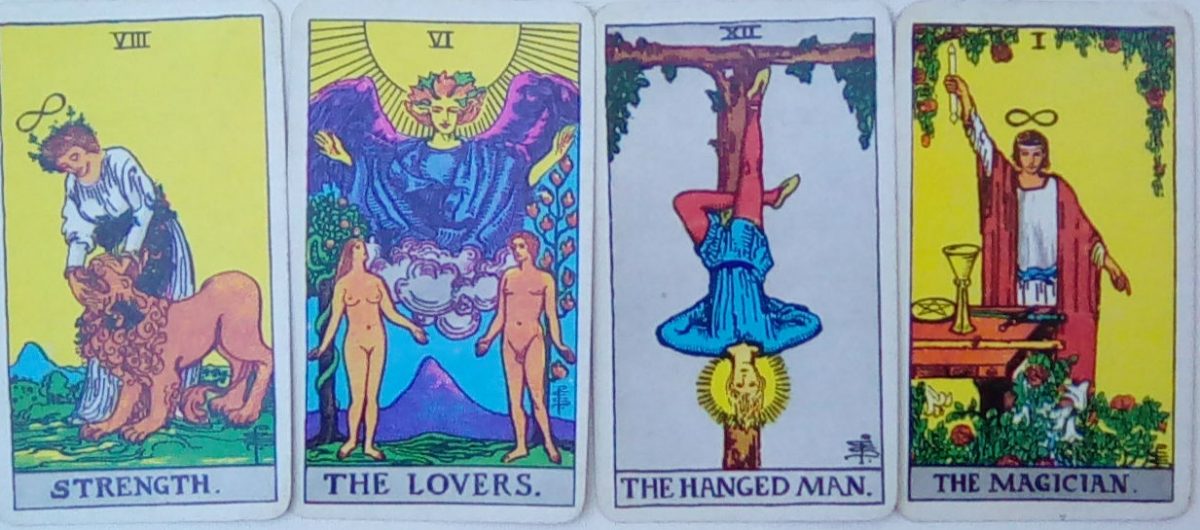
The Hanged Man (XII) — Seeing karma differently

When we find ourselves “stuck,” suspended between worlds, it’s often because the universe is asking us to pause and see things from another perspective. The Hanged Man teaches surrender, acceptance, and the wisdom that comes only when we release control. Sometimes, karma simply says: Wait. See. Understand.

Death (XIII) — Karmic transformation

Death ends what has outlived its purpose. It’s the natural completion of a karmic story — the moment when the past dissolves so new life can begin. In karmic terms, Death is liberation, not loss.

The Devil (XV) — Karma we create ourselves

The Devil shows entanglement — the cycles of desire, addiction, and illusion that keep us bound. It’s the reminder that we forge our own chains, and the key to freedom lies within. Whenever this card appears, it invites us to stop creating new karma and start unbinding the old.

The Tower (XVI) — Karma as course correction

When we resist growth, the universe sometimes intervenes dramatically. The Tower represents those moments of sudden change that dismantle illusion and force renewal. It’s not cosmic punishment — it’s divine intervention, clearing away what can no longer stand.

The World (XXI) — Karma fulfilled

Here, the cycle completes. The lessons have been learned, the soul has integrated its experiences, and balance has been restored. The World is the joy of completion — the karmic graduation that makes space for a new beginning.

Karmic Echoes in the Minor Arcana

While the Major Arcana show the grand architecture of karmic movement, echoes of those same lessons appear in the Minor cards.

Ten of Swords — the final reckoning of a mental or verbal pattern.

Ten of Wands — karmic burdens carried too long.

Six of Pentacles — the law of giving and receiving, the return of generosity.

Eight of Cups — walking away from a karmic cycle that has served its purpose.

Each of these cards shows a microcosm of cause and effect — personal moments of realization that mirror the larger soul journey.

The Deeper Message

The Tarot doesn’t show karma as destiny written in stone — it shows movement, opportunity, and awareness. Every card offers a chance to respond consciously, to change course, to balance energy, and to evolve.

When we recognize a “karma card,” we’re not seeing a sentence. We’re seeing a mirror.

And in that mirror, we find both the story of what has been — and the power to write what comes next.

Please feel free to leave questions in the comments section and I’ll get back to you as soon as I can.