
The Death card is one of the most misunderstood cards in Tarot. Far from simply representing physical death—or the rather vague modern idea of “transformation”—Pamela Colman Smith’s imagery appears to present death as the first stage of a much larger journey: death, passage through the unknown, and eventual return to the light.
Few Tarot cards have undergone as dramatic a transformation as Death.
In many early Tarot decks, such as the Marseilles deck, Death is exactly what we would expect him to be: a skeletal figure wielding a scythe, mowing down human beings almost as though they were wheat. Kings, commoners, young and old all fall before him.
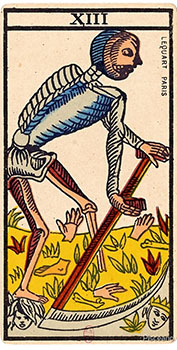
The symbolism isn’t particularly subtle.
Death comes for everyone.
But when Arthur Edward Waite and Pamela Colman Smith created the Rider-Waite-Smith deck, they radically reimagined the card.
The scythe disappeared. Death climbed onto a white horse. And, perhaps most importantly, Smith created an entire landscape behind him.
That landscape may tell us what happens after Death passes.
From the Grim Reaper to the Rider
The mounted skeleton almost certainly draws upon one of the most famous images in the Book of Revelation: the Four Horsemen of the Apocalypse.
When the fourth seal is opened, Death appears riding a pale horse.
Waite and Smith borrow that terrifying image, but significantly change its character. Their Death carries no scythe and no sword. Instead, he carries a black banner bearing a white rose.
He isn’t simply killing people.
He is moving through the landscape.
And the landscape appears to be divided into three remarkably distinct regions.
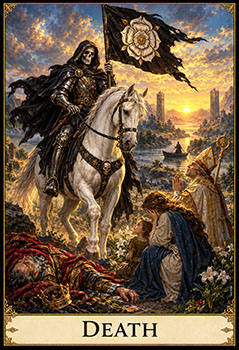
The First Realm: Death in the Clear Light of Day
The foreground is brightly and naturally illuminated.
Everything is clearly visible. We see the white horse, the skeletal rider, the fallen king, the bishop, the woman and the child. There is nothing particularly mysterious about this portion of the card.
Perhaps that is appropriate.
Whatever we may believe about an afterlife, reincarnation or resurrection, death itself is observable. Living things die. We may fear it, deny it or try not to think about it, but there is nothing metaphysically mysterious about the physical event itself.
Smith even gives us several different human responses to it.
The king has fallen before Death. His crown lies uselessly on the ground. Political power and worldly status provide no protection.
The woman turns away.
The child looks directly at Death, apparently without fear.
And the bishop remains standing, hands clasped before the approaching rider.
The bishop is particularly interesting. Unlike the king, he possesses no worldly means of resisting Death. But he does possess a spiritual framework through which death can be understood.
He doesn’t defeat Death.
He is able to face him.
The figures also recall the medieval Dance of Death tradition, in which Death comes for every rank of society. King, priest, woman and child ultimately share the same fate.
But then our eyes move beyond them.
And the card changes.
The Second Realm: The Liminal World
The middle distance is dramatically different from the foreground.
The clear light disappears. The landscape becomes gray and indistinct.
And separating the two regions is water.
On that water Smith has placed one of the smallest—and potentially most important—details in the entire card:
a boat.
The image immediately recalls the ancient story of Charon, the ferryman who transports the dead across the river separating the world of the living from the realm of the dead.
Whether Smith consciously intended Charon is impossible to establish simply from the picture. But the symbolic association is extraordinarily appropriate.
The river marks a boundary.
The boat crosses it.
And on the other side lies a strange, shadowy landscape.
In other words, Death itself may not be the mystery depicted by the card.
The mystery begins after Death.
Is the Moon Hidden Inside the Death Card?
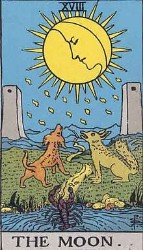
At the far edge of this gray landscape stand two towers.
Anyone familiar with the Rider-Waite-Smith deck has seen them before.
They strongly resemble the two towers in The Moon.
In The Moon, a path leads between two towers and disappears into a strange nocturnal landscape. It is the territory of uncertainty, dreams, fears, illusions, instincts and the unconscious—the world in which the ordinary clarity of daylight has disappeared.
Smith appears to evoke remarkably similar visual territory in Death.
That gives us a fascinating possibility.
The middle portion of the Death card may function almost like a miniature version of The Moon: the liminal realm between one state of existence and another.
We have left the known world.
We haven’t reached the next one.
We are between states.
That is the essence of liminality:
I am no longer what I was, but I have not yet become what I will be.
The Third Realm: And Then the Sun Rises
Beyond the gray landscape and between the two towers, something entirely different appears.
The rising sun.
This is not a minor decorative feature. Waite himself called attention to it and associated it with immortality.
And visually, its placement is extraordinary.
If the towers recall The Moon, the brilliant sun appearing between them naturally anticipates The Sun.
The progression therefore becomes:
Death → the shadowy realm → the rising Sun.
Or, expressed through the Major Arcana:
Death → Moon → Sun.
And what follows The Sun in the Major Arcana?
Judgment.
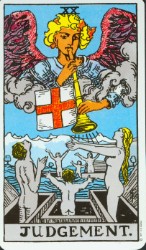
That is where the dead rise from their graves.
Suddenly, an extraordinary symbolic sequence becomes visible:
Death XIII → Moon XVIII → Sun XIX → Judgment XX
Death.
Passage through the unknown.
Return of the light.
Resurrection.
We cannot know whether Pamela Colman Smith consciously sat down and constructed that sequence. But we don’t need to know. The visual relationships are present in the cards themselves.
Death and Judgment
This also helps us understand why the Death card cannot be considered in isolation from Judgment.
The connection already exists within Christianity.
The Book of Revelation gives us Death riding his horse—and later gives us the resurrection of the dead and the Last Judgment.
The early Tarot’s scythe also contains an interesting implication. Death isn’t merely slaughtering people.
He is harvesting them.
And harvesting belongs to a cycle.
The crop grows. It is cut down. The field lies barren. Eventually new life appears.
Christian theology calls the eventual return of the dead resurrection, not reincarnation. They are very different doctrines.
Symbolically, however, both contain the same fundamental pattern:
Life → Death → Intermediate State → New Life
The Tarot journey appears to contain precisely that pattern.
The White Rose: Life Carried by Death
And this brings us back to Death’s strange banner.
Against the black background appears a white, five-petaled rose.
Waite explicitly tells us what it signifies. He calls it the “Mystic Rose” and says that it represents life.
Think about the paradox.
Death is carrying the symbol of Life.
The regenerative principle isn’t waiting somewhere beyond Death.
Death himself carries it.
There is also a beautiful visual echo elsewhere in the deck. The Fool carries a white rose as he begins his journey.

The Fool sets out carrying the rose.
Death carries the rose.
Bodies and identities disappear, but symbolically something essential continues.
The white rose may therefore give us the central message of the entire card:
The form dies. Life does not.
Death Is Only the First Third of the Picture
Perhaps the most remarkable thing about Smith’s Death card becomes apparent only after we stop staring at the skeleton.
Death occupies the foreground.
But the card continues far beyond him.
There is a river.
There is a crossing.
There is a mysterious intermediate landscape.
There is a gateway marked by two towers.
And beyond that gateway, the sun is rising.
Smith and Waite took an older image whose basic message was Death destroys everyone and expanded it into something much more complex.
Death became not simply an ending but the entrance to a process.
That is why describing XIII merely as the card of “transformation” doesn’t quite do it justice.
Transformation sounds almost painless.
Death is more radical.
Something has reached the end of its existing form. That form cannot accompany us farther. We must relinquish it before whatever comes next can emerge.
The card doesn’t promise that we will understand the passage while we’re traveling through it.
In fact, Smith seems to suggest exactly the opposite.
Between Death and the rising Sun lies the gray territory of uncertainty.
But the Sun is already rising.
What Death Means in a Tarot Reading
In a reading, Death usually indicates a genuine ending and an irreversible transition. Something has completed its natural life and cannot continue in its present form. This might be a relationship, job, belief, identity, habit, period of life or way of seeing ourselves.
The card’s advice is not simply “change.”
It is release.
Death says that we may temporarily enter a liminal period in which the old life is gone but the new one isn’t yet visible. That uncertainty is part of the process, not evidence that something has gone wrong.
The most important symbol may therefore be the smallest one on the horizon:
Beyond the ending, the Sun is already beginning to rise.