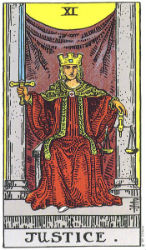
The Justice card in the Tarot is, at its most basic level, about society judging us, but there are few harsher judgements than those which we make about ourselves. And most of them are horribly unjust.
As Cynthia Kane points out in, “Talk to Yourself Like a Buddhist,” we say things to ourselves that we would never, ever, in a million years, say to our friends and family. When we really start listening to our inner dialogue, we may find little poisoned pellets like:
You’re so stupid.
I can’t believe that you fucked that up . . . again.
What in the hell is wrong with you?
Why can’t you ever get anything right?
Your problem is that you’re just lazy.
And on and on and on. The more dysfunctional that our family of origin was, the more likely we are to have that harsh inner critic constantly deriding us. Constantly telling us that we don’t measure up and we’re never quite good enough, no matter how hard we try.
Now, there’s a basic formula in New Age Thought that goes like this:
Our thoughts create our emotions.
Our emotions create our vibrations.
Our vibrations create our lives.
When we break that down, it just means that every single thought we have has an emotion attached to it, either positive or negative. When we think of puppies or cookies, we feel good. When we think of dentists and written tests, we feel bad. Our feelings about those thoughts add up to create our overall vibration. If we’re constantly thinking of things that make us sad or scared, we end up with negative vibrations. If we’re constantly thinking of things that make us happy, we end up with positive vibrations. And, eventually, our overall vibrations will draw similar vibrations into our lives. If we have really negative vibrations, we’ll draw in negative people and failures. If we have really positive vibrations, we’ll draw in positive people and abundance.
It’s really cool when we figure that out because it empowers us to make changes. We can jump in at any one of those three points and start to transform our lives. Most of the self-help guides advocate one approach or another. If we change our thoughts, we’ll change our emotions. Or if we work on feeling happier about life, that will change our thoughts. Or if we meditate on raising our vibrations, that will change what we attract. Pull on any one of those three strings and our lives will start to change.
There’s one element that’s frequently left out of that equation, though, and that element is beliefs. We can change our thoughts, our emotions, and our vibrations but if we don’t change our underlying beliefs, we’re not going to get anywhere.
The classic example of that is the person who wins the lottery and two years later he’s bankrupt. Maybe he spent hundreds of hours visualizing getting that winning ticket and wrote out a kazillion affirmations and did vision boards and all of that helped him to win. But he didn’t change that underlying belief, which was, “I’m poor,” so the money floated away. It wasn’t a vibrational match for his basic beliefs about himself.
To put it in a nutshell, our beliefs create our thoughts which create our emotions which create our vibrations which create our lives.
Which begs the question, “What IS a belief?”
A belief is nothing more than a thought that we repeat over and over until we think it’s true. Sometime they ARE true, but frequently they aren’t. If we want to know what our real beliefs are, all we have to do is to listen to that inner dialogue. If we’re constantly degrading and belittling ourselves, then those are beliefs that we need to change before we can effect permanent changes in our lives.
So how do we change our basic, underlying beliefs? We actually pull them out and look at them.
One of the most powerful tools for doing that is Byron Katie’s, “The Work.”
To use The Work method, we take a, “work sheet,” (download one here) and focus on four areas:
1- What’s the belief that I need to change?
2- Is it true?
3 – What kind of a person would I be without that belief?
4 – What are some opposite turn arounds that I can substitute for that belief?
Here’s an example of a negative belief that a lot of us carry around: “I’ll never have enough money.”
IS IT TRUE? For most of us, it’s not true at all, at least for most of our lives. There are very few of us who have been homeless or starving. That doesn’t mean that we haven’t gone through some bitchy, bad times. There may very well have been times when paying our bills or even just buying groceries was a struggle. Still, if we’re honest with ourselves, most of us, most of the time, manage to pull it together even through the occasional hard times.
Of course, one of the questions that we need to look at there is, “What do I mean by, ‘enough money.’ “ If we put together a vision board that’s covered with pictures of sports cars, McMansions, and private jets, we’ll probably feel like we don’t have, “enough.” If we think in terms of food, clothing, shelter, a car that runs, and a job, though, we realize that we’ve usually had plenty.
WHO WOULD I BE WITHOUT THAT BELIEF? Well, for one thing, we’d probably be a lot more grateful. When we actually focus on the fact that we have always had enough money to eat, enough money for a warm place to live in the winter, enough money to pay our bills, then we can start to see how very lucky we’ve actually been.
For another thing, we can start feeling a lot less anxious about the future. If we’re able to look at our past and see that there’s always, somehow, been enough, then we can see that there’s absolutely no empirical evidence for the idea that we won’t have enough in the future. It’s just a movie playing in our heads that’s based on a bad fantasy.
WHAT ARE SOME OPPOSITE TURN AROUNDS TO THIS BELIEF? The obvious one, of course, is, “I always have enough money.” Some others might be, “I manifest what I need as I go along,” or “The Universe always provides for my needs.”
Once we’re able to flip that basic belief, then some miracles start to happen. Our thoughts begin to be more positive (“I always have enough money.”). Since our thoughts have changed, our emotions start to change (“I really don’t have anything to worry about financially and I’m happy about that.”). Since our emotions have changed, our vibrations start to change (“I feel really secure, relaxed and positive about life.”). And when our vibrations change, then we start to create the life that we always wanted.
It’s a really good and relatively simple method for changing our basic beliefs. Of course, Byron Katie probably named it, “The Work,” for a reason, because it does take some work. It’s not just a matter of sitting down and filling out a sheet of paper. It’s actually taking the time to listen to our own thought stream, write down those negative beliefs, and then meditate on them as we fill out the sheets.
And changing negative beliefs is work on a whole different level, as well. We tend to cling to beliefs about ourselves and the world around us simply because they’re comfortable and they’re what we’re used to. When we adopt the very opposite of those beliefs, it can initially feel very strange and foreign. The negatives will keep popping up in our thought streams for a while, but we now have the consciousness to stop and say, “Nope. It’s not true, it doesn’t make me feel good, and it’s not who I am.”
Note: as a member of Amazon Associates, I may receive a tiny remuneration if you buy a product listed on this page. I am in no way associated with the authors of the books quoted.